


26 Nov National Milk Day 2025: India’s Dairy Revolution and the Road to Global Leadership
This article covers “Daily Current Affairs” and From National Milk Day 2025: India’s Dairy Revolution and the Road to Global Leadership
SYLLABUS MAPPING
GS-3- Agriculture & Allied Sectors– National Milk Day 2025: India’s Dairy Revolution and the Road to Global Leadership
FOR PRELIMS
What are the key goals of White Revolution 2.0, and why are they important for the dairy industry?
FOR MAINS
What is the significance of National Milk Day 2025, and how does it reflect India’s progress in the dairy sector?
Why in the News?
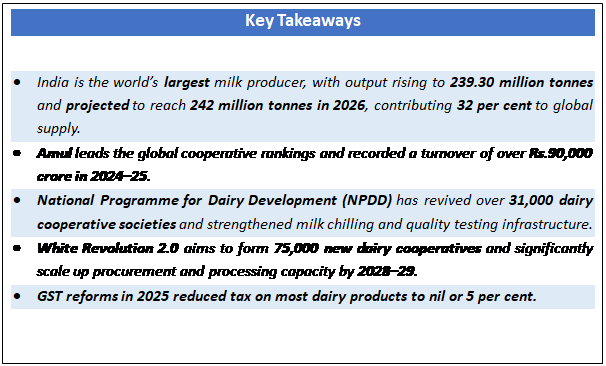
National Milk Day is being celebrated across India on 26 November 2025 to mark the birth anniversary of Dr. Verghese Kurien, the Father of the White Revolution. The day highlights the pivotal role of India’s 8 crore dairy farmers, especially women, in sustaining the country’s position as the world’s largest milk producer, contributing nearly one-fourth of global output. This year’s observance gains significance as India records a 70% growth in its dairy sector over the last 11 years, with the sector contributing around 5% to GDP and emerging as a powerful engine of women-led rural development.

India’s Dairy Progress in the Last Decade
1. Rapid Growth in Production and Availability: Milk output increased from 146.3 million tonnes (2014-15) to 239.3 million tonnes (2023-24) — a surge of 63.56%. Per capita milk availability rose from 124 grams to 471 grams/day.
2. Improved Bovine Productivity: India’s 303.76 million bovines (cattle, buffalo, mithun, yak) form the backbone of its dairy wealth. Productivity increased 27.39% (2014–2022) — the highest globally, compared to the world average of 13.97%.
3. Indigenous Breeds Making a Comeback: Indigenous cow milk production grew from 29 million tonnes to 50 million tonnes. The number of milch animals increased from 86 million to 112 million.
4. Livestock Health & Ayurveda Integration: Programmes like LHDCP, ethno-veterinary medicine (EVM), and vaccination drives have helped reduce disease burden and dependence on antibiotics.
Progress under Rashtriya Gokul Mission (RGM)
| Component | Details / Achievements | Impact |
|---|---|---|
| Mission Overview | – Launched in 2014, revised in 2025. – Allocation: ₹3,400 crore (2021–2026). – Objectives: conservation of indigenous breeds, genetic improvement, productivity enhancement. |
– Strengthened long-term sustainability of India’s dairy sector. – Boosted productivity of native breeds. |
| Overall Achievements | – 92 million animals benefited. – 56 million farmers supported. – Strengthening of semen stations. – Expansion of AI infrastructure. |
– Improved breed quality and milk yield. – Direct benefits to small and marginal farmers. |
| Artificial Insemination (AI) Coverage | – Current AI coverage: 33% of breedable bovines (still low; high future potential). | – Scope for rapid productivity gains in coming years. |
| National AI Programme (NAIP) | – Free doorstep AI services for farmers. – 9.16 crore animals covered. – 14.12 crore inseminations performed. – 22 IVF labs established. – 1 crore sex-sorted semen doses produced. |
– Higher share of female calves → future milk production growth. – Reduction in unproductive male population. |
| MAITRIs (Rural Technicians) | – 38,736 MAITRIs trained and deployed. – Provide AI + basic veterinary support. – Significant participation of women farmers. |
– Enhanced last-mile service delivery. – Improved access to breeding services in remote villages. |
| Progeny Testing Programme | – 3,747 bulls scientifically evaluated (2021–24). – 132 breed multiplication farms sanctioned. |
– Ensures high genetic merit in future offspring. – Strengthens long-term genetic improvement of bovines. |

National Programme for Dairy Development (NPDD) key facts (2021-26)
| Category | Details |
|---|---|
| Revision Year | Revised in 2021 for the 2021–26 period |
| Component A: Infrastructure Strengthening | • Milk testing equipment • Bulk Milk Coolers (BMCs) • Primary chilling facilities |
| Component B: Dairying through Cooperatives | • Enhancing cooperative capacity • Improving marketing & processing • Modernised dairy plant laboratories |
| Cooperative Network Expansion | • 31,908 dairy cooperatives formed/revived • 17.63 lakh new producers enrolled • Milk procurement increased by 120.68 lakh kg/day |
| Key Infrastructure Achievements | • 61,677 milk testing labs • 6,000 bulk milk coolers installed |
| New/Modernised Dairy Plants | Major plants in Mehsana, Indore, Bhilwara, Karimnagar and new units in Andhra Pradesh, Telangana, Haryana |
| Women’s Leadership in Dairy Sector | • Women constitute 70% of the dairy workforce • 48,000+ women-led cooperatives • 16 all-women Milk Producer Organisations (MPOs), including award-winning Shreeja MPP (AP) |
Conclusion
National Milk Day 2025 is both a celebration of India’s dairy revolution and a reaffirmation of its commitment to farmers. From the visionary leadership of Dr. Verghese Kurien to the monumental success of Operation Flood and the rise of cooperative institutions, India’s dairy story exemplifies rural empowerment, women’s leadership, and sustainable development. Government programmes including RGM, NAIP, NPDD, GST reforms, and White Revolution 2.0 have strengthened every link of the dairy value chain—from genetic improvement and animal health to procurement, processing, and marketing. With expanding digital tools, rising processing capacity, structured cooperatives, and women-led growth, India is well-positioned to not only remain the world’s largest milk producer but also emerge as a global dairy exporter.
Q. Consider the following statements regarding India’s dairy sector:
1. India contributes nearly one-fourth of global milk production.
2. Artificial Insemination (AI) coverage under the National AI Programme has crossed 60% of breedable bovines.
3. Women constitute more than half of India’s dairy workforce.
4. GST reforms in 2025 reduced the tax on ice cream from 18% to 5%.
Which of the statements given above are correct?
(a) 1, 3 and 4 only
(b) 1 and 4 only
(c) 1, 2 and 3 only
(d) 2, 3 and 4 only
Answer: A
Main question:
Q. Discuss the recent developments in India’s dairy sector with reference to National Milk Day 2025. How are initiatives such as RGM, NPDD, NAIP, and GST reforms strengthening the dairy value chain and promoting women-led rural development?
(250 words)

- RBI’s Shrinking Real-Rate Cushion Amid Rising Inflation and Strong Demand - September 21, 2026
- India’s NGOs at a New Funding Crossroads - September 21, 2026
- Deep-Sea Discovery, Environmental Responsibility - September 19, 2026

No Comments