Edible oils have recently been in the news due to India’s widening demand–supply gap despite their critical role in food and nutritional security. New data for 2023–24 highlights that although edible oil production has reached 12.18 million tonnes, domestic output is meeting only 44% of total requirements. India’s dependence on imports, though reduced from 63.2% in 2015–16 to 56.25% in 2023–24, remains a major concern as rising consumption continues to outpace production.
Per capita edible oil consumption has shown a significant surge—from 5.76 kg (rural) and 7.92 kg (urban) in 2004–05 to 10.58 kg and 11.78 kg respectively in 2022–23—reflecting improved incomes and dietary diversification. This has renewed policy attention on enhancing oilseed productivity, reducing import dependence, and strengthening farmer livelihoods under various government missions and interventions.
Shifting Trends in India’s Edible Oil Ecosystem
India achieved near self-sufficiency in edible oils during the “Yellow Revolution” of the 1990s, driven by the Technology Mission on Oilseeds (TMO), strong price support, and import substitution policies. However, post-WTO commitments led to reduced import duties and withdrawal of protection measures. As domestic output stagnated and per capita consumption rose rapidly, imports surged—reaching 15.66 million tonnes in 2023–24, meeting around 56% of India’s demand. This reliance burdens foreign exchange reserves and increases vulnerability to global price volatility and supply shocks.
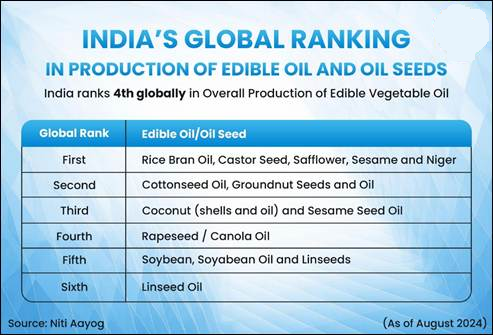
Globally, the edible oil sector is dominated by soybean, palm, and rapeseed oils, with steady growth in sunflower oil. India is the fourth-largest player after the USA, China, and Brazil, accounting for 15–20% of global oilseed area, 6–7% of vegetable oil production, and 9–10% of global consumption. Despite its large acreage, India faces severe yield gaps and limited scope for area expansion, preventing production from keeping pace with rising demand.
India’s Edible Oil and Oil Seeds Production
As per NITI Aayog’s report “Pathways and Strategies for Accelerating Growth in Edible Oils Towards the Goal of Atmanirbharta” (released on August 28, 2024):
Domestic Oilseed Scenario
Oilseeds constitute the second-largest crop group in India after food grains, with nine major oilseeds—groundnut, soybean, rapeseed-mustard, sunflower, sesame, safflower, niger, castor, and linseed—covering about 14.3% of the gross cropped area. They contribute 12–13% of India’s dietary energy and around 8% of agricultural exports. However, nearly 76% of oilseed cultivation is rainfed, making production highly susceptible to climate variability and yield fluctuations. Production is geographically concentrated. Rajasthan, Madhya Pradesh, Gujarat, and Maharashtra together account for nearly 78% of total oilseed output, reflecting strong regional specialisation—Rajasthan in mustard, and Madhya Pradesh in soybean.
To address chronic import dependence and low productivity, the government launched the National Mission on Edible Oils (NMEO) with a dual strategy:
1. NMEO–Oil Palm (2021): Expands oil palm area and enhances domestic crude palm oil production.
2. NMEO–Oilseeds (2024): Focuses on boosting productivity, improving seed quality, strengthening processing capacity, and enhancing market linkages for traditional oilseed crops.
National Mission on Edible Oils – Oil Palm
Introduction to Oil Palm Production
Oil Palm has highest vegetable oil yielding capability per hectare. It produces two distinct oils, i.e. palm oil and palm kernel oil, which are used for culinary as well as industrial purposes. In comparative terms, the yield of palm oil is 5 times the yield of edible oil obtainable from traditional oilseeds. Andhra Pradesh and Telangana are major Oil palm growing States and account 98% of total production. Karnataka, Kerala, Tamil Nadu, Odisha, Chhattisgarh, Gujarat, Goa, and Mizoram also have sizable areas under Oil palm cultivation. Recently, Arunachal Pradesh, Assam, Manipur, Tripura, and Nagaland have also initiated the Oil palm plantation program on a large scale.
NMEO – Oil Palm
Considering the growing domestic demand for edible oils and the cost to the national exchequer due to imports, the National Mission on Edible Oils – Oil Palm (NMEO-OP) was approved in 2021, as a Centrally Sponsored Scheme, with the aim to enhance the edible oilseeds production and oils availability in the country by area expansion and increasing Crude Palm Oil (CPO) production. A financial outlay of Rs. 11,040 crore has been made for the mission, out of which Rs. 8,844 crore was the central share and Rs. 2,196 crore was the State share.
The mission aimed to immensely benefit the oil palm farmers, increase capital investment, create employment, reduce the import dependence and also increase the income of the farmers. Special emphasis is being placed on leveraging the agro-climatic potential of the North-eastern region and other oil palm-growing states.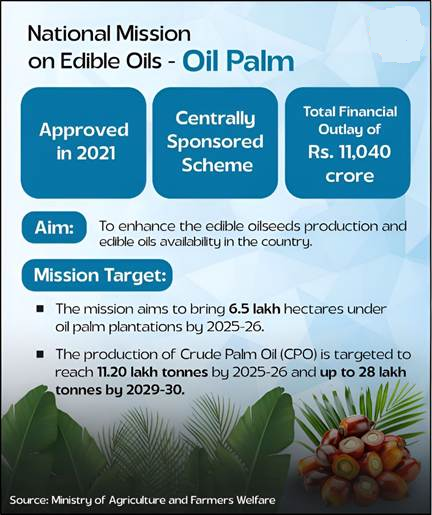
The mission focusses on increasing production of seedlings by establishment of seed garden, and nurseries of oil palm in order to assure domestic availability of seedlings as per target fixed under NMEO-OP. Strategies like improving productivity of Fresh Fruit Bunches (FFBs), increasing drip irrigation coverage under oil palm, diversification of area from low yielding cereals crops to oil palm, inter-cropping during gestation period of 4 years, provides economic return to the farmers.
Two Major Focus Areas of NMEO–OP
1. Two Major Focus Areas of NMEO–OP: Price Assurance through Viability Price (VP). Farmers sell Fresh Fruit Bunches (FFBs) used to extract palm oil. FFB prices fluctuate with international Crude Palm Oil (CPO) markets. For the first time, the Government provides a Viability Price (VP) to ensure farmers receive a minimum assured price, insulating them from global price volatility.
2. Enhanced Financial Assistance to Farmers: Input support for planting material increased from ₹12,000/ha to ₹29,000/ha. Additional assistance provided for maintenance, drip irrigation, and intercropping. ₹250 per plant offered for rejuvenation of old and unproductive oil palm gardens.
Implementation of the Mission
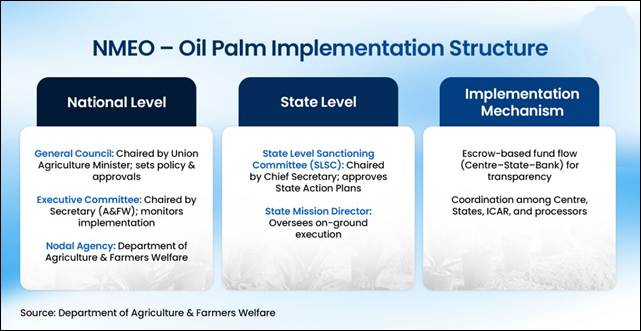
The implementation of NMEO-OP is carried out through a structured, multi-tiered institutional framework involving central and state authorities.
National Mission on Edible Oils – Oilseeds
1. Introduction to Oilseeds Production in India
India contributes about 5-6% of the world oilseeds production. Export of oil meals, oilseeds and minor oils was about 5.44 million tons in the financial year 2023-24 valued at Rs. 29,587 crores. India’s oilseed production reached a new high of 42.609 million tonnes (MT) as of May 2025.
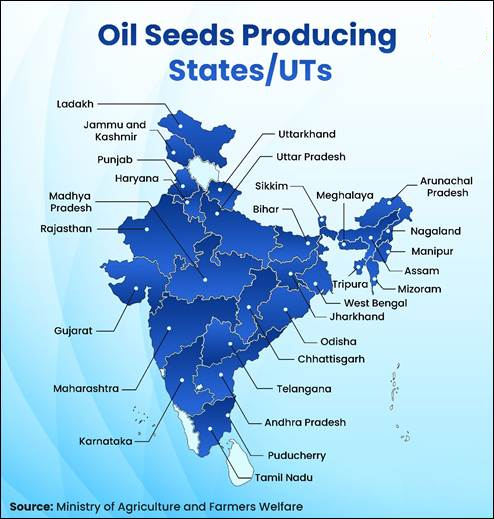
Nine major oilseeds account for 14.3% of the yearly gross cropped area in India, contribute 12-13% to the dietary energy and account for about 8% of the agricultural exports. India ranks first in the production of castor, safflower, sesame and niger, second in groundnut, third in rapseed-mustard, fourth in linseed, and fifth in soybean. Rajasthan, Madhya Pradesh, Gujarat, and Maharashtra are the major oilseed-producing states, contributing to more than 77% of the total oil-seed production in the country
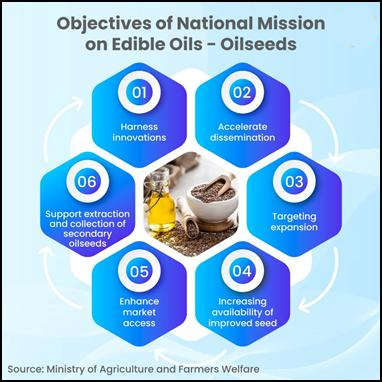
Objectives of the Mission
1. Harness innovations: Utilizing already available and early-maturing innovations and technological breakthroughs for addressing the yield gap.
2. Accelerate dissemination: Promoting the rapid dissemination of improved seed varieties and technologies within crop-specific clusters involving cooperatives, FPOs, and the private sector.
3. Targeting expansion: Encouraging the expansion of oilseed cultivation in fallow areas specially in eastern states and promoting intercropping through demonstrations.
4. Increasing availability of improved seeds: Addressing deficiencies in the seed production and distribution system to ensure availability and accessibility of quality seeds.
5. Enhance market access: Linking oilseed farmers and value chain partners with processors to improve their market access and ensure better returns.
6. Support extraction and collection of secondary oilseeds: Bolstering the production of secondary oilseeds and Tree Borne Oils through targeted interventions
Conclusion
The National Mission on Edible Oils (NMEO) embodies India’s commitment to realizing the vision of Atmanirbhar Bharat by transforming the edible oil sector from an import-dependent to a self-reliant one. Through focused interventions in oil palm expansion, yield improvement in traditional oilseeds, assured pricing mechanisms, advanced seed technologies, and coordinated institutional implementation, the mission seeks to build a resilient and competitive domestic edible oil value chain.
By reducing import dependence, the mission not only conserves our foreign exchange but also strengthens rural economies by empowering farmers with better income opportunities, access to quality inputs, and market linkages. Moreover, it reinforces India’s long-term goals of achieving food and nutritional security, promoting rural development, and fostering sustainable agricultural growth.
In essence, the NMEO stands as a cornerstone of India’s agricultural transformation, bridging productivity gaps, fostering innovation, and advancing the country’s journey towards true Atmanirbharta in edible oil production.





No Comments