


09 Sep National Nutrition Month 2026: Govt’s 3 Pillars for Malnutrition-Free India by 2047
✎ National Nutrition Month (Poshan Maah) is a flagship annual campaign under Poshan Abhiyaan that uses Anganwadi centres as community hubs to deliver integrated nutrition, health, and early childhood services, with a 2026 focus on…
Subject Relevance — Where This Topic Fits
- GS Paper II — Governance, Welfare Schemes for Vulnerable Sections | GS Paper III — Human Development Indicators, Nutrition and Health
- Prelims: Poshan Maah, Mission Saksham Anganwadi and Poshan 2.0, Integrated Child Development Services (ICDS), National Nutrition Mission (NNM), Direct Benefit Transfer (DBT), Maternal and Child Health, Early Childhood Care and Education (ECCE)
- Essay: Nutrition as a Public Good: From Policy to People’s Movement, Building a Healthy India: The Role of Institutions in Social Transformation
Quick Revision: National Nutrition Month (Poshan Maah) is a flagship annual campaign under Poshan Abhiyaan that uses Anganwadi centres as community hubs to deliver integrated nutrition, health, and early childhood services, with a 2026 focus on dietary diversity, protein sufficiency, and freshly cooked meals to accelerate progress towards a malnourishment-free India by 2047.
Why is this in the news?
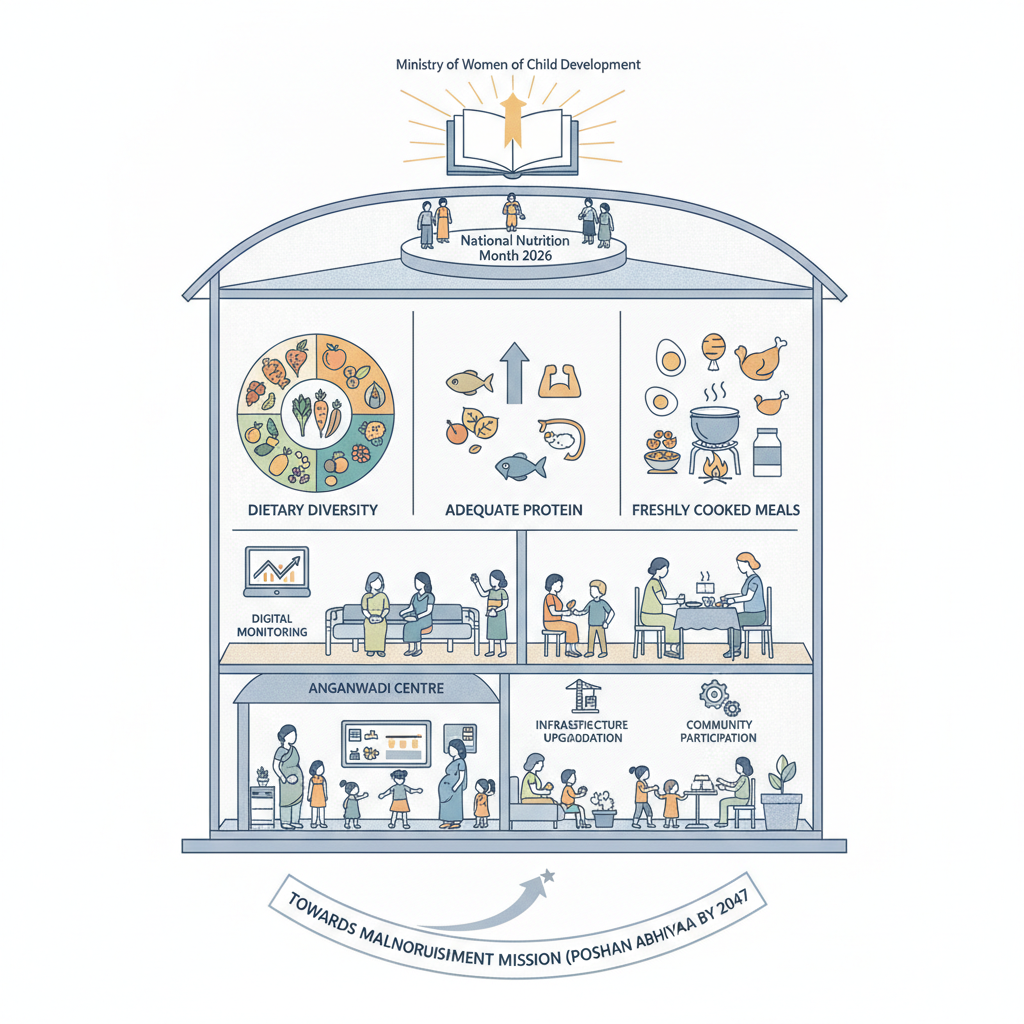
The Ministry of Women and Child Development launched the 9th National Nutrition Month (Poshan Maah) 2026 on 9 September 2026 in Varanasi, marking a nationwide campaign focused on dietary diversity, adequate protein intake, and consumption of freshly cooked meals. The event underscored the transformative role of Anganwadi centres as community hubs delivering integrated nutrition, health, and early childhood care services to over 7.5 crore children and 1.10 crore pregnant and lactating women. The launch highlighted the convergence of digital monitoring, infrastructure upgradation, and community participation to accelerate progress towards a malnourishment-free India by 2047.
Background
- The National Nutrition Mission (NNM), renamed as Poshan Abhiyaan, was launched in 2018 with the objective of reducing stunting, underweight, and anaemia among children, adolescents, girls, and women by 2022.
- The Integrated Child Development Services (ICDS) Scheme, operational since 1975, provides a package of services including supplementary nutrition, pre-school non-formal education, nutrition and health education, immunisation, health check-up, and referral services through a network of 14 lakh Anganwadi centres.
- Mission Saksham Anganwadi and Poshan 2.0 (2022) is an umbrella scheme that consolidates the ICDS platform with improved governance, technology integration, and convergence with health and sanitation programmes to enhance service delivery and outcomes.
- The Pradhan Mantri Matru Vandana Yojana (PMMVY), launched in 2017, provides conditional cash transfers to pregnant women and lactating mothers to promote institutional delivery and early registration of pregnancy for better maternal and child health outcomes.
- The first 1,000 days of life—from conception to a child’s second birthday—are critical for physical and cognitive development, making early nutrition interventions pivotal for long-term human capital formation.
- Digital Public Infrastructure (DPI) initiatives such as Common Application Software (ICDS-CAS) and Poshan Tracker have been deployed to enable real-time monitoring, data-driven decision-making, and transparency in service delivery across Anganwadi centres.
What is National Nutrition Month (Poshan Maah) and its Strategic Framework?
- National Nutrition Month (Poshan Maah) is an annual month-long campaign (September) under the National Nutrition Mission (Poshan Abhiyaan) to raise awareness and mobilise communities on critical nutrition themes such as dietary diversity, protein sufficiency, and consumption of freshly cooked meals.
- The 2026 campaign theme, ‘Hamari Anganwadi, Hamari Zimmedari’ (Our Anganwadi, Our Responsibility), emphasises the pivotal role of Anganwadi centres as community institutions delivering integrated services for children (0–6 years), pregnant and lactating women, and adolescent girls.
- Mission Saksham Anganwadi and Poshan 2.0 (2022) is the overarching scheme that integrates ICDS with health, sanitation, and digital governance to enhance service quality, infrastructure, and convergence across sectors.
- Under Poshan 2.0, 2 lakh Anganwadi centres are being upgraded to ‘Saksham Anganwadi’ centres with improved infrastructure, learning environments, and digital tools to strengthen early childhood care and education (ECCE).
- The campaign leverages community participation through Self-Help Groups (SHGs), Accredited Social Health Activists (ASHAs), and Anganwadi Workers (AWWs) to drive behavioural change and ensure last-mile delivery of nutrition services.
- Dietary diversity is promoted through the distribution of Take-Home Ration (THR) and hot-cooked meals at Anganwadi centres, ensuring balanced nutrient intake for vulnerable populations.
- Digital monitoring through Poshan Tracker and ICDS-CAS enables real-time tracking of service delivery, beneficiary attendance, and nutritional status, facilitating evidence-based policymaking and corrective actions.
- The campaign aligns with the Sustainable Development Goals (SDGs), particularly SDG 2 (Zero Hunger) and SDG 3 (Good Health and Well-being), by addressing malnutrition through multi-sectoral convergence and community engagement.
Key Features
| Feature | Significance |
|---|---|
| National Nutrition Month 2026 | A month-long nationwide campaign focusing on diet diversity, adequate protein intake, and freshly cooked meals to address malnutrition through community participation. |
| Anganwadi Centres as Community Hubs | Transformed into vibrant institutions with improved infrastructure, digital monitoring, and real-time data entry via smartphones to enhance service delivery. |
| Supplementary Nutrition Services | Provision of hot cooked meals and take-home rations to eligible beneficiaries, including children, pregnant women, and lactating mothers. |
| Mission Saksham Anganwadi and POSHAN 2.0 Phase-II | Government’s commitment to improving nutrition outcomes through targeted interventions and capacity-building of frontline workers. |
| Pradhan Mantri Matru Vandana Yojana (PMMVY) | Direct Benefit Transfer scheme providing financial support to pregnant and lactating mothers, completing a decade of implementation with significant coverage. |
Why it Matters
Public Health
- Addresses acute malnutrition in children under five and maternal undernutrition, critical for reducing stunting, wasting, and anaemia.
- Promotes dietary diversity and protein sufficiency, aligning with WHO and UNICEF recommendations for child growth and development.
- Enhances early childhood care through structured interventions in the first 1,000 days of life, a period proven to have lifelong health benefits.
Social Equity
- Ensures equitable access to nutrition services across socio-economic groups, particularly in rural and tribal areas.
- Empowers women as primary caregivers through targeted nutrition education and community engagement.
Governance and Service Delivery
- Strengthens the role of Anganwadi workers as frontline service providers with digital tools for real-time monitoring and accountability.
- Facilitates inter-departmental coordination between health, women and child development, and local governance structures.
Economic Development
- Reduces healthcare costs associated with malnutrition-related diseases, contributing to a healthier and more productive workforce.
- Supports India’s demographic dividend by ensuring optimal physical and cognitive development of future generations.
Challenges
1. Geographical Disparities in Service Delivery
- Urban-rural divide in access to Anganwadi services and supplementary nutrition, particularly in remote and hilly regions.
- Inadequate infrastructure in some Anganwadi centres, despite recent upgrades, leading to suboptimal service delivery.
UPSC Link: GS-II: Social Justice
2. Behavioural and Cultural Barriers
- Deep-rooted dietary practices that prioritise calorie-dense but nutrient-poor foods, especially in marginalised communities.
- Low awareness among caregivers about the importance of diet diversity, protein intake, and hygiene practices.
UPSC Link: GS-II: Social Justice
3. Human Resource Constraints
- Shortage of trained Anganwadi workers and supervisors, particularly in high-burden states.
- High attrition rates among frontline workers due to inadequate remuneration and lack of career progression.
UPSC Link: GS-II: Governance
4. Monitoring and Accountability Gaps
- Delays in real-time data reporting and verification, undermining the effectiveness of digital monitoring systems.
- Inconsistent beneficiary identification and exclusion errors in supplementary nutrition programmes.
UPSC Link: GS-II: Governance
5. Funding and Resource Allocation
- Dependence on centralised funding for state-level implementation, leading to delays and uneven resource distribution.
- Insufficient allocation for nutrition-specific interventions in state budgets, despite central schemes.
UPSC Link: GS-III: Economic Development
Challenges — UPSC Perspective
| Issue | Concern |
|---|---|
| Urban-Rural Divide | Limited access to Anganwadi services in rural and tribal areas, exacerbating malnutrition disparities. |
| Dietary Practices | Cultural preferences for starchy foods over nutrient-rich diets, hindering behavioural change. |
| Workforce Shortages | Inadequate number of trained Anganwadi workers, impacting service quality and coverage. |
| Digital Divide | Limited smartphone access among some frontline workers, affecting real-time data entry and monitoring. |
| Funding Gaps | Uneven distribution of central funds leading to delays in supplementary nutrition distribution. |
| Monitoring Deficits | Gaps in beneficiary tracking and verification, resulting in exclusion or duplication errors. |
Government Initiatives — Must-Memorise for Prelims
- Mission Saksham Anganwadi and POSHAN 2.0 (Phase-II)
Way Forward
- Strengthen inter-departmental coordination between the Ministry of Women and Child Development, Ministry of Health and Family Welfare, and state governments to ensure seamless service delivery.
- Expand digital infrastructure in Anganwadi centres, including training for frontline workers on real-time data entry and beneficiary tracking systems.
- Conduct targeted behaviour change communication campaigns to promote diet diversity, protein sufficiency, and hygiene practices in high-burden districts.
- Increase budgetary allocations for supplementary nutrition programmes, with a focus on reducing urban-rural disparities and improving infrastructure.
- Enhance the capacity of Anganwadi workers through regular training, better remuneration, and career progression pathways to reduce attrition.
- Leverage community-based organisations and self-help groups to amplify reach and ensure sustained community participation in nutrition programmes.
- Implement robust monitoring and evaluation mechanisms to track progress, identify gaps, and ensure accountability in service delivery.
- Integrate nutrition education into school curricula and adolescent health programmes to foster long-term dietary habits and awareness.
UPSC Value Addition
Keywords for Mains Answer-Writing
National Nutrition Month 2026 · Poshan Maah · Poshan Abhiyaan · Anganwadi Services · Mission Saksham Anganwadi and Poshan 2.0 · Supplementary Nutrition Programme · Maternal and Child Nutrition · Integrated Child Development Services (ICDS) · Direct Benefit Transfer (DBT) · Pradhan Mantri Matru Vandana Yojana (PMMVY) · Early Childhood Care and Education (ECCE) · Dietary Diversity · Protein Adequacy in Diet · Community Participation in Nutrition · 1000 Days of Conception · Nutrition-Sensitive Agriculture · Malnutrition Eradication · Poshan Tracker
Concept Flow
Malnutrition in early childhood and maternal undernutrition → Government launches National Nutrition Month 2026 with focus on diet diversity and protein sufficiency → Anganwadi centres upgraded to community hubs with digital monitoring → Supplementary nutrition and hot cooked meals provided to eligible beneficiaries → Behavioural change communication campaigns to address cultural dietary practices → Improved health outcomes in children and mothers → Contribution to India’s demographic dividend and economic growth → 2047 vision of a ‘Swasth and Vikasit Bharat’
Prelims Practice Questions
Q1. Consider the following statements regarding the National Nutrition Month (Poshan Maah) 2026:
1. Poshan Maah is launched under the aegis of the Ministry of Women and Child Development.
2. The campaign emphasizes dietary diversity, adequate protein intake, and freshly cooked meals.
3. Poshan Maah is exclusively focused on urban areas to address malnutrition.
4. The Poshan Tracker is a digital platform used for real-time monitoring of nutritional services.
How many of the above statements are correct?
- Only one
- Only two
- Only three
- All four
Answer: Only three — Statements 1, 2, and 4 are correct. Statement 3 is incorrect as Poshan Maah is a nationwide campaign, not limited to urban areas.
Q2. Assertion (A): The Pradhan Mantri Matru Vandana Yojana (PMMVY) provides direct cash transfers to pregnant women and lactating mothers.
Reason (R): The scheme aims to compensate for wage loss during pregnancy and ensure adequate nutrition for the mother and child.
In the context of the above two statements, which one of the following is correct?
- Both A and R are true and R is the correct explanation of A.
- Both A and R are true but R is NOT the correct explanation of A.
- A is true but R is false.
- A is false but R is true.
Answer: Both A and R are true but R is NOT the correct explanation of A. — Both the Assertion and Reason are true, and the Reason correctly explains the Assertion. PMMVY provides cash transfers to compensate for wage loss and support maternal and child nutrition.
Q3. Match the following initiatives with their respective objectives:
Column I (Initiative) | Column II (Objective)
———————————————–|————————————————-
A. Mission Saksham Anganwadi and Poshan 2.0 | 1. Enhancing nutritional outcomes through community participation
B. Poshan Tracker | 2. Real-time monitoring of nutritional services
C. Pradhan Mantri Matru Vandana Yojana (PMMVY) | 3. Direct cash transfer to pregnant and lactating mothers
D. Integrated Child Development Services (ICDS)| 4. Holistic development of children under six years
Select the correct match:
- A-1, B-2, C-3, D-4
- A-2, B-1, C-3, D-4
- A-4, B-2, C-1, D-3
- A-1, B-3, C-2, D-4
Answer: A-1, B-2, C-3, D-4 — Correct matches: A-1 (Mission Saksham Anganwadi and Poshan 2.0 aims to enhance nutritional outcomes), B-2 (Poshan Tracker is a digital platform for real-time monitoring), C-3 (PMMVY provides direct cash transfers), D-4 (ICDS focuses on holistic development of children under six).
Mains Practice Question
✍ The National Nutrition Month (Poshan Maah) 2026, launched under the Poshan Abhiyaan, emphasizes dietary diversity, adequate protein intake, and freshly cooked meals as key strategies to combat malnutrition. In this context, critically examine the role of community participation and institutional mechanisms like Anganwadi Services in achieving the goals of a ‘Suposhit Bharat’ by 2047. (15 Marks)
Approach: MODEL-ANSWER SKELETON:
1. **Introduction (2 Marks)**
– Briefly define Poshan Maah 2026, its objectives, and the broader framework of Poshan Abhiyaan.
– State the significance of dietary diversity, protein adequacy, and freshly cooked meals in addressing malnutrition.
2. **Role of Community Participation (4 Marks)**
– Explain how community participation fosters ownership and sustainability in nutrition programs.
– Discuss the role of Anganwadi workers as frontline workers in mobilizing communities.
– Highlight the importance of behavior change communication (BCC) and awareness campaigns.
– Cite examples of successful community-driven nutrition interventions (e.g., community kitchens, nutrition gardens).
3. **Institutional Mechanisms: Anganwadi Services (4 Marks)**
– Outline the structure and functions of Anganwadi Services under the Integrated Child Development Services (ICDS) scheme.
– Discuss the expansion of Anganwadi centers (e.g., Mission Saksham Anganwadi and Poshan 2.0) and their enhanced infrastructure.
– Explain the role of the Poshan Tracker in real-time monitoring and data-driven decision-making.
– Highlight the integration of health, nutrition, and early childhood care services.
4. **Challenges and Way Forward (3 Marks)**
– Identify challenges such as last-mile delivery, digital divide, and socio-cultural barriers.
– Discuss the need for convergence among ministries (e.g., Women and Child Development, Health, Rural Development).
– Suggest measures like leveraging technology (AI, mobile apps), strengthening local governance, and ensuring accountability.
5. **Conclusion (2 Marks)**
– Summarize the critical role of community participation and institutional mechanisms in achieving ‘Suposhit Bharat’ by 2047.
– Emphasize the need for a multi-sectoral approach and sustained political will.
Source: PIB (Press Information Bureau)
Generated by AanyaAi for educational purpose.
Related guides on our sites
- Best PSIR optional coaching for upsc
- Best PSIR optional teacher for upsc
- Best teacher of PSIR optional for upsc
- Best PSIR optional coaching in delhi for UPSC

- Gurugram’s groundwater extraction exceeds limit by 212%; HC seeks ban - October 4, 2026
- स्वतंत्रता सेनानी श्यामजी कृष्ण वर्मा की जन्म जयंती पर पीएम का श्रद्धांजलि - October 4, 2026
- KWML’s Feasibility Reports for Water Metro in 18 Cities: UPSC & PCS Insights - October 3, 2026

No Comments