


28 Jul National SC-ST Hub Scheme Boosts Inclusive Industrial Growth & Employment
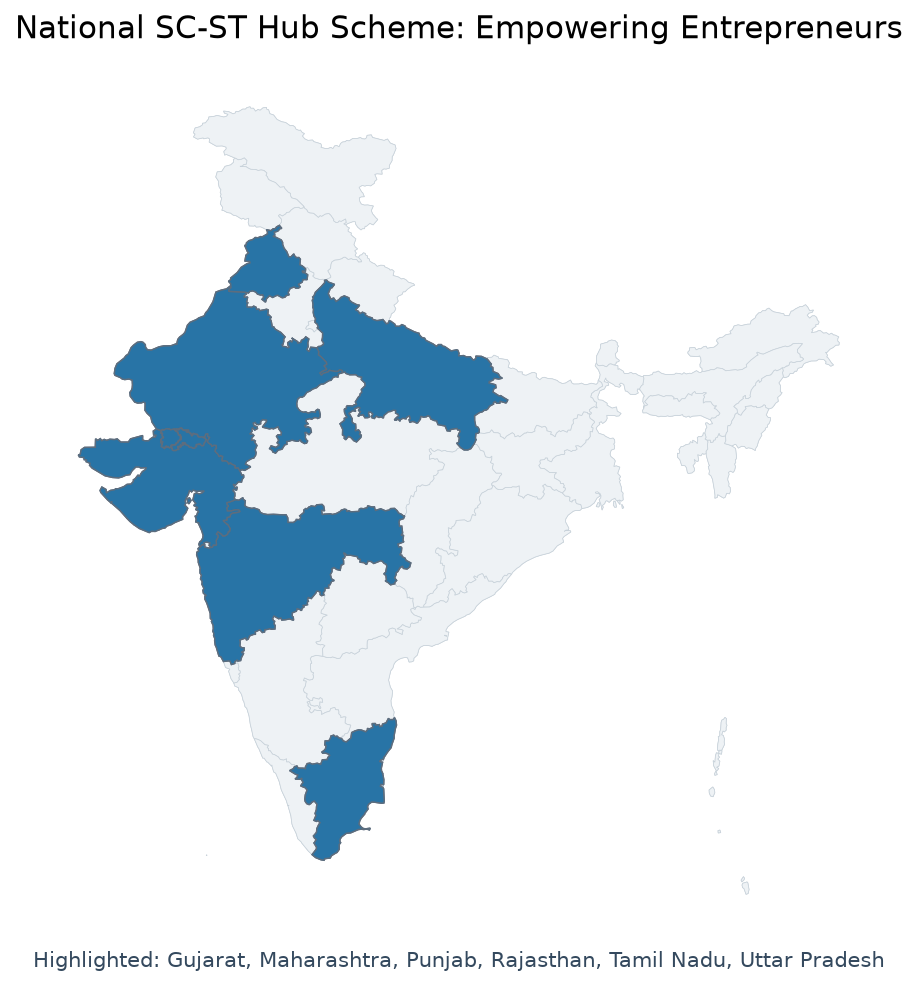
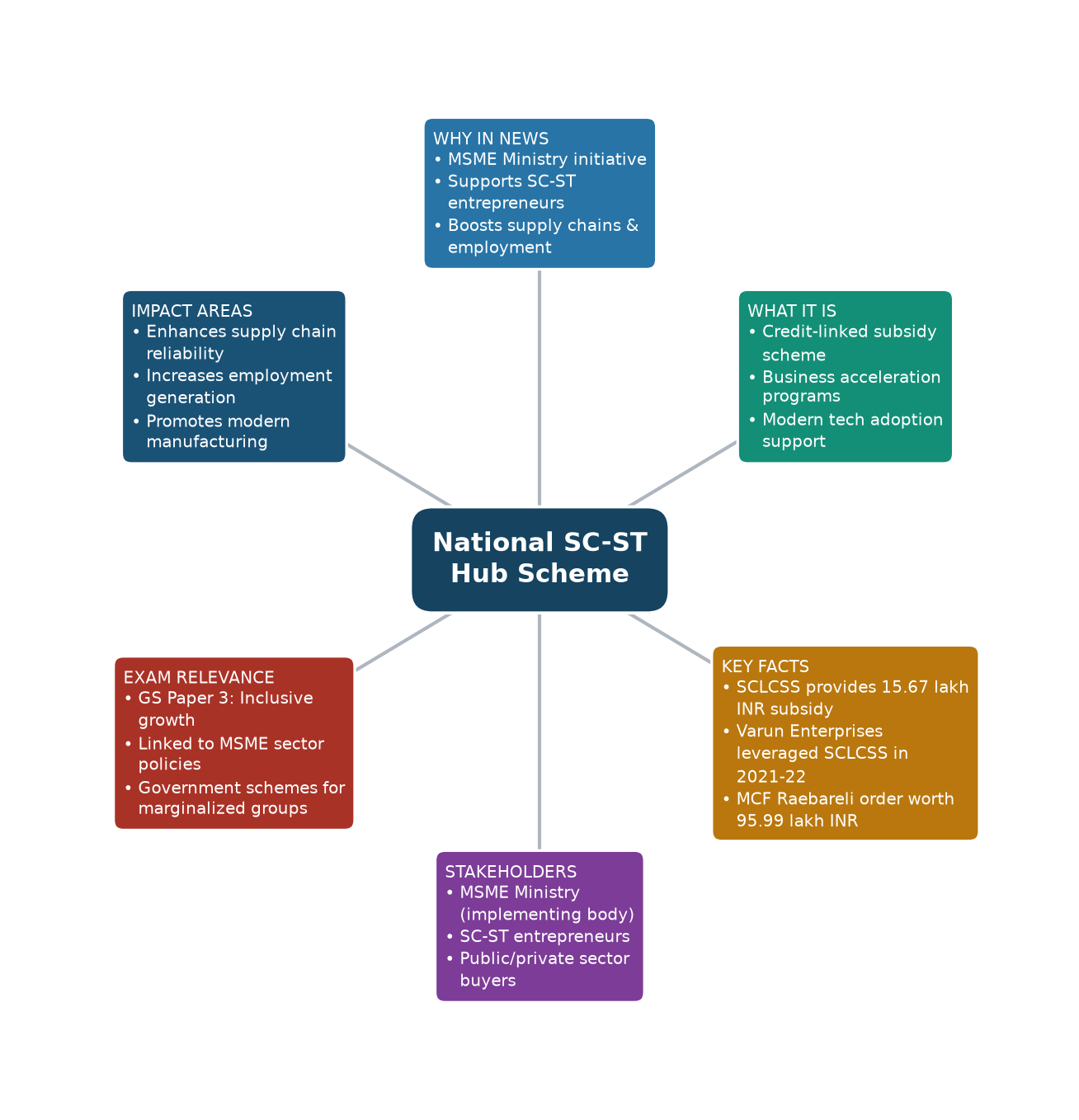
Map & concept mind-map: National SC-ST Hub Scheme: Empowering Entrepreneurs
Subject Relevance — Where This Topic Fits
- GS Paper II — Welfare Schemes for Vulnerable Sections | GS Paper III — Micro, Small and Medium Enterprises (MSMEs), Employment Generation, Industrial Policy
- Prelims: SC-ST Hub Scheme, MSME Ministry, Credit Linked Capital Subsidy Scheme (CLCSS), Business Acceleration Programme (BAP), Public Procurement Policy for MSMEs, Fiber Laser Cutting System, CNC Hydraulic Press Brake
- Essay: Inclusive growth and equitable access to economic opportunities in India, Role of technology and innovation in bridging socio-economic divides
Quick Revision: The National SC-ST Hub Scheme empowers SC/ST entrepreneurs by providing credit linkages, and market access through public procurement, thereby fostering inclusive industrialisation and employment generation.
Why is this in the news?
The National SC-ST Hub Scheme (NSSH), operational under the Ministry of Micro, Small and Medium Enterprises (MSME), has been highlighted for its role in enhancing the participation of Scheduled Caste (SC) and Scheduled Tribe (ST) entrepreneurs in India’s industrial landscape. Through targeted interventions such as the Special Credit Linked Capital Subsidy Scheme (SCLCSS) and Business Acceleration Programme (BAP), the scheme is fostering reliable supply chains, employment generation, and technological adoption among marginalised enterprises, as evidenced by case studies like Varun Enterprises (Punjab) and Raju Thangavelu’s enterprise (Tamil Nadu).
Background
- The NSSH Scheme was launched in 2016 as a central sector scheme under the MSME Ministry to promote entrepreneurship among SC/ST communities by addressing systemic barriers in access to credit, technology, and markets.
- The scheme operates under the broader framework of the Public Procurement Policy for MSMEs (2012), which mandates 4% procurement from SC/ST-owned enterprises in government purchases.
- The Business Acceleration Programme (BAP) offers mentorship, training, and market linkages to enhance the competitiveness of SC/ST enterprises in high-value sectors.
- The scheme aligns with the government’s vision of ‘Atmanirbhar Bharat’ by promoting self-reliance in critical industrial segments through inclusive industrialisation.
- Case studies of Varun Enterprises and Raju Thangavelu’s enterprise illustrate the scheme’s impact on employment generation, supply chain integration, and technological modernisation.
What is the National SC-ST Hub Scheme (NSSH)?
- Launched in 2016 under the Ministry of Micro, Small and Medium Enterprises (MSME), the NSSH Scheme is a central sector initiative aimed at promoting entrepreneurship and economic empowerment among SC and ST communities in India.
- The scheme provides a three-pronged support framework: (i) technology upgradation through subsidies and grants, (ii) credit facilitation via linkages with financial institutions, and (iii) market access through public procurement and business acceleration programmes.
- The Business Acceleration Programme (BAP) provides mentorship, training, and capacity-building support to SC/ST entrepreneurs, enabling them to scale operations, adopt modern technologies, and comply with regulatory standards.
- The scheme facilitates participation in government procurement by sensitising procuring entities and providing certification support to SC/ST enterprises, thereby enhancing their visibility and credibility in institutional markets.
- NSSH collaborates with industry associations, technical institutions, and financial intermediaries to deliver end-to-end support, including skill development, supply chain integration, and compliance assistance.
- The scheme’s impact is measured through metrics such as employment generation, revenue growth, technology adoption rates, and participation in public procurement contracts.
- NSSH is a critical instrument for realising the constitutional mandate of social justice (Articles 15(4) and 16(4)) by ensuring equitable access to economic opportunities for historically marginalised communities.
Key Features
| Feature | Significance |
|---|---|
| Credit Linked Capital Subsidy Scheme (CLCSS) | Provides financial assistance to SC/ST entrepreneurs for adopting advanced manufacturing technologies, reducing capital expenditure barriers and enhancing competitiveness. |
| Business Acceleration Programme (BAP) | Facilitates capacity-building, compliance enhancement, and market access for SC/ST enterprises through structured mentorship and skill development interventions. |
| Technology Adoption Support | Enables SC/ST entrepreneurs to integrate modern machinery (e.g., fiber laser cutting systems, CNC hydraulic press brakes) for improved production efficiency and quality standards. |
| Public Procurement Facilitation | Increases participation of SC/ST enterprises in government and institutional tenders by addressing compliance gaps and enhancing operational reliability. |
| Supply Chain Integration | Strengthens backward and forward linkages for SC/ST enterprises, ensuring sustainable market access and reducing dependency on informal networks. |
Why it Matters
Economic Inclusion
- Enhances economic participation of SC/ST communities by reducing structural barriers in entrepreneurship and industrial engagement.
- Promotes equitable growth by integrating marginalized sections into formal supply chains and high-value manufacturing sectors.
- Contributes to GDP growth through increased employment generation and industrial diversification.
Industrial Competitiveness
- Elevates the technological quotient of SC/ST-led enterprises, enabling them to meet global quality standards and compete in institutional markets.
- Facilitates adoption of Industry 4.0 technologies, improving operational efficiency and reducing time-to-market for products.
- Strengthens India’s industrial resilience by diversifying the supplier base in critical sectors such as engineering and logistics.
Social Equity
- Reduces historical economic disparities by providing targeted support to historically disadvantaged groups in industrial development.
- Fosters intergenerational mobility by enabling SC/ST entrepreneurs to transition from informal to formal economic sectors.
- Promotes inclusive industrialization, aligning with constitutional directives for social justice and economic empowerment.
Policy Synergy
- Complements broader MSME policies by addressing specific vulnerabilities of SC/ST entrepreneurs through tailored interventions.
- Aligns with the Atmanirbhar Bharat initiative by strengthening domestic manufacturing capabilities in niche sectors.
- Supports the implementation of the SC/ST (Prevention of Atrocities) Act, 1989, by promoting economic self-reliance among target communities.
Challenges
1. Access to Formal Credit
- SC/ST entrepreneurs face higher collateral requirements and risk aversion from financial institutions, limiting access to growth capital.
- Informal credit markets often exploit marginalized entrepreneurs, leading to debt traps and operational instability.
UPSC Link: GS3: Inclusive growth & issues
2. Technological Lag
- Low adoption of advanced manufacturing technologies due to high initial costs and limited awareness of Industry 4.0 tools.
- Lack of skilled labor for operating modern machinery, creating a productivity bottleneck in SC/ST-led enterprises.
UPSC Link: GS3: Industrial policy & technology
3. Market Access Barriers
- Systemic biases in public procurement favor established firms, marginalizing SC/ST enterprises despite their competitive potential.
- Limited exposure to global supply chains restricts export opportunities and revenue diversification.
UPSC Link: GS3: Liberalization & MSMEs
4. Regulatory Compliance Burden
- Complex and evolving compliance requirements for safety, quality, and environmental standards increase operational costs.
- Delays in certification and approvals disrupt production schedules and erode competitiveness.
UPSC Link: GS2: Governance & ease of doing business
5. Skill Gaps & Capacity Constraints
- Inadequate vocational training infrastructure in SC/ST-dominated regions limits access to industry-relevant skills.
- Entrepreneurs lack managerial expertise in scaling operations, financial planning, and strategic marketing.
UPSC Link: GS2: Skill development & employment
Challenges — UPSC Perspective
| Issue | Concern |
|---|---|
| Collateral Requirements | Exclusion of SC/ST entrepreneurs from formal credit due to lack of assets for collateral. |
| Technology Affordability | High upfront costs deter adoption of advanced manufacturing equipment in SC/ST enterprises. |
| Procurement Bias | Systemic preference for established firms in government tenders limits market participation. |
| Regulatory Overload | Complex compliance frameworks disproportionately burden resource-constrained SC/ST enterprises. |
| Skill Mismatch | Vocational training programs do not align with industry demands, creating talent shortages. |
| Supply Chain Exclusion | Informal networks dominate SC/ST entrepreneurs’ access to raw materials and distribution channels. |
Government Initiatives — Must-Memorise for Prelims
- National SC-ST Hub (NSSH) Scheme
- Business Acceleration Programme (BAP)
Way Forward
- Expand CLCSS coverage to include emerging technologies like AI, IoT, and automation for SC/ST enterprises.
- Strengthen BAP by partnering with IITs, NITs, and industry associations for specialized mentorship programs.
- Mandate 5% procurement quotas for SC/ST enterprises in all government tenders above ₹50 lakh, with performance-linked incentives.
- Establish regional skill development hubs in SC/ST-dominated districts to bridge the talent gap in advanced manufacturing.
- Simplify regulatory compliance by creating a single-window portal for certifications, approvals, and inspections.
- Promote public-private partnerships to develop SC/ST-led industrial clusters with shared infrastructure and technology access.
- Launch awareness campaigns in local languages to educate SC/ST entrepreneurs on scheme benefits and compliance requirements.
- Integrate NSSH with state-level SC/ST finance corporations to provide end-to-end financial and technical support.
UPSC Value Addition
Keywords for Mains Answer-Writing
National SC-ST Hub (NSSH) Scheme · MSME Ministry · Credit Linked Capital Subsidy Scheme (CLCSS) · Scheduled Castes (SCs) · Scheduled Tribes (STs) · entrepreneurship development · inclusive growth · public procurement · supply chain resilience · industrial competitiveness · technological adoption · capacity building · government procurement policy · MSME sector · economic empowerment of marginalised communities
Constitutional & Policy Linkages
- Article 15(4): Special provisions for socially and educationally backward classes.
- Article 16(4): Reservation in public employment and services.
- Article 46: Promotion of educational and economic interests of SC/ST.
- Seventh Schedule, State List: Empowerment of local governments to implement welfare schemes.
Concept Flow
Historical exclusion of SC/ST communities from industrial development → Limited access to capital, technology, and markets → Entrenchment of economic disparities → Government intervention via NSSH Scheme → Provision of CLCSS and BAP → Reduction of capital and skill barriers → Adoption of advanced manufacturing technologies → Enhanced productivity and quality → Competitive positioning in institutional markets → Increased participation in public procurement → Revenue growth and supply chain integration → Sustainable enterprise scaling → Reinvestment of profits into R&D and workforce training → Long-term competitiveness and job creation → Contribution to national industrial growth → Replication of success stories → Expansion of NSSH’s impact → Broader economic inclusion and social equity
Prelims Practice Questions
Q1. Which of the following schemes is NOT directly associated with the National SC-ST Hub (NSSH) Scheme for the empowerment of SC/ST entrepreneurs?
- A. Credit Linked Capital Subsidy Scheme (CLCSS)
- B. Stand-Up India Scheme
- C. Business Acceleration Programme (BAP)
- D. Public Procurement Policy for MSEs
Answer: B. Stand-Up India Scheme — The Stand-Up India Scheme is a separate initiative launched by the Government of India to promote entrepreneurship among SC/ST and women, whereas CLCSS, BAP, and Public Procurement Policy for MSEs are directly linked to the NSSH Scheme.
Q2. The National SC-ST Hub (NSSH) Scheme is implemented under which Ministry?
- A. Ministry of Social Justice and Empowerment
- B. Ministry of Micro, Small and Medium Enterprises (MSME)
- C. Ministry of Commerce and Industry
- D. Ministry of Finance
Answer: B. Ministry of Micro, Small and Medium Enterprises (MSME) — The NSSH Scheme is implemented by the Ministry of Micro, Small and Medium Enterprises (MSME) to promote entrepreneurship and industrial participation among SC/ST communities.
Q3. Which of the following is a key objective of the National SC-ST Hub (NSSH) Scheme?
- A. To provide financial assistance to large-scale industries
- B. To enhance the competitiveness of SC/ST entrepreneurs through technology adoption and capacity building
- C. To promote foreign direct investment in the MSME sector
- D. To regulate the prices of goods produced by MSMEs
Answer: B. To enhance the competitiveness of SC/ST entrepreneurs through technology adoption and capacity building — The NSSH Scheme aims to empower SC/ST entrepreneurs by enabling technology adoption, capacity building, and improved access to markets, particularly through public procurement.
Mains Practice Question
✍ Critically examine the role of the National SC-ST Hub (NSSH) Scheme in promoting inclusive growth and industrial competitiveness in India. How does the scheme address the challenges faced by SC/ST entrepreneurs in accessing modern technology, financial resources, and market opportunities? Substantiate your answer with relevant examples.
Approach: Begin by defining the NSSH Scheme and its objectives under the MSME Ministry. Discuss its three-pronged approach: technological adoption (e.g., CLCSS for advanced machinery), capacity building (e.g., Business Acceleration Programme), and market access (e.g., public procurement policies). Analyse how these measures address structural barriers such as limited access to finance, technological lag, and market exclusion. Use the case studies of Varun Enterprises (Punjab) and Rajan Enterprises (Tamil Nadu) to illustrate the scheme’s impact on supply chain resilience, employment generation, and industrial participation. Conclude by evaluating the scheme’s effectiveness in achieving inclusive growth and suggesting measures for further strengthening its outcomes, such as expanding the scope of CLCSS or integrating with other government initiatives like Stand-Up India.
Source: PIB (Press Information Bureau)
Generated by AanyaAi for educational purpose.

- केरल लोक सेवा आयोग ने उच्च न्यायालय में दायर किया मामला, सदस्यों के खिलाफ मामला रद्द करने की मांग - September 23, 2026
- KPSC Challenges Prosecution Sanction in Kerala High Court: Key UPSC Polity Insight - September 23, 2026
- केरल में एंटीमाइक्रोबियल रेजिस्टेंस: सरकारी रिपोर्ट में चौंकाने वाले आँकड़े सामने - September 23, 2026

No Comments