


08 Aug National Tribunal Commission Bill: UPSC Polity Current Affairs 2026
✎ The न्यायाधिकरण सुधार विधेयक (Tribunal Reforms Bill) seeks to institutionalise transparent, merit-based, and independent appointments to tribunals by establishing a statutory body with judicial and technical expertise, in…
Subject Relevance — Where This Topic Fits
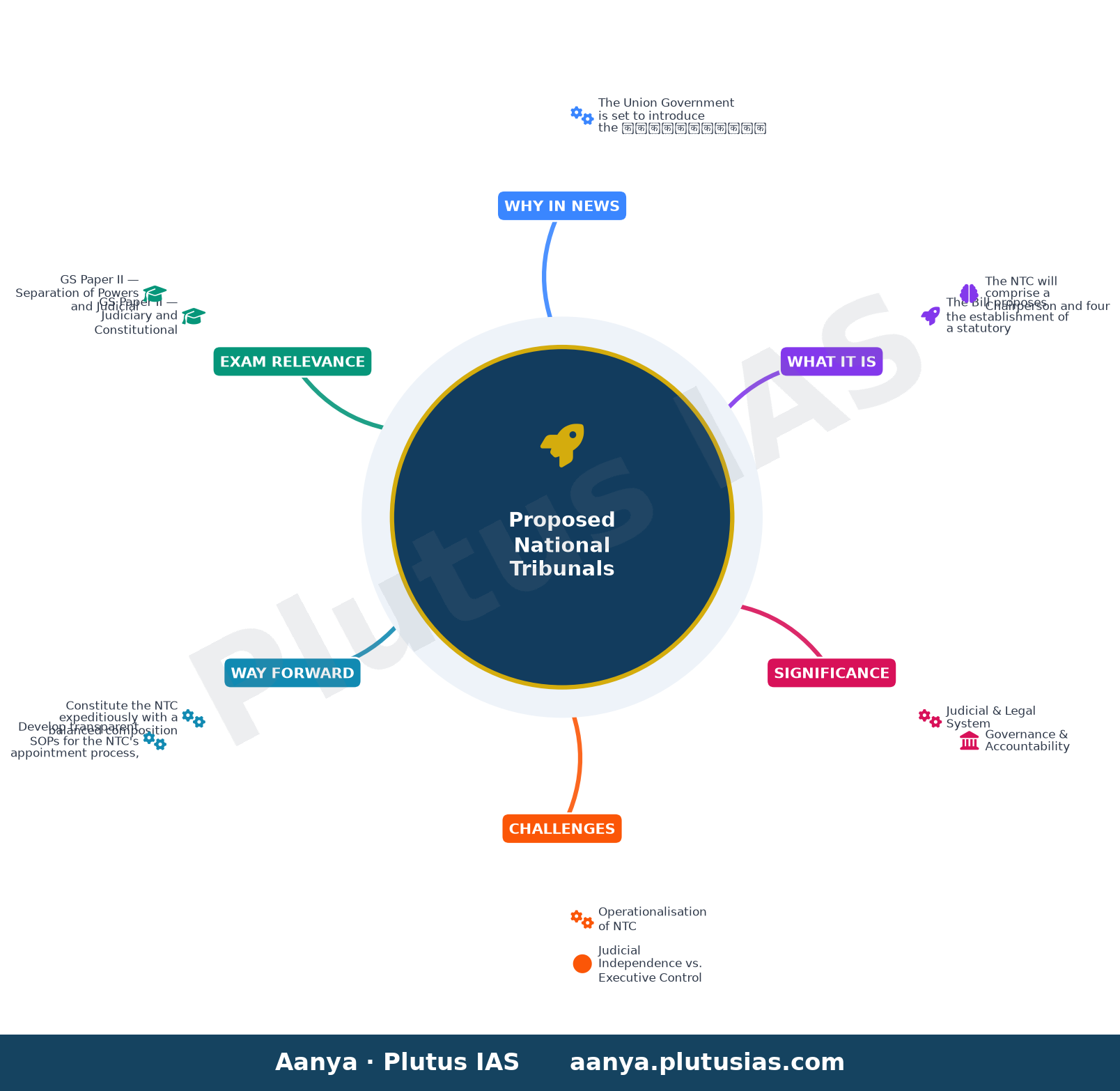
- GS Paper II — Judiciary and Constitutional Framework | GS Paper II — Separation of Powers and Judicial Independence | GS Paper IV — Ethics and Governance: Transparency and Accountability in Public Institutions
- Prelims: Tribunal Reforms Act, 2021, National Tribunal Commission, Supreme Court directives on judicial appointments, Article 50 of the Constitution, Separation of Powers, Judicial Independence
- Essay: Judicial Reforms and Democratic Accountability, Balancing Efficiency and Independence in Quasi-Judicial Bodies
Quick Revision: The न्यायाधिकरण सुधार विधेयक (Tribunal Reforms Bill) seeks to institutionalise transparent, merit-based, and independent appointments to tribunals by establishing a statutory body with judicial and technical expertise, in compliance with the Supreme Court’s directives.
Why is this in the news?
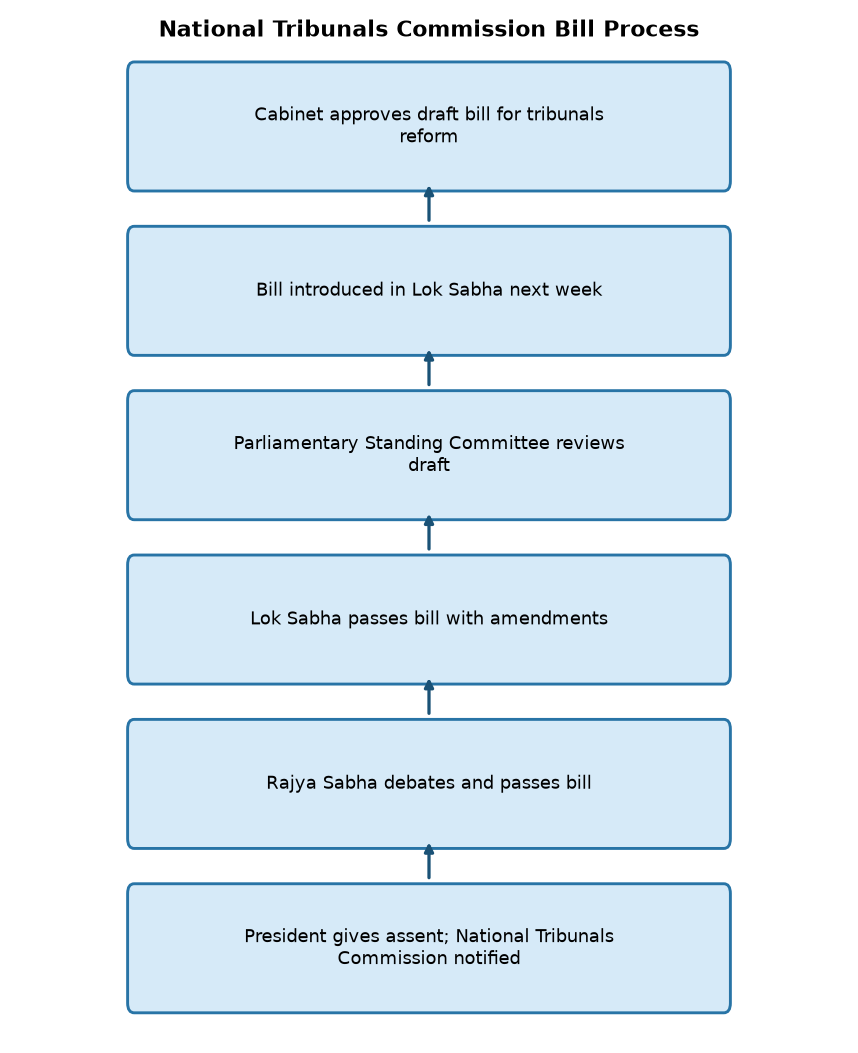
The Union Government is set to introduce the न्यायाधिकरण सुधार विधेयक (Tribunal Reforms Bill) in the Lok Sabha next week, aiming to overhaul the appointment process for tribunals by establishing a statutory body to ensure transparency, professionalism, and institutional independence. This legislative move follows the Supreme Court’s 2021 ruling striking down key provisions of the Tribunal Reforms Act, 2021 for violating the principles of separation of powers and judicial independence, thereby necessitating a structured reform mechanism.
Background
- The Tribunal Reforms Act, 2021, introduced by the Union Government, sought to regulate appointments, terms of service, and conditions of service for members of various tribunals across India.
- The Supreme Court, in its 2021 judgment (Rojer Mathew v. South India Bank Ltd.), struck down several provisions of the Act, including those delegating the power of appointment to the Executive, citing violations of the doctrine of separation of powers and judicial independence.
- The Court directed the Government to constitute a National Tribunal Commission (NTC) to ensure independent, transparent, and merit-based appointments to tribunals, with a focus on professional expertise.
- Tribunals in India function as quasi-judicial bodies, adjudicating specialised disputes such as tax, administrative, labour, and environmental matters, thereby reducing the burden on regular courts.
- The lack of standardised appointment processes has historically led to concerns over nepotism, lack of domain expertise, and compromised independence in tribunal functioning.
What is the न्यायाधिकरण सुधार विधेयक (Tribunal Reforms Bill)?
- The Bill proposes the establishment of a statutory राष्ट्रीय न्यायाधिकरण आयोग (National Tribunals Commission) as a high-powered body responsible for the appointment, selection, and monitoring of the Chairpersons and Members of various tribunals in India.
- The NTC will comprise a Chairperson and four Members: two judicial members (retired Supreme Court judges or Chief Justices of High Courts) and two technical members with domain expertise in relevant fields such as law, economics, or administration.
- The Commission will operate independently of the Executive, ensuring that tribunal appointments are insulated from political interference and bureaucratic influence.
- The Bill mandates transparent selection processes, including the publication of criteria for eligibility, a merit-based selection committee, and a defined tenure for appointed members to prevent arbitrary removals.
- The NTC will also be tasked with framing guidelines for the functioning of tribunals, ensuring uniformity in procedures, and monitoring their performance to enhance efficiency and accountability.
- The Bill is aligned with the Supreme Court’s observations in the Rojer Mathew case, which emphasised the need for a specialised body to oversee tribunal appointments and ensure judicial independence.
- The NTC’s jurisdiction will extend to all central tribunals, including the Income Tax Appellate Tribunal (ITAT), Customs, Excise and Service Tax Appellate Tribunal (CESTAT), National Green Tribunal (NGT), and others.
Key Features
| Feature | Significance |
|---|---|
| Constitution of National Tribunal Commission (NTC) | Centralised authority to streamline appointments, ensuring uniformity, transparency, and institutional independence in tribunal governance. |
| Composition: 1 Chairperson + 4 Members (2 Judicial, 2 Technical) | Balances judicial expertise with domain-specific technical knowledge to enhance decision-making quality in tribunal appointments. |
| Eligibility: Retired SC Judge or HC Chief Justice for Chairperson | Upholds judicial independence by vesting leadership in experienced jurists with constitutional stature. |
| Transparent Selection Process | Reduces arbitrariness, mitigates nepotism, and aligns with judicial precedents on fair appointment standards. |
| Repeal of Tribunal Reforms Act, 2021 | Removes contentious provisions struck down by SC, replacing them with a legally robust framework compliant with separation of powers. |
Why it Matters
Judicial & Legal System
- Restores constitutional legitimacy to tribunal appointments by adhering to the principle of separation of powers, as mandated by the Supreme Court.
- Ensures adherence to judicial precedents (e.g., Rojer Mathew v. South Indian Bank Ltd., 2020) on tribunal autonomy and appointment standards.
- Enhances functional efficiency of tribunals by reducing vacancies and improving member selection criteria.
Governance & Accountability
- Introduces a structured, merit-based appointment mechanism, curbing executive overreach in tribunal governance.
- Establishes a dedicated body (NTC) to monitor performance and enforce accountability in tribunal operations.
- Promotes institutional independence, a critical requirement for tribunals adjudicating disputes involving the state and citizens.
Rule of Law & Judicial Reforms
- Aligns with the broader judicial reform agenda, particularly the need for specialised tribunals to address complex legal and technical disputes.
- Ensures consistency in tribunal functioning, reducing fragmentation in judicial processes across different domains (e.g., taxation, labour, environment).
- Strengthens public trust in tribunal adjudication by eliminating perceptions of political interference.
Challenges
1. Operationalisation of NTC
- Risk of bureaucratic delays in establishing the NTC due to inter-ministerial coordination requirements.
- Potential resistance from existing tribunal members or executive authorities accustomed to discretionary appointment powers.
UPSC Link: Constitutional bodies – Tribunals (GS-II)
2. Judicial Independence vs. Executive Control
- Ensuring the NTC remains insulated from executive pressure while maintaining accountability to Parliament.
- Balancing the need for executive oversight in administrative matters with judicial autonomy in adjudicatory functions.
UPSC Link: Separation of Powers (GS-II)
3. Resource Constraints
- Limited availability of retired Supreme Court judges or High Court Chief Justices to lead the NTC, given their post-retirement engagements.
- Potential shortage of domain experts (technical members) for specialised tribunals, delaying recruitment.
UPSC Link: Judicial Appointments (GS-II)
4. Legal Challenges to the Bill
- Possibility of judicial review if the NTC’s composition or powers are perceived as encroaching on the judiciary’s domain.
- Risk of the Bill being struck down if it fails to address the Supreme Court’s concerns on appointment standards comprehensively.
UPSC Link: Judicial Review (GS-II)
Challenges — UPSC Perspective
| Issue | Concern |
|---|---|
| Appointment Delays | Bureaucratic hurdles may prolong the establishment of the NTC, delaying tribunal reforms. |
| Executive Overreach | Risk of the executive influencing NTC appointments despite its intended independence. |
| Expertise Shortage | Insufficient pool of retired judges or technical experts to staff the NTC effectively. |
| Judicial Scrutiny | Potential legal challenges if the NTC’s powers are deemed unconstitutional or ultra vires. |
| Resource Allocation | Limited budgetary provisions for the NTC’s operational expenses and member remuneration. |
Way Forward
- Constitute the NTC expeditiously with a balanced composition to ensure immediate operational readiness.
- Develop transparent SOPs for the NTC’s appointment process, including eligibility criteria and evaluation benchmarks.
- Undertake capacity-building initiatives for technical members to align with judicial standards in tribunal adjudication.
- Establish a grievance redressal mechanism within the NTC to address disputes over appointments or performance.
- Conduct periodic reviews of tribunal functioning post-NTC implementation to assess efficacy and identify gaps.
- Engage stakeholders (judiciary, legal fraternity, and domain experts) in consultations to refine the NTC’s operational framework.
- Ensure robust funding and administrative support for the NTC to prevent operational bottlenecks.
- Monitor judicial precedents to pre-emptively address any constitutional challenges to the NTC’s powers.
UPSC Value Addition
Keywords for Mains Answer-Writing
Tribunals Reform Act 2021 · National Tribunals Commission · Judicial Appointments · Separation of Powers · Supreme Court directives on tribunals · Article 50 of the Constitution · Judicial Independence · Administrative Tribunals Act 1985 · Lok Sabha legislative process · Constitutional validity of tribunal appointments · Judicial vs Executive appointments · Transparency in judicial appointments
Constitutional & Policy Linkages
- Article 50: Separation of Judiciary from Executive (Directive Principle of State Policy).
- Article 124(2): Appointment of Supreme Court Judges (analogous principle for tribunals).
- Article 227: High Court’s power of superintendence over tribunals (functional oversight).
Concept Flow
Supreme Court strikes down Tribunal Reforms Act, 2021 provisions → Cites violation of separation of powers and lack of transparency → Directs Centre to establish NTC → → Centre introduces Tribunal (Amendment) Bill, 2026 → Proposes NTC with judicial and technical members → → NTC assumes responsibility for tribunal appointments → Ensures merit-based, transparent selections → → Tribunals function with greater independence and efficiency → Reduces pendency and enhances public trust → → Judicial reforms align with constitutional principles → Strengthens rule of law in tribunal adjudication.
Prelims Practice Questions
Q1. Consider the following statements regarding the proposed National Tribunals Commission (NTC):
1. The NTC will be headed by a retired Chief Justice of a High Court or a retired Supreme Court judge.
2. The NTC will include two judicial members and two technical members.
3. The NTC will have its headquarters in Mumbai.
4. The NTC is envisaged to ensure transparency and efficiency in the appointment of tribunal members.
How many of the above statements are correct?
- Only one
- Only two
- Only three
- All four
Answer: Only three — Statements 1, 2, and 4 are correct as per the proposed bill. Statement 3 is incorrect; the headquarters of the NTC is proposed to be in New Delhi, not Mumbai.
Q2. Assertion (A): The Supreme Court of India has struck down certain provisions of the Tribunals Reform Act 2021, citing violation of the principle of separation of powers.
Reason (R): The Act vested excessive powers in the executive for the appointment of tribunal members, undermining judicial independence.
Options:
A. Both A and R are true, and R is the correct explanation of A.
B. Both A and R are true, but R is NOT the correct explanation of A.
C. A is true, but R is false.
D. A is false, but R is true.
Answer: ? — Both A and R are true, and R correctly explains A. The Supreme Court held that the Act violated the principle of separation of powers by conferring excessive executive control over judicial appointments.
Q3. Match the following tribunals with their respective areas of jurisdiction:
Column I (Tribunal) | Column II (Jurisdiction)
— | —
A. Central Administrative Tribunal | 1. Disputes related to service matters of government employees
B. National Green Tribunal | 2. Environmental protection and conservation
C. Income Tax Appellate Tribunal | 3. Appeals against income tax assessments
D. Armed Forces Tribunal | 4. Disputes related to Armed Forces personnel
Options:
A. A-1, B-2, C-3, D-4
B. A-2, B-1, C-4, D-3
C. A-3, B-4, C-1, D-2
D. A-4, B-3, C-2, D-1
Answer: ? — A-1: Central Administrative Tribunal deals with service matters of government employees. B-2: National Green Tribunal handles environmental disputes. C-3: Income Tax Appellate Tribunal adjudicates income tax appeals. D-4: Armed Forces Tribunal resolves disputes related to Armed Forces personnel.
Mains Practice Question
✍ The Supreme Court has consistently emphasized the principle of separation of powers in its rulings on tribunal appointments. Critically examine the constitutional and institutional implications of the proposed National Tribunals Commission (NTC) in this context. Also, discuss the potential consequences if the NTC fails to ensure transparency and independence in tribunal appointments. (15 Marks)
Approach: MODEL-ANSWER SKELETON:
1. **Introduction (2 Marks)**
– Briefly define the principle of separation of powers as enshrined in the Constitution.
– State the Supreme Court’s stance on tribunal appointments, citing key judgments (e.g., Rojer Mathew v. South Indian Bank Ltd., 2020).
2. **Constitutional and Institutional Implications of the NTC (6 Marks)**
– **Constitutional Validity**:
– Examine the NTC’s alignment with Article 50 (separation of judiciary from executive) and Article 323B (Administrative Tribunals Act 1985).
– Discuss whether the NTC addresses the Supreme Court’s concerns about executive overreach in the Tribunals Reform Act 2021.
– **Institutional Design**:
– Highlight the composition of the NTC (retired judges, technical experts) and its potential to balance judicial and technical expertise.
– Evaluate the independence of the NTC from executive interference.
– **Transparency and Accountability**:
– Assess the proposed mechanisms for transparency (e.g., merit-based selection, public consultations).
– Compare with existing models (e.g., the collegium system for higher judiciary).
3. **Potential Consequences of NTC’s Failure (5 Marks)**
– **Judicial Independence**:
– Risks of executive dominance in tribunal appointments leading to politicization.
– Impact on the credibility of tribunal decisions.
– **Efficiency and Access to Justice**:
– Delays in dispute resolution due to lack of qualified members.
– Erosion of public trust in tribunals.
– **Judicial Review**:
– Likelihood of increased litigation challenging tribunal appointments.
– Possible judicial intervention to strike down flawed appointments.
4. **Conclusion (2 Marks)**
– Summarize the need for a balanced approach to ensure judicial independence while maintaining efficiency.
– Emphasize the role of the NTC as a reformative step, contingent on robust implementation.
Source: amarujala.com
Generated by AanyaAi for educational purpose.

- आरबीआई ने सरकारी प्रतिभूतियों की ओएमओ बिक्री की घोषणा, जानिए पूरा विवरण - September 23, 2026
- RBI to Sell ₹25,000 Crore Govt Securities via OMO on Sept 28, 2026 - September 23, 2026
- भारत-श्रीलंका नौसैनिक अभ्यास ‘स्लाईनेक्स-26’: विशाखापत्तनम में संपन्न, जानें प्रमुख बिंदु - September 23, 2026

No Comments