


03 Oct NAVYA – Skilling Young Women for India’s Viksit Bharat@2047 Vision
This article covers “Daily Current Affairs” and the NAVYA – Skilling Young Women for India’s Viksit Bharat@2047 Vision
SYLLABUS MAPPING:
GS– 2 – Governance and Social Justice- NAVYA – Skilling Young Women for India’s Viksit Bharat@2047 Vision
FOR PRELIMS
What is the NAVYA initiative?
FOR MAINS
What are the main objectives of the NAVYA programme?
Why in the News?
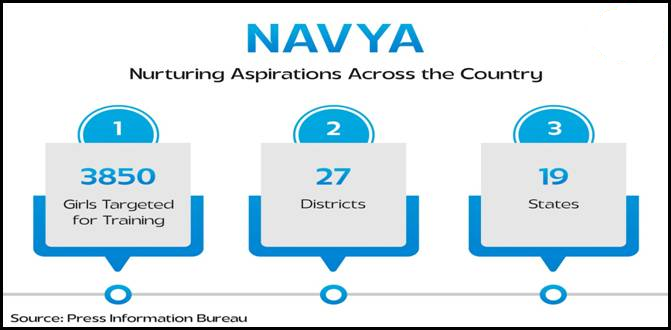
The Government of India launched the NAVYA (Nurturing Aspirations through Vocational Training for Young Adolescent Girls) initiative on June 24, 2025, in Sonbhadra, Uttar Pradesh. It is a joint effort of the Ministry of Skill Development and Entrepreneurship (MSDE) and the Ministry of Women and Child Development (MWCD) to provide skill training to adolescent girls (16–18 years, minimum Class X pass), especially in underserved and tribal regions. The programme will cover 3,850 girls, equipping them with vocational skills for emerging sectors along with training in personal hygiene, communication, workplace safety, financial literacy, and fostering confidence, employability, and entrepreneurship.
Key Objectives
“Navya will be a milestone in making adolescent girls self-reliant. Our shared commitment is to equip girls with skills that enable them to become independent and empowered citizens. This initiative will help them live a life of dignity and confidence.” —- (Mrs. Savitri Thakur, Minister of State for Women and Child Development)
The NAVYA initiative imparts technical skills to young women, thereby enabling them to develop the confidence and resilience needed to thrive in competitive job markets or pursue entrepreneurial ventures. Through this holistic approach, NAVYA ensures that participants are well-prepared to achieve socio-economic independence and contribute meaningfully to their communities. The initiative ensures access to standardised, industry-aligned training and certifications, fostering employability.
Implemented as a pilot across 27 Aspirational and North-Eastern districts in 19 states, and with a target to train 3,850 girls under PMKVY 4.0 the NAVYA initiative aligns with the Prime Minister’s vision of Viksit Bharat@2047.
Some of the key objectives of the initiative include:
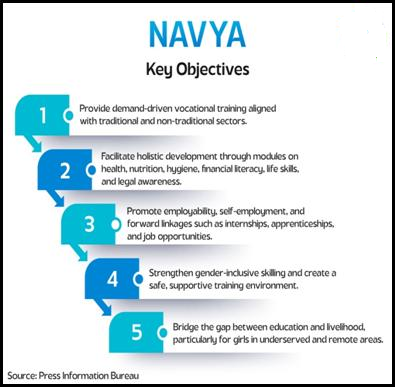
1. Provide demand-driven vocational training aligned with traditional and non-traditional sectors: NAVYA offers tailored training in fields like technology, healthcare, and crafts, blending traditional skills with modern roles like AI and digital marketing. Courses are designed to meet current industry demands, ensuring relevance and employability.
2. Facilitate holistic development through modules on health, nutrition, hygiene, financial literacy, life skills, and legal awareness: NAVYA integrates comprehensive training modules to empower adolescent girls with essential life skills. These include health and nutrition education, financial literacy for economic independence, and legal awareness to navigate rights and protections.
3. Promote employability, self-employment, and forward linkages such as internships, apprenticeships, and job opportunities: The program connects trainees to job markets through internships and apprenticeships in high-demand sectors. It also fosters entrepreneurship by providing resources and mentorship for self-employment ventures.
4. Strengthen gender-inclusive skilling and create a safe, supportive training environment: The initiative prioritises safe, female-friendly training spaces with stipends and flexible schedules. It promotes gender equity by encouraging girls to enter non-traditional, fields like cybersecurity.
Bridge the gap between education and livelihood, particularly for girls in underserved and remote areas: Targeting girls in Aspirational Districts and North-Eastern States, NAVYA links education to sustainable livelihoods. It provides certifications and job placements to overcome socio-economic barriers in remote regions.
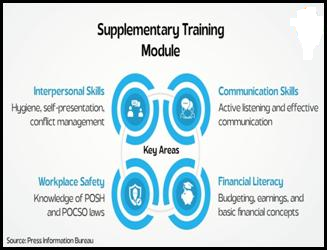
A specially designed 7-hour supplementary training module further enhances the program’s impact, focusing on four critical areas:
Interpersonal Skills: Covering hygiene, self-presentation, and conflict management to build professional demeanour;
Communication Skills: Emphasising active listening and effective communication to enhance workplace interactions;
Workplace Safety: Providing knowledge of the POSH (Prevention of Sexual Harassment) and POCSO (Protection of Children from Sexual Offences) laws to ensure a safe working environment;
Financial Literacy: Teaching budgeting, earnings management, and basic financial concepts to promote economic empowerment.
This comprehensive framework ensures that NAVYA participants are equipped with both technical expertise and essential life skills, positioning them as catalysts in India’s inclusive growth story.
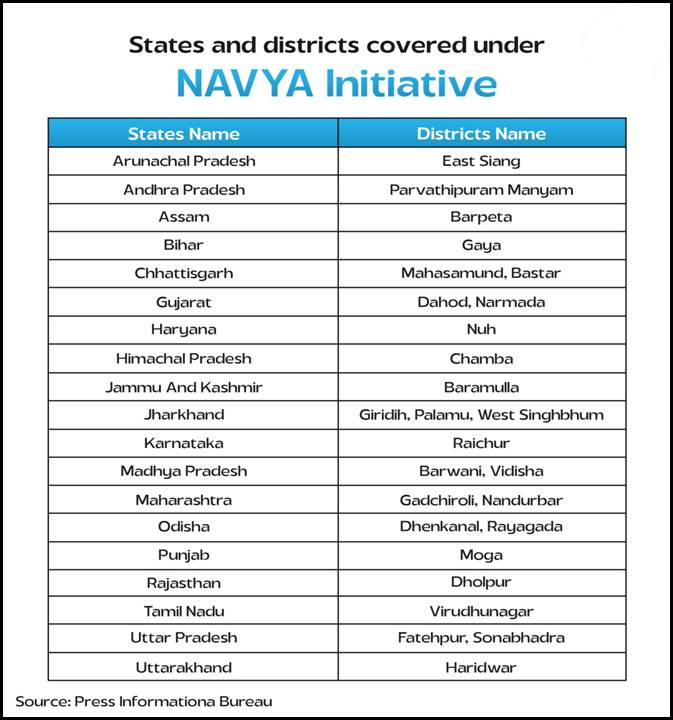
Currently, the initiative is being piloted in 9 districts across 9 states — Maharashtra, Gujarat, Karnataka, Punjab, Uttar Pradesh, Bihar, Madhya Pradesh, Jharkhand, and Himachal Pradesh. These districts have been identified as ’aspirational’ by NITI Aayog.
Conclusion
The NAVYA initiative represents a transformative step toward empowering adolescent girls in India’s Aspirational and North-Eastern districts. Through the integration of vocational training under PMKVY 4.0 with holistic life skills development, NAVYA empowers young women with the tools to attain socio-economic independence and actively contribute to India’s vision of Viksit Bharat@2047. Through its focus on emerging fields like digital marketing and cybersecurity, alongside essential skills such as financial literacy and workplace safety, the initiative bridges the gap between education and sustainable livelihoods. The pilot implementation across nine states demonstrates its potential to create inclusive, gender-equitable opportunities, fostering resilience and entrepreneurial spirit among participants. As NAVYA continues to grow, it serves as a symbol of hope, empowering young girls to become confident, skilled, and self-reliant drivers of India’s inclusive development.
Prelims question:
Q. With reference to the NAVYA initiative recently launched by the Government of India, consider the following statements:
1. It is a joint initiative of the Ministry of Skill Development & Entrepreneurship and the Ministry of Women and Child Development.
2. It is implemented under PMKVY 4.0 with a pilot target of training 3,850 adolescent girls.
3. The initiative focuses only on traditional skill sectors like handicrafts and excludes emerging fields like digital marketing and cybersecurity.
4. It is initially being piloted in aspirational districts identified by NITI Aayog.
Which of the above statements are correct?
(a) 1, 2 and 4 only
(b) 2 and 3 only
(c) 1 and 3 only
(d) 1, 2, 3 and 4
Answer: A
Mains Question:
Q. The NAVYA initiative is a transformative step towards bridging the gap between education and sustainable livelihoods for adolescent girls in India. Discuss its objectives, significance, and potential contribution to the vision of Viksit Bharat@20
(250 words)

- RBI’s Shrinking Real-Rate Cushion Amid Rising Inflation and Strong Demand - September 21, 2026
- India’s NGOs at a New Funding Crossroads - September 21, 2026
- Deep-Sea Discovery, Environmental Responsibility - September 19, 2026

No Comments