


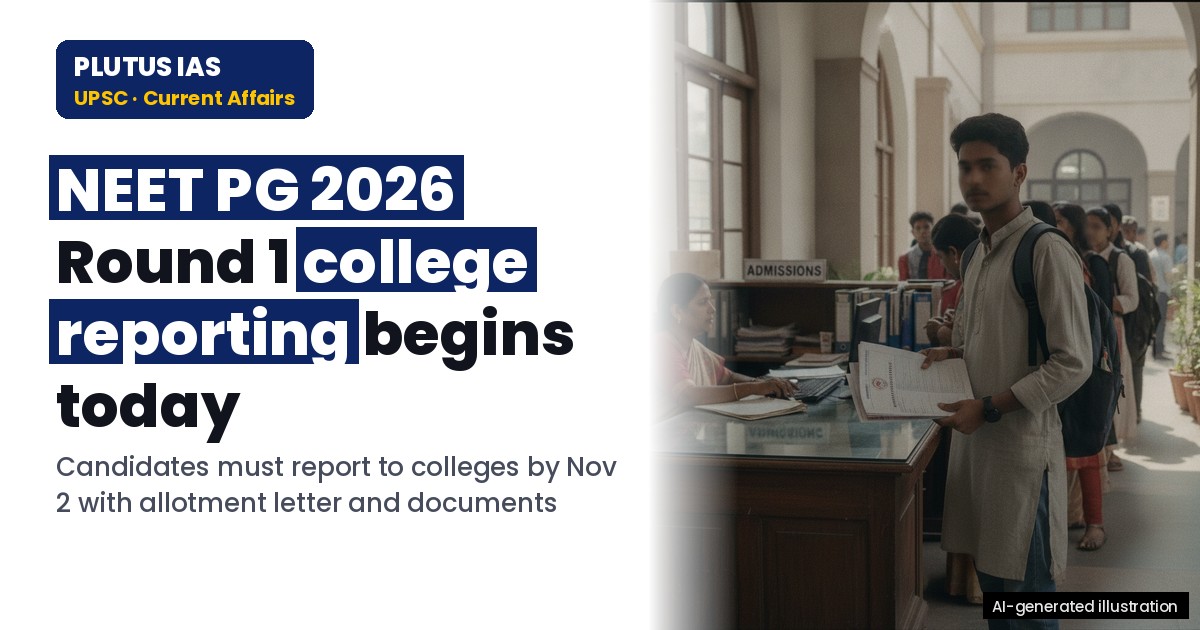
26 Oct NEET PG Counselling 2026: College Reporting Starts Today – Key Documents & Process
✎ NEET-PG Counselling 2026 Round 1 college reporting requires candidates to verify original documents, download the allotment letter from mcc.nic.in, and complete admission by 2 November 2026; failure to report or submit documents…
Subject Relevance — Where This Topic Fits
- GS Paper II — Governance, Transparency and Accountability | GS Paper III — Issues relating to Health, Human Resources and Development
- Prelims: NEET-PG, Medical Council of India (MCI), Medical Counselling Committee (MCC), Counselling rounds, Document verification, Seat allotment, Freeze/Float option, Service bond
- Essay: Ethical dimensions of medical education and admission processes in India, Role of regulatory bodies in ensuring transparency in higher education
Quick Revision: NEET-PG Counselling 2026 Round 1 college reporting requires candidates to verify original documents, download the allotment letter from mcc.nic.in, and complete admission by 2 November 2026; failure to report or submit documents may lead to seat forfeiture.
Why is this in the news?
The Medical Counselling Committee (MCC) has initiated the college reporting phase for candidates allotted seats in the first round of NEET-PG Counselling 2026, commencing on 26 October 2026. This phase is critical as candidates must complete admission formalities by 2 November 2026, failing which their allotted seats may be forfeited. The process underscores the importance of regulatory oversight in medical education admissions, ensuring adherence to procedural transparency and document verification norms.
Background
- NEET-PG (National Eligibility cum Entrance Test for Postgraduate) is a national-level entrance examination conducted annually for admission to MD/MS/PG Diploma courses in medical colleges across India.
- The Medical Counselling Committee (MCC), under the aegis of the Directorate General of Health Services (DGHS), Ministry of Health and Family Welfare, is the nodal authority responsible for conducting NEET-PG counselling.
- NEET-PG counselling is conducted in multiple rounds, including a mop-up round, to fill all available seats in government and private medical colleges.
- The counselling process follows a centralised online system to ensure transparency, reduce malpractices, and streamline seat allocation.
- Document verification is a mandatory step to confirm the eligibility of candidates, including academic qualifications, internship completion, and registration with the National Medical Commission (NMC) or State Medical Councils.
- The Freeze/Float option introduced in recent years allows candidates to either secure their allotted seat or retain the possibility of upgrading to a preferred seat in subsequent rounds.
What is NEET-PG Counselling?
- NEET-PG Counselling is a centralised online process conducted by the MCC for seat allocation in postgraduate medical courses (MD/MS/PG Diploma) based on NEET-PG ranks.
- The counselling process is divided into multiple rounds: Round 1, Round 2, Mop-Up Round, and Stray Vacancy Round, to ensure maximum seat utilisation.
- Candidates who are allotted seats in Round 1 must report to the designated college within the stipulated timeframe to complete admission formalities, including document verification and fee payment.
- The Freeze option allows candidates to accept the allotted seat and complete admission, while the Float option enables them to retain the possibility of upgrading to a higher-preference seat in subsequent rounds.
- Document verification is a critical component of the process, requiring candidates to produce original and photocopies of academic certificates, internship completion proof, registration certificates, and identity documents.
- The MCC publishes seat allotment results online, and candidates must download their allotment letter from the official website (mcc.nic.in) to proceed with college reporting.
- Failure to report to the college or submit required documents may result in the forfeiture of the allotted seat, and the candidate will not be eligible for further rounds of counselling.
Key Features
| Feature | Significance |
|---|---|
| Counselling Rounds | Structured multi-stage process to allocate postgraduate medical seats based on merit and preference, ensuring transparency and optimal utilisation of available seats. |
| Seat Allotment Letter | Official document issued by the Medical Counselling Committee (MCC) confirming the allocation of a specific seat, required for admission and subsequent reporting. |
| Document Verification | Mandatory process where candidates submit original and photocopies of academic, identity, and reservation certificates to validate eligibility for admission. |
| Freeze vs Float Option | Critical decision point where candidates either lock their allotted seat (Freeze) or opt for potential upgrade in subsequent rounds (Float), directly impacting final admission status. |
| Reporting Timeline | Strict deadline (2 November 2026) for candidates to physically report to their allotted colleges, ensuring adherence to the counselling schedule and preventing seat forfeiture. |
Why it Matters
Governance & Transparency
- Ensures a merit-based, transparent allocation of postgraduate medical seats through a centralised counselling mechanism under the aegis of the Medical Counselling Committee (MCC).
- Reduces discretionary practices in admissions by standardising the verification of academic and reservation credentials across institutions.
- Facilitates equitable access to specialised medical education by providing a structured, time-bound process for all eligible candidates.
Institutional Efficiency
- Enables medical colleges to plan resource allocation, faculty deployment, and infrastructure utilisation based on confirmed admissions.
- Streamlines the admission cycle by consolidating multiple counselling rounds into a phased, predictable schedule.
- Minimises administrative bottlenecks by centralising document verification and seat allocation through a single nodal agency (MCC).
Candidate Preparedness
- Empowers candidates to make informed decisions regarding seat acceptance or potential upgrades through the Freeze/Float mechanism.
- Mandates advance preparation of academic and identity documents, reducing last-minute procedural errors during reporting.
- Provides a clear timeline for candidates to secure accommodation, financial arrangements, and travel logistics for college reporting.
Challenges
1. Documentation Discrepancies
- Risk of rejection due to mismatches between submitted documents and original certificates, particularly in cases of name discrepancies, date of birth errors, or incomplete internship records.
- Candidates from diverse educational backgrounds may face challenges in obtaining certified copies of academic transcripts or migration certificates within the stipulated timeline.
UPSC Link: GS Paper 2: Health, Education
2. Geographical Accessibility
- Candidates allotted seats in distant or remote medical colleges may encounter logistical hurdles, including travel costs, accommodation arrangements, and potential delays in reporting.
- Urban-centric seat allocations may exacerbate regional disparities in access to postgraduate medical education, particularly for candidates from rural or underrepresented states.
UPSC Link: GS Paper 2: Governance, Social Justice
3. Financial Constraints
- Candidates from economically weaker sections may struggle to meet incidental expenses such as travel, accommodation, and document attestation fees during the reporting phase.
- Non-refundable counselling fees and potential seat acceptance deposits add to the financial burden, necessitating prior budgetary planning.
UPSC Link: GS Paper 2: Welfare Schemes
4. Seat Upgrade Uncertainty
- Candidates opting for the Float option face uncertainty regarding seat upgrades, which may lead to prolonged anxiety and delayed finalisation of admission plans.
- Institutional constraints, such as limited vacant seats in subsequent rounds, may restrict the feasibility of upgrades despite a candidate’s preference.
UPSC Link: GS Paper 2: Governance
5. Verification Infrastructure
- Overburdened verification systems at medical colleges or nodal agencies may result in delays, particularly during peak reporting periods, affecting candidates’ admission timelines.
- Digital verification mechanisms, while efficient, may exclude candidates lacking access to reliable internet or technical support, especially in rural areas.
UPSC Link: GS Paper 2: E-Governance
Challenges — UPSC Perspective
| Issue | Concern |
|---|---|
| Documentation Errors | Mismatches in academic records or identity proofs may lead to rejection of candidature, necessitating pre-emptive verification. |
| Logistical Delays | Geographical distance between allotted colleges and candidates’ residences may cause reporting delays, risking seat forfeiture. |
| Financial Burden | Incidental costs associated with reporting (travel, accommodation, attestation) may deter candidates from economically weaker backgrounds. |
| Verification Bottlenecks | High volume of candidates during reporting periods may overwhelm institutional verification systems, causing procedural delays. |
| Uncertainty in Upgrades | Candidates opting for Float may face prolonged uncertainty, impacting career planning and financial commitments. |
Way Forward
- Candidates must conduct a pre-emptive audit of all required documents (originals and photocopies) at least 7 days prior to the reporting deadline to identify and rectify discrepancies.
- Institutions and nodal agencies (MCC) should disseminate detailed checklists and FAQs in regional languages to ensure universal accessibility and reduce procedural ambiguities.
- Medical colleges must establish dedicated helplines and grievance redressal mechanisms to address document-related or logistical challenges during the reporting phase.
- State governments and union territories should explore subsidised travel schemes or accommodation partnerships for candidates allotted seats in distant locations.
- Candidates opting for the Float option should maintain financial and logistical flexibility to accommodate potential upgrades or final seat confirmation.
- Digital verification portals should be upgraded to handle high traffic volumes, with provisions for offline submission of documents in case of technical failures.
- Awareness campaigns through medical associations (e.g., IMA) and student bodies should be conducted to educate candidates on the Freeze/Float decision-making process.
UPSC Value Addition
Keywords for Mains Answer-Writing
NEET-PG Counselling 2026 · Medical Counselling Committee (MCC) · Seat Allotment Process · Document Verification · Freeze and Float Options · Medical Education Governance · NEET-PG Admission Process · Healthcare Human Resource Policy · Medical Council of India Act · Postgraduate Medical Education Regulations · Reservation Policy in Medical Admissions · Institutional Reporting for Admissions · Allotment Letter and Admission Documents · Ethical Dimensions of Medical Admission Processes
Concept Flow
NEET-PG Examination → Merit-based ranking of candidates → Centralised counselling by MCC → Seat allocation based on merit and preference → Issuance of Seat Allotment Letter → Document verification at allotted college → Physical reporting within stipulated timeline → Admission confirmation or forfeiture of seat.
Prelims Practice Questions
Q1. Consider the following statements regarding the NEET-PG Counselling process in India:
1. The Medical Counselling Committee (MCC) is responsible for conducting NEET-PG counselling.
2. Candidates who opt for the ‘Freeze’ option cannot participate in subsequent rounds of counselling.
3. The ‘Float’ option allows candidates to retain their current seat while seeking a better one in the next round.
4. Seat allotment is solely based on the candidate’s NEET-PG rank without considering reservation categories.
How many of the above statements are correct?
- Only one
- Only two
- Only three
- All
Answer: Only three — Statements 1, 2, and 3 are correct. Statement 4 is incorrect because seat allotment in NEET-PG counselling is conducted through a centralized process that includes reservation categories as per government norms.
Q2. Assertion (A): The Medical Counselling Committee (MCC) is a statutory body established under the Medical Council of India Act, 1956.
Reason (R): The MCC conducts counselling for undergraduate and postgraduate medical admissions in India, including NEET-PG and NEET-UG.
In the context of the above two statements, which one of the following is correct?
- Both A and R are true, and R is the correct explanation of A
- Both A and R are true, but R is NOT the correct explanation of A
- A is true but R is false
- A is false but R is true
Answer: A is true but R is false — Assertion (A) is false because the MCC is not a statutory body established under the Medical Council of India Act, 1956. It is an advisory body under the Directorate General of Health Services (DGHS), Ministry of Health and Family Welfare. Reason (R) is true as the MCC does conduct counselling for NEET-PG and NEET-UG admissions.
Q3. Match the following options related to NEET-PG Counselling 2026 with their correct descriptions:
Column I (Options) Column II (Descriptions)
A. Seat Allotment Letter 1. Document issued by MCC confirming the candidate’s allocated seat
B. Freeze Option 2. Candidate accepts the allocated seat and does not participate in further rounds
C. Float Option 3. Candidate retains the current seat while seeking a better one in the next round
D. Document Verification 4. Mandatory step to confirm the authenticity of submitted documents at the allotted college
Select the correct match:
- A-1, B-2, C-3, D-4
- A-2, B-1, C-4, D-3
- A-3, B-4, C-1, D-2
- A-4, B-3, C-2, D-1
Answer: A-1, B-2, C-3, D-4 — The correct match is: A-1 (Seat Allotment Letter is issued by MCC confirming the candidate’s allocated seat), B-2 (Freeze Option means the candidate accepts the allocated seat and does not participate in further rounds), C-3 (Float Option means the candidate retains the current seat while seeking a better one in the next round), and D-4 (Document Verification is a mandatory step to confirm the authenticity of submitted documents at the allotted college).
Mains Practice Question
✍ The NEET-PG counselling process, managed by the Medical Counselling Committee (MCC), involves multiple stages including seat allotment, document verification, and institutional reporting. Critically examine the role of the ‘Freeze’ and ‘Float’ options in this process. Also, analyse the ethical and governance implications of these options in ensuring transparency and fairness in medical admissions. (15 Marks)
Approach: MODEL-ANSWER SKELETON:
1. Introduction (2 marks):
– Briefly define NEET-PG counselling and the role of MCC in the postgraduate medical admissions process.
– Mention the significance of the counselling process in ensuring merit-based and equitable admissions.
2. Role of ‘Freeze’ and ‘Float’ Options (6 marks):
– ‘Freeze’ Option:
– Definition: Candidate accepts the allocated seat and withdraws from further rounds.
– Purpose: Provides stability to the counselling process by reducing last-minute vacancies.
– Governance Angle: Ensures finality in seat allocation, reducing administrative burden on MCC.
– ‘Float’ Option:
– Definition: Candidate retains the current seat while seeking a better one in subsequent rounds.
– Purpose: Allows candidates to improve their seat allocation based on merit or preference.
– Governance Angle: Introduces flexibility but may lead to vacancies in earlier rounds, requiring careful management.
3. Ethical and Governance Implications (5 marks):
– Transparency: Discuss how the options ensure transparency in the allocation process.
– Fairness: Analyse whether the options lead to equitable outcomes for all candidates, including reserved categories.
– Administrative Challenges: Highlight issues such as last-minute withdrawals, seat vacancies, and the role of MCC in managing these.
– Ethical Dimensions: Discuss the pressure on candidates to make informed decisions and the potential for exploitation by coaching institutes.
4. Conclusion (2 marks):
– Summarise the importance of the ‘Freeze’ and ‘Float’ options in balancing flexibility and stability in the counselling process.
– Emphasise the need for continuous monitoring and improvements in the counselling mechanism to uphold the principles of meritocracy and equity in medical education.
Source: amarujala.com
Generated by AanyaAi for educational purpose.
Related guides on our sites
- Best PSIR optional coaching for upsc
- Best PSIR optional teacher for upsc
- Best teacher of PSIR optional for upsc
- Best PSIR optional coaching in delhi for UPSC

- NEET PG Counselling 2026: College Reporting Starts Today – Key Documents & Process - October 26, 2026
- सीओपी31: जलवायु शिक्षा से कार्रवाई तक का भारत का प्रयास - October 26, 2026
- Northeast Monsoon 2026: Unpredictability & El Niño Impact for UPSC - October 26, 2026

No Comments