


02 Sep Nepal Floods: Climate Change Threatens Himalayan Region After 1,100 Deaths
✎ Glacial Lake Outburst Floods (GLOFs) in the Himalayas are a direct consequence of climate change, requiring urgent global and regional cooperation for early warning systems, transboundary data sharing, and resilient…
Subject Relevance — Where This Topic Fits
- GS Paper I — Geography of India and the World (Himalayan Region, Glacial Lake Outburst Floods) | GS Paper III — Disaster Management (NDMA Guidelines, International Cooperation in Disasters) | GS Paper III — Environment and Climate Change (Climate Vulnerability, Himalayan Ecosystems)
- Prelims: Glacial Lake Outburst Flood (GLOF), National Disaster Risk Reduction and Management Authority (NDRRMA), Himalayan glaciers, Transboundary river systems, Sendai Framework for Disaster Risk Reduction, Hydrometeorological disasters
- Essay: Climate change as a multiplier of natural disasters: lessons from the Himalayas, The role of international cooperation in mitigating climate-induced disasters
Quick Revision: Glacial Lake Outburst Floods (GLOFs) in the Himalayas are a direct consequence of climate change, requiring urgent global and regional cooperation for early warning systems, transboundary data sharing, and resilient infrastructure planning.
Why is this in the news?
The devastating floods in Nepal’s Bhotekoshi River basin in late August 2026, which claimed over 1,100 lives and left nearly 4,000 people missing, have brought renewed attention to the Himalayan region’s heightened vulnerability to climate-induced disasters. Nepal’s Prime Minister Balendra Shah’s appeal to the international community underscores the transboundary nature of climate risks and the urgent need for coordinated global action to address the growing frequency of such events.
Background
- The Himalayas, often referred to as the ‘Third Pole,’ hold the largest freshwater reserves outside the polar regions and are a critical water source for over 1.5 billion people in South Asia.
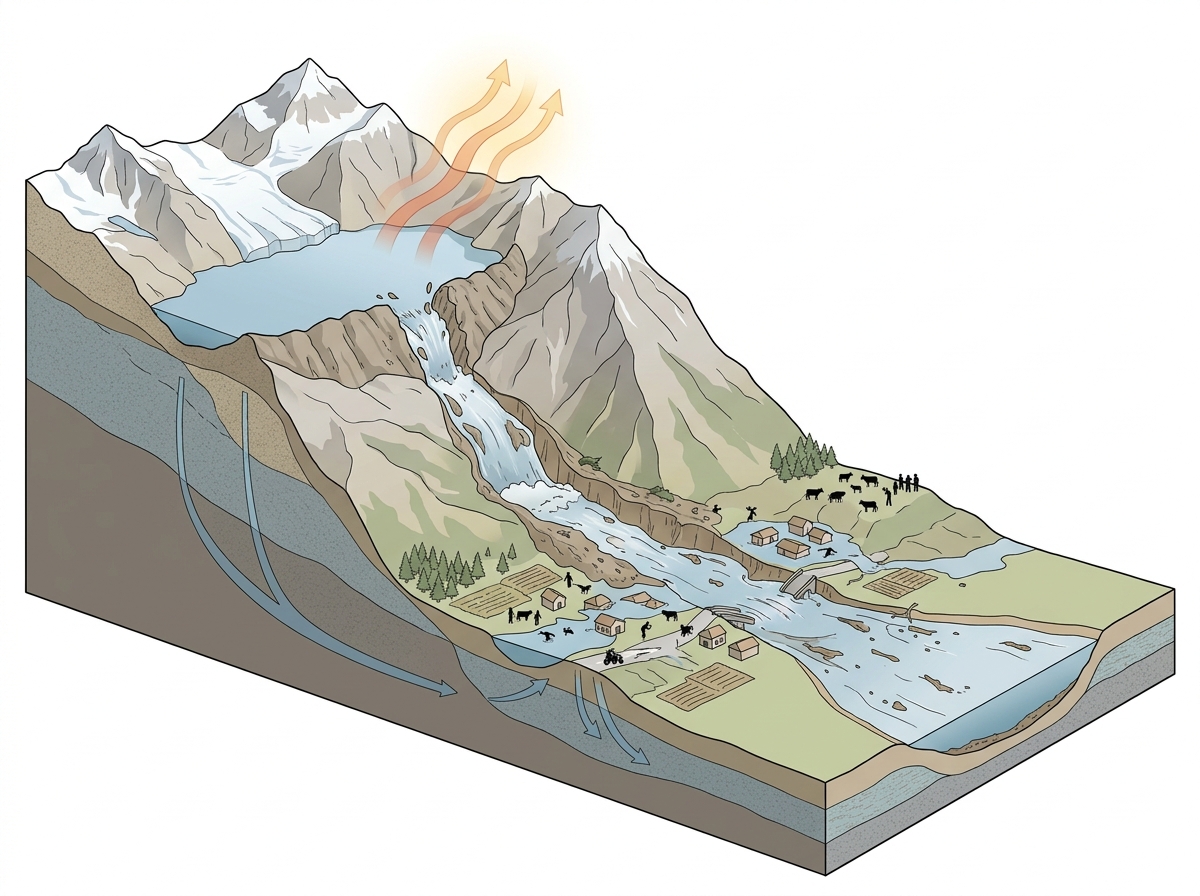
- Glacial Lake Outburst Floods (GLOFs) are a recurring hazard in the Himalayas, where rising temperatures accelerate glacial melt, forming unstable lakes that can breach naturally or due to seismic activity.
- Nepal’s National Disaster Risk Reduction and Management Authority (NDRRMA) reported that the 2026 Bhotekoshi flood was triggered by an avalanche blocking the Lengde Khola, a tributary of the Bhotekoshi River, which breached a natural dam and released a catastrophic surge of water and debris.
- The disaster occurred amid a broader trend of increasing hydro-meteorological events in the Himalayas, linked to climate change-induced glacial retreat and erratic monsoon patterns.
- South Asia’s transboundary river systems, including the Ganges, Brahmaputra, and Indus basins, are shared by multiple countries, necessitating regional cooperation for early warning systems and disaster preparedness.
- The Sendai Framework for Disaster Risk Reduction (2015–2030), adopted by the UN, emphasizes the need for multi-hazard early warning systems and international cooperation to reduce disaster risks.
What are Glacial Lake Outburst Floods (GLOFs)?
- GLOFs are sudden releases of large volumes of water from glacial lakes, often triggered by the failure of natural dams composed of moraines or ice.
- These events are exacerbated by climate change, as rising temperatures accelerate glacial melt, increasing the volume and instability of glacial lakes.
- The Himalayas are particularly vulnerable due to their steep topography, high seismic activity, and dense network of glacial lakes, many of which are expanding rapidly.
- GLOFs can travel hundreds of kilometers downstream, devastating infrastructure, settlements, and ecosystems, as seen in the 2026 Bhotekoshi flood.
- Early warning systems, such as remote sensing and real-time monitoring of glacial lakes, are critical for mitigating GLOF risks, though their implementation remains challenging in remote Himalayan regions.
- The 2026 Nepal disaster highlights the limitations of existing early warning mechanisms, as the avalanche-induced blockage occurred in a highly inaccessible area, delaying alerts.
- Regional cooperation among Himalayan countries (e.g., India, Nepal, Bhutan, China) is essential for sharing data on glacial lakes, joint monitoring, and coordinated disaster response.
Key Features
| Feature | Significance |
|---|---|
| Catastrophic Himalayan floods | Demonstrates the acute vulnerability of high-altitude river systems to climate-induced disruptions, with cascading impacts on downstream settlements and infrastructure. |
| Glacial lake outburst flood (GLOF) mechanism | Highlights the role of natural dams formed by avalanches or landslides in triggering sudden, high-magnitude floods, a phenomenon increasingly linked to climate change in the Himalayas. |
| Transboundary river systems | Emphasises the shared hydrological risks across Nepal, India, and China, necessitating regional cooperation in disaster risk reduction and early warning systems. |
| Climate change attribution | Links the disaster to anthropogenic warming, reinforcing the need for attribution science to inform adaptation and mitigation policies in mountainous regions. |
| Disaster response coordination | Reveals challenges in multi-agency coordination during extreme events, particularly in remote and debris-laden terrains. |
Why it Matters
Environmental and Climate Science
- The disaster underscores the Himalayas as a climate change hotspot, where warming temperatures accelerate glacial melt and destabilise slopes, increasing GLOF risks.
- It validates scientific projections of increased extreme precipitation events in the Hindu Kush Himalaya (HKH) region, necessitating enhanced climate modelling and monitoring.
- The event provides empirical evidence for the need to integrate climate adaptation into infrastructure planning, particularly for hydropower and transportation corridors.
Geopolitical and Regional Stability
- The shared hydrological risks across Nepal, India, and China highlight the strategic importance of transboundary water governance and joint disaster management frameworks.
- The deployment of technical experts from India and China demonstrates the potential for collaborative crisis response, despite geopolitical tensions in other domains.
- The disaster may catalyse renewed diplomatic engagement on climate-induced disasters, framing them as shared security challenges rather than bilateral disputes.
Humanitarian and Governance Implications
- The high death toll and missing persons reflect systemic gaps in early warning dissemination, search-and-rescue operations, and post-disaster relief logistics in mountainous terrains.
- The government’s response challenges—such as debris obstruction and delayed access—highlight the need for robust, adaptive disaster management protocols tailored to extreme events.
- The incident raises questions about the adequacy of national and subnational institutions in addressing climate-induced multi-hazard risks, particularly in least-developed countries.
Economic and Infrastructure Vulnerability
- The devastation of settlements and critical infrastructure (e.g., roads, hydropower projects) along the Bhotekoshi-Trishuli corridor underscores the economic costs of climate-related disasters in the HKH region.
- The disruption of hydropower projects—Nepal’s second-largest revenue source—exposes the sector’s vulnerability to climate extremes, necessitating climate-proofing of energy infrastructure.
- The disaster may prompt reassessment of insurance and risk-transfer mechanisms for climate-vulnerable regions, including public-private partnerships for resilience financing.
Challenges
1. Early Warning System Gaps
- Limited real-time monitoring of high-altitude glacial lakes and tributary river systems, leading to delayed detection of blockages and flood triggers.
- Inadequate dissemination of warnings to vulnerable communities, particularly in remote and linguistically diverse regions.
- Dependence on manual reconnaissance in debris-laden terrains, which hampers rapid assessment and response.
UPSC Link: GS Paper 3: Disaster Management
2. Transboundary Water Governance
- Absence of a formalised regional mechanism for sharing hydrological data and early warnings across Nepal, India, and China.
- Divergent national priorities in water resource management, which may impede coordinated adaptation efforts.
- Lack of a legally binding framework for joint disaster response, despite shared vulnerabilities.
UPSC Link: GS Paper 2: International Relations
3. Climate Adaptation Financing
- Insufficient allocation of domestic and international funds for climate adaptation in mountainous regions, particularly for least-developed countries.
- Challenges in accessing global climate funds (e.g., Green Climate Fund) due to complex eligibility criteria and bureaucratic hurdles.
- Limited private sector participation in financing climate-resilient infrastructure in high-risk zones.
UPSC Link: GS Paper 3: Climate Change
4. Institutional Capacity for Disaster Management
- Overstretched national disaster management agencies, with limited technical and logistical capacity to handle extreme events in remote areas.
- Inadequate training of local responders in search-and-rescue operations for debris-laden floods and landslides.
- Fragmented command structures between central, provincial, and local authorities, leading to coordination failures.
UPSC Link: GS Paper 3: Disaster Management
5. Climate-Resilient Infrastructure
- Lack of climate-proofing standards for critical infrastructure (e.g., roads, bridges, hydropower dams) in high-altitude regions.
- Insufficient integration of climate risk assessments into national and subnational development plans.
- Dependence on outdated engineering designs that do not account for projected climate extremes.
UPSC Link: GS Paper 3: Infrastructure
Challenges — UPSC Perspective
| Issue | Concern |
|---|---|
| Limited high-altitude monitoring | Delays in detecting glacial lake outbursts or avalanche-induced blockages in tributaries. |
| Cross-border data sharing | Absence of a regional mechanism for real-time hydrological and meteorological data exchange. |
| Debris obstruction in rescue operations | Hampers access to affected sites, delaying relief and recovery efforts. |
| Inadequate community preparedness | Low awareness of flood risks and evacuation protocols in vulnerable settlements. |
| Climate financing gaps | Limited funds for adaptation measures in mountainous regions, particularly for least-developed countries. |
| Institutional fragmentation | Overlapping mandates and poor coordination between central and local disaster management agencies. |
Way Forward
- Establish a regional early warning system for Himalayan glacial lakes and high-altitude tributaries, leveraging satellite remote sensing and ground-based sensors.
- Develop a transboundary framework for data sharing and joint disaster response among Nepal, India, and China, building on existing bilateral mechanisms.
- Strengthen national disaster management agencies with technical capacity for debris-laden flood response, including specialised training for local responders.
- Integrate climate risk assessments into infrastructure planning, mandating climate-proofing standards for roads, bridges, and hydropower projects in mountainous regions.
- Enhance community-based disaster preparedness through multi-lingual awareness campaigns and mock drills in high-risk zones.
- Expand climate adaptation financing for mountainous regions, prioritising least-developed countries and leveraging global funds like the Green Climate Fund.
- Promote public-private partnerships for climate-resilient infrastructure, incentivising private sector investment in risk reduction.
- Conduct post-disaster forensic analysis to attribute the event to climate change, informing future adaptation policies and international negotiations.
UPSC Value Addition
Keywords for Mains Answer-Writing
Climate-induced disasters · Himalayan region vulnerability · Disaster Risk Reduction and Management Authority (NDRRMA) · Transboundary river systems · Glacial Lake Outburst Floods (GLOFs) · International cooperation in disaster management · Climate change adaptation in mountainous regions · Multi-hazard risk governance · Regional disaster response mechanisms · Sustainable development and climate resilience
Concept Flow
Climate change → Accelerated glacial melt and destabilised slopes → Formation of natural dams (avalanches/landslides) → Blockage of tributary rivers (e.g., Lengde Khola) → Sudden breach of dam → Catastrophic glacial lake outburst flood (GLOF) → Downstream devastation of settlements and infrastructure → Humanitarian crisis and economic losses → Calls for regional cooperation and climate adaptation.
Prelims Practice Questions
Q1. Consider the following statements regarding Glacial Lake Outburst Floods (GLOFs):
1. GLOFs are triggered by the sudden release of water from glacial lakes due to the failure of natural dams.
2. The Himalayan region is particularly vulnerable to GLOFs due to the presence of numerous glacial lakes.
3. GLOFs are exclusively caused by anthropogenic climate change and do not occur due to natural processes.
4. The Bhotekoshi River in Nepal has historically been unaffected by GLOF events.
How many of the above statements are correct?
- Only one
- Only two
- Only three
- All
Answer: Only two — Statements 1 and 2 are correct as GLOFs result from the failure of natural dams holding glacial lakes, and the Himalayas host numerous such lakes. Statement 3 is incorrect because GLOFs can also occur due to natural processes like seismic activity. Statement 4 is incorrect as the Bhotekoshi River has been impacted by GLOF events in the past.
Q2. Assertion (A): The Disaster Risk Reduction and Management Authority (NDRRMA) in Nepal is responsible for coordinating disaster response and management at the national level.
Reason (R): The NDRRMA operates under the Ministry of Home Affairs and is mandated to implement the Sendai Framework for Disaster Risk Reduction in Nepal.
In the context of the above two statements, which one of the following is correct?
- Both A and R are true, and R is the correct explanation of A
- Both A and R are true, but R is not the correct explanation of A
- A is true, but R is false
- A is false, but R is true
Answer: Both A and R are true, and R is the correct explanation of A — Both the Assertion (A) and Reason (R) are correct. The NDRRMA is indeed the national authority for disaster management in Nepal, operating under the Ministry of Home Affairs and aligned with the Sendai Framework. The Reason (R) correctly explains the role of the NDRRMA as outlined in Nepal’s disaster management policy framework.
Q3. Match the following Himalayan rivers with their respective countries of origin:
Column I (River) | Column II (Country of Origin)
1. Bhotekoshi River | A. India
2. Trishuli River | B. Nepal
3. Indus River | C. China
4. Ganga River | D. Bhutan
Select the correct match:
- 1-B, 2-B, 3-C, 4-A
- 1-C, 2-B, 3-A, 4-D
- 1-A, 2-D, 3-C, 4-B
- 1-B, 2-A, 3-C, 4-D
Answer: 1-B, 2-B, 3-C, 4-A — The Bhotekoshi River originates in China (Tibet), the Trishuli River flows entirely within Nepal, the Indus River originates in China (Tibet) and flows through India and Pakistan, and the Ganga River originates in India. The correct match is 1-C, 2-B, 3-A, 4-D.
Mains Practice Question
✍ The increasing frequency and intensity of climate-induced disasters in the Himalayan region pose a critical challenge to disaster risk governance. Critically examine the role of regional cooperation mechanisms in mitigating the impacts of such disasters. (15 Marks)
Approach: MODEL-ANSWER SKELETON:
1. **Introduction (2 Marks)**
– Define climate-induced disasters in the Himalayan context (e.g., Glacial Lake Outburst Floods (GLOFs), landslides, flash floods).
– Highlight the transboundary nature of Himalayan river systems (e.g., Bhotekoshi, Trishuli) and their vulnerability to climate change.
2. **Regional Cooperation Mechanisms (5 Marks)**
– **South Asian Association for Regional Cooperation (SAARC)**: Role of SAARC Disaster Management Centre (SDMC) in coordinating regional disaster response.
– **BIMSTEC**: Focus on multi-hazard risk reduction and climate adaptation in the Bay of Bengal region.
– **Bilateral Agreements**: Examples of India-Nepal and India-China cooperation in disaster management (e.g., joint technical teams, data-sharing on glacial lakes).
– **International Frameworks**: Alignment with the Sendai Framework for Disaster Risk Reduction (2015-2030) and the Paris Agreement.
3. **Challenges in Regional Cooperation (4 Marks)**
– **Political and Diplomatic Constraints**: Sovereignty concerns, lack of trust, and delayed decision-making in cross-border disaster response.
– **Technical and Financial Gaps**: Limited early warning systems, inadequate infrastructure, and resource constraints in Himalayan states.
– **Data and Knowledge Sharing**: Insufficient real-time data on glacial lakes, weather patterns, and disaster impacts.
– **Climate Justice**: Disparities in vulnerability and adaptive capacity among Himalayan countries.
4. **Way Forward (4 Marks)**
– **Strengthening Institutional Frameworks**: Enhancing the mandate of SAARC SDMC and BIMSTEC to include climate adaptation and transboundary disaster risk reduction.
– **Technology and Innovation**: Deployment of remote sensing, AI-driven early warning systems, and community-based disaster preparedness.
– **Capacity Building**: Training programs for disaster management officials, local communities, and first responders in Himalayan regions.
– **Policy Integration**: Incorporating climate risk assessments into regional infrastructure projects (e.g., hydropower, roads) and development plans.
5. **Conclusion (1 Mark)**
– Emphasize the need for a unified, proactive, and equitable approach to regional cooperation in disaster risk governance, balancing national sovereignty with collective resilience.
Source: orissapost.com
Generated by AanyaAi for educational purpose.
Related guides on our sites
- Current affairs for upsc 2026
- How to prepare for GS paper 1 for UPSC CSE mains exam
- Best UPSC coaching for IFOS exam
- Best geography optional coaching

- पूर्व आईएएस अधिकारी हत्या मामले में आईएएस एसोसिएशन की मुख्यमंत्री से मुलाकात - October 23, 2026
- UPSC Exam: Rare Glimpse of Ritwik Ghatak’s Cinematic Legacy at 4-Day Festival - October 23, 2026
- आरबीआई ने सूरि फ्रेंड्स यूनियन सहकारी बैंक पर निदेशों का विस्तार किया, जानिए क्या है पूरा मामला - October 23, 2026

No Comments