


14 May New Tariff War Brews Between Major Economies: India vs US
This article covers “Daily Current Affairs” and the Topic. India’s First Trade Retaliation Against Trump-Era Tariffs Targets US Exports
SYLLABUS MAPPING:
GS- 3- Economic- New Tariff War Brews Between Major Economies: India vs US
FOR PRELIMS
What is a tariff? Explain how recent tariff actions have affected India’s trade with the U.S.
FOR MAINS
Why did India complain to the WTO about U.S. tariffs? What are the possible outcomes of such a step?
Why in the News?
India has formally notified the World Trade Organisation (WTO) of its decision to suspend trade concessions granted to the United States, in response to the US safeguard duties on steel, aluminium, and related products. The move comes as part of India’s plan to impose retaliatory import duties on select US goods, potentially effective from early June 2025. According to the think tank Global Trade Research Initiative (GTRI), this step could strain ongoing trade negotiations between the two countries unless the US agrees to consultations or withdraws the tariffs. The retaliatory duties aim to counter the adverse impact of US tariffs on Indian exports of steel and aluminium.
What is a tariff?
A tariff is a tax imposed by a government on imported or exported goods. It is mainly used to protect domestic industries by making foreign products more expensive. Tariffs can also generate revenue for the government. They are of different types, such as ad valorem (percentage-based) and specific (fixed amount per unit). Tariffs may lead to higher prices for consumers and can affect international trade relations. For example, imposing a tariff on imported steel can make local steel more competitive.
USA Tariff Policy on India
1. Digital Services Tax (DST) and Section 301 Investigation: The U.S. initiated a Section 301 investigation against India’s digital services tax (DST), which targets revenue from large foreign tech companies like Google and Amazon. The U.S. argued that it unfairly discriminates against American businesses.
2. Impact on Agricultural Products: The U.S. has pushed for India to lower its tariffs on agricultural products, including high-value items like almonds, apples, and wines, which face high import duties in India. India has resisted lowering these tariffs, leading to ongoing trade tensions.
3. Increased Scrutiny on Trade Deficits: The U.S. has consistently raised concerns over India’s trade surplus with the U.S., which exceeds $45 billion, and has used tariffs as leverage to demand market access for U.S. exports like agricultural goods and medical devices.
4. Bilateral Trade Negotiations and Phase 1 Agreement: While the U.S. and India have been engaged in talks to resolve tariff issues, the Phase 1 trade agreement reached in early 2020 did not provide a comprehensive solution.
5. WTO Dispute Settlement: The U.S. has repeatedly brought India to the WTO over trade issues like tariff hikes, subsidies, and market access. India has won some cases but remains under pressure to align its trade policies with global norms, especially in the context of the ongoing tariff dispute.
6. Tariff Impact on India’s Exports: The U.S. tariffs, especially on steel and aluminium, have had a significant impact on India’s export industries. The tariffs have increased the cost of Indian goods in the U.S. market, potentially reducing India’s export competitiveness.
7. Biden Administration’s Approach: While the Biden administration has not significantly altered the tariff policy, there have been indications of a more diplomatic approach to resolving trade issues with India. However, strategic priorities such as trade in critical sectors (e.g., semiconductors, defence) are likely to influence future tariff decisions.
India’s retaliation against the U.S tariff
| Aspect | Details |
|---|---|
| Key Retaliatory Actions | – Imposition of tariffs on U.S. goods (motorcycles, wine, aluminium, steel, agricultural products) |
| – WTO dispute against U.S. tariffs on steel and aluminium (Section 232) | |
| – Defence of India’s Digital Services Tax (DST) against U.S. claims | |
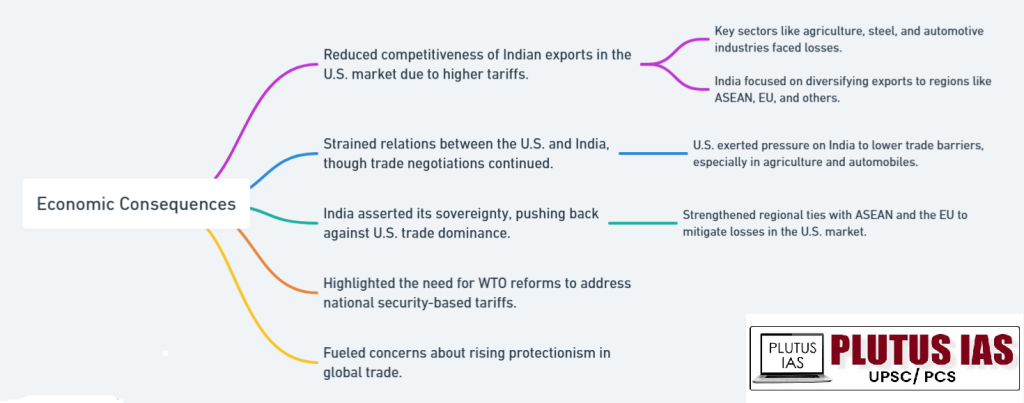
| Economic Impact | – Increased export costs for Indian goods to the U.S., reducing competitiveness in key sectors |
| – Focus on diversifying export markets to regions like ASEAN, EU, and others | |
| Diplomatic Consequences | – Strained U.S.-India relations, with trade talks continuing despite tensions |
| – U.S. pressure for trade liberalisation in the agriculture and automobile sectors | |
| Geopolitical Implications | – Push for asserting trade sovereignty and promoting a balanced trade framework with the U.S. |
| Global Trade Impact | – Calls for WTO reforms to address national security tariffs and unilateral trade actions |
| – Potential reconsideration of U.S. trade policy toward emerging markets like India |
Consequences of India’s retaliation
Impacts on the India-USA relationship
1. Strained Diplomatic Ties: Tariff disputes and retaliatory measures led to tensions, challenging overall bilateral relations.
2. Trade Imbalances: The U.S. raised concerns over India’s trade surplus, with both countries at odds over tariffs and market access.
3. Ongoing Trade Talks: Despite tensions, both nations continue negotiations for potential Free Trade Agreements (FTAs) and the resolution of trade issues.
4. Strategic Partnership: Strong cooperation remains in defence, counter-terrorism, and regional security, despite trade disputes.
5. Digital Trade Issues: India’s Digital Services Tax (DST) caused friction, especially with U.S. tech companies, though discussions continue.
6. Domestic and Political Pressures: Political pressures in both countries shape trade policy decisions, with India seeking to protect domestic industries.
7. Future Collaboration Potential: Opportunities for comprehensive trade deals and global trade reforms remain if both sides address core issues.
Way to navigate tariff Challenges
1. Strengthen Bilateral Trade Talks: Continue regular dialogues to resolve tariff disputes and enhance mutual understanding. Constructive engagement can prevent escalation and foster long-term solutions.
2. Pursue Free Trade Agreements (FTAs): Negotiating FTAs can reduce tariff barriers and ensure stable market access. A comprehensive U.S.-India FTA would benefit key sectors on both sides.
3. Diversify Export Markets: Reducing reliance on the U.S. by expanding trade with ASEAN, EU, and others is vital. It helps buffer against external shocks and geopolitical trade risks.
4. Use WTO Mechanisms: Utilise WTO dispute settlement to challenge unjustified tariffs like Section 232. This ensures trade conflicts are addressed through a rules-based system.
5. Reform Domestic Tariffs: Rationalizing high import duties can ease global pressure and improve competitiveness. It may also encourage reciprocal tariff reductions by trade partners.
6. Boost Export Competitiveness: Invest in quality, innovation, and value addition to offset higher tariffs abroad. Competitive pricing and global standards enhance market sustainability.
7. Engage in Digital Trade Frameworks: Cooperate on digital tax norms, e-commerce, and data sharing protocols. This reduces friction in a growing area of bilateral trade interest.
8. Promote Strategic Diplomacy: Align trade issues with broader strategic and security cooperation. Strong geopolitical ties can soften trade tensions and open dialogue channels.
Conclusion
The recent escalation in tariff-related tensions between India and the United States underscores the complex interplay of trade, diplomacy, and strategic interests. While the U.S. tariffs on Indian steel and aluminium and India’s retaliatory measures have strained trade relations, both nations continue to engage in dialogue, reflecting the resilience of their broader partnership. Strategic cooperation in defence, technology, and geopolitics remains largely unaffected, highlighting the depth of bilateral ties. To navigate these challenges, both countries must pursue a balanced approach, resolving disputes through WTO mechanisms, exploring Free Trade Agreements, and aligning trade policies with long-term strategic goals. Diversifying markets, reforming domestic tariffs, and fostering competitiveness will also be key for India.
Download Plutus IAS Current Affairs (Eng) 14th May 2025
Prelims Questions
Q. With reference to recent developments in India-U.S. trade relations, consider the following statements:
1. The U.S. imposed tariffs on Indian steel and aluminium under Section 301 of the Trade Act.
2. India has imposed retaliatory tariffs on selected U.S. agricultural and industrial products.
3. The Digital Services Tax (DST) imposed by India was a key reason for the U.S. initiating trade investigations.
Which of the above statements is/are correct?
A. 1 and 2 only
B. 2 and 3 only
C. 1 and 3 only
D. 1, 2, and 3
Answer: B
Mains Questions
Q. Discuss the recent tariff tensions between India and the United States, highlighting their impact on bilateral trade relations. What are the possible strategies India can adopt to mitigate such challenges and ensure stable economic ties?
(250 words, 15 marks)

- RBI’s Shrinking Real-Rate Cushion Amid Rising Inflation and Strong Demand - September 21, 2026
- India’s NGOs at a New Funding Crossroads - September 21, 2026
- Deep-Sea Discovery, Environmental Responsibility - September 19, 2026

No Comments