


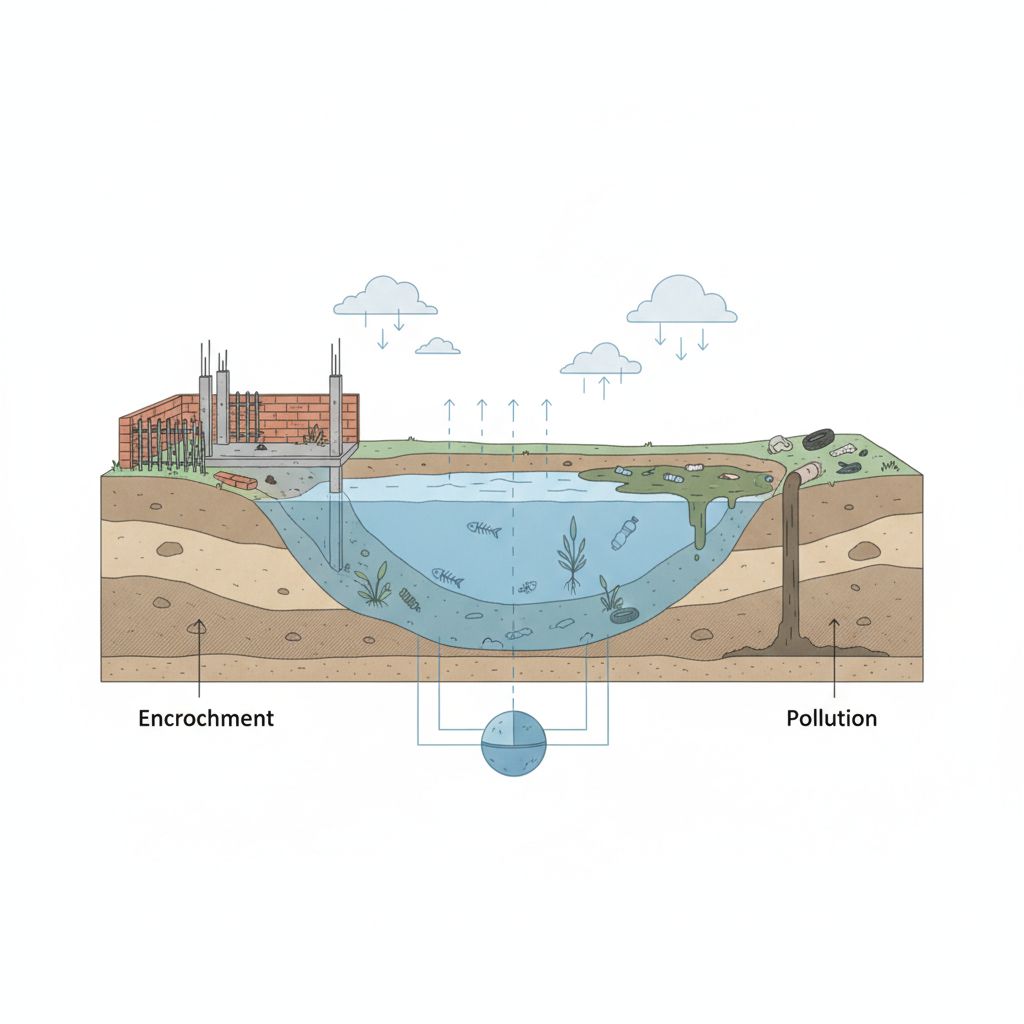
22 Sep NGT Orders Probe into Agra’s Encroached & Polluted Water Bodies in 10 Weeks
✎ The National Green Tribunal (NGT) is empowered under the National Green Tribunal Act, 2010, to adjudicate environmental disputes and enforce compliance with pollution control laws, including directives for the restoration of…
Subject Relevance — Where This Topic Fits
- GS Paper II — Governance, Transparency and Accountability | GS Paper III — Environment and Pollution Control | GS Paper III — Conservation, Environmental Pollution and Degradation
- Prelims: National Green Tribunal (NGT), Water (Prevention and Control of Pollution) Act, 1974, Environmental Impact Assessment (EIA), Water bodies (lakes, ponds, wetlands), Encroachment on public land, Pollution Control Boards
- Essay: Environmental governance and judicial activism in India, Balancing urbanisation and ecological preservation
Quick Revision: The National Green Tribunal (NGT) is empowered under the National Green Tribunal Act, 2010, to adjudicate environmental disputes and enforce compliance with pollution control laws, including directives for the restoration of encroached water bodies.
Why is this in the news?
The National Green Tribunal (NGT) has directed the constitution of a joint committee to investigate encroachment and pollution in water bodies across Agra district, including ponds, lakes, and reservoirs, within a stipulated period of ten weeks. This directive follows a public interest litigation (PIL) seeking the restoration and conservation of these water bodies, highlighting systemic failures in enforcement of environmental laws and land-use regulations. The order underscores the Tribunal’s proactive role in environmental governance and the need for inter-departmental coordination in addressing ecological degradation.
Background
- Water bodies such as ponds, lakes, and wetlands are critical components of the hydrological cycle and serve as vital ecological habitats, groundwater recharge zones, and flood mitigation systems.
- Urbanisation, industrialisation, and unplanned development have led to widespread encroachment on water bodies across India, resulting in loss of biodiversity, reduced water retention capacity, and increased pollution.
- The Water (Prevention and Control of Pollution) Act, 1974, empowers State Pollution Control Boards to monitor and regulate water pollution, while the Environment Protection Act, 1986, provides a legal framework for environmental conservation.
- The National Green Tribunal (NGT), established under the National Green Tribunal Act, 2010, has jurisdiction over matters related to environmental protection, conservation of forests, and enforcement of environmental laws.
- Agra, a city of historical and cultural significance, faces severe environmental challenges due to rapid urban expansion, industrial activity, and inadequate waste management infrastructure.
- Public interest litigations (PILs) have emerged as a significant tool for environmental justice, enabling citizens to seek judicial intervention in cases of environmental degradation and regulatory failures.
What is the National Green Tribunal (NGT)?
- The NGT is a specialised judicial body established under the National Green Tribunal Act, 2010, to adjudicate disputes related to environmental protection, conservation of forests, and enforcement of environmental laws.
- It has original jurisdiction over matters involving substantial questions relating to the environment, including pollution control, hazardous waste management, and ecological restoration.
- The Tribunal comprises a Chairperson, judicial members, and expert members with domain knowledge in environmental science and law.
- NGT’s orders are binding and enforceable, with penalties for non-compliance, including fines and directions for remediation.
- The Tribunal operates through zonal benches across India, ensuring decentralised adjudication and accessibility to litigants.
- NGT plays a pivotal role in environmental governance by directing government agencies, industries, and local bodies to comply with environmental norms and undertake corrective measures.
- The Tribunal’s jurisdiction extends to inter-state disputes and matters referred by the Supreme Court or High Courts under Article 226 or 32 of the Constitution.
- NGT’s functioning is guided by principles of sustainable development, polluter pays, and precautionary approach, ensuring a balanced approach to environmental protection and economic development.
Key Features
| Feature | Significance |
|---|---|
| National Green Tribunal (NGT) directive | Provides a quasi-judicial mechanism for environmental governance, ensuring compliance with environmental laws through suo motu or petition-based interventions. |
| Joint Committee formation | Ensures multi-stakeholder assessment by including representatives from the State Pollution Control Board, Environment Department, Town and Country Planning (TTCP), and District Magistrate, enhancing accountability. |
| Satellite imagery and GPS-based documentation | Facilitates objective verification of encroachments and pollution sources, reducing subjectivity in assessment. |
| 10-week timeline for report submission | Balances urgency with thoroughness, allowing time for field surveys, data collation, and analysis while maintaining pressure for compliance. |
| Revenue records verification | Ensures legal clarity on land ownership and encroachment status, aiding in delineation of protected water bodies. |
Why it Matters
Environmental Governance
- Demonstrates the NGT’s role as a critical institution for enforcing environmental safeguards under the Water (Prevention and Control of Pollution) Act, 1974, and the Environment (Protection) Act, 1986.
- Highlights the intersection of urbanisation and ecological degradation, necessitating proactive measures to preserve urban commons like water bodies.
- Reinforces the principle of ‘polluter pays’ by mandating pollution source identification and remediation.
Urban Planning and Land Use
- Exposes systemic gaps in land-use planning, where encroachments on water bodies persist despite legal protections under the Water Bodies (Prevention of Misuse and Encroachment) Act, 2023 (Uttar Pradesh).
- Underscores the need for integrated planning between municipal bodies, revenue departments, and environmental agencies to prevent ad-hoc development.
Public Interest Litigation (PIL) Mechanism
- Illustrates the efficacy of PIL as a tool for environmental justice, enabling citizens to seek judicial intervention for ecological preservation.
- Showcases the role of evidence-based advocacy in environmental litigation, where satellite data and revenue records strengthen legal arguments.
Challenges
1. Encroachment on Water Bodies
- Urban expansion and unplanned development lead to illegal occupation of water bodies, reducing their ecological and hydrological functions.
- Lack of stringent enforcement of existing laws, such as the Uttar Pradesh Water Bodies Act, 2023, exacerbates the issue.
- Revenue records often do not reflect ground realities, enabling encroachments to persist undetected.
UPSC Link: GS-III: Environmental Pollution & Degradation
2. Pollution from Domestic and Industrial Sources
- Discharge of untreated sewage and solid waste into water bodies degrades water quality, posing health risks and disrupting aquatic ecosystems.
- Absence of adequate sewage treatment infrastructure in peri-urban and rural areas exacerbates pollution.
- Monitoring and enforcement mechanisms for water quality standards remain weak.
UPSC Link: GS-III: Environmental Pollution & Degradation
3. Institutional Coordination Gaps
- Fragmented responsibilities among multiple agencies (e.g., local bodies, pollution control boards, revenue departments) hinder effective management.
- Lack of real-time data sharing and joint monitoring mechanisms delays corrective action.
- District-level agencies often lack technical and financial capacity for comprehensive water body restoration.
UPSC Link: GS-II: Government Policies & Interventions
4. Legal and Bureaucratic Delays
- Protracted legal processes and administrative inertia delay the implementation of restoration measures.
- Inadequate penalties for encroachments and pollution deter compliance with environmental laws.
UPSC Link: GS-II: Judiciary & Governance
Challenges — UPSC Perspective
| Issue | Concern |
|---|---|
| Encroachment by residential and commercial structures | Loss of water storage capacity, disruption of groundwater recharge, and increased flood risk. |
| Discharge of untreated sewage and solid waste | Eutrophication, spread of water-borne diseases, and degradation of aquatic biodiversity. |
| Lack of updated land records | Inability to accurately demarcate protected water bodies, leading to legal ambiguities. |
| Weak enforcement of environmental laws | Perpetuation of illegal activities due to inadequate monitoring and penalties. |
| Limited public awareness and participation | Absence of community-driven conservation efforts, reducing long-term sustainability. |
Way Forward
- Constitute a district-level task force comprising all relevant agencies to oversee the implementation of the NGT’s directives and ensure periodic reviews.
- Undertake GIS-based mapping of all water bodies in Agra to create a dynamic inventory for real-time monitoring and enforcement.
- Strengthen sewage treatment infrastructure in peri-urban and rural areas through public-private partnerships and central/state funding schemes.
- Implement strict penalties for encroachments and pollution, including fines, demolition of illegal structures, and mandatory restoration of degraded water bodies.
- Launch awareness campaigns involving local communities, schools, and NGOs to promote the conservation of water bodies and report violations.
- Integrate water body conservation into urban planning frameworks, such as the Smart Cities Mission and Atal Mission for Rejuvenation and Urban Transformation (AMRUT).
- Ensure timely submission of the joint committee’s report to the NGT and follow up with actionable timelines for remediation.
- Explore the use of remote sensing and drone technology for continuous monitoring of water bodies and encroachment detection.
UPSC Value Addition
Keywords for Mains Answer-Writing
National Green Tribunal (NGT) · Water bodies conservation · Encroachment of water bodies · Pollution of water bodies · Environmental governance · Water (Prevention and Control of Pollution) Act, 1974 · Environment Protection Act, 1986 · Jal Shakti Abhiyan · Sustainable Development Goals (SDG) 6 · Judicial activism in environmental governance · Joint committee for environmental assessment · Agra water bodies · Urban water pollution · Groundwater depletion and water body degradation
Constitutional & Policy Linkages
- [‘Article 48A’, ‘DPSP: Protection and improvement of environment’]
- [‘Article 51A(g)’, ‘Fundamental Duty: Protection of environment’]
Concept Flow
Urbanisation and unplanned development → Encroachment on water bodies and discharge of untreated waste → Degradation of water quality and loss of ecological functions → Public interest litigation (PIL) filed before NGT → NGT directs multi-agency joint committee for investigation → Committee submits report identifying encroachments and pollution sources → NGT mandates restoration and remediation within stipulated timeline → Implementation of corrective measures by district administration and relevant agencies.
Prelims Practice Questions
Q1. Consider the following statements regarding the National Green Tribunal (NGT):
1. The NGT was established under the National Green Tribunal Act, 2010.
2. It has jurisdiction over all civil cases involving substantial questions relating to the environment.
3. The NGT can impose penalties for violations of environmental laws but cannot award compensation for environmental damage.
4. The Tribunal consists of a Chairperson, Judicial Members, and Expert Members.
How many of the above statements are correct?
- Only one
- Only two
- Only three
- All
Answer: Only three — Statements 1, 2, and 4 are correct. The NGT was established under the National Green Tribunal Act, 2010, and has jurisdiction over civil cases involving substantial environmental questions. It consists of a Chairperson, Judicial Members, and Expert Members. However, the NGT can award compensation for environmental damage, making statement 3 incorrect.
Q2. Assertion (A): The National Green Tribunal (NGT) has been empowered to enforce the provisions of the Water (Prevention and Control of Pollution) Act, 1974.
Reason (R): The NGT derives its authority to adjudicate environmental disputes from the Environment Protection Act, 1986, which includes water pollution as a key concern.
In the context of the above two statements, which one of the following is correct?
- Both A and R are true, and R is the correct explanation of A.
- Both A and R are true, but R is not the correct explanation of A.
- A is true, but R is false.
- A is false, but R is true.
Answer: A is true, but R is false. — Both Assertion (A) and Reason (R) are true. The NGT is empowered to enforce the Water (Prevention and Control of Pollution) Act, 1974, among other environmental laws. However, the NGT’s authority is derived from the National Green Tribunal Act, 2010, not directly from the Environment Protection Act, 1986, making R an incorrect explanation of A.
Q3. Match the following environmental laws with their respective years of enactment:
LIST I (Environmental Law)
A. Water (Prevention and Control of Pollution) Act
B. Environment Protection Act
C. National Green Tribunal Act
D. Forest Conservation Act
LIST II (Year of Enactment)
1. 1986
2. 1980
3. 2010
4. 1974
- A-4, B-1, C-3, D-2
- A-1, B-4, C-2, D-3
- A-2, B-3, C-1, D-4
- A-3, B-2, C-4, D-1
Answer: A-4, B-1, C-3, D-2 — The correct match is: A-4 (Water (Prevention and Control of Pollution) Act, 1974), B-1 (Environment Protection Act, 1986), C-3 (National Green Tribunal Act, 2010), D-2 (Forest Conservation Act, 1980).
Mains Practice Question
✍ The National Green Tribunal (NGT) has recently directed the constitution of a joint committee to investigate encroachment and pollution of water bodies in Agra within a stipulated timeframe. In this context, critically examine the role of the NGT in environmental governance in India. Also, discuss the legal and institutional challenges faced by the NGT in ensuring effective environmental justice. (15 Marks)
Approach: MODEL-ANSWER SKELETON:
1. **Introduction (2 marks)**
– Brief overview of the NGT: establishment under the National Green Tribunal Act, 2010, and its mandate to adjudicate environmental disputes.
– Mention the recent Agra water bodies case as a contemporary example of NGT’s proactive role.
2. **Role of NGT in Environmental Governance (5 marks)**
– **Adjudicatory Function**: NGT’s jurisdiction over civil cases involving substantial environmental questions (e.g., pollution, encroachment, biodiversity loss).
– **Preventive and Remedial Measures**: Power to issue directions, impose penalties, and award compensation for environmental damage (e.g., closure of polluting industries, restoration of water bodies).
– **Expeditious Disposal**: Emphasis on time-bound resolution of cases (e.g., 6-month deadline for disposal of cases).
– **Multi-Disciplinary Approach**: Composition includes judicial members, expert members, and environmental scientists for informed decision-making.
– **Judicial Activism**: Use of suo motu powers and suo motu cognizance to address environmental issues proactively (e.g., suo motu case on Delhi air pollution).
3. **Legal and Institutional Challenges (5 marks)**
– **Jurisdictional Limitations**: Overlapping jurisdictions with other courts (e.g., High Courts, Supreme Court) and lack of clarity in certain environmental matters.
– **Enforcement Gaps**: Challenges in implementing NGT orders due to lack of executive cooperation, political interference, and resource constraints.
– **Expertise and Capacity**: Limited technical expertise within the NGT to assess complex environmental issues (e.g., groundwater depletion, ecological impact assessments).
– **Lack of Appellate Authority**: NGT’s orders can be challenged in the Supreme Court, leading to delays in justice delivery.
– **Public Participation**: Inadequate mechanisms for involving local communities and stakeholders in environmental decision-making processes.
4. **Conclusion and Way Forward (3 marks)**
– **Strengthening NGT**: Recommendations such as increasing the number of benches, enhancing technical capacity, and ensuring executive compliance with NGT orders.
– **Collaborative Governance**: Emphasize the need for inter-institutional coordination between NGT, state pollution control boards, and local bodies for effective environmental governance.
– **Empowering Local Institutions**: Strengthening the role of Gram Panchayats and urban local bodies in monitoring and protecting local water bodies.
**Balanced View**: Highlight both the strengths of NGT (e.g., suo motu powers, time-bound disposal) and its limitations (e.g., enforcement challenges, jurisdictional ambiguities).
Source: amarujala.com
Generated by AanyaAi for educational purpose.
Related guides on our sites
- Current affairs for upsc 2026
- Best PSIR optional coaching for upsc
- Best economics optional coaching for upsc
- Best PSIR optional teacher for upsc

- NGT Orders Probe into Agra’s Encroached & Polluted Water Bodies in 10 Weeks - September 22, 2026
- यूएनजीए 2026: युद्ध, एआई और सुधार – दुनिया के नेता क्या करेंगे? (UPSC दृष्टिकोण) - September 22, 2026
- 40 दिन बाद भी संसद सत्र अनिर्णीत, महिला आरक्षण विधेयक पर सरकार की तैयारी - September 22, 2026

No Comments