


09 Sep NHRC Takes Suo Motu Cognizance of Dangerous Bridge for School Children in Chhattisgarh
✎ The NHRC’s suo motu cognisance of the incomplete bridge case underscores the constitutional duty of the state to ensure the right to life (Article 21) and the right to education (RTE Act, 2009), while highlighting systemic gaps…
Subject Relevance — Where This Topic Fits
- GS Paper II — Governance, Constitution, Polity, Social Justice and International Relations (Human Rights) | GS Paper III — Infrastructure, Development and Inclusive Growth
- Prelims: NHRC, suo motu cognisance, Article 21, Right to Education (RTE) Act 2009, Pradhan Mantri Gram Sadak Yojana (PMGSY), National Rural Infrastructure Development Agency (NRIDA), State Human Rights Commissions (SHRCs), Right to Life under Constitution of India
- Essay: Infrastructure as a public good: Balancing development, equity, and human rights, The role of constitutional bodies in safeguarding citizens’ rights in a federal polity
Quick Revision: The NHRC’s suo motu cognisance of the incomplete bridge case underscores the constitutional duty of the state to ensure the right to life (Article 21) and the right to education (RTE Act, 2009), while highlighting systemic gaps in public infrastructure delivery under PMGSY.
Why is this in the news?
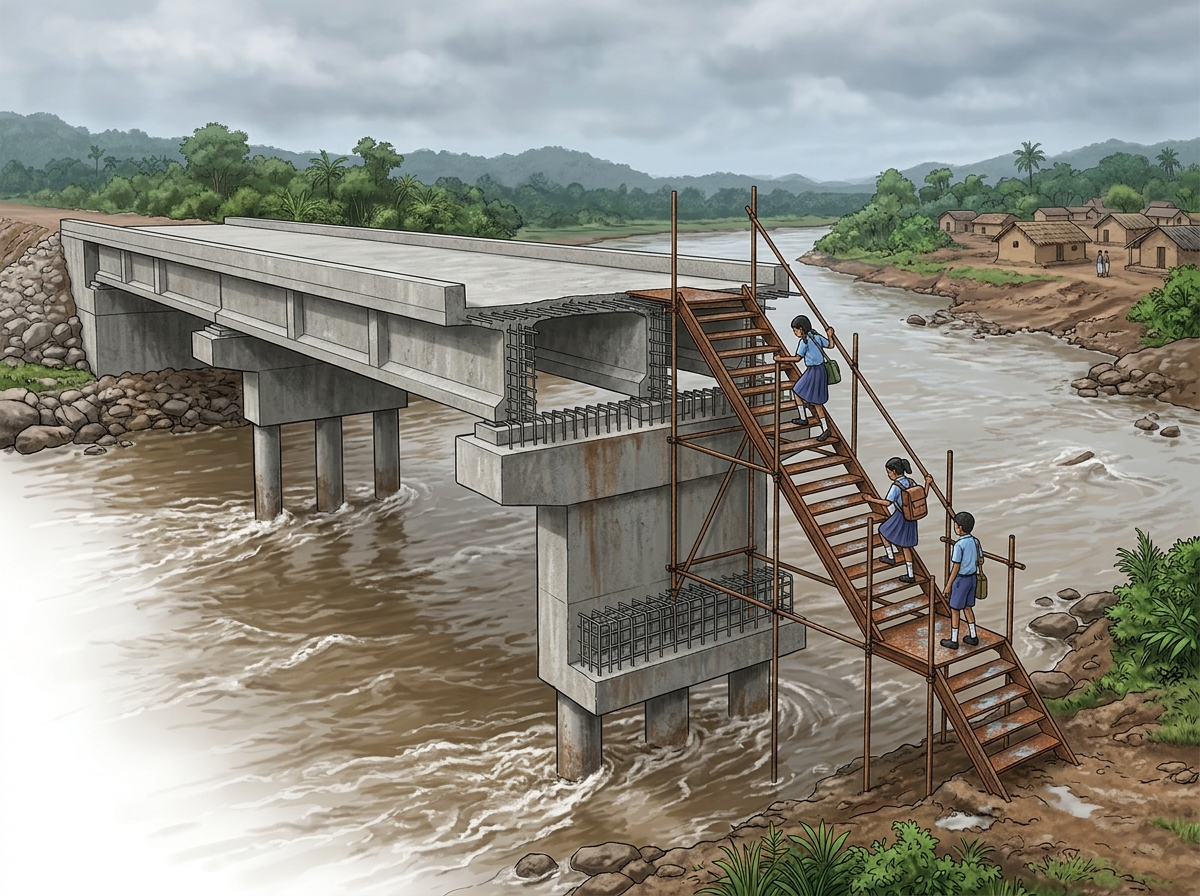
The National Human Rights Commission (NHRC) has taken suo motu cognisance of media reports alleging that children in Mainpur Block, Gariyaband district, Chhattisgarh, are compelled to traverse an incomplete bridge using narrow, slippery iron staircases to cross the Pairi River en route to school, exposing them to grave safety risks, particularly during the monsoon season. The Commission has issued a notice to the Chief Secretary of Chhattisgarh, seeking a detailed report within two weeks to assess the veracity of the claims and the adequacy of remedial measures.
Background
- The incomplete bridge, approximately 300 metres long, has been under construction for six years between Deherguda and Khambhatha villages in Mainpur Block, Gariyaband district, Chhattisgarh.
- Local authorities had previously assured villagers of completion within six months, a deadline that has not been met despite repeated assurances.
- The Pairi River, though shallow, becomes torrential during the monsoon, exacerbating the hazards faced by children crossing via the makeshift stairway.
- The Right to Education (RTE) Act, 2009, guarantees free and compulsory education to children aged 6–14 years and mandates safe access to educational institutions.
- The Pradhan Mantri Gram Sadak Yojana (PMGSY) aims to provide all-weather road connectivity to unconnected habitations, including bridges over rivers and streams.
- The NHRC’s suo motu powers are derived from the Protection of Human Rights Act, 1993, enabling it to act on media reports or suo motu cognisance of human rights violations.
What is the National Human Rights Commission (NHRC)?
- The NHRC is a statutory body established under the Protection of Human Rights Act, 1993, to protect and promote human rights in India as enshrined in the Constitution and international covenants.
- It is composed of a Chairperson (a former Chief Justice of India) and four members, including a serving or retired judge of the Supreme Court or High Court, and two members with knowledge or practical experience in human rights.
- The NHRC has the power to inquire into complaints of human rights violations, either on its own motion (suo motu) or upon petitions, and can recommend relief, compensation, or initiate proceedings for prosecution or disciplinary action.
- The Commission’s jurisdiction extends to matters involving the violation of human rights by public servants, including negligence by state authorities, and it can intervene in cases of child rights violations, including those affecting access to education.
- The NHRC operates within the constitutional framework of federalism and respects the autonomy of State Human Rights Commissions (SHRCs), which function at the state level.
- The NHRC’s recommendations are advisory in nature but carry significant moral and institutional weight, often prompting corrective action by the executive or judiciary.
- The Commission’s suo motu powers are a critical tool for addressing systemic or widespread human rights concerns, particularly where vulnerable groups such as children are at risk.
- The NHRC’s mandate includes the promotion of human rights awareness and the formulation of guidelines for the protection of human rights by the government and civil society.
Key Features
| Feature | Significance |
|---|---|
| Incomplete Bridge Construction | Prolonged construction over six years without completion, leading to unsafe access routes for children. |
| Hazardous Pedestrian Access | Use of narrow, slippery iron staircases on the incomplete bridge to cross the Pari River, posing high risk of accidents. |
| Seasonal River Behavior | The Pari River becomes turbulent during monsoon, exacerbating risks for children crossing during flood conditions. |
| NHRC Suo Motu Action | National Human Rights Commission’s intervention under Section 12(1)(i) of the Protection of Human Rights Act, 1993, to investigate alleged rights violations. |
| Government Accountability | Chief Secretary of Chhattisgarh directed to submit a detailed report within two weeks, ensuring institutional responsibility. |
Why it Matters
Human Rights and Child Safety
- The case underscores the right to safe and dignified access to education under Article 21A of the Constitution and the UN Convention on the Rights of the Child.
- Exposure of vulnerable children to life-threatening conditions violates their fundamental right to life and personal liberty.
- Highlights systemic failures in infrastructure planning and implementation for marginalized communities.
Public Health and Safety
- Risk of accidents and injuries due to unstable and slippery access routes, particularly during monsoon.
- Potential psychological trauma and stress on children and parents due to daily exposure to hazardous conditions.
Governance and Administrative Efficiency
- Delays in infrastructure projects reflect poor project management, monitoring, and accountability mechanisms.
- Failure to meet public assurances (e.g., six-month completion timeline) erodes trust in government commitments.
Challenges
1. Infrastructure Project Delays
- Prolonged construction timelines without tangible progress, indicating inefficiencies in project execution.
- Lack of transparent timelines and accountability in public infrastructure projects.
UPSC Link: GS-II: Governance, Transparency
2. Rural Connectivity Gaps
- Inadequate transportation infrastructure in tribal and remote areas, hindering access to essential services like education.
- Geographical challenges (e.g., river crossings) exacerbate connectivity issues in hilly or riverine regions.
UPSC Link: GS-I: Rural Development
3. Safety of Vulnerable Groups
- Children, as a vulnerable demographic, face disproportionate risks due to inadequate safety measures.
- Absence of child-friendly infrastructure in rural areas, despite legal obligations under child rights frameworks.
UPSC Link: GS-II: Social Justice
4. Institutional Responsiveness
- Delayed intervention by statutory bodies (e.g., NHRC) despite repeated media reports and public grievances.
- Lack of proactive monitoring by local authorities to address infrastructure gaps in a timely manner.
UPSC Link: GS-II: Constitutional Bodies
5. Resource Allocation and Prioritization
- Competing demands for limited public resources may lead to prioritization of urban over rural infrastructure.
- Inadequate budgetary allocations for maintenance and completion of ongoing projects.
UPSC Link: GS-III: Economic Development
Challenges — UPSC Perspective
| Issue | Concern |
|---|---|
| Project Delays | Prolonged construction without completion, violating public trust and safety. |
| Hazardous Access Routes | Use of unsafe staircases and river crossings for children, risking life and limb. |
| Seasonal Vulnerabilities | Monsoon-induced river turbulence exacerbates risks during critical periods. |
| Accountability Gaps | Absence of timely corrective action despite repeated assurances and reports. |
| Resource Constraints | Insufficient allocation of funds and manpower for rural infrastructure completion. |
Way Forward
- Direct the concerned district administration to expedite the completion of the bridge with strict timelines and penalties for delays.
- Conduct a joint inspection by NHRC, Public Works Department, and local authorities to assess safety risks and immediate remedial measures.
- Implement temporary safety measures such as temporary bridges or ferry services during monsoon to ensure safe passage for children.
- Establish a multi-stakeholder monitoring committee to oversee the project’s progress and address grievances proactively.
- Undertake a district-wide audit of incomplete infrastructure projects to identify systemic bottlenecks and prioritize completion.
- Strengthen grievance redressal mechanisms at the local level to ensure timely resolution of public concerns.
- Incorporate child safety audits in all rural infrastructure projects to preempt risks to vulnerable groups.
UPSC Value Addition
Keywords for Mains Answer-Writing
National Human Rights Commission (NHRC) · Right to Education (RTE) Act, 2009 · Right to Life and Personal Liberty (Article 21) · Infrastructure deficit in rural India · Public accountability mechanisms · Social sector governance failures · Judicial activism in human rights · Sustainable Development Goals (SDG) 4 and 10 · Gram Panchayat and local governance · Judicial review and suo motu cognisance · Public health and safety risks · Constitutional remedies for human rights violations · Role of media in highlighting human rights issues · Inter-state riverine challenges in infrastructure development
Constitutional & Policy Linkages
- [‘Article 21A’, ‘Right to Education’]
- [‘Article 21’, ‘Right to Life and Personal Liberty’]
- [‘Article 39(f)’, ‘Children’s rights to development and protection’]
- [‘Article 41’, ‘Right to public assistance in cases of disability’]
Concept Flow
Inadequate rural infrastructure (e.g., incomplete bridge) leads to unsafe access routes for children. → Children forced to use hazardous staircases and river crossings to reach schools. → Exposure to life-threatening conditions during monsoon exacerbates risks. → Media reports highlight the issue, prompting NHRC’s suo motu intervention. → NHRC directs the state government to submit a detailed report, ensuring institutional accountability. → Long-term solution requires completion of the bridge and systemic reforms in project execution.
Prelims Practice Questions
Q1. Consider the following statements regarding the National Human Rights Commission (NHRC):
1. NHRC is a constitutional body established under Article 338 of the Constitution of India.
2. The Chairperson of NHRC must be a retired Chief Justice of India.
3. NHRC can take suo motu cognisance of human rights violations.
4. NHRC has the power to enforce its recommendations through judicial orders.
How many of the above statements are correct?
- Only one
- Only two
- Only three
- All
Answer: Only three — Statements 2 and 3 are correct. NHRC is a statutory body established under the Protection of Human Rights Act, 1993 (not a constitutional body under Article 338). The Chairperson must be a retired Chief Justice of India. NHRC can take suo motu cognisance of human rights violations. NHRC does not have the power to enforce its recommendations through judicial orders; it can only recommend actions to the government.
Q2. Assertion (A): The Right to Education (RTE) Act, 2009 guarantees free and compulsory education to all children aged 6 to 14 years.
Reason (R): The RTE Act mandates that the state shall provide infrastructure and resources to ensure the effective implementation of the right to education.
- Both A and R are true, and R is the correct explanation of A
- Both A and R are true, but R is NOT the correct explanation of A
- A is true, but R is false
- A is false, but R is true
Answer: A is true, but R is false — Assertion (A) is true: the RTE Act guarantees free and compulsory education to all children aged 6 to 14 years. Reason (R) is also true: the Act mandates state responsibility for infrastructure and resources. However, R is not the correct explanation of A, as A is a legal guarantee while R is a policy directive.
Q3. Match the following constitutional provisions with their correct descriptions:
Column I (Provision) | Column II (Description)
— | —
1. Article 21 | A. Right to Constitutional Remedies
2. Article 32 | B. Protection of Life and Personal Liberty
3. Article 19 | C. Protection of certain rights regarding freedom of speech etc.
4. Article 14 | D. Equality before law
Select the correct match:
- 1-B, 2-A, 3-C, 4-D
- 1-A, 2-B, 3-D, 4-C
- 1-D, 2-C, 3-B, 4-A
- 1-C, 2-D, 3-A, 4-B
Answer: 1-B, 2-A, 3-C, 4-D — Article 21 protects the right to life and personal liberty. Article 32 provides the right to constitutional remedies. Article 19 guarantees protection of certain rights regarding freedom of speech, etc. Article 14 ensures equality before the law.
Mains Practice Question
✍ The failure to complete critical rural infrastructure projects, such as bridges, undermines the constitutional guarantee of the Right to Education (RTE) Act, 2009, and poses a direct threat to the Right to Life and Personal Liberty under Article 21 of the Constitution. Critically examine this proposition with reference to the recent suo motu cognisance taken by the National Human Rights Commission (NHRC) in the case of an incomplete bridge in Chhattisgarh’s Gariyaband district. Also, outline the constitutional and statutory mechanisms available to citizens to address such governance failures. (15 Marks)
Approach: A full answer must cover the following dimensions:
1. **Constitutional Guarantees**:
– Article 21 (Right to Life and Personal Liberty) and its judicial interpretation (e.g., Unnikrishnan v. State of Andhra Pradesh, 1993; Mohini Jain v. State of Karnataka, 1992) to include the right to education and safety.
– Article 21A (Right to Education) and the RTE Act, 2009, which mandates free and compulsory education and requires the state to ensure safe access to schools.
2. **Governance Failure**:
– The case of the incomplete bridge in Chhattisgarh: suo motu cognisance by NHRC, media reports, and the six-year delay in completion despite assurances.
– The role of Gram Panchayats, state agencies, and the Ministry of Rural Development in infrastructure development.
– The intersection of public health, safety, and education rights.
3. **NHRC and suo motu cognisance**:
– Powers of NHRC under the Protection of Human Rights Act, 1993 (Section 12).
– The significance of suo motu cognisance in addressing human rights violations without formal complaints.
– Limitations of NHRC recommendations (no coercive powers).
4. **Constitutional and Statutory Mechanisms for Citizens**:
– **Writs**: Article 32 (Supreme Court) and Article 226 (High Courts) for enforcement of fundamental rights.
– **Public Interest Litigation (PIL)**: Judicial activism in addressing governance failures (e.g., Bandhua Mukti Morcha v. Union of India, 1984).
– **Right to Information (RTI) Act, 2005**: For accessing information on project delays and governance lapses.
– **Gram Sabha and Panchayati Raj Institutions**: Role in monitoring and ensuring accountability in rural infrastructure projects.
5. **Balancing Views and Way Forward**:
– Arguments for judicial activism in ensuring accountability vs. concerns about judicial overreach.
– The need for multi-stakeholder coordination (Centre, State, local bodies) and time-bound completion of projects.
– Role of the media in highlighting such issues and driving public discourse.
6. **SDG Linkages**:
– Sustainable Development Goals (SDG) 4 (Quality Education) and SDG 10 (Reduced Inequalities) and their relevance to the case.
**Structure**:
– Introduction: Contextualise the issue with the NHRC case.
– Body: Divide into the above four sub-heads with sub-points.
– Conclusion: Summarise the constitutional obligations and suggest measures for accountability and timely completion of projects.
Source: PIB (Press Information Bureau)
Chhattisgarh PCS (CGPSC) — State PCS Practice
Prelims: Recently, the National Human Rights Commission (NHRC) took suo motu cognizance of alleged safety risks faced by school children in Mainpur block of which district in Chhattisgarh due to an incomplete bridge?
- A. Raipur
- B. Durg
- C. Gariyaband
- D. Bilaspur
Answer: C. Gariyaband — The NHRC intervened after reports highlighted children crossing a river via an incomplete bridge in Mainpur block, Gariyaband district, exposing them to safety hazards.
Mains: Analyze the socio-economic and infrastructural challenges faced by tribal and rural communities in Chhattisgarh due to incomplete or missing bridges in remote areas. Suggest measures to ensure safe access to education and essential services for children in such regions.
Generated by AanyaAi for educational purpose.
Related guides on our sites
- Current affairs for upsc 2026
- Best PSIR optional coaching for upsc
- Best PSIR optional teacher for upsc
- Best teacher of PSIR optional for upsc

- Gurugram’s groundwater extraction exceeds limit by 212%; HC seeks ban - October 4, 2026
- स्वतंत्रता सेनानी श्यामजी कृष्ण वर्मा की जन्म जयंती पर पीएम का श्रद्धांजलि - October 4, 2026
- KWML’s Feasibility Reports for Water Metro in 18 Cities: UPSC & PCS Insights - October 3, 2026

No Comments