


16 Jul NHRC Takes Suo Motu Cognizance of Sewer Cleaner’s Death in Noida
Subject Relevance — Where This Topic Fits
- GS Paper I — Social Issues (Poverty and Developmental issues, Urbanization, their problems and their remedies) | GS Paper II — Governance, Constitution, Polity, Social Justice (Welfare schemes for vulnerable sections, mechanisms, laws, institutions and Bodies constituted for the protection and betterment of these vulnerable sections) | GS Paper III — Environment (Pollution and Degradation) | GS Paper IV — Ethics, Integrity, and Aptitude (Human Values, Ethics in Public Administration)
- Prelims: National Human Rights Commission (NHRC), Manual Scavenging, Prohibition of Employment as Manual Scavengers and their Rehabilitation Act, 2013, Hazardous Cleaning, Swachh Bharat Abhiyan, Constitutional Rights (Article 21, 23, 42, 47), Safai Karamchari Andolan, Environmental Justice, Occupational Safety, Judicial Activism
- Essay: The Paradox of Progress: Development, Dignity, and the Plight of the Marginalized, Human Rights as the Bedrock of a Just Society: Examining State’s Role and Responsibilities
Quick Revision: The NHRC’s suo motu cognizance of a sanitation worker’s death highlights the persistent challenge of manual scavenging and the critical need for strict enforcement of laws, mechanization, and dignified rehabilitation to uphold human rights and dignity.
Why is this in the news?
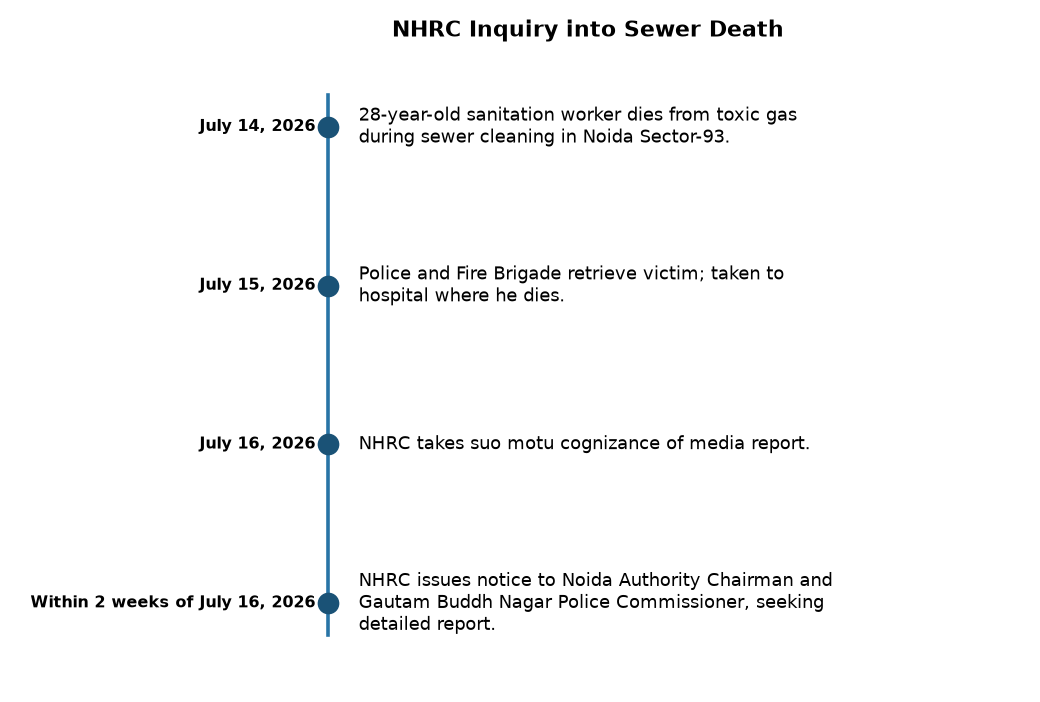
The National Human Rights Commission (NHRC) has taken suo motu cognizance of a media report detailing the tragic death of a 28-year-old sanitation worker due to toxic gas inhalation during a sewer cleaning operation conducted by the Noida Authority in Gautam Buddh Nagar, Uttar Pradesh, on July 14, 2026. The incident, where the worker was reportedly sent into the sewer without adequate safety equipment, raises serious concerns about human rights violations and the persistent issue of manual scavenging despite its legal prohibition.
Background
- Manual scavenging, defined as the practice of manually cleaning, carrying, disposing of, or handling human excreta in any manner, has been a deeply entrenched social evil in India, primarily affecting individuals from marginalized communities.
- Despite legislative prohibitions and judicial pronouncements, the practice, particularly hazardous cleaning of sewers and septic tanks, continues to claim lives across the country.
- The Prohibition of Employment as Manual Scavengers and their Rehabilitation Act, 2013 (PEMSR Act), explicitly bans manual scavenging and mandates the rehabilitation of those engaged in it.
- The Supreme Court of India has consistently emphasized the need for strict enforcement of the PEMSR Act and compensation for the families of victims.
- The incident in Noida highlights the critical failure of local authorities to adhere to safety protocols and provide essential protective gear, underscoring a systemic disregard for the dignity and lives of sanitation workers.
- The NHRC’s intervention underscores its role as a watchdog for human rights, particularly in cases involving vulnerable sections of society and state accountability.
What is the National Human Rights Commission (NHRC)?
- The NHRC is a statutory body established on October 12, 1993, under the Protection of Human Rights Act (PHRA), 1993.
- It is tasked with the promotion and protection of human rights, defined as rights relating to life, liberty, equality, and dignity of the individual guaranteed by the Constitution or embodied in the International Covenants and enforceable by courts in India.
- The Commission comprises a Chairperson (a former Chief Justice of India), one member who is a former Judge of the Supreme Court, one member who is a former Chief Justice of a High Court, and two members appointed from among persons having knowledge of, or practical experience in, matters relating to human rights.
- It has the power to inquire suo motu or on a petition presented to it by a victim or any person on his behalf, into complaints of violation of human rights or abetment thereof.
- The NHRC can intervene in any proceeding involving any allegation of violation of human rights pending before a court with the approval of such court.
- It reviews the safeguards provided by or under the Constitution or any law for the protection of human rights and recommends measures for their effective implementation.
- The Commission also undertakes and promotes research in the field of human rights and spreads human rights literacy among various sections of society.
- Its recommendations are advisory in nature, but they carry significant moral and legal weight, often prompting governmental action and policy changes.
Key Features
| Feature | Significance |
|---|---|
| Statutory Body | Established by an Act of Parliament (PHRA, 1993), providing it with legal backing and authority. |
| Composition | Includes former senior judges and human rights experts, ensuring judicial independence and specialized knowledge. |
| Suo Motu Powers | Allows the NHRC to initiate inquiries based on media reports or its own information, crucial for addressing systemic human rights abuses without formal complaints. |
| Inquiry Powers | Can summon witnesses, demand documents, and conduct investigations, similar to a civil court, to ascertain facts of human rights violations. |
| Advisory Recommendations | While not legally binding, its recommendations hold significant moral authority and often influence policy and legal reforms. |
| Promotional Role | Engages in human rights education, research, and awareness campaigns, fostering a culture of human rights respect. |
Why it Matters
Protection of Vulnerable Sections
- The NHRC’s intervention is crucial for safeguarding the rights of marginalized communities, such as sanitation workers, who are often subjected to hazardous working conditions and systemic discrimination.
- It acts as a vital recourse for those whose voices are often unheard, ensuring that their grievances are addressed at a national level.
Accountability and Governance
- By issuing notices to authorities like the Noida Authority and the Police Commissioner, the NHRC reinforces the principle of state accountability for human rights violations.
- It compels government agencies to adhere to legal mandates and safety regulations, fostering better governance and administrative responsibility.
Reinforcing Rule of Law
- The Commission’s actions uphold the rule of law by ensuring that statutory prohibitions, such as the ban on manual scavenging, are strictly enforced.
- It sends a strong message that violations of human dignity and life will not be tolerated, irrespective of the socio-economic status of the victim.
Policy Advocacy and Reform
- NHRC’s reports and recommendations often serve as a basis for policy reforms and legislative amendments aimed at strengthening human rights protection.
- Its consistent focus on issues like manual scavenging can drive systemic changes in occupational safety, rehabilitation, and social welfare programs.
Challenges
1. Persistence of Manual Scavenging
- Despite legal prohibitions, manual scavenging continues due to societal attitudes, lack of proper mechanization, and inadequate enforcement of laws.
- The practice is often linked to caste-based discrimination, perpetuating a cycle of poverty and indignity for specific communities.
UPSC Link: GS Paper I — Social Issues; GS Paper II — Social Justice
2. Inadequate Implementation of Laws
- The Prohibition of Employment as Manual Scavengers and their Rehabilitation Act, 2013, faces challenges in effective implementation, particularly at the municipal and local body levels.
- Lack of political will, insufficient budgetary allocations, and weak monitoring mechanisms contribute to non-compliance.
UPSC Link: GS Paper II — Governance; GS Paper II — Social Justice
3. Occupational Safety and Health Deficiencies
- Sanitation workers are frequently exposed to hazardous environments without adequate personal protective equipment (PPE), training, or safety protocols.
- This leads to high rates of injuries, diseases, and fatalities due to toxic gases, pathogens, and physical hazards.
UPSC Link: GS Paper III — Environment; GS Paper II — Social Justice
4. Rehabilitation Challenges
- Rehabilitation schemes for manual scavengers often fall short, with beneficiaries struggling to find alternative livelihoods due to lack of skills, capital, and social stigma.
- The transition from manual scavenging to dignified employment remains a significant hurdle.
UPSC Link: GS Paper II — Social Justice; GS Paper I — Social Issues
5. Lack of Data and Underreporting
- Accurate data on the number of manual scavengers and deaths related to hazardous cleaning is often elusive, leading to underestimation of the problem’s scale.
- Underreporting can hinder effective policy formulation and resource allocation for rehabilitation and safety measures.
UPSC Link: GS Paper II — Governance; GS Paper II — Social Justice
Challenges — UPSC Perspective
| Issue | Concern |
|---|---|
| Systemic Neglect | Local authorities often overlook safety protocols and legal mandates, leading to preventable deaths. |
| Caste-based Discrimination | The practice disproportionately affects marginalized communities, perpetuating social injustice. |
| Lack of Mechanization | Reliance on manual methods for sewer cleaning due to insufficient investment in appropriate technology. |
| Inadequate PPE | Workers are frequently deployed without essential safety gear like masks, gloves, and oxygen cylinders. |
| Enforcement Gaps | Weak prosecution and accountability for those violating the PEMSR Act, 2013. |
| Rehabilitation Failures | Former manual scavengers struggle to find alternative, dignified employment opportunities. |
Government Initiatives — Must-Memorise for Prelims
- Prohibition of Employment as Manual Scavengers and their Rehabilitation Act, 2013 (PEMSR Act)
- Self-Employment Scheme for Rehabilitation of Manual Scavengers (SRMS)
- Swachh Bharat Abhiyan (Urban and Gramin) – focuses on sanitation infrastructure, though its implementation has implications for manual scavenging.
- National Action Plan for Mechanized Sanitation Ecosystem (NAMASTE) Scheme
- Pre-Matric and Post-Matric Scholarship Schemes for children of those engaged in unclean occupations
- Pradhan Mantri Awas Yojana (PMAY) – for housing support, indirectly aiding rehabilitation.
- Skill India Mission – for skill development to facilitate alternative livelihoods.
- National Safai Karamcharis Finance and Development Corporation (NSKFDC) – provides financial assistance for economic empowerment.
Way Forward
- Strict and unwavering enforcement of the Prohibition of Employment as Manual Scavengers and their Rehabilitation Act, 2013, holding responsible authorities accountable for violations.
- Mandatory adoption of modern, mechanized cleaning technologies for sewers and septic tanks, eliminating the need for human entry.
- Provision of comprehensive training, adequate Personal Protective Equipment (PPE), and regular health check-ups for all sanitation workers.
- Robust rehabilitation programs that offer skill development, financial assistance, and dignified alternative livelihoods for former manual scavengers.
- Intensified public awareness campaigns to eradicate the social stigma associated with sanitation work and promote respect for sanitation workers.
- Strengthening monitoring mechanisms, including independent audits and community participation, to ensure compliance with safety norms and legal provisions.
- Expeditious investigation and prosecution of cases involving deaths due to hazardous cleaning, ensuring timely justice and adequate compensation for victims’ families.
- Integration of manual scavenging elimination and worker safety into urban planning and smart city initiatives, making it a core component of sustainable development.
UPSC Value Addition
Keywords for Mains Answer-Writing
Manual Scavenging · Human Rights Violation · State Accountability · Dignity of Labour · Social Justice · PEMSR Act 2013 · Mechanization · Occupational Safety · Rehabilitation Challenges · NHRC Intervention · Constitutional Morality · Vulnerable Sections
Constitutional & Policy Linkages
- Article 21: Right to Life and Personal Liberty (includes right to live with dignity, right to health, and safe working conditions).
- Article 23: Prohibition of Traffic in Human Beings and Forced Labour (manual scavenging can be construed as a form of forced labour).
- Article 39(e): Directive Principle of State Policy (DPSP) – health and strength of workers are not abused.
- Article 42: DPSP – just and humane conditions of work and maternity relief.
- Article 47: DPSP – duty of the State to raise the level of nutrition and the standard of living and to improve public health.
- Protection of Human Rights Act, 1993: Statutory basis for NHRC and its functions.
- Prohibition of Employment as Manual Scavengers and their Rehabilitation Act, 2013: Specific legislation banning manual scavenging.
Concept Flow
Media Report of Death in Sewer Cleaning → NHRC Takes Suo Motu Cognizance → Notices Issued to Noida Authority & Police Commissioner → Investigation into Human Rights Violation → Recommendations for Accountability & Remedial Action → Policy Reforms & Enforcement for Worker Safety → Eradication of Manual Scavenging & Rehabilitation
Prelims Practice Questions
Q1. Consider the following statements regarding the National Human Rights Commission (NHRC) of India:
1. The NHRC is a constitutional body established under Article 338 of the Indian Constitution.
2. The Chairperson of the NHRC must be a retired Chief Justice of India.
3. The recommendations of the NHRC are legally binding on the government.
Which of the statements given above is/are correct?
- A. 1 and 2 only
- B. 2 only
- C. 2 and 3 only
- D. None of the above
Answer: B. 2 only — Statement 1 is incorrect: NHRC is a statutory body, not a constitutional body. It was established under the Protection of Human Rights Act, 1993. Statement 2 is correct: The Chairperson of the NHRC must be a retired Chief Justice of India. Statement 3 is incorrect: The recommendations of the NHRC are advisory in nature and not legally binding on the government, though they carry significant moral weight.
Q2. Which of the following Acts primarily prohibits the employment of manual scavengers and provides for their rehabilitation in India?
- A. The Scheduled Castes and the Scheduled Tribes (Prevention of Atrocities) Act, 1989
- B. The Bonded Labour System (Abolition) Act, 1976
- C. The Prohibition of Employment as Manual Scavengers and their Rehabilitation Act, 2013
- D. The Minimum Wages Act, 1948
Answer: C. The Prohibition of Employment as Manual Scavengers and their Rehabilitation Act, 2013 — The Prohibition of Employment as Manual Scavengers and their Rehabilitation Act, 2013 (PEMSR Act) is the specific legislation enacted to prohibit manual scavenging and ensure the rehabilitation of those engaged in it. The other acts address related but distinct issues.
Mains Practice Question
✍ Despite legislative prohibitions and judicial pronouncements, manual scavenging continues to be a grave human rights violation in India. Critically analyze the reasons behind its persistence and suggest comprehensive measures for its complete eradication and the dignified rehabilitation of sanitation workers. (250 words)
Approach: Begin by acknowledging the constitutional and legal framework against manual scavenging, such as Article 21 and the PEMSR Act, 2013. Then, delve into the multi-faceted reasons for its persistence, including societal discrimination (caste-based), inadequate implementation of laws, lack of mechanization, poor occupational safety standards, and failures in rehabilitation programs. Subsequently, propose comprehensive measures focusing on strict enforcement, technological adoption, robust rehabilitation with skill development, public awareness campaigns, and enhanced accountability of state actors. Conclude by emphasizing the need for a holistic approach that combines legal, technological, and social interventions to uphold human dignity.
Source: PIB (Press Information Bureau)
Generated by AanyaAi for educational purpose.


No Comments