


29 Jul NIPUN Bharat Mission: Transforming Foundational Literacy & Numeracy in India

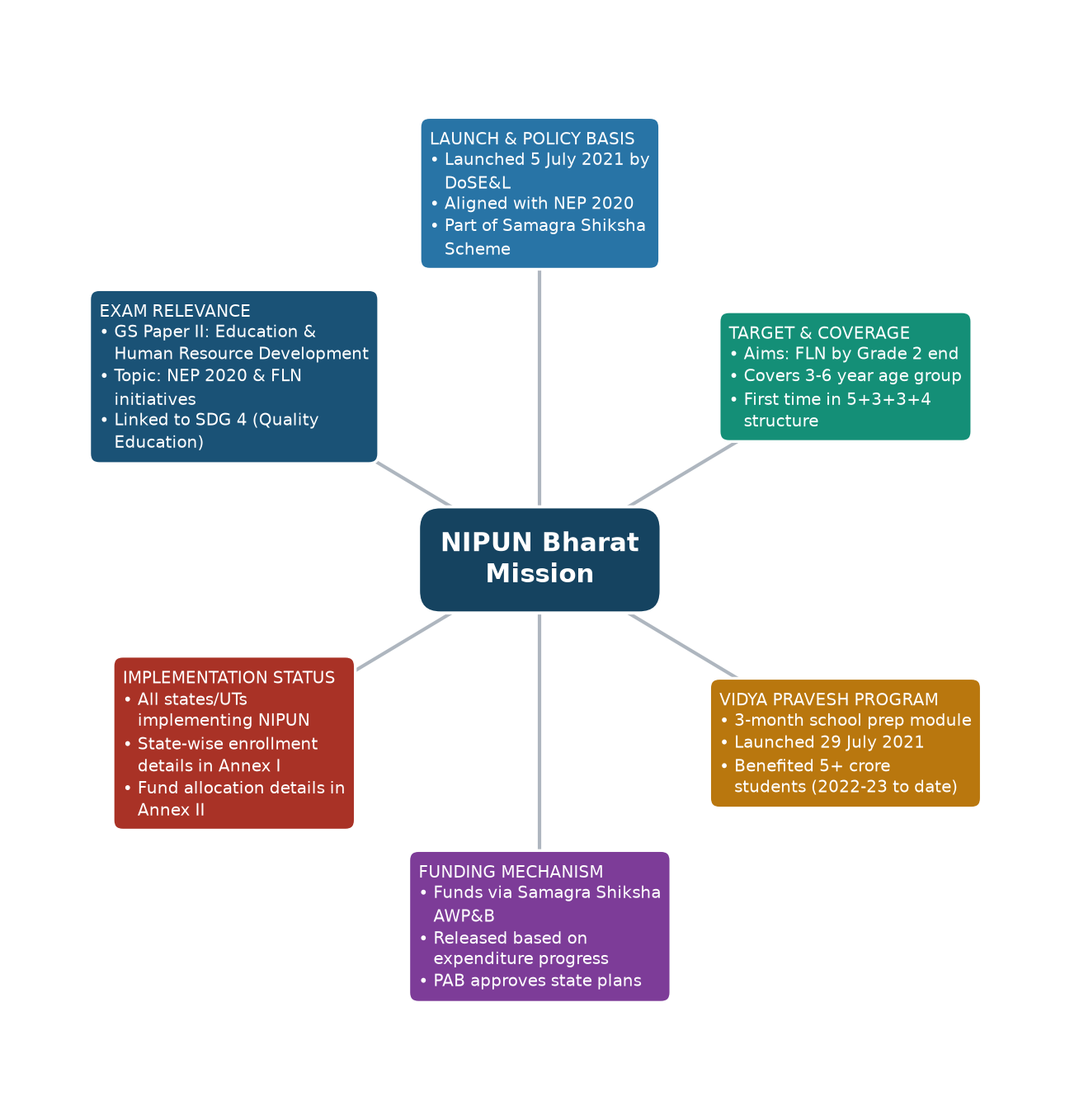
Map & concept mind-map: NIPUN Bharat Mission: FLN Status & Implementation
Subject Relevance — Where This Topic Fits
- GS Paper I — Social Issues and Developmental Challenges | GS Paper II — Governance, Polity and Administration
- Prelims: NIPUN Bharat Mission, Foundational Literacy and Numeracy (FLN), National Education Policy (NEP) 2020, Samagra Shiksha Abhiyaan, Vidya Pravesh, Jadui Pitara, E-Jadui Pitara, Balvatika, 3-6 age cohort, Learning Outcomes, Project Approval Board (PAB), Annual Work Plan and Budget (AWP&B)
- Essay: The transformative potential of foundational education in shaping India’s demographic dividend, Balancing equity and excellence in India’s education policy: A case study of NIPUN Bharat
Quick Revision: NIPUN Bharat Mission ensures foundational literacy and numeracy (FLN) for all children by Grade 2 through the Samagra Shiksha Abhiyaan, integrating ECCE via ‘Balvatika’, ‘Vidya Pravesh’, and ‘Jadui Pitara’ with digital augmentation through ‘E-Jadui Pitara’.
Why is this in the news?
The Press Information Bureau (PIB) released an official update on 29 July 2026 detailing the implementation and progress of the NIPUN Bharat Mission (NBM), a flagship initiative under the Samagra Shiksha Abhiyaan to ensure universal foundational literacy and numeracy (FLN) by Grade 2. The release highlights the expansion of early childhood care and education (ECCE) through the inclusion of the 3–6 age cohort within the formal schooling framework, the deployment of innovative pedagogical tools such as ‘Vidya Pravesh’ and ‘Jadui Pitara’, and the digital augmentation via ‘E-Jadui Pitara’. The update also underscores the financial architecture of the mission under the Annual Work Plan and Budget (AWP&B) mechanism, governed by the Project Approval Board (PAB).
Background
- The National Education Policy (NEP) 2020 envisages a 5+3+3+4 curricular and pedagogic restructuring, integrating early childhood education (ECCE) into the formal schooling system for the first time.
- Foundational Literacy and Numeracy (FLN) is identified as a critical gateway skill, essential for subsequent academic progression and lifelong learning.
- The NIPUN Bharat Mission was launched on 5 July 2021 by the Department of School Education & Literacy (DoSE&L), Ministry of Education, to achieve universal FLN by the end of Grade 2 across all states and Union Territories.
- Samagra Shiksha Abhiyaan, a centrally sponsored scheme, serves as the umbrella framework for the mission’s implementation, integrating multiple interventions under a unified financial and monitoring architecture.
- The mission operationalises the ECCE component through ‘Balvatika’ (a preparatory class) and extends support to children aged 3-6 years in Grades 1 and 2.
- Financial assistance to states and UTs is disbursed based on Annual Work Plans and Budgets (AWP&B), with releases contingent on expenditure progress, audit compliance, and utilisation certificates.
What is the NIPUN Bharat Mission?
- The NIPUN Bharat Mission is a national initiative under the Samagra Shiksha Abhiyaan aimed at ensuring that every child in India attains foundational literacy and numeracy (FLN) by the end of Grade 2.
- It is aligned with the National Education Policy (NEP) 2020 and operationalises the 5+3+3+4 school education structure by integrating children aged 3–6 years into the formal schooling framework through ‘Balvatika’ and Grades 1 and 2.
- The mission employs a multi-pronged strategy, including curriculum reforms, teacher training, development of learning materials, and robust monitoring mechanisms to track learning outcomes.
- Key pedagogical tools include: (a) ‘Vidya Pravesh’ — a three-month play-based school readiness module for Grade 1 entrants, launched on 29 July 2021, and (b) ‘Jadui Pitara’ — a collection of 53 teaching-learning materials (TLM) for children aged 3–6 years, launched on 20 February 2023, available in 22 Indian languages.
- Financial outlays under the mission are released to states and UTs based on their Annual Work Plans and Budgets (AWP&B), with disbursements subject to compliance with expenditure norms, audit requirements, and utilisation certificates.
- The Project Approval Board (PAB) oversees the approval, monitoring, and evaluation of the mission’s implementation, ensuring alignment with programme and financial standards.
- The mission targets universal FLN through structured interventions, teacher capacity-building, and community engagement, with a focus on equity and inclusion across diverse socio-economic contexts.
Key Features
| Feature | Significance |
|---|---|
| National Mission for Foundational Literacy and Numeracy (NIPUN Bharat) | Aligns with NEP 2020 to ensure every child achieves foundational literacy and numeracy by Grade 2, addressing critical early childhood learning gaps. |
| 3+3+3+4 School Structure Integration | Includes age group 3-6 years in formal schooling for the first time, ensuring continuity from pre-primary to secondary education. |
| Vidya Pravesh (School Readiness Module) | A 3-month play-based preparatory module for Grade 1 students, bridging diverse backgrounds (anganwadis, home, private schools) for seamless transition. |
| Jadui Pitara (Learning Material Kit) | A comprehensive kit with 53 play-based learning resources in 22 languages, designed for ages 3-6 to enhance pre-literacy and pre-numeracy skills. |
| E-Jadui Pitara (Digital Platform) | Mobile application and website extending Jadui Pitara’s reach, enabling digital access to learning resources for children aged 3-8. |
Why it Matters
Educational
- Addresses systemic gaps in early childhood education by institutionalising foundational literacy and numeracy as a national priority.
- Ensures equitable access to quality pre-primary education through standardised learning materials and teacher training.
- Promotes holistic development by integrating cognitive, social, and emotional learning in early years.
Economic
- Enhances human capital formation by improving foundational skills, which are critical for future employability and economic productivity.
- Reduces long-term costs of remedial education by preventing learning deficits early in the education cycle.
Social
- Bridges socio-economic disparities by providing uniform learning resources across diverse linguistic and cultural backgrounds.
- Strengthens inclusion by accommodating children from marginalised communities, including those in anganwadis and rural areas.
Policy Alignment
- Operationalises the National Education Policy 2020’s emphasis on foundational learning and early childhood care.
- Integrates with Samagra Shiksha Abhiyan, ensuring financial and administrative synergy for implementation.
Challenges
1. Implementation Gaps
- Variability in state-level execution due to differing administrative capacities and resource allocation.
- Teacher training and capacity-building challenges in scaling up play-based and activity-oriented pedagogy.
- Monitoring and evaluation mechanisms to track progress at grassroots levels remain underdeveloped.
UPSC Link: GS2: Centre-State Relations
2. Equity and Access
- Digital divide limits reach of E-Jadui Pitara in remote and socio-economically disadvantaged regions.
- Uneven enrollment and retention in pre-primary classes, particularly for girls and children with disabilities.
UPSC Link: GS1: Social Justice
3. Resource Constraints
- Insufficient funding for state-specific adaptations of learning materials and teacher support systems.
- Logistical challenges in distributing physical kits (Jadui Pitara) to all schools, especially in hilly and tribal areas.
UPSC Link: GS3: Resource Mobilisation
4. Curriculum and Pedagogy
- Resistance to shift from traditional rote-learning methods to play-based and experiential learning approaches.
- Lack of standardised assessment tools to measure foundational learning outcomes objectively.
UPSC Link: GS2: Education Policy
5. Multi-Stakeholder Coordination
- Coordination challenges between Ministry of Education, state governments, anganwadi workers, and private stakeholders.
- Delays in approvals and fund disbursements under Samagra Shiksha due to procedural bottlenecks.
UPSC Link: GS2: Governance
Challenges — UPSC Perspective
| Issue | Concern |
|---|---|
| State-Level Variability | Differing administrative capacities lead to uneven implementation quality across states. |
| Teacher Training Gaps | Inadequate pre-service and in-service training for adopting play-based pedagogies. |
| Digital Divide | Limited internet access and device availability restrict E-Jadui Pitara’s reach in rural areas. |
| Assessment Mechanisms | Lack of standardised tools to evaluate foundational learning outcomes effectively. |
| Resource Distribution | Logistical hurdles in delivering physical kits to remote and tribal schools. |
| Curriculum Resistance | Traditional teaching methods persist due to lack of awareness or cultural barriers. |
Government Initiatives — Must-Memorise for Prelims
- NIPUN Bharat Mission (National Mission for Foundational Literacy and Numeracy)
- Samagra Shiksha Abhiyan (Integrated Scheme for School Education)
- Vidya Pravesh (School Readiness Module)
- Jadui Pitara (Learning Material Kit)
- E-Jadui Pitara (Digital Platform)
Way Forward
- Strengthen state-level implementation through targeted capacity-building programs for teachers and administrators.
- Expand digital infrastructure in rural and tribal areas to ensure equitable access to E-Jadui Pitara.
- Develop standardised assessment frameworks to monitor foundational learning outcomes systematically.
- Enhance multi-stakeholder coordination by establishing district-level task forces involving anganwadi workers, teachers, and local bodies.
- Increase budgetary allocations for state-specific adaptations of learning materials and teacher support systems.
- Promote community engagement through awareness campaigns to foster parental support for play-based learning.
- Integrate foundational literacy and numeracy outcomes into existing monitoring mechanisms under Samagra Shiksha Abhiyan.
- Conduct periodic reviews of state-wise progress to identify bottlenecks and replicate best practices.
UPSC Value Addition
Keywords for Mains Answer-Writing
NIPUN Bharat Mission · Foundational Literacy and Numeracy (FLN) · National Education Policy 2020 · Samagra Shiksha Scheme · Vidya Pravesh programme · Jadui Pitara · E-Jadui Pitara · Early Childhood Care and Education (ECCE) · Learning Outcomes · Holistic Development of Children · School Readiness Module · 3-6 years age group · Play-based learning · National Initiative for Proficiency in Reading with Understanding and Numeracy · Comprehensive Annual Work Plan and Budget (AWP&B) · Project Approval Board (PAB) · State-wise allocation of funds under Samagra Shiksha · Assessment of FLN · Early Grade Reading and Numeracy · School Transition for Children
Constitutional & Policy Linkages
- Article 21A (Right to Education) — Guarantees free and compulsory education for children aged 6-14 years, indirectly supporting early childhood education.
- Article 45 (Directive Principles) — Directs the State to provide early childhood care and education for all children until age 6.
Concept Flow
National Education Policy 2020 → Emphasis on Foundational Literacy and Numeracy (FLN) → NIPUN Bharat Mission launched → Operational framework for FLN by Grade 2 → 3+3+3+4 School Structure → Inclusion of age group 3-6 years in formal schooling → Vidya Pravesh and Jadui Pitara → Implementation tools for pre-primary and early grades → Samagra Shiksha Abhiyan → Financial and administrative support for mission execution → Teacher Training and Digital Platforms → Pedagogical and technological enablers → Monitoring and Evaluation → Ensuring accountability and continuous improvement
Prelims Practice Questions
Q1. Consider the following statements regarding the NIPUN Bharat Mission:
1. It was launched on 5th July 2021 under the Samagra Shiksha scheme.
2. The mission aims to ensure that every child attains Foundational Literacy and Numeracy (FLN) by the end of Grade 3.
3. The ‘Vidya Pravesh’ programme is a three-month school readiness module for Grade 1 students.
4. The ‘Jadui Pitara’ initiative includes 53 teaching-learning materials for children aged 3-6 years.
How many of the above statements are correct?
- Only one
- Only two
- Only three
- All four
Answer: All four — Statements 1, 3, and 4 are correct. Statement 2 is incorrect because the mission aims for FLN by the end of Grade 2, not Grade 3.
Q2. Assertion (A): The NIPUN Bharat Mission aligns with the National Education Policy 2020.
Reason (R): The mission seeks to integrate early childhood care and education (ECCE) into the formal schooling system for the first time in India.
Options:
A. Both A and R are true, and R is the correct explanation of A.
B. Both A and R are true, but R is not the correct explanation of A.
C. A is true, but R is false.
D. A is false, but R is true.
- A
- B
- C
- D
Answer: B — Both A and R are true, and R correctly explains A. The NIPUN Bharat Mission is a direct implementation of the ECCE-related provisions outlined in NEP 2020.
Q3. Match the following initiatives under the NIPUN Bharat Mission with their respective years of launch:
Column I (Initiative) | Column II (Year of Launch)
———————————————–|—————————–
A. Vidya Pravesh | 1. 2023
B. Jadui Pitara | 2. 2021
C. E-Jadui Pitara | 3. 2024
Options:
1. A-2, B-1, C-3
2. A-1, B-2, C-3
3. A-3, B-1, C-2
4. A-2, B-3, C-1
- 1
- 2
- 3
- 4
Answer: 2 — Vidya Pravesh was launched on 29th July 2021, Jadui Pitara on 20th February 2023, and E-Jadui Pitara on 10th February 2024.
Mains Practice Question
✍ The NIPUN Bharat Mission represents a paradigm shift in India’s approach to early childhood education by integrating Foundational Literacy and Numeracy (FLN) into the formal schooling system. Critically examine the mission’s objectives, implementation strategies, and challenges in achieving universal FLN. Also, analyse how the mission aligns with the broader goals of the National Education Policy 2020. (15 Marks)
Approach: MODEL-ANSWER SKELETON:
1. Introduction (2 Marks):
– Define FLN and its significance in early childhood development.
– Briefly introduce the NIPUN Bharat Mission (NBM) and its launch under the Samagra Shiksha scheme.
– Mention the alignment with NEP 2020, particularly the 5+3+3+4 school structure and ECCE integration.
2. Objectives of NBM (3 Marks):
– Ensure every child attains FLN by the end of Grade 2.
– Focus on holistic development (cognitive, social, emotional) of children aged 3-6 years.
– Bridge learning gaps arising from diverse backgrounds (Anganwadi, Balvatika, private schools).
– Promote play-based and activity-oriented learning.
3. Implementation Strategies (4 Marks):
– School Readiness Module: ‘Vidya Pravesh’ for Grade 1 students (3-month module).
– ‘Jadui Pitara’ (2023): 53 teaching-learning materials for 3-6 years age group.
– ‘E-Jadui Pitara’ (2024): Digital platform for accessible learning resources.
– State-wise implementation under Samagra Shiksha with financial support via AWP&B and PAB approvals.
– Training and capacity-building for teachers and anganwadi workers.
4. Challenges in Achieving Universal FLN (3 Marks):
– Regional disparities in infrastructure and teacher training.
– Digital divide affecting access to E-Jadui Pitara.
– Socio-economic barriers limiting participation in early childhood programmes.
– Need for continuous assessment and monitoring mechanisms.
5. Alignment with NEP 2020 (2 Marks):
– NEP 2020’s emphasis on ECCE and FLN.
– Integration of 3-6 years age group into formal schooling (Balvatika).
– Focus on experiential and play-based learning.
– Emphasis on equitable access to quality education.
6. Conclusion (1 Mark):
– Summarise the mission’s potential to transform early childhood education.
– Highlight the need for sustained multi-stakeholder collaboration (government, NGOs, communities).
Source: PIB (Press Information Bureau)
Generated by AanyaAi for educational purpose.

- यूपीएससी तैयारी: गुजरात में हुआर संरक्षण के लिए नया एक्शन प्लान, जानिए डिटेल्स - September 14, 2026
- Gujarat Action Plan for Great Indian Bustard Conservation: Key UPSC Focus - September 14, 2026
- अगस्त 2026 में खुदरा मुद्रास्फीति 4.82%: सीपीआई एवं खाद्य मुद्रास्फीति के प्रमुख आँकड़े - September 14, 2026

No Comments