


04 Nov Odisha-J-PAL Pact: Evidence-Based Policymaking for UPSC
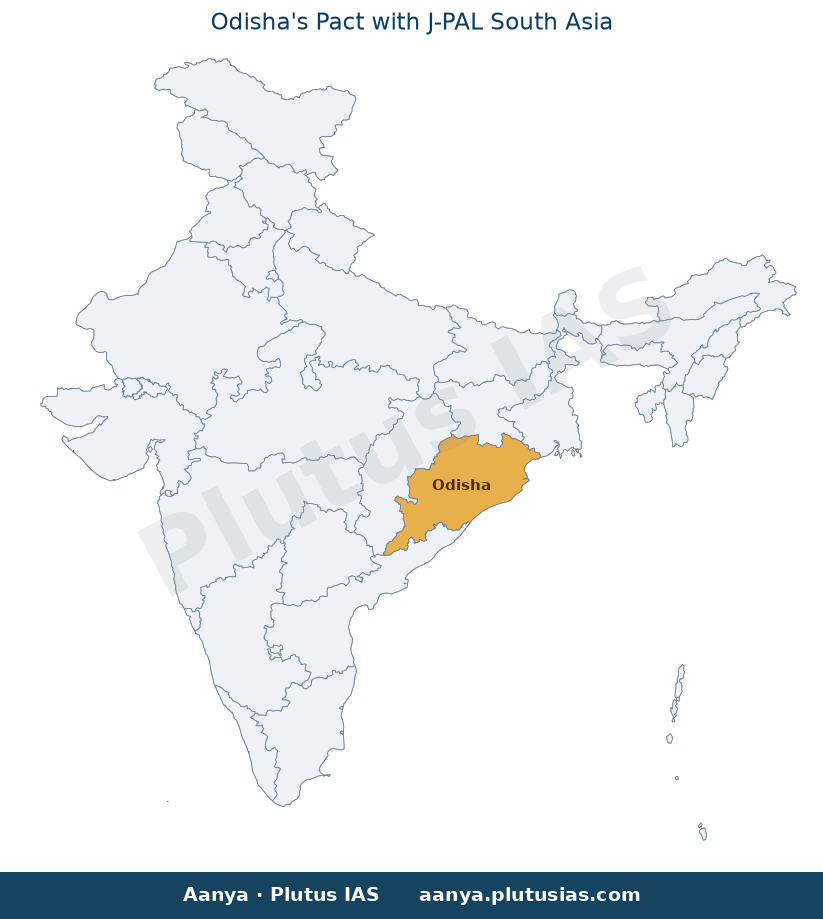
✎ Odisha's three-year MoU with J-PAL South Asia aims to strengthen evidence-based policymaking by leveraging rigorous research and capacity building to inform state-level developmental initiatives.
Subject Relevance — Where This Topic Fits
- GS Paper II — Governance, Social Justice | GS Paper III — Economy, Science and Technology
- Prelims: Evidence-based policymaking, J-PAL South Asia, Randomized Control Trials (RCTs), Planning and Convergence Department, Vision 2036 and 2047, Viksit Odisha for Viksit Bharat
- Essay: The imperative of evidence-based governance for sustainable development, Leveraging research and innovation for inclusive growth in India
Quick Revision: Odisha’s three-year MoU with J-PAL South Asia aims to strengthen evidence-based policymaking by leveraging rigorous research and capacity building to inform state-level developmental initiatives.
Why is this in the news?
The Odisha government has formally entered into a three-year Memorandum of Understanding (MoU) with the Abdul Latif Jameel Poverty Action Lab (J-PAL) South Asia. This collaboration aims to fortify evidence-based policymaking across various governmental departments, aligning with the state’s long-term developmental objectives, including Vision 2036 and 2047, and contributing to the broader ‘Viksit Bharat’ initiative.
Background
- The partnership is anchored within the Planning and Convergence Department of the Odisha government, signifying a strategic institutional commitment to data-driven governance.
- J-PAL South Asia, a research centre headquartered in Chennai, has maintained an engagement with Odisha since 2006, contributing to policy insights in diverse sectors such as early childhood education, foundational literacy, governance, sanitation, agriculture, and gender.
- The collaboration is designed to identify critical policy challenges, generate rigorous evidence through research, and translate these findings into actionable policy recommendations for effective implementation.
- Odisha’s Chief Secretary has articulated the state’s vision to integrate global research findings, adapt successful approaches to local contexts, and pilot data-based solutions before their large-scale expansion.
- The initiative underscores a commitment to adopting data- and AI-based interventions, aligning with global best practices in public administration and policy formulation.
- This partnership is a continuation of Odisha’s historical inclination towards utilising research evidence as a cornerstone for its policymaking processes.
Understanding Evidence-Based Policymaking and J-PAL’s Role
- Evidence-based policymaking (EBP) is an approach that helps governments make decisions about policies and programmes by systematically using the best available research evidence.
- It involves a rigorous process of identifying policy problems, reviewing existing evidence, generating new evidence through research, evaluating policy options, and monitoring implementation.
- The Abdul Latif Jameel Poverty Action Lab (J-PAL) is a global research centre dedicated to reducing poverty by ensuring that policy is informed by scientific evidence.
- J-PAL’s core methodology often involves the use of Randomized Control Trials (RCTs), which are considered the gold standard for evaluating the causal impact of interventions.
- J-PAL South Asia, specifically, focuses on generating and disseminating rigorous evidence to inform policy in the South Asian context, collaborating with governments and non-governmental organisations.
- The organisation’s work encompasses various sectors, including education, health, agriculture, finance, and governance, aiming to identify effective solutions to development challenges.
- Capacity building is a crucial component of J-PAL’s partnerships, involving training government officials and researchers in evidence generation and utilisation.
- The ultimate objective of such collaborations is to enhance the efficiency, effectiveness, and accountability of public spending and developmental programmes by grounding them in empirical evidence.
Key Features
| Feature | Significance |
|---|---|
| Partnership Duration | A three-year Memorandum of Understanding (MoU) signifies a sustained commitment to integrating research into governance, fostering long-term policy development. |
| Anchor Department | The Planning and Convergence Department’s role ensures that evidence-based policymaking is strategically integrated across diverse governmental functions, promoting coherence. |
| Scope of Collaboration | J-PAL South Asia will identify policy challenges, generate rigorous evidence, and translate research into actionable recommendations, covering areas such as education, governance, sanitation, agriculture, and gender. |
| Vision Alignment | The initiative supports Odisha’s Vision 2036 and 2047, aligning state-level development goals with national aspirations like ‘Viksit Bharat’ through data-driven strategies. |
| Capacity Building | The partnership includes provisions for capacity building within government departments, enhancing their ability to utilise research findings effectively. |
| Innovation and Adaptation | Focus on bringing global research findings, adapting successful approaches to local needs, and piloting data-based solutions before large-scale implementation. |
Why it Matters
Governance and Public Administration
- Enhances the efficacy and accountability of public administration by grounding policy decisions in empirical evidence rather than anecdotal observations or political expediency.
- Promotes a culture of continuous learning and adaptation within government, fostering innovation in public service delivery and programme design.
- Strengthens the institutional capacity of state departments to analyse complex socio-economic issues and formulate targeted interventions.
Socio-Economic Development
- Facilitates the development of more effective programmes in critical sectors like early childhood education, foundational literacy, sanitation, agriculture, and gender equality, directly impacting human development indicators.
- Optimises resource allocation by identifying interventions that yield the highest impact per unit of investment, reducing wastage and improving developmental outcomes.
- Contributes to achieving state-specific development targets and national goals such as ‘Viksit Bharat’ by systematically addressing poverty and inequality.
Research and Academia
- Establishes a robust interface between academic research institutions and governmental bodies, ensuring that cutting-edge research is directly applied to real-world policy challenges.
- Provides a platform for rigorous evaluation of public programmes, generating valuable data and insights that can inform future policy cycles and academic discourse.
- Fosters the development of a strong ecosystem for evidence-based research within India, potentially inspiring similar collaborations in other states.
Challenges
1. Data Availability and Quality
- Ensuring the availability of comprehensive, reliable, and timely data across all relevant sectors for rigorous evaluation.
- Addressing potential biases or inconsistencies in existing data sources that could compromise research integrity.
UPSC Link: Governance, Data Management
2. Translating Research into Policy
- Bridging the gap between academic research findings, which can be complex, and actionable policy recommendations that are practical for government implementation.
- Overcoming bureaucratic inertia or resistance to change when introducing new, evidence-based approaches.
UPSC Link: Public Policy, Administrative Reforms
3. Scaling Up Successful Interventions
- Effectively scaling up pilot projects that demonstrate positive outcomes to cover a wider population or geographical area, while maintaining fidelity to the original intervention design.
- Securing adequate financial and human resources for the widespread implementation of evidence-based programmes.
UPSC Link: Development Programmes, Implementation Challenges
4. Capacity Building and Skill Development
- Developing the necessary analytical skills and understanding of research methodologies among government officials to effectively interpret and utilise evidence.
- Ensuring sustained training and continuous professional development to keep pace with evolving research techniques and policy challenges.
UPSC Link: Human Resource Development, Public Administration
5. Political Will and Sustainability
- Maintaining consistent political commitment to evidence-based policymaking across changes in government or administrative leadership.
- Ensuring the long-term sustainability of such partnerships beyond the initial agreement period, integrating evidence use into routine governance processes.
UPSC Link: Governance, Policy Continuity
Challenges — UPSC Perspective
| Issue | Concern |
|---|---|
| Data Infrastructure | Lack of standardised data collection mechanisms and interoperability across government departments. |
| Research Utilisation | Difficulty in integrating complex research findings into rapid policy formulation cycles. |
| Resource Constraints | Limited financial and human resources for conducting large-scale impact evaluations and implementing new programmes. |
| Stakeholder Engagement | Ensuring active participation and buy-in from various government departments and local communities. |
| Ethical Considerations | Addressing privacy concerns and ensuring ethical conduct in data collection and research involving human subjects. |
Way Forward
- Establish a dedicated ‘Evidence Utilisation Unit’ within the Planning and Convergence Department to institutionalise the process of integrating research into policy formulation.
- Develop a robust data governance framework to ensure the collection, standardisation, and accessibility of high-quality administrative data across all government departments.
- Implement a structured capacity-building programme for civil servants at all levels, focusing on data literacy, research methodology, and evidence-informed decision-making.
- Create a transparent mechanism for prioritising policy challenges for research, ensuring alignment with state development goals and citizen needs.
- Foster a ‘learning by doing’ approach by regularly conducting pilot projects, rigorously evaluating their impact, and disseminating findings to inform broader policy adjustments.
- Develop a clear communication strategy to effectively translate complex research findings into accessible policy briefs and actionable recommendations for policymakers.
- Explore innovative financing mechanisms and partnerships with other research institutions and philanthropic organisations to sustain and expand evidence-based initiatives.
UPSC Value Addition
Keywords for Mains Answer-Writing
Evidence-based policymaking · J-PAL South Asia · Policy research · Capacity building · Rigorous evidence · Impact evaluation · Randomized Controlled Trials (RCTs) · Good governance · Sustainable Development Goals (SDGs) · State Vision 2036/2047
Concept Flow
Policy Challenge Identification → Rigorous Evidence Generation → Research Findings Translation → Actionable Policy Recommendations → Programme Design and Implementation → Impact Evaluation and Learning → Policy Refinement and Scaling
Prelims Practice Questions
Q1. Consider the following statements regarding evidence-based policymaking:
1. It primarily relies on anecdotal evidence and expert opinions.
2. Randomized Controlled Trials (RCTs) are a key methodology used to generate rigorous evidence.
3. The objective is to translate research findings into actionable policy recommendations.
How many of the above statements are correct?
- Only one
- Only two
- Only three
- None
Answer: Only two — Statement 1 is incorrect; evidence-based policymaking emphasizes rigorous, empirical evidence, not anecdotal accounts. Statement 2 is correct; RCTs are a gold standard for establishing causality in social interventions. Statement 3 is correct; the ultimate goal is to inform and improve policy decisions.
Q2. Which of the following best describes the primary role of organizations like J-PAL South Asia in supporting government initiatives?
- Providing direct financial aid for poverty alleviation programs.
- Conducting political lobbying to influence legislative processes.
- Generating and disseminating rigorous evidence to inform policy decisions.
- Implementing government schemes directly at the grassroots level.
Answer: Generating and disseminating rigorous evidence to inform policy decisions. — J-PAL South Asia’s core mandate involves conducting research, particularly impact evaluations, to generate robust evidence on the effectiveness of social programs and policies, thereby informing government decisions.
Mains Practice Question
✍ Examine the significance of evidence-based policymaking in achieving developmental goals in India. Discuss how collaborations between state governments and research institutions can strengthen this approach. (15 Marks)
Approach: MODEL-ANSWER SKELETON:
1. **Introduction:** Define evidence-based policymaking (EBP) – a systematic approach to policy design, implementation, and evaluation using rigorous empirical evidence.
2. **Significance of EBP in India:**
* **Improved Efficacy:** Ensures policies are effective and achieve intended outcomes (e.g., in health, education, poverty reduction).
* **Resource Optimization:** Prevents wastage of public funds on ineffective programs; directs resources towards proven interventions.
* **Accountability and Transparency:** Provides a rational basis for policy decisions, enhancing public trust and governmental accountability.
* **Adaptive Governance:** Allows for continuous learning and adaptation of policies based on real-world impact.
* **Targeted Interventions:** Helps identify specific needs and design interventions tailored to particular contexts.
* **Achieving SDGs and National Visions:** Directly contributes to targets under Sustainable Development Goals and national developmental visions (e.g., Viksit Bharat, Viksit Odisha).
3. **Role of Collaborations (State Governments & Research Institutions):**
* **Expertise and Methodological Rigour:** Research institutions (like J-PAL) bring specialized knowledge in research design, data collection, and impact evaluation methodologies (e.g., RCTs).
* **Capacity Building:** Training government officials in data analysis, research interpretation, and evidence utilization.
* **Independent Evaluation:** Provides objective assessment of policy effectiveness, free from political influence.
* **Knowledge Translation:** Bridging the gap between academic research and practical policy implementation by translating complex findings into actionable recommendations.
* **Innovation and Piloting:** Facilitating the testing of new interventions on a smaller scale before widespread adoption.
* **Access to Global Best Practices:** Bringing international research findings and successful models to local contexts.
* **Examples:** Refer to the Odisha-J-PAL partnership as a concrete example, mentioning areas like early childhood education, sanitation, agriculture.
4. **Challenges (briefly):** Data availability, political will, bureaucratic inertia, funding for research.
5. **Conclusion:** Reiterate that such partnerships are crucial for fostering a culture of evidence-informed governance, leading to more impactful and sustainable development outcomes for India.
Source: orissapost.com
Odisha PCS (OPSC (OAS)) — State PCS Practice
Prelims: Odisha has recently signed a three-year pact with which organization to strengthen evidence-based policymaking in the state?
- A. NITI Aayog
- B. J-PAL South Asia
- C. World Bank
- D. International Monetary Fund
Answer: B. J-PAL South Asia — Odisha signed a three-year pact with J-PAL South Asia to integrate evidence-based approaches into its policymaking processes.
Mains: Discuss the significance of Odisha’s three-year pact with J-PAL South Asia in promoting evidence-based policymaking within the state. How can this collaboration contribute to more effective governance and improved public service delivery in Odisha?
Generated by AanyaAi for educational purpose.
Related guides on our sites
- Current affairs for upsc 2026
- Best PSIR optional coaching for upsc
- Best PSIR optional teacher for upsc
- Best teacher of PSIR optional for upsc

- Odisha-J-PAL Pact: Evidence-Based Policymaking for UPSC - November 4, 2026
- भारत-कनाडा प्रथम रक्षा संवाद: सुरक्षा चुनौतियों पर सहयोग - November 4, 2026
- Cabinet Approves VISTAR Scheme for Statistical Transformation - November 4, 2026

No Comments