


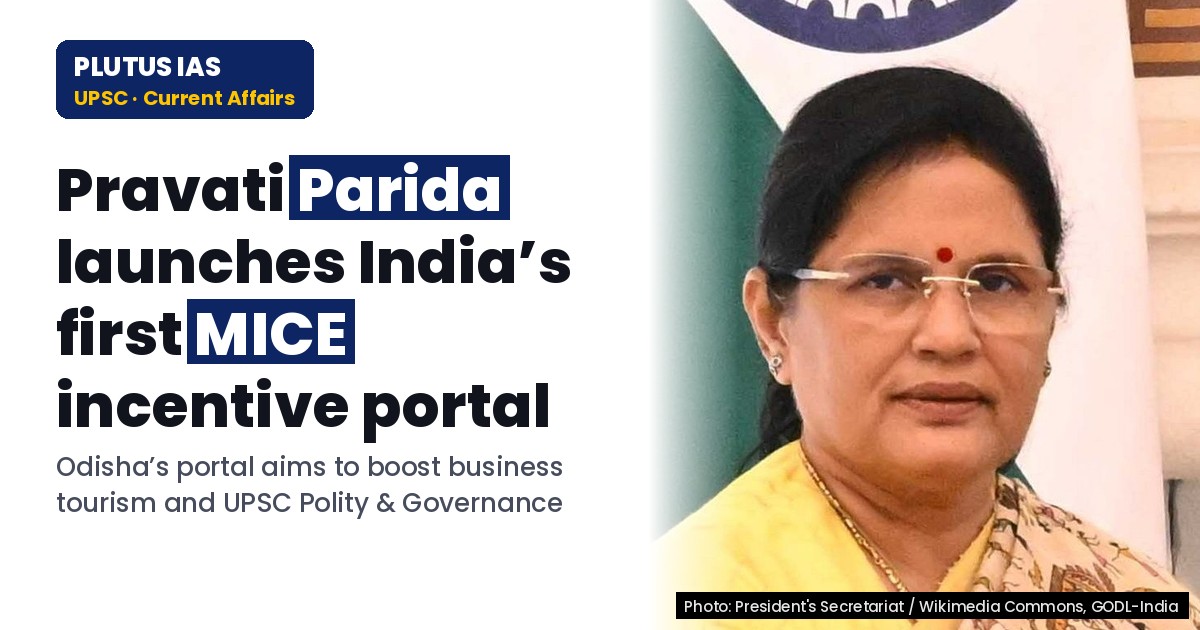
05 Oct Odisha Launches India’s First MICE Incentive Portal for UPSC Aspirants
✎ The MICE Incentive Portal is India’s first dedicated digital mechanism for promoting business tourism, streamlining incentive applications, and positioning Odisha as a premier destination for corporate events.
Subject Relevance — Where This Topic Fits
- GS Paper II — Governance, Transparency and Accountability | GS Paper III — Infrastructure: Tourism and Hospitality
- Prelims: MICE tourism, business tourism, tourism incentive schemes, destination weddings, experiential tourism, single-window clearance, state-led digital portals, convention centres
- Essay: The role of state-led initiatives in transforming India’s tourism sector, Digital governance as a catalyst for economic growth and employment
Quick Revision: The MICE Incentive Portal is India’s first dedicated digital mechanism for promoting business tourism, streamlining incentive applications, and positioning Odisha as a premier destination for corporate events.
Why is this in the news?
On 5 October 2026, the Government of Odisha launched India’s first dedicated digital portal for Meetings, Incentives, Conferences and Exhibitions (MICE) tourism, aimed at streamlining incentive applications and positioning the state as a premier destination for corporate events. This initiative underscores the growing emphasis on business tourism as a catalyst for economic diversification and employment generation, particularly in states with rich cultural and historical assets.
Background
- Business tourism, comprising MICE activities, is a high-value segment of the global travel industry, characterised by longer stays, higher expenditure per visitor, and multiplier effects on local economies.
- Odisha’s tourism sector has historically been driven by pilgrimage and cultural tourism, with Bhubaneswar’s historic monuments and temple architecture serving as key attractions.
- The COVID-19 pandemic disrupted global travel, prompting states to reimagine tourism strategies with a focus on domestic and business segments to ensure resilience.
- The Union Government’s ‘Dekho Apna Desh’ initiative and the National Tourism Policy 2022 emphasise the development of niche tourism products, including MICE, to enhance India’s share in global tourism.
- Odisha’s proactive approach aligns with the broader trend of state governments leveraging digital governance to improve ease of doing business and attract investment.
- The launch coincides with the Odisha Travel Bazaar 2026, a platform for industry stakeholders to engage with policymakers and explore investment opportunities.
What is the MICE Incentive Portal?
- A state-led digital platform designed to promote Odisha as a destination for corporate conventions, conferences, exhibitions, and incentive trips.
- The portal serves as a single-window mechanism for event organisers and tourism operators to apply for financial incentives, thereby reducing administrative bottlenecks.
- It offers a streamlined process for approvals related to MICE events, destination weddings, sports events, and cultural heritage-related ventures, ensuring faster turnaround times.
- The portal integrates destination marketing, incentive disbursement, and stakeholder facilitation, enhancing transparency and accountability in the tourism ecosystem.
- Odisha’s initiative is the first of its kind in India, setting a precedent for other states to adopt similar digital tools for business tourism promotion.
- The portal aligns with Odisha’s broader tourism strategy, which includes promoting experiential tourism such as temple weddings, local cultural experiences, and regional cuisine tours.
- Bhubaneswar’s historic and cultural assets, including its designation as the ‘temple city’, provide a unique value proposition for hosting distinctive corporate and leisure events.
- The government has assured industry stakeholders of targeted capital subsidies and policy support to encourage investment in tourism infrastructure.
Key Features
| Feature | Significance |
|---|---|
| Dedicated MICE incentive portal | First-of-its-kind digital platform in India to streamline financial incentives for event organisers and tourism operators, enhancing ease of doing business in Odisha. |
| One-window clearance mechanism | Facilitates expedited approvals for MICE events, destination weddings, sports events, and cultural heritage ventures, reducing bureaucratic delays. |
| Destination marketing focus on Bhubaneswar | Leverages the city’s status as the ‘temple city’ with historic monuments and cultural heritage to attract corporate conventions and experiential tourism. |
| Private sector engagement framework | Government commits to considering industry recommendations, addressing administrative bottlenecks, and offering targeted capital subsidies to encourage investment. |
| Integration of experiential tourism | Expands beyond traditional MICE tourism to include temple weddings, local cultural experiences, and regional cuisine tours, diversifying revenue streams. |
Why it Matters
Economic Growth
- Stimulates business tourism, a high-value segment with multiplier effects on hospitality, transportation, and ancillary services, thereby enhancing state GDP.
- Attracts corporate investment through targeted incentives, creating employment opportunities in tourism, event management, and allied sectors.
- Diversifies Odisha’s tourism portfolio beyond conventional pilgrimage and leisure, reducing seasonal dependence and stabilising revenue flows.
Governance and Ease of Doing Business
- Demonstrates Odisha’s commitment to digital governance by introducing a first-of-its-kind portal, aligning with national initiatives like Digital India and ease of doing business reforms.
- Reduces administrative friction through a unified clearance mechanism, improving transparency and predictability for investors and event organisers.
- Showcases inter-departmental coordination, as the portal integrates tourism, culture, and urban development portfolios for holistic destination management.
Cultural and Heritage Promotion
- Leverages Bhubaneswar’s UNESCO World Heritage Sites (e.g., Lingaraj Temple, Konark Sun Temple) as unique selling propositions for corporate and experiential events.
- Encourages preservation and sustainable utilisation of cultural assets by positioning them as revenue-generating assets rather than static monuments.
- Promotes Odisha’s intangible cultural heritage (e.g., Odissi dance, handicrafts) through curated experiences, enhancing brand equity.
Competitive Positioning in National Tourism
- Positions Odisha as a pioneer in India’s MICE tourism sector, potentially attracting national and international event organisers seeking innovative destinations.
- Creates a benchmark for other states to emulate, fostering healthy competition in tourism policy and infrastructure development.
- Enhances Odisha’s visibility in global tourism circuits, particularly among corporate clients prioritising unique and culturally rich event locations.
Challenges
1. Infrastructure Bottlenecks
- Limited availability of world-class convention centres and high-end hospitality infrastructure in Bhubaneswar and other tier-2 cities in Odisha.
- Inadequate connectivity (air, rail, road) to major tourist hubs, which may deter international corporate events with stringent logistical requirements.
- Seasonal over-reliance on pilgrimage tourism, necessitating year-round capacity utilisation to sustain MICE tourism growth.
UPSC Link: GS-III: Infrastructure (Tourism)
2. Human Resource Development
- Shortage of skilled manpower in event management, hospitality, and allied sectors, particularly in niche areas like MICE operations and experiential tourism.
- Need for continuous upskilling to meet international standards in service delivery, language proficiency, and technology adoption.
UPSC Link: GS-III: Human Resource Development
3. Regulatory and Policy Gaps
- Complexity in obtaining multiple approvals (e.g., fire safety, environmental clearances) for large-scale events, despite the portal’s streamlined clearance mechanism.
- Lack of uniform national guidelines for MICE tourism, leading to state-specific disparities in incentives and regulatory frameworks.
UPSC Link: GS-II: Centre-State Relations (Cooperative Federalism)
4. Sustainability Concerns
- Risk of over-commercialisation of cultural and religious sites, leading to degradation of heritage assets and loss of authenticity.
- Environmental impact of large-scale events, including waste generation, carbon footprint, and strain on local resources in ecologically sensitive areas.
UPSC Link: GS-III: Environment and Sustainable Development
5. Market Competition
- Presence of established MICE destinations in India (e.g., Delhi, Mumbai, Goa) and globally (e.g., Singapore, Dubai), requiring Odisha to differentiate its offerings.
- Need for aggressive marketing and branding to compete with destinations offering more mature infrastructure and proven track records.
UPSC Link: GS-III: Economic Development (Tourism)
Challenges — UPSC Perspective
| Issue | Concern |
|---|---|
| Infrastructure gaps | Limited convention centres and high-end hotels in Odisha’s tier-2 cities constrain large-scale event hosting. |
| Regulatory hurdles | Multiple approvals required for events, despite portal’s intent to streamline processes. |
| Skilled workforce shortage | Insufficient trained professionals in event management and hospitality to meet MICE tourism demands. |
| Sustainability risks | Over-commercialisation of heritage sites and environmental degradation from large events. |
| Market competition | Established MICE destinations with superior infrastructure pose a challenge to Odisha’s positioning. |
| Seasonal tourism dependence | Pilgrimage tourism’s seasonality may limit year-round utilisation of MICE infrastructure. |
Way Forward
- Develop world-class convention centres in Bhubaneswar and other strategic locations with public-private partnerships to address infrastructure deficits.
- Invest in skill development programmes through institutions like the Odisha Tourism Development Corporation (OTDC) and industry collaborations to build a MICE-ready workforce.
- Strengthen inter-state and inter-ministerial coordination to harmonise regulatory frameworks and reduce approval bottlenecks for large-scale events.
- Implement sustainable tourism practices, including green certifications for event venues, waste management systems, and carbon-neutral event protocols.
- Launch targeted marketing campaigns in collaboration with corporate associations (e.g., FICCI, CII) to position Odisha as a premium MICE destination globally.
- Enhance connectivity through expansion of air, rail, and road networks, with a focus on international gateways (e.g., Biju Patnaik International Airport).
- Establish a dedicated MICE tourism cell within the Odisha Tourism Development Corporation to monitor implementation, address grievances, and facilitate continuous improvement.
- Promote public-private partnerships for heritage conservation and adaptive reuse of historical structures to balance tourism growth with preservation.
UPSC Value Addition
Keywords for Mains Answer-Writing
MICE tourism · business tourism · destination branding · tourism policy · incentive mechanisms · digital governance · tourism infrastructure · conference tourism · state-led tourism promotion · sustainable tourism development · tourism governance framework · public-private partnership in tourism
Concept Flow
Odisha’s rich cultural and natural assets → Government identifies MICE tourism as a high-value economic driver → Launch of India’s first MICE incentive portal → Streamlined approvals and financial incentives attract event organisers → Increased corporate events and experiential tourism → Growth in hospitality, transportation, and allied sectors → Employment generation and state revenue enhancement → Reinvestment in infrastructure and skill development → Sustainable long-term positioning in India’s MICE tourism market.
Prelims Practice Questions
Q1. Consider the following statements regarding Meetings, Incentives, Conferences and Exhibitions (MICE) tourism:
1. MICE tourism is primarily focused on leisure and recreational activities.
2. The Odisha government has launched India’s first dedicated MICE incentive portal to promote business tourism.
3. Destination weddings and cultural heritage events are excluded from MICE tourism.
4. MICE tourism contributes significantly to local economies through extended stays and high-spending delegates.
How many of the above statements are correct?
- Only one
- Only two
- Only three
- All four
Answer: Only three — Statement 1 is incorrect as MICE tourism is focused on professional, commercial, and networking purposes. Statement 2 is correct as Odisha launched India’s first MICE incentive portal. Statement 3 is incorrect as destination weddings and cultural heritage events are included in MICE tourism. Statement 4 is correct as MICE tourism generates substantial economic benefits.
Q2. Assertion (A): The launch of a dedicated MICE incentive portal by a state government is an example of digital governance in tourism promotion.
Reason (R): Digital governance enhances transparency, efficiency, and accessibility in public service delivery.
Options:
A. Both A and R are true, and R is the correct explanation of A.
B. Both A and R are true, but R is not the correct explanation of A.
C. A is true, but R is false.
D. A is false, but R is true.
Answer: ? — Assertion (A) is true as the MICE incentive portal is a digital governance tool. Reason (R) is also true and correctly explains why digital governance improves public service delivery, including tourism promotion.
Q3. Match the following pairs related to tourism governance in India:
Column I
1. MICE tourism
2. Digital governance
3. Destination branding
4. Public-private partnership
Column II
A. Promotion of specific locations through marketing strategies
B. Collaboration between government and private entities for tourism development
C. Organised group travel for professional and commercial purposes
D. Use of digital platforms to streamline governance processes
Options:
1-C, 2-D, 3-A, 4-B
1-A, 2-B, 3-C, 4-D
1-B, 2-A, 3-D, 4-C
1-D, 2-C, 3-B, 4-A
Answer: ? — 1-C: MICE tourism involves organised group travel for professional purposes. 2-D: Digital governance uses digital platforms to enhance governance. 3-A: Destination branding promotes specific locations. 4-B: Public-private partnership involves collaboration between government and private entities.
Mains Practice Question
✍ In recent years, state governments in India have increasingly adopted innovative governance mechanisms to promote tourism, as exemplified by Odisha’s launch of India’s first MICE incentive portal. Critically examine the significance of such initiatives for India’s tourism sector. Also, analyse the potential challenges in implementing such digital governance tools in the tourism ecosystem. (15 Marks)
Approach: MODEL-ANSWER SKELETON:
1. **Introduction (2 Marks)**:
– Define MICE tourism and its economic significance for India.
– Briefly introduce Odisha’s MICE incentive portal as a case study of state-led innovation in tourism promotion.
2. **Significance of State-Led Initiatives (6 Marks)**:
– **Destination Branding and Competitiveness**: How dedicated portals enhance Odisha’s visibility as a business tourism hub (e.g., Bhubaneswar as the ‘temple city’).
– **Ease of Doing Business**: Streamlining approvals and incentives for event organisers and tourism operators.
– **Public-Private Partnership (PPP)**: Facilitating collaboration between government and industry stakeholders.
– **Digital Governance**: Role of digital platforms in transparency, efficiency, and real-time monitoring.
– **Economic Multiplier Effect**: Impact on local economies through extended stays, employment, and ancillary services.
3. **Challenges in Implementation (5 Marks)**:
– **Digital Divide**: Limited access to technology in rural or remote tourist destinations.
– **Administrative Bottlenecks**: Delays in approvals despite digital portals due to inter-departmental coordination issues.
– **Sustainability Concerns**: Balancing mass tourism with environmental and cultural preservation.
– **Data Privacy and Security**: Risks associated with digital platforms handling sensitive data.
– **Policy Coherence**: Ensuring alignment with national tourism policies (e.g., National Tourism Policy 2022) and Sustainable Development Goals (SDGs).
4. **Conclusion (2 Marks)**:
– Summarise the transformative potential of such initiatives.
– Emphasise the need for a balanced approach combining innovation with sustainability and inclusivity.
Source: orissapost.com
Odisha PCS (OPSC (OAS)) — State PCS Practice
Prelims: Which of the following is the primary objective of Odisha’s newly launched MICE (Meetings, Incentives, Conferences, and Exhibitions) incentive portal, making it India’s first such initiative?
- A. To provide financial subsidies for international tourists visiting Odisha
- B. To promote Odisha as a premier destination for business tourism by offering incentives to event organizers
- C. To regulate and monitor all business events held in Odisha
- D. To exclusively support domestic business tourism within Odisha
Answer: B. To promote Odisha as a premier destination for business tourism by offering incentives to event organizers — The portal aims to boost business tourism by offering incentives to event organizers, positioning Odisha as a competitive MICE destination.
Mains: Discuss the significance of Odisha’s launch of India’s first MICE incentive portal in the context of promoting business tourism. How can this initiative contribute to the state’s economic growth and global visibility?
Generated by AanyaAi for educational purpose.
Related guides on our sites
- Best PSIR optional coaching for upsc
- Best PSIR optional teacher for upsc
- Best teacher of PSIR optional for upsc
- Best PSIR optional coaching in delhi for UPSC

- Odisha Launches India’s First MICE Incentive Portal for UPSC Aspirants - October 5, 2026
- आईआईटी और एआई स्टार्टअप: क्या अब मास्टर डिग्री जरूरी नहीं? - October 5, 2026
- Himachal High Court VC Appointment Row: SC to Decide Future of Agriculture Universities - October 5, 2026

No Comments