


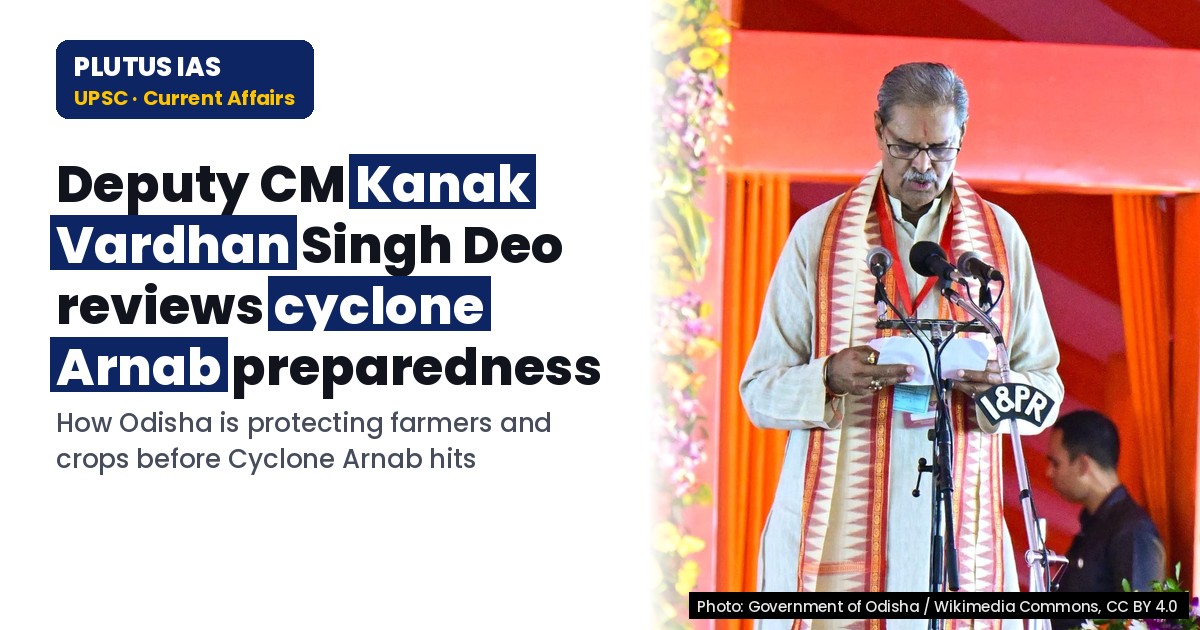
25 Oct Odisha’s cyclone preparedness: How farmers’ safety net is being strengthened
✎ Odisha’s cyclone preparedness integrates IMD’s early warning systems and farmer advisories to mitigate agricultural risks during cyclonic events.
Subject Relevance — Where This Topic Fits
- GS Paper III — Disaster Management | GS Paper III — Agriculture
- Prelims: Cyclone warning systems, National Disaster Management Authority (NDMA) guidelines, Pradhan Mantri Fasal Bima Yojana (PMFBY), Integrated Agromet Advisory Services (IMAS), State Disaster Response Fund (SDRF), Crop Insurance Schemes, IMD cyclone classification, Agro-climatic zones of Odisha
- Essay: Resilience in governance: Balancing preparedness and response in natural disasters, The role of technology in mitigating agricultural risks in developing economies
Quick Revision: Odisha’s cyclone preparedness integrates IMD’s early warning systems and farmer advisories to mitigate agricultural risks during cyclonic events.
Why is this in the news?
Odisha’s proactive measures to safeguard agricultural interests ahead of Cyclone Arnab, scheduled to make landfall in October 2026, underscore the state’s institutional preparedness for cyclonic disasters and the integration of meteorological, administrative, and agricultural systems to mitigate farmer losses. The deployment of real-time advisory systems, institutional coordination, and direct farmer support mechanisms highlights the evolving framework for climate-resilient agriculture in India.
Background
- Cyclones are recurring hydro-meteorological hazards in the Bay of Bengal, with Odisha being one of the most vulnerable coastal states in India due to its geographical location and low-lying terrain.
- The state has historically faced severe cyclonic storms, including Cyclone Phailin (2013), Cyclone Titli (2018), and Cyclone Fani (2019), which caused extensive damage to agriculture, infrastructure, and livelihoods.
- Odisha’s agricultural sector, dominated by paddy cultivation, is particularly susceptible to cyclonic winds, storm surges, and prolonged flooding, leading to significant pre- and post-harvest losses.
Cyclone Preparedness and Agricultural Risk Mitigation in Odisha: Institutional Framework and Operational Measures
- Cyclone Early Warning Systems: The India Meteorological Department (IMD) classifies cyclones based on wind speed (e.g., ‘Very Severe Cyclonic Storm’ for winds exceeding 118 km/h), and issues colour-coded alerts (Yellow, Orange, Red) to state governments for phased preparedness and response.
- Real-Time Advisory Mechanisms: The Integrated Agromet Advisory Services (IMAS) under IMD provides district-wise weather forecasts, including rainfall intensity, wind speed, and storm surge predictions, to guide agricultural operations.
- Farmer Support Infrastructure: Dedicated control rooms and toll-free helplines (e.g., 155333) are activated during cyclone warnings to disseminate crop-specific advisories, including protective measures for standing crops like paddy, horticultural crops, and livestock.
- Operational Readiness: Cancellation of leaves for agricultural officers and their deployment at district headquarters ensures continuous monitoring and rapid response to farmer queries and field conditions post-cyclone.
- Post-Disaster Assessment: Field inspections by agricultural officers assess crop damage, soil erosion, and waterlogging, enabling timely submission of damage reports to the State Agriculture Department for relief and compensation.
- Agricultural Advisories: The Odisha University of Agriculture and Technology (OUAT) issues crop-specific advisories, including staggered sowing, use of windbreaks, and protective measures for livestock, to minimise losses during cyclonic events.
Key Features
| Feature | Significance |
|---|---|
| High-level review meeting chaired by Deputy CM | Ensures inter-departmental coordination and immediate policy directives for disaster preparedness. |
| Cancellation of leave for agriculture officers (Oct 25–Nov 7) | Guarantees uninterrupted field-level monitoring and response during cyclone impact period. |
| Dedicated control room and toll-free helpline (155333) | Provides real-time crop management and weather guidance to farmers, reducing panic and loss. |
| Field inspections post-cyclone by agriculture officers | Enables rapid damage assessment and targeted relief distribution under existing schemes. |
| Widespread circulation of agricultural advisories | Facilitates pre-emptive measures by farmers to mitigate crop and livestock losses. |
Why it Matters
Economic
- Minimises agricultural GDP loss from cyclonic damage through proactive measures, safeguarding rural livelihoods and food security.
- Protects paddy and non-paddy crops, ensuring stability in Odisha’s agricultural output, a key contributor to state GDP.
- Reduces long-term economic burden on farmers by preventing catastrophic losses, thereby stabilising rural credit and insurance markets.
Institutional
- Demonstrates the Odisha government’s institutional capacity in disaster risk reduction and climate adaptation for agriculture.
- Strengthens the role of the Agriculture & Farmers’ Empowerment Department as a nodal agency for farmer welfare during natural calamities.
- Enhances public trust in state institutions by ensuring visible, coordinated action ahead of forecasted disasters.
Social
- Protects vulnerable farming communities, particularly small and marginal farmers, from livelihood disruptions caused by cyclones.
- Provides psychological reassurance to farmers through dedicated helplines and field-level support, reducing stress and panic.
- Ensures continuity of agricultural operations post-disaster, preventing migration or distress sales of assets.
Challenges
1. Limited lead time for farmer preparedness
- Cyclone Arnab’s rapid intensification reduces the window for farmers to implement protective measures.
- Small and marginal farmers, with fewer resources, face disproportionate challenges in executing timely actions.
UPSC Link: GS3: Disaster Management
2. Logistical constraints in field inspections
- Post-cyclone field assessments may be hindered by damaged infrastructure, impassable roads, or communication blackouts.
- High-density cropped areas require rapid, multi-agency coordination to cover all affected zones efficiently.
UPSC Link: GS3: Disaster Management
3. Effectiveness of agricultural advisories
- Advisories must be tailored to diverse crops and agro-climatic zones to ensure relevance and uptake by farmers.
- Language barriers and digital divide may limit reach of advisories, particularly in remote rural areas.
UPSC Link: GS3: Agriculture
4. Resource allocation for relief and rehabilitation
- State exchequer faces pressure to fund immediate relief, crop compensation, and long-term rehabilitation.
- Coordination with central schemes (e.g., PMFBY) is critical to avoid duplication or gaps in compensation.
UPSC Link: GS3: Agriculture
5. Climate change-induced frequency of cyclones
- Increasing intensity and unpredictability of cyclones pose a structural challenge to Odisha’s agricultural resilience.
- Requires integration of climate-smart agriculture practices into long-term planning.
UPSC Link: GS3: Environment & Disaster Management
Challenges — UPSC Perspective
| Issue | Concern |
|---|---|
| Rapid cyclone intensification | Reduces time available for farmers to implement protective measures. |
| Post-cyclone infrastructure damage | Impedes field assessments and delays relief distribution. |
| Digital and language barriers | Limit the reach and effectiveness of agricultural advisories. |
| Resource constraints for compensation | May strain state finances and require central support. |
| Climate variability | Increases the frequency and unpredictability of cyclonic events. |
Way Forward
- Conduct pre-emptive training sessions for farmers on cyclone-resistant agricultural practices in vulnerable districts.
- Expand the toll-free helpline to operate 24/7 during cyclone season for real-time support.
- Integrate satellite-based crop monitoring with field inspections to improve damage assessment accuracy.
- Strengthen coordination between the Agriculture Department, IMD, and district administrations for seamless information flow.
- Develop region-specific contingency plans for high-risk crops (e.g., paddy, horticulture) in cyclone-prone areas.
- Leverage PM-KISAN and PMFBY databases to ensure targeted compensation and avoid delays.
- Promote climate-resilient crop varieties and agroforestry to reduce vulnerability to cyclonic winds.
UPSC Value Addition
Keywords for Mains Answer-Writing
Cyclone disaster preparedness · Agricultural risk mitigation · State-level disaster management · Farmer welfare measures · IMD cyclone forecasting · Odisha State Disaster Management Authority · Agricultural advisories · Crop insurance mechanisms · National Disaster Management Policy 2009 · Integrated Agromet Advisory Service · Agrometeorological advisories · Post-disaster agricultural assessment · Farmers’ safety nets · Toll-free helpline systems · District-level disaster response · Agricultural contingency plans
Concept Flow
Cyclone forecast by IMD → State government review meeting → Cancellation of leave for agriculture officers → Launch of helpline and control room → Dissemination of advisories → Field inspections post-cyclone → Damage assessment → Relief distribution under existing schemes → Restoration of agricultural operations
Prelims Practice Questions
Q1. Consider the following statements regarding the National Disaster Management Policy 2009 of India:
1. It mandates the establishment of State Disaster Management Authorities (SDMAs) in every state.
2. It provides for the creation of a National Disaster Response Force (NDRF) under the administrative control of the Ministry of Home Affairs.
3. It requires all states to prepare District Disaster Management Plans (DDMPs) in line with the National Plan.
4. It empowers the Prime Minister to declare a ‘National Calamity’ without the recommendation of the National Disaster Management Authority (NDMA).
How many of the above statements are correct?
- Only one
- Only two
- Only three
- All four
Answer: Only three — Statements 1, 2, and 3 are correct as per the National Disaster Management Policy 2009. Statement 4 is incorrect because the declaration of a ‘National Calamity’ requires the recommendation of the NDMA as per the Disaster Management Act, 2005.
Q2. Assertion (A): The Integrated Agromet Advisory Service (IAAS) is a scheme under the Ministry of Agriculture and Farmers’ Welfare aimed at providing location-specific weather-based crop advisories to farmers.
Reason (R): The IAAS operates through a network of agrometeorological field units and Krishi Vigyan Kendras (KVKs) to disseminate advisories via multiple channels including toll-free helplines.
Options:
A. Both A and R are true, and R is the correct explanation of A.
B. Both A and R are true, but R is NOT the correct explanation of A.
C. A is true but R is false.
D. A is false but R is true.
Answer: ? — Both Assertion (A) and Reason (R) are true, and Reason (R) correctly explains Assertion (A). The IAAS is indeed a scheme under the Ministry of Agriculture and Farmers’ Welfare, and it disseminates advisories through KVKs and other channels, including toll-free helplines.
Q3. Match the following pairs related to disaster management in India:
Column I (Institution/Scheme) Column II (Purpose/Function)
1. National Disaster Response Force (NDRF) A. Provides immediate relief and rescue operations during disasters
2. State Disaster Response Force (SDRF) B. Coordinates long-term disaster risk reduction strategies
3. National Disaster Management Authority (NDMA) C. Provides financial assistance to states for disaster relief
4. National Disaster Mitigation Fund (NDMF) D. Deploys specialized teams for disaster response in states
Options:
A. 1-D, 2-A, 3-B, 4-C
B. 1-A, 2-D, 3-B, 4-C
C. 1-D, 2-A, 3-C, 4-B
D. 1-A, 2-D, 3-C, 4-B
- A
- B
- C
- D
Answer: A — 1-D: NDRF deploys specialized teams for disaster response. 2-A: SDRF provides immediate relief and rescue operations. 3-B: NDMA coordinates long-term disaster risk reduction strategies. 4-C: NDMF provides financial assistance to states for disaster relief.
Mains Practice Question
✍ Critically examine the role of state governments in India in mitigating agricultural risks during cyclonic events. In your answer, analyse the constitutional and statutory framework governing disaster management, and evaluate the effectiveness of Odisha’s proactive measures in safeguarding farmers’ interests ahead of Cyclone Arnab. (15 Marks)
Approach: MODEL-ANSWER SKELETON:
1. **Constitutional and Statutory Framework** (5 points):
– Article 21 (Right to Life) and Article 48A (Directive Principles of State Policy) as foundational legal bases for disaster management.
– Disaster Management Act, 2005: Roles of NDMA, SDMAs, and District Disaster Management Authorities (DDMAs).
– National Disaster Management Policy 2009: Emphasis on preparedness, mitigation, and response.
– State-specific Disaster Management Authorities (e.g., Odisha State Disaster Management Authority – OSDMA).
– Integration of agricultural risk mitigation within the broader disaster management framework.
2. **Odisha’s Proactive Measures for Cyclone Arnab** (5 points):
– Cancellation of leave for agriculture officers (October 25–November 7) to ensure operational readiness.
– Launch of a dedicated control room and toll-free helpline (155333) for real-time crop management and weather guidance.
– Field inspections post-cyclone to assess damage and provide timely assistance (as per OUAT advisories).
– Dissemination of agricultural advisories by the Agriculture & Farmers’ Empowerment Department.
– Coordination with IMD for accurate forecasting and with district administrations for ground-level execution.
3. **Effectiveness and Challenges** (5 points):
– Strengths: Early warning systems, institutional coordination, and farmer-centric advisories.
– Limitations: Dependence on IMD accuracy, resource constraints in remote areas, and post-disaster assessment timelines.
– Comparative perspective: Contrast with other cyclone-prone states (e.g., Andhra Pradesh, Tamil Nadu) in terms of preparedness.
– Role of agrometeorological services (e.g., Integrated Agromet Advisory Service) in reducing crop losses.
– Suggestions for improvement: Strengthening KVK networks, enhancing insurance mechanisms (e.g., PMFBY), and community-based preparedness programs.
Source: orissapost.com
Odisha PCS (OPSC (OAS)) — State PCS Practice
Prelims: Which of the following initiatives has Odisha recently launched to strengthen the farmer safety net ahead of cyclones?
- A. Cyclone Resilient Agriculture (CRA) Scheme
- B. Kisan Credit Card (KCC) with cyclone insurance coverage
- C. State-wide distribution of cyclone-resistant seed varieties
- D. All of the above
Answer: D. All of the above — Odisha has introduced multiple measures including the Cyclone Resilient Agriculture (CRA) Scheme, enhanced Kisan Credit Card (KCC) with cyclone insurance, and distribution of cyclone-resistant seeds to safeguard farmers.
Mains: Discuss the significance of Odisha’s multi-pronged approach to strengthen the farmer safety net ahead of cyclones, highlighting the role of technological interventions, financial inclusion, and policy measures in building climate resilience for agriculture.
Generated by AanyaAi for educational purpose.
Related guides on our sites
- Current affairs for upsc 2026
- How to prepare for GS paper 1 for UPSC CSE mains exam
- Best UPSC coaching for IFOS exam
- Best agriculture optional coaching

- Odisha’s cyclone preparedness: How farmers’ safety net is being strengthened - October 25, 2026
- बिहार में नया औद्योगिक गढ़: गया आईएमसी से 4,200 करोड़ रुपये के निवेश की उम्मीद - October 25, 2026
- India-Uzbekistan Bilateral Ties: Key Agreements & Strategic Focus - October 25, 2026

No Comments