


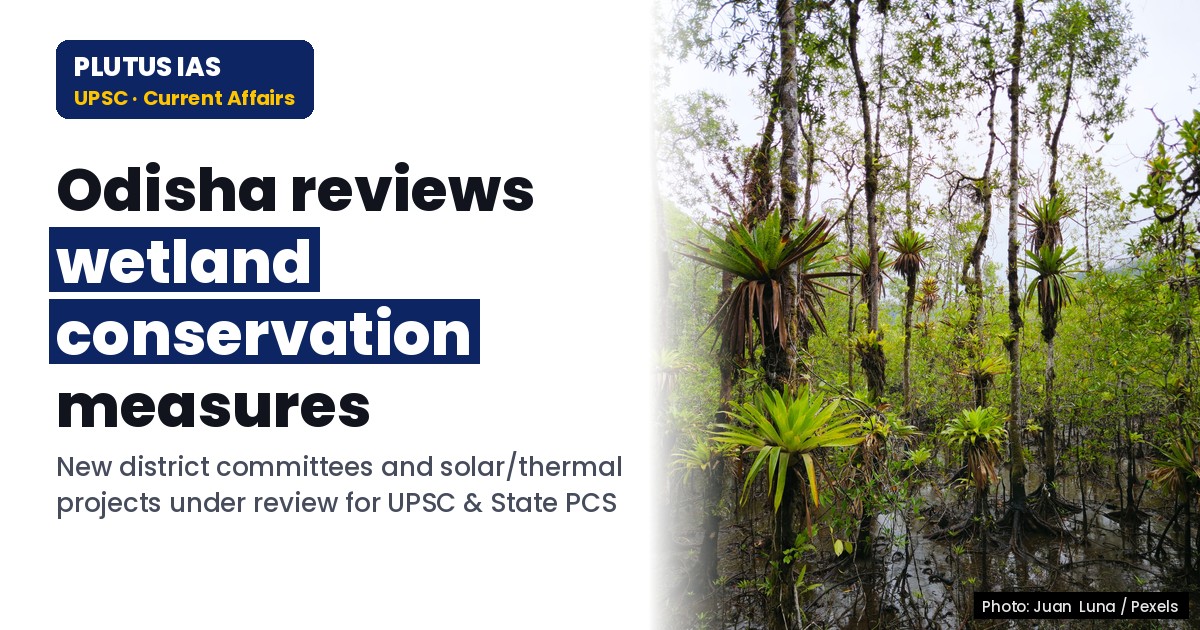
01 Nov Odisha’s Wetland Conservation: Key Steps for UPSC & State PCS
✎ Wetlands are governed in India under the Wetlands (Conservation and Management) Rules, 2017, which mandate the establishment of State Wetlands Authorities and District Wetland Committees to ensure decentralised and participatory…
Subject Relevance — Where This Topic Fits
- GS Paper III — Environment and Ecology | GS Paper II — Governance, Constitution and Polity
- Prelims: Wetlands (Conservation and Management) Rules, 2017, Ramsar Convention, State Wetlands Authority, District Wetland Committees, National Mission for Clean Ganga, Environment Impact Assessment (EIA) 2006, Forest (Conservation) Act, 1980, Odisha State Wetlands Authority, Floating Solar Projects, Thermal Power Expansion
- Essay: Balancing Development and Environmental Conservation: A Case Study of Odisha’s Wetlands, Institutional Mechanisms for Sustainable Governance of Natural Resources
Quick Revision: Wetlands are governed in India under the Wetlands (Conservation and Management) Rules, 2017, which mandate the establishment of State Wetlands Authorities and District Wetland Committees to ensure decentralised and participatory management.
Why is this in the news?
The Odisha State Wetlands Authority conducted its fifth meeting to review wetland conservation measures, including the constitution of District Wetland Committees, while evaluating major infrastructure and renewable energy proposals such as thermal power expansion and floating solar projects. This highlights the intersection of developmental imperatives and ecological sustainability in wetland governance, underscoring the need for robust institutional frameworks and adherence to statutory environmental safeguards.
Background
- Wetlands are among the most productive ecosystems, providing critical services such as flood regulation, groundwater recharge, carbon sequestration, and biodiversity support.
- The Wetlands (Conservation and Management) Rules, 2017, mandate the establishment of State Wetlands Authorities and District Wetland Committees to ensure participatory and decentralised management of wetlands.
- Odisha, with its extensive wetland cover, faces competing demands from infrastructure development, renewable energy projects, and conservation imperatives.
- The Forest (Conservation) Act, 1980, and the Environment Impact Assessment (EIA) Notification, 2006, provide the statutory framework for regulating activities in ecologically sensitive areas.
- Floating solar projects and thermal power expansions are increasingly proposed in wetland-adjacent areas, necessitating rigorous environmental impact assessments.
What are Wetlands and Why Are They Significant?
- Wetlands are transitional zones between terrestrial and aquatic ecosystems, characterized by the presence of water either seasonally or permanently, such as lakes, marshes, peatlands, and floodplains.
- They are biodiversity hotspots, supporting a wide range of flora and fauna, including migratory birds, amphibians, and aquatic species, many of which are endangered or endemic.
- Wetlands play a crucial role in climate regulation by sequestering carbon, mitigating greenhouse gas emissions, and acting as natural buffers against extreme weather events like floods and cyclones.
- They provide essential ecosystem services, including water purification, groundwater recharge, shoreline stabilization, and nutrient cycling, which are vital for agricultural and urban sustainability.
- Wetlands are also cultural and economic assets, supporting livelihoods through fisheries, tourism, and recreation, while serving as spiritual and aesthetic landmarks in many societies.
- The Ramsar Convention, an intergovernmental treaty established in 1971, is the primary global framework for wetland conservation, with 172 contracting parties, including India.
- In India, wetlands are governed under the Wetlands (Conservation and Management) Rules, 2017, which classify wetlands into three categories: Ramsar sites, wetlands of national importance, and other wetlands, each with distinct regulatory requirements.
- The Odisha State Wetlands Authority, chaired by the Forest, Environment and Climate Change Minister, is the apex body responsible for implementing wetland conservation policies and coordinating with district-level institutions.
Key Features
| Feature | Significance |
|---|---|
| State Wetlands Authority meeting | A statutory body under the Odisha Wetlands (Conservation and Management) Rules, 2019, tasked with reviewing conservation measures and ensuring compliance with environmental regulations. |
| District Wetland Committees | Proposed decentralised governance mechanism to enhance localised monitoring, protection, and management of wetlands, chaired by District Collectors with DFOs as Member-Conveners. |
| Thermal power expansion proposal | Odisha Power Generation Corporation’s (OPGC) 1,320 MW expansion of the IB Thermal Power Station requires environmental impact assessment (EIA) and wetland conservation compliance under the Water (Prevention and Control of Pollution) Act, 1974. |
| Floating solar projects | GRIDCO’s 3,500 MW (Hirakud) and 225 MW (Upper Indravati) projects, along with OPGC’s 10 MW floating solar and 2 MW/8 MWh battery storage, necessitate wetland use permissions and ecological impact studies under the National Green Tribunal (NGT) guidelines. |
| Environmental safeguards directive | The Minister’s directive to expedite wetland-related proposals while ensuring statutory compliance underscores the balance between development and conservation under the Ramsar Convention and Wetlands (Conservation and Management) Rules, 2019. |
Why it Matters
Ecological
- Wetlands in Odisha, including Chilika and Ansupa, are critical biodiversity hotspots supporting migratory birds, fish species, and mangrove ecosystems, necessitating stringent conservation measures.
- Floating solar projects and thermal power expansions pose risks of habitat fragmentation, water pollution, and altered hydrological regimes, threatening wetland functionality.
- The Ramsar Convention (1971) designates wetlands of international importance, requiring India to maintain ecological character and adopt sustainable development practices.
Governance and Legal
- The Odisha Wetlands (Conservation and Management) Rules, 2019, provide a statutory framework for wetland protection, including delineation, regulation of activities, and penalties for violations.
- District Wetland Committees enhance decentralised governance, aligning with the 73rd and 74th Constitutional Amendments by empowering local bodies in environmental management.
- The National Green Tribunal (NGT) plays a pivotal role in resolving disputes related to wetland degradation and enforcing compliance with environmental laws.
Economic
- Wetlands contribute to fisheries, agriculture, and tourism, with Chilika Lake alone supporting livelihoods for over 1.5 lakh fishermen and generating substantial revenue.
- Renewable energy projects like floating solar align with India’s climate commitments under the Paris Agreement and Odisha’s renewable energy policy, but require careful siting to avoid ecological trade-offs.
- Thermal power expansion supports energy security but must balance with water-intensive cooling requirements and emissions control under the National Clean Air Programme (NCAP).
Climate Resilience
- Wetlands act as natural carbon sinks, mitigating climate change impacts, and are vital for flood mitigation and groundwater recharge in Odisha’s cyclone-prone coastal regions.
- Climate change-induced sea-level rise and altered precipitation patterns threaten wetland integrity, necessitating adaptive management and conservation strategies.
Challenges
1. Balancing Development and Conservation
- Thermal power and renewable energy projects often conflict with wetland conservation goals due to land-use change, water consumption, and ecological disruption.
- The need to meet energy demands while preserving wetland ecosystem services requires integrated planning and multi-stakeholder consultations.
- Statutory compliance under the Water Act, 1974, and Wetlands Rules, 2019, must be balanced with economic development imperatives to avoid regulatory bottlenecks.
UPSC Link: GS3: Environment & Ecology
2. Decentralised Governance Gaps
- District Wetland Committees, while empowering local bodies, may face capacity constraints in technical expertise, funding, and inter-departmental coordination.
- Ensuring uniformity in wetland management practices across districts requires standardised guidelines and capacity-building initiatives for District Collectors and DFOs.
- Monitoring and enforcement at the district level may be hindered by limited resources and competing administrative priorities.
UPSC Link: GS2: Governance
3. Legal and Regulatory Complexity
- The multiplicity of laws—Water Act, 1974; Wetlands Rules, 2019; Environmental Impact Assessment (EIA) Notification, 2006—creates overlapping jurisdictions and procedural delays.
- The National Green Tribunal (NGT) and State Pollution Control Boards (SPCBs) must coordinate effectively to address wetland-related disputes and violations.
- Public interest litigation (PIL) and citizen-led environmental activism often escalate disputes, necessitating transparent and participatory decision-making.
UPSC Link: GS3: Environment & Ecology
4. Climate Change and Anthropogenic Pressures
- Rising temperatures, altered monsoon patterns, and sea-level rise exacerbate wetland degradation, particularly in coastal Odisha.
- Agricultural runoff, industrial effluents, and urbanisation contribute to eutrophication and loss of wetland biodiversity, requiring integrated watershed management.
- Tourism and infrastructure development pose additional pressures on fragile wetland ecosystems.
UPSC Link: GS3: Environment & Ecology
5. Technological and Financial Constraints
- Floating solar projects require advanced engineering solutions to mitigate ecological impacts on aquatic flora and fauna.
- Limited funding for wetland conservation and restoration programmes constrains the implementation of the Odisha Wetlands Rules, 2019.
- Public-private partnerships (PPPs) for wetland management may face challenges in ensuring equitable benefit-sharing and long-term sustainability.
UPSC Link: GS3: Environment & Ecology
Challenges — UPSC Perspective
| Issue | Concern |
|---|---|
| Land-use conflicts | Thermal power and renewable energy projects encroach upon wetland areas, leading to habitat loss and regulatory violations. |
| Water resource depletion | Thermal power stations require significant water for cooling, exacerbating water scarcity in wetland-dependent regions. |
| Ecological disruption | Floating solar projects alter light penetration, oxygen levels, and sediment dynamics, impacting aquatic biodiversity. |
| Regulatory delays | Overlapping jurisdictions among SPCBs, NGT, and State Wetlands Authority cause procedural bottlenecks in project approvals. |
| Capacity constraints | District Wetland Committees may lack technical expertise and financial resources to enforce conservation measures effectively. |
| Climate vulnerability | Wetlands in coastal Odisha are highly susceptible to sea-level rise, storm surges, and salinity intrusion, threatening their ecological functions. |
Way Forward
- Constitute District Wetland Committees with clear Terms of Reference (ToR) and capacity-building programmes for District Collectors and DFOs to enhance local governance.
- Integrate Environmental Impact Assessments (EIAs) with wetland-specific studies to evaluate cumulative impacts of thermal power and renewable energy projects on wetland ecosystems.
- Strengthen inter-departmental coordination between the Forest, Environment and Climate Change Department, Odisha State Pollution Control Board (OSPCB), and Odisha Renewable Energy Development Agency (OREDA) to streamline approvals.
- Adopt a landscape approach to wetland management, incorporating climate resilience strategies such as mangrove restoration and floodplain zoning.
- Enhance public participation and transparency in decision-making by mandating consultations with local communities, civil society, and scientific experts for wetland-related projects.
- Leverage technology for real-time monitoring of wetland health using remote sensing, GIS, and citizen science initiatives to detect early signs of degradation.
- Develop a state-level wetland fund with contributions from public and private sectors to finance conservation, restoration, and research programmes.
- Align Odisha’s wetland conservation strategy with national frameworks such as the National Plan for Conservation of Aquatic Ecosystems (NPCA) and Ramsar Convention commitments.
UPSC Value Addition
Keywords for Mains Answer-Writing
Wetland conservation · Ramsar Convention · Odisha State Wetlands Authority · District Wetland Committees · Environmental Impact Assessment · Floating solar projects · Thermal power expansion · Biodiversity hotspots · National Wetland Conservation Programme · Sustainable development · Forest Rights Act · Constitutional provisions for environment · Climate change mitigation · Ecosystem services · Statutory compliance in environmental governance
Concept Flow
Anthropogenic development pressures (thermal power, renewable energy) → Wetland ecosystem degradation → Statutory review by State Wetlands Authority → Proposal for District Wetland Committees → Localised governance and monitoring → Environmental Impact Assessment (EIA) and compliance → Balancing development with conservation under Ramsar Convention and Wetlands Rules, 2019 → Long-term ecological and economic sustainability
Prelims Practice Questions
Q1. Consider the following statements regarding wetlands in India:
1. Wetlands are defined under the Environment (Protection) Act, 1986.
2. The National Wetland Conservation Programme (NWCP) was launched in 1985.
3. Odisha hosts at least one Ramsar site.
4. The Forest Rights Act, 2006, does not apply to wetlands.
How many of the above statements are correct?
- Only one
- Only two
- Only three
- All four
Answer: Only three — Statements 1 and 3 are correct. Wetlands are defined under the Environment (Protection) Act, 1986, and Odisha hosts the Chilika Lake, a Ramsar site. Statements 2 and 4 are incorrect; NWCP was launched in 1986, and the Forest Rights Act, 2006, applies to all forest lands, including wetlands.
Q2. Assertion (A): Floating solar projects are exempt from environmental impact assessments under the Environmental Impact Assessment Notification, 2006.
Reason (R): The Ministry of Environment, Forest and Climate Change (MoEFCC) has categorised floating solar projects as ‘Category B’ activities requiring site-specific assessments.
Options:
A. Both A and R are true, and R is the correct explanation of A.
B. Both A and R are true, but R is not the correct explanation of A.
C. A is true, but R is false.
D. A is false, but R is true.
Answer: ? — Assertion (A) is false because floating solar projects are not exempt from Environmental Impact Assessments (EIAs) and often require site-specific assessments. Reason (R) is true as MoEFCC categorises such projects under Category B requiring detailed assessments.
Q3. Match the following committees with their respective roles in wetland conservation:
Column I (Committee) | Column II (Role)
———————————–|———————————–
1. Odisha State Wetlands Authority | A. Constituted under the chairmanship of District Collectors for local monitoring
2. District Wetland Committees | B. Statutory body for overall wetland conservation policy and oversight
3. National Wetland Committee | C. Advisory body at the central level for wetland conservation
4. State Wetland Authorities | D. State-level bodies constituted under the Wetlands (Conservation and Management) Rules, 2017
Options:
A. 1-B, 2-A, 3-C, 4-D
B. 1-A, 2-B, 3-C, 4-D
C. 1-D, 2-A, 3-B, 4-C
D. 1-C, 2-D, 3-A, 4-B
Answer: ? — 1-B: Odisha State Wetlands Authority is a statutory body for policy oversight. 2-A: District Wetland Committees are chaired by District Collectors for local monitoring. 3-C: National Wetland Committee is an advisory body at the central level. 4-D: State Wetland Authorities are constituted under the Wetlands (Conservation and Management) Rules, 2017.
Mains Practice Question
✍ Critically examine the institutional framework for wetland conservation in India with reference to the recent initiatives taken by the Odisha State Wetlands Authority. Also analyse the challenges posed by large-scale infrastructure projects such as thermal power plants and floating solar projects to wetland ecosystems. (15 Marks)
Approach: MODEL-ANSWER SKELETON:
1. **Institutional Framework for Wetland Conservation in India** (6 points):
– **Statutory Basis**: Wetlands (Conservation and Management) Rules, 2017, framed under the Environment (Protection) Act, 1986.
– **National-Level Bodies**: National Wetland Committee (advisory role), National Wetland Conservation Programme (NWCP) under MoEFCC.
– **State-Level Bodies**: State Wetland Authorities (e.g., Odisha State Wetlands Authority) for policy formulation and oversight.
– **District-Level Committees**: Newly proposed District Wetland Committees under District Collectors for local monitoring and enforcement.
– **Ramsar Convention Integration**: India’s commitment to the Ramsar Convention and identification of Ramsar sites (e.g., Chilika Lake in Odisha).
– **Judicial Role**: Landmark judgments such as *Vellore Citizens Welfare Forum v. Union of India* (1996) on the precautionary principle and *T.N. Godavarman Thirumulpad v. Union of India* (1997) on forest conservation.
2. **Recent Initiatives by Odisha State Wetlands Authority** (4 points):
– **Constitution of District Wetland Committees**: Proposal to establish committees chaired by District Collectors with DFOs as Member-Conveners for decentralised management.
– **Review of Infrastructure Projects**: Scrutiny of proposals such as OPGC’s 1,320 MW thermal power expansion and GRIDCO’s 3,500 MW floating solar projects at Hirakud.
– **Balancing Development and Conservation**: Emphasis on expediting proposals while ensuring statutory compliance and environmental safeguards.
– **Multi-Stakeholder Engagement**: Involvement of local communities, experts, and line departments in decision-making.
3. **Challenges Posed by Infrastructure Projects** (5 points):
– **Thermal Power Plants**: Air and water pollution, habitat fragmentation, and carbon emissions impacting biodiversity and ecosystem services.
– **Floating Solar Projects**: Alteration of aquatic ecosystems, disruption of fish migration routes, and potential conflicts with traditional livelihoods (e.g., fishing communities).
– **Regulatory Gaps**: Ambiguities in the Environmental Impact Assessment (EIA) Notification, 2006, regarding exemptions and thresholds for solar projects.
– **Climate Change Vulnerabilities**: Wetlands as carbon sinks; large-scale projects may exacerbate climate change impacts.
– **Legal and Policy Challenges**: Enforcement of the Forest Rights Act, 2006, and compliance with the Wetlands Rules, 2017, in project-affected areas.
4. **Way Forward** (3 points):
– Strengthening decentralised governance through District Wetland Committees.
– Adopting integrated water resources management (IWRM) frameworks.
– Enhancing multi-stakeholder consultations and transparency in project approvals.
Source: orissapost.com
Odisha PCS (OPSC (OAS)) — State PCS Practice
Prelims: Which of the following initiatives has the Odisha government recently undertaken to strengthen wetland conservation in the state?
- A. Launching the ‘Odisha Wetland Mission’ under the Forest and Environment Department
- B. Implementing the ‘National Wetland Conservation Programme’ in all 30 districts
- C. Signing a MoU with the World Wildlife Fund (WWF) for wetland restoration in Chilika Lake only
- D. Introducing a state-specific ‘Wetland (Conservation and Management) Rules’ modeled after the central rules
Answer: D. Introducing a state-specific ‘Wetland (Conservation and Management) Rules’ modeled after the central rules — The Odisha government recently notified the ‘Odisha Wetland (Conservation and Management) Rules, 2023’ to align with the central Wetland (Conservation and Management) Rules, 2017, ensuring better conservation and management of wetlands in the state.
Mains: Discuss the significance of the ‘Odisha Wetland (Conservation and Management) Rules, 2023’ in the context of the state’s wetland conservation efforts. Highlight the key provisions of these rules and their potential impact on Odisha’s biodiversity and local communities.
Generated by AanyaAi for educational purpose.
Related guides on our sites
- Current affairs for upsc 2026
- UPSC EPFO syllabus
- Gs Paper 1 Syllabus
- How to prepare for GS paper 1 for UPSC CSE mains exam

- Odisha’s Wetland Conservation: Key Steps for UPSC & State PCS - November 1, 2026
- आरबीआई का कठोर प्रस्ताव: रुपये को बचाने के लिए क्या होगा बड़ा बदलाव? - November 1, 2026
- Delhi’s October AQI 2026: Lowest in 8 Years, Key Reasons & Impact - November 1, 2026

No Comments