


20 Feb Ol Chiki Script and Santhali Language: From Oral Tradition to Constitutional Empowerment
This article covers “Daily Current Affairs” and From Ol Chiki Script and Santhali Language: From Oral Tradition to Constitutional Empowerment
SYLLABUS MAPPING
GS-1- Indian Heritage & Culture- Ol Chiki Script and Santhali Language: From Oral Tradition to Constitutional Empowerment
FOR PRELIMS
What is the Ol Chiki script?
FOR MAINS
What is the constitutional significance of the Santhali language in India?
Why in the News?
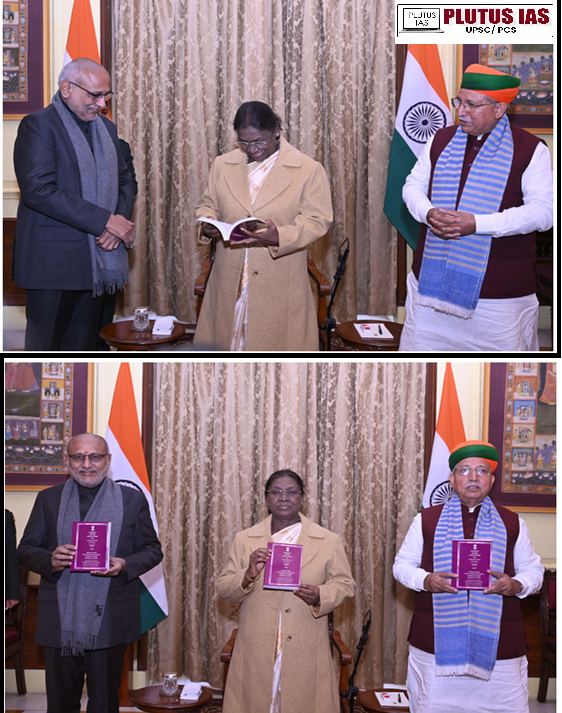
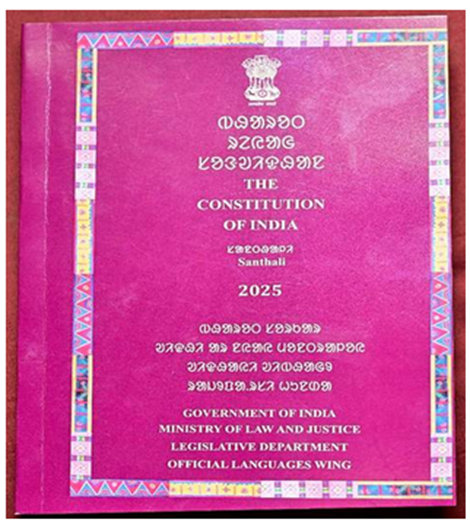
In February 2026, the Ministry of Culture, in collaboration with the Santhali newspaper Fagun, organized the inaugural centenary celebrations of the Ol Chiki script in New Delhi. To commemorate 100 years of this indigenous script (1925–2025), the Government of India released a ₹100 commemorative coin and a postage stamp. This follows the landmark release of the Constitution of India translated into Santhali using the Ol Chiki script in December 2025.
Defining Ol Chiki
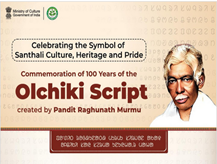
Ol Chiki is the official and indigenous writing system of the Santhali language, a prominent tribal language belonging to the Austroasiatic family. Created in 1925 by the visionary Pandit Raghunath Murmu, the script comprises 30 letters specifically designed to represent the unique phonetic features of Santhali, such as glottal stops and specific vowel patterns, which external scripts often fail to capture accurately.
Historical Background and Context
For centuries, Santhali was maintained through a rich oral tradition of folklore, songs, and storytelling. Before the 20th century, the language was transcribed using borrowed scripts like Roman, Bengali, Odia, and Devanagari. However, these writing systems were inadequate for Santhali’s distinctive phonetics, leading to distortions in meaning and pronunciation. Recognizing this gap, Pandit Raghunath Murmu (born 1905 in Odisha) developed Ol Chiki to provide his community with a scientific and dedicated writing system. His work, including the first book in Ol Chiki, Hital Serena (1936), transformed Santhali from an oral medium into a structured written legacy.
Constitutional and Legal Dimensions
The journey of Ol Chiki is closely tied to India’s constitutional framework for linguistic diversity:
• Eighth Schedule Inclusion: Through the 92nd Constitutional Amendment Act of 2003, Santhali was formally included in the Eighth Schedule of the Constitution. This transition from a marginalized language to a formally recognized one enabled its use in competitive exams, governance, and public communication.
• Linguistic Justice: The 2025 translation of the Constitution into Santhali using Ol Chiki by the Legislative Department serves as a tool for democratic empowerment. It allows Santhali speakers to directly engage with constitutional provisions, including tribal safeguards under the Fifth and Sixth Schedules.
• Article 29 & 350A: While not explicitly cited in the press note, this development aligns with Article 29 (protection of interests of minorities/distinct scripts) and Article 350A (instruction in mother tongue at the primary stage).
Significance and Importance
1. Phonetic Authenticity: Unlike borrowed writing systems, Ol Chiki was designed with 30 letters to specifically capture the unique phonetic features of Santhali, such as glottal stops and specific vowel patterns.
2. Transition to Written Legacy: The script enabled Santhali to transition from a purely oral tradition into a structured written medium, allowing for the accurate recording of vocabulary and grammar.
3. Constitutional Validation: The existence and adoption of the script facilitated the 2003 inclusion of Santhali in the Eighth Schedule of the Constitution via the 92nd Amendment Act.
4. Democratic Empowerment: By enabling the translation of the Constitution of India into an indigenous script, Ol Chiki provides Santhali speakers direct access to their legal rights and tribal safeguards.
5. Symbol of Self-Determination: Ol Chiki serves as a vital symbol of linguistic dignity, cultural resilience, and intellectual self-determination for the Santhal community.
6. National Cultural Integration: The formal recognition through commemorative coins and stamps acknowledges tribal knowledge systems as an integral part of India’s national cultural mosaic.
Key Issues and Challenges
1. Distortion via External Scripts: Historically, the use of Roman, Bengali, Odia, and Devanagari scripts led to significant distortions in the pronunciation and meaning of Santhali words.
2. Barriers to Documentation: The absence of a standardized script for centuries posed challenges for formal documentation, literary development, and the preservation of cultural memory.
3. Educational Impediments: Before Ol Chiki’s widespread adoption, the mismatch between the language’s sounds and external scripts created persistent obstacles in educational contexts.
4. Administrative Marginalization: For much of its history, the language was considered administratively marginalized, lacking institutional support in governance and public communication.
5. Risk to Oral Traditions: Relying solely on oral transmission made the continuity of identity and folklore vulnerable to generational gaps and external cultural pressures.
6. Institutional Gaps: Until its formal recognition, there was a lack of systemic support for using the language in competitive examinations and high-level academic research.
Way Forward
1. Institutionalizing Education: There is a need to further integrate Ol Chiki into formal school curricula and state-level publications to ensure the script’s survival among youth.
2. Expanding Digital Presence: To remain a “vibrant written medium,” the script must be increasingly adapted for digital platforms, social media, and modern knowledge systems.
3. Enhancing Linguistic Justice: The government should continue translating essential legal and administrative documents into Santhali to deepen democratic engagement.
4. Promoting Literary Research: Supporting academic research at the university level (following the example of Ranchi University) can help archive Santhali oral history using the script.
5. Safeguarding Knowledge Traditions: Policy efforts should focus on using Ol Chiki as a tool to preserve indigenous knowledge traditions for future generations.
6. Bridging Tradition and Modernity: Future initiatives should position the script as both a protector of tribal identity and a bridge that enables speakers to engage fully with modern public life.
Conclusion
Prelims question:
Q. With reference to the Ol Chiki script, consider the following statements:
1. It is the indigenous writing system of the Santhali language.
2. It was created by Pandit Raghunath Murmu in 1925.
3. Santhali was included in the Eighth Schedule through the 92nd Constitutional Amendment Act, 2003.
Which of the statements given above is/are correct?
(a) 1 only
(b) 1 and 2 only
(c) 2 and 3 only
(d) 1, 2 and 3
Answer: D
Mains Question:
Q. The centenary of the Ol Chiki script marks a significant milestone in India’s journey toward linguistic justice and cultural preservation. Discuss its historical evolution, constitutional significance, and role in strengthening tribal identity. Also examine the challenges in its contemporary adoption. (250 words)

- Europe’s AI Rules May Become India’s Opportunity - August 14, 2026
- Transparency as the Foundation of Trust in Medicine - August 14, 2026
- A Timely Reset for the Food Security Act: From Foodgrain Security to Nutrition Security - August 13, 2026

No Comments