


14 Aug Pakistan’s Jinnah-1 Rover to Join China’s 2029 Moon Mission: UPSC & PCS Prep
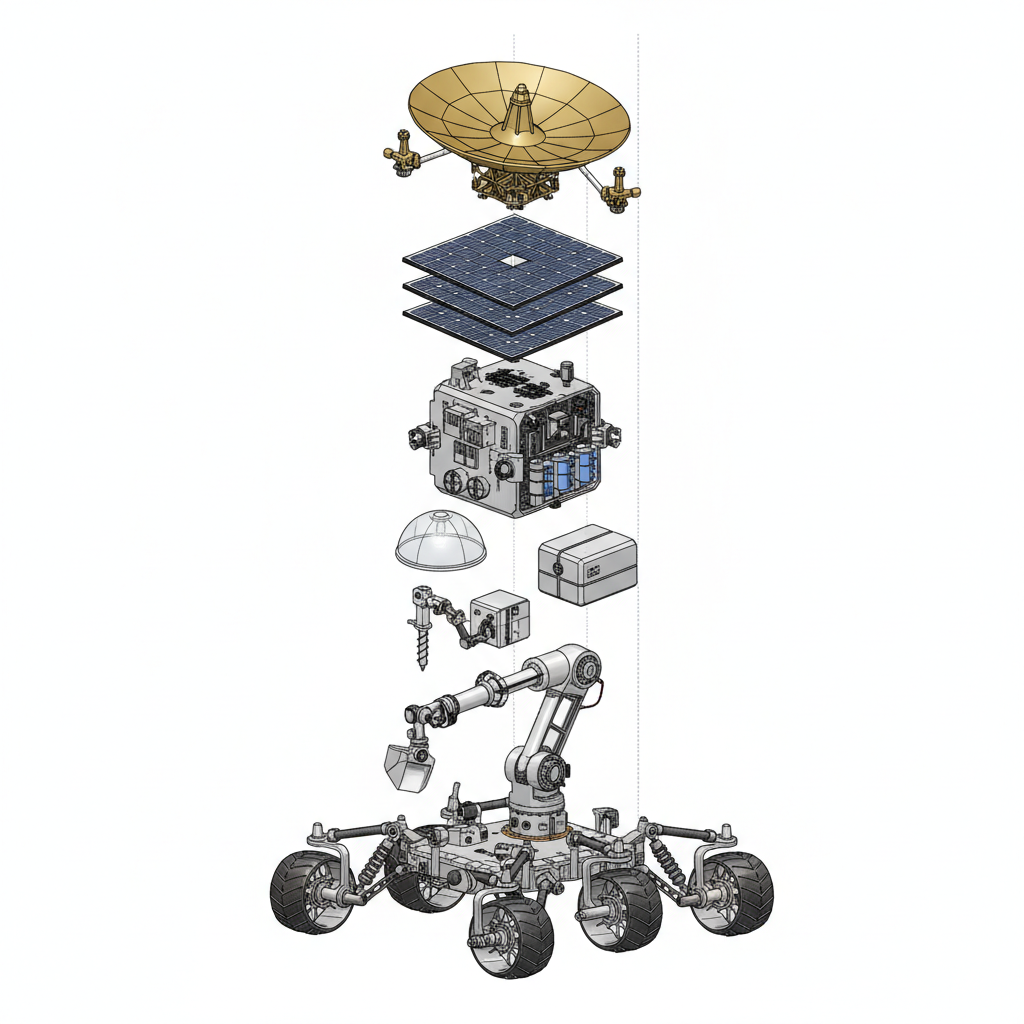
✎ The Jinnah-1 rover, aboard China’s Chang’e-8 mission, will study lunar south pole geology, radiation, and plasma, marking Pakistan’s first deep-space mission and underscoring the strategic importance of international space…
Subject Relevance — Where This Topic Fits
- GS Paper III — Science and Technology — Developments and their Applications and Effects in Everyday Life | GS Paper III — Awareness in the fields of Space | GS Paper II — International Relations — Bilateral, Regional and Global Groupings and Agreements involving India and/or affecting India’s interests
- Prelims: Chang’e Programme, Lunar South Pole, Suparco, Space Diplomacy, Artemis Programme, Regolith, Plasma and Radiation Studies on Moon, International Lunar Research Station (ILRS)
- Essay: The New Space Race: Cooperation, Competition, and the Quest for Lunar Resources, Scientific Collaboration in the 21st Century: Balancing National Ambitions and Global Knowledge
Quick Revision: The Jinnah-1 rover, aboard China’s Chang’e-8 mission, will study lunar south pole geology, radiation, and plasma, marking Pakistan’s first deep-space mission and underscoring the strategic importance of international space cooperation.
Why is this in the news?
Pakistan’s announcement of its first lunar rover, Jinnah-1, scheduled for launch aboard China’s Chang’e-8 mission in 2029, marks a significant expansion of international lunar exploration efforts. This development underscores the strategic importance of the lunar south pole, where the rover will conduct scientific studies on plasma, radiation, and geology. The collaboration reflects broader trends in space diplomacy, where emerging spacefaring nations are leveraging international partnerships to advance their scientific and technological capabilities.
Background
- The lunar south pole has emerged as a focal point for global space missions due to its permanently shadowed regions, which may contain water ice—a critical resource for future lunar habitation and scientific research.
- China’s Chang’e programme, named after the Chinese moon goddess, represents one of the most ambitious lunar exploration initiatives, with missions ranging from orbiters to sample-return and now in-situ exploration.
- The Chang’e-8 mission is part of China’s broader lunar exploration strategy, which includes plans for a permanent lunar research station in collaboration with international partners.
- The Artemis Programme, led by NASA, is another major effort targeting the lunar south pole, aiming to return humans to the Moon and establish sustainable exploration.
- Space diplomacy has evolved into a key tool for nations to share technological expertise, reduce costs, and foster international cooperation in high-cost, high-risk space missions.
- Suparco, Pakistan’s national space agency, was established in 1961 and has historically focused on satellite development, remote sensing, and atmospheric research, with this mission marking its first foray into deep space exploration.
What is the Jinnah-1 Rover and the Chang’e-8 Mission?
- Jinnah-1 is Pakistan’s first lunar rover, developed by the Space and Upper Atmosphere Research Commission (Suparco), and is scheduled to be deployed as part of China’s Chang’e-8 mission in 2029.
- The rover is named in honour of Muhammad Ali Jinnah, the founder of Pakistan, symbolising the country’s commitment to scientific progress and space exploration.
- Chang’e-8 is a robotic lunar mission under China’s Chang’e programme, designed to land near the lunar south pole and conduct in-situ scientific experiments, including the study of lunar regolith and the testing of 3D printing technologies using lunar soil.
- The mission will involve international collaboration, with 11 countries and regions, including Russia, Türkiye, South Africa, and Italy, participating in various scientific and technological experiments.
- Jinnah-1 will weigh approximately 35 kg and carry instruments to study lunar soil composition, radiation levels, and plasma environments, as well as to map the lunar surface and test technologies for future exploration.
- The rover will operate under the control of Pakistani specialists after landing, with China providing the lander and launch vehicle, highlighting a model of international cooperation in space missions.
- The mission aligns with broader efforts to explore the lunar south pole, a region of scientific interest due to its potential water ice deposits and suitability for future human bases.
- This collaboration represents a milestone for Pakistan’s space programme, demonstrating its growing capabilities in deep space exploration and its integration into the global space community.
Key Features
| Feature | Significance |
|---|---|
| Jinnah-1 Rover | First indigenous lunar rover developed by Pakistan’s Suparco, marking a technological milestone in the country’s space programme. |
| Chang’e-8 Mission Collaboration | Integration of Jinnah-1 with China’s Chang’e-8 mission, enabling Pakistan to participate in an international lunar exploration effort. |
| Lunar South Pole Focus | Scientific studies of the lunar south pole, a region of strategic importance due to potential water ice deposits and unexplored terrain. |
| Plasma and Radiation Sensors | Instruments aboard Jinnah-1 to study lunar plasma and radiation, contributing to understanding of space weather and lunar environment. |
| Terrain Testing Instrument (TTI) | Device to analyse lunar soil characteristics, aiding future lunar construction and resource utilisation technologies. |
| 3D Printing with Regolith Experiment | Part of Chang’e-8 mission to test in-situ resource utilisation, critical for sustainable lunar base construction. |
Why it Matters
Scientific Advancement
- Demonstrates Pakistan’s growing capability in space technology through indigenous rover development and international collaboration.
- Advances global understanding of the lunar south pole, a key target for future human and robotic missions.
- Contributes to the study of lunar geology, plasma, and radiation, supporting long-term lunar exploration goals.
International Cooperation
- Strengthens Pakistan-China bilateral ties in space exploration, aligning with China’s broader lunar programme.
- Facilitates participation in a multi-national mission (11 countries/regions), enhancing scientific exchange and technological sharing.
- Demonstrates the viability of international partnerships in addressing complex space exploration challenges.
Strategic and Geopolitical Implications
- Positions Pakistan as a participant in the global space race, particularly in lunar exploration, alongside established players like the US, China, and India.
- Highlights the strategic importance of the lunar south pole, a region of interest for resource extraction and future human settlements.
- Underscores the role of space missions in projecting soft power and technological prowess on the global stage.
Technological Innovation
- Showcases advancements in miniaturised robotic systems for planetary exploration, relevant to India’s own lunar and interplanetary missions.
- Supports research in in-situ resource utilisation (ISRU), a critical area for sustainable space exploration.
- Encourages development of indigenous technologies in robotics, sensors, and data analysis within Pakistan’s space sector.
Challenges
1. Technological Readiness
- Development of a 35 kg rover with advanced instruments requires significant engineering and testing capabilities.
- Integration with China’s Chang’e-8 mission demands compatibility with lander systems and communication protocols.
- Ensuring reliability of instruments in the harsh lunar environment, including extreme temperatures and radiation.
UPSC Link: Science & Tech – Space Missions
2. Mission Timelines and Delays
- The launch, currently scheduled for 2029, may face delays due to technical or logistical challenges in either Pakistan’s or China’s programme.
- Coordinating with multiple international partners (11 countries) adds complexity to mission planning and execution.
UPSC Link: Science & Tech – Space Missions
3. Scientific Uncertainty in Lunar South Pole
- The permanently shadowed regions of the lunar south pole pose challenges for rover mobility and instrument operation.
- Limited prior data on the region increases the risk of unexpected geological or environmental conditions affecting mission objectives.
UPSC Link: Geography – Lunar Surface Features
4. Resource Constraints
- Limited funding and infrastructure in Pakistan’s space programme may constrain the scope and scale of the mission.
- Dependence on China for launch and lander services raises questions about long-term sustainability and self-reliance.
UPSC Link: Economy – Space Sector Investment
5. Data Ownership and Sharing
- Ensuring equitable access to scientific data generated by the mission among international partners may pose diplomatic and technical challenges.
- Balancing national pride (e.g., naming the rover after Jinnah) with collaborative research goals requires careful negotiation.
UPSC Link: International Relations – Data Governance
Challenges — UPSC Perspective
| Issue | Concern |
|---|---|
| Rover Development | Achieving technical readiness within the constrained timeline for a first-of-its-kind mission. |
| International Coordination | Managing logistics, communication, and data-sharing among 11 participating countries. |
| Lunar Environment | Operating instruments in extreme cold, radiation, and low-gravity conditions near the lunar south pole. |
| Mission Funding | Securing and sustaining financial resources for development, testing, and launch phases. |
| Data Sovereignty | Ensuring national and international stakeholders have fair access to mission data without compromising proprietary interests. |
| Technology Transfer | Balancing collaboration with China while developing indigenous capabilities in space technology. |
Way Forward
- Enhance indigenous R&D in space robotics and sensor technologies to reduce dependence on foreign collaborations.
- Strengthen bilateral and multilateral agreements for joint lunar missions, focusing on technology sharing and capacity building.
- Invest in ground-based testing facilities to simulate lunar conditions, improving mission reliability and reducing risks.
- Develop a national space policy framework to guide long-term goals, funding, and international partnerships.
- Promote STEM education and research in planetary science to build a skilled workforce for future space missions.
- Establish a dedicated lunar exploration programme within Suparco, with clear milestones and timelines.
- Encourage private sector participation in space technology development to diversify funding and innovation sources.
- Collaborate with international agencies (e.g., ISRO, NASA) for knowledge exchange and joint missions.
UPSC Value Addition
Keywords for Mains Answer-Writing
Lunar South Pole · International Lunar Research Station (ILRS) · Chang’e-8 mission · Pakistan Space and Upper Atmosphere Research Commission (SUPARCO) · Jinnah-1 lunar rover · Lunar regolith utilisation · Space cooperation between China and Pakistan · Permanently shadowed regions (PSRs) · Lunar water ice · Artemis Accords · Multilateral space exploration · Lunar geology and plasma studies
Concept Flow
Global interest in lunar south pole exploration → China’s Chang’e programme and international collaborations → Pakistan’s Suparco develops Jinnah-1 rover → Integration with Chang’e-8 mission → Launch and lunar landing → Scientific data collection and analysis → Contribution to lunar geology, plasma, and radiation studies → Advancements in in-situ resource utilisation → Paving the way for future human missions and lunar bases
Prelims Practice Questions
Q1. Consider the following statements regarding the Chang’e-8 mission:
1. It is a lunar mission focused on the Moon’s south pole.
2. The mission includes a Pakistani rover named Jinnah-1.
3. The mission aims to test technologies for using lunar regolith in 3D printing.
4. The mission is being conducted solely by China without any international cooperation.
How many of the above statements are correct?
- Only one
- Only two
- Only three
- All
Answer: Only three — Statements 1, 2, and 3 are correct. Statement 4 is incorrect as the Chang’e-8 mission involves international cooperation with 11 countries and regions.
Q2. Assertion (A): The lunar south pole is a region of significant scientific interest due to the presence of permanently shadowed areas.
Reason (R): Permanently shadowed areas at the lunar south pole may contain water ice deposits, which are crucial for future lunar exploration and potential human habitation.
Options:
A. Both A and R are true, and R is the correct explanation of A.
B. Both A and R are true, but R is not the correct explanation of A.
C. A is true, but R is false.
D. A is false, but R is true.
Answer: ? — Both the assertion and reason are correct. The presence of permanently shadowed regions at the lunar south pole is a key reason for scientific interest, as these areas may harbour water ice deposits essential for future exploration.
Q3. Match the following lunar missions with their respective countries:
Column I (Mission) | Column II (Country)
——————————————
1. Chang’e-8 | A. India
2. Jinnah-1 rover | B. Pakistan
3. Chandrayaan-3 | C. China
4. Artemis programme | D. USA
Options:
A. 1-C, 2-B, 3-A, 4-D
B. 1-A, 2-B, 3-C, 4-D
C. 1-D, 2-A, 3-B, 4-C
D. 1-C, 2-D, 3-A, 4-B
Answer: ? — The correct matches are: 1. Chang’e-8 (China), 2. Jinnah-1 rover (Pakistan), 3. Chandrayaan-3 (India), 4. Artemis programme (USA).
Mains Practice Question
✍ The collaboration between China’s Chang’e-8 mission and Pakistan’s Jinnah-1 rover represents a significant milestone in international lunar exploration. Critically examine the scientific and strategic implications of such multilateral space missions for the future of lunar research and human spaceflight. (15 Marks)
Approach: MODEL-ANSWER SKELETON:
1. **Scientific Implications**:
– Highlight the importance of the lunar south pole for studying permanently shadowed regions (PSRs) and potential water ice deposits (cite NASA/ISRO findings).
– Explain the role of Jinnah-1 in studying lunar plasma, radiation, and geology, and its contribution to understanding lunar regolith utilisation.
– Mention the Chang’e-8 mission’s focus on 3D printing using lunar regolith, a critical technology for sustainable lunar bases.
2. **Strategic Implications**:
– Discuss how multilateral missions like Chang’e-8 foster international cooperation in space exploration, reducing duplication of efforts and sharing costs.
– Analyse the geopolitical dimension: China’s ILRS initiative and Pakistan’s participation as part of its space diplomacy.
– Compare with other initiatives like the Artemis Accords and India’s Chandrayaan programme to illustrate the evolving landscape of lunar exploration.
3. **Challenges and Limitations**:
– Address technical challenges: landing precision, communication delays, and operational constraints in the lunar south pole’s harsh environment.
– Highlight ethical considerations: equitable access to lunar resources and the need for a regulatory framework (cite Outer Space Treaty, Artemis Accords).
4. **Future Trajectory**:
– Outline the potential for human missions to the lunar south pole, including the role of international partnerships in supporting Artemis and other programmes.
– Conclude with a balanced view: while multilateral missions accelerate scientific progress, they also raise questions about sovereignty, technology transfer, and long-term sustainability.
Source: Times of India
Generated by AanyaAi for educational purpose.

- Gurugram’s groundwater extraction exceeds limit by 212%; HC seeks ban - October 4, 2026
- स्वतंत्रता सेनानी श्यामजी कृष्ण वर्मा की जन्म जयंती पर पीएम का श्रद्धांजलि - October 4, 2026
- KWML’s Feasibility Reports for Water Metro in 18 Cities: UPSC & PCS Insights - October 3, 2026

No Comments