


16 Jul Parivartan Scheme: NCR’s Old Vehicle Replacement for Pollution Control
Subject Relevance — Where This Topic Fits
- GS Paper I — Urbanisation, Environmental Degradation | GS Paper II — Government Policies and Interventions, Federalism | GS Paper III — Environmental Pollution & Degradation, Conservation, Infrastructure, Economy (Growth & Development, Mobilisation of Resources)
- Prelims: Parivartan Scheme, NCAP, BS-VI standards, Vehicle Scrappage Policy, National Capital Region Planning Board (NCRPB), Original Equipment Manufacturers (OEMs), Certificate of Deposit (CoD) Trading, Air Quality Index (AQI), PM2.5, PM10, Ministry of Housing and Urban Affairs (MoHUA)
- Essay: Sustainable Urbanisation and Environmental Governance: A Path to Healthier Cities, The Nexus of Economic Growth, Environmental Protection, and Public Health in India
Quick Revision: The ‘Parivartan’ Scheme, approved by MoHUA and implemented by MoRTH with NCRPB financial aid, offers comprehensive incentives to replace old, polluting trucks and buses in the NCR with BS-VI or electric vehicles, aiming to significantly improve air quality and promote green mobility through a multi-stakeholder, digitally-enabled approach.
Why is this in the news?
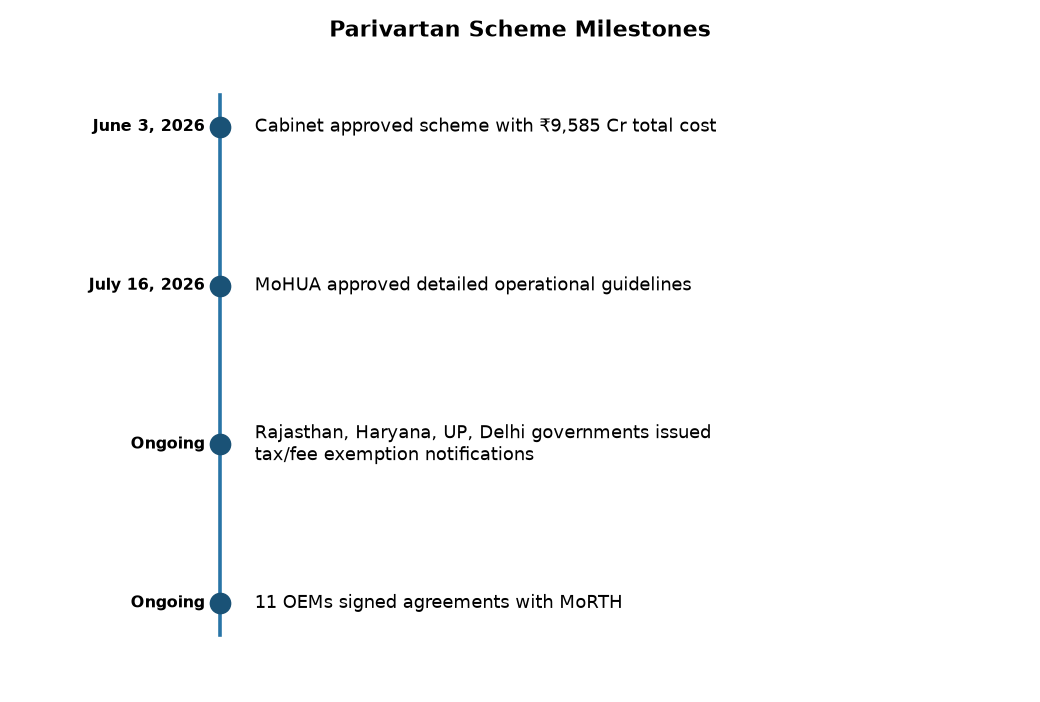
The Ministry of Housing and Urban Affairs (MoHUA) has recently approved the detailed operational guidelines for the ‘Parivartan’ Scheme, a significant initiative aimed at accelerating the replacement of old and highly polluting trucks and buses in the National Capital Region (NCR) with cleaner Bharat Stage (BS)-VI compliant or electric vehicles. This approval follows the Central Cabinet’s sanction of the scheme on June 3, 2026, with a total outlay of ₹9,585 crore, marking its readiness for implementation.
Background
- The National Capital Region (NCR) consistently faces severe air pollution challenges, particularly from vehicular emissions, which significantly impact public health and environmental quality.
- Previous efforts to mitigate vehicular pollution in the NCR have included the implementation of stricter emission norms (e.g., BS-VI), the Eastern and Western Peripheral Expressways to divert non-destined heavy vehicles, and various Graded Response Action Plan (GRAP) measures.
- The ‘Parivartan’ scheme aligns with the broader vision of Prime Minister Shri Narendra Modi to reduce vehicular pollution in Delhi-NCR, promote clean transportation, and ensure a healthier living environment for citizens.
- The scheme builds upon the existing ‘Voluntary Vehicle Fleet Modernization Program’ (Vehicle Scrappage Policy) by specifically targeting commercial vehicles in a critically polluted region.
- Inter-state cooperation is crucial for addressing pollution in the NCR, as emissions from one constituent state often impact others, necessitating a coordinated approach.
- The scheme’s approval by MoHUA, with implementation by MoRTH and financial assistance via NCRPB, underscores a multi-ministerial and multi-agency collaborative framework.
What is the ‘Parivartan’ Scheme?
- Parivartan (Parivahan Se Hone Wale Vayu Pradushan Aur Network Utserjan Mein Kami Laane Ke Liye Vahan Parisampattiyon Ka Twarit Navinikaran Evam Protsahan Karyakram) is a Central Sector Scheme.
- Its primary objective is the rapid replacement of old, highly polluting trucks and buses operating in the National Capital Region (NCR) with new Bharat Stage (BS)-VI compliant or Electric Vehicles (EVs).
- The scheme has a total outlay of ₹9,585 crore, with a budgetary support of ₹5,041 crore from the Central Government.
- Implementation responsibility lies with the Ministry of Road Transport and Highways (MoRTH), with financial assistance channelled through the National Capital Region Planning Board (NCRPB).
- It offers a comprehensive package of incentives to beneficiaries, including financial subsidies, tax concessions, and non-financial benefits.
- The scheme is designed to be executed through an integrated digital platform, ensuring transparency, efficiency, and a fully digital process for availing benefits.
- Key stakeholders include the Central Government, NCR constituent states (Rajasthan, Haryana, Uttar Pradesh, NCT Delhi), Original Equipment Manufacturers (OEMs), and financial institutions.
- It is a targeted intervention to improve the Air Quality Index (AQI) in the NCR by addressing a significant source of vehicular emissions.
Key Features
| Feature | Significance |
|---|---|
| Targeted Vehicle Replacement | Focuses specifically on old, polluting trucks and buses in NCR, directly addressing a major source of air pollution. |
| Comprehensive Incentive Package | Includes motor vehicle tax concessions, registration fee waivers, interest subsidies on loans, OEM discounts, fuel vouchers, and one-time financial aid for EVs, making replacement economically viable for owners. |
| Inter-State Cooperation | State governments of Rajasthan, Haryana, Uttar Pradesh, and NCT Delhi have notified tax and fee concessions, demonstrating a unified regional approach to pollution control. |
| Industry Partnership | Over 95% of commercial vehicle market share represented by 11 OEMs signing MoUs to provide discounts, ensuring broad industry support and availability of compliant vehicles. |
| Digital Implementation Platform | Integration with ‘Vahan’, ‘V-Scrap’, ‘DigiELV’, ‘PFMS’, financial institutions, and fuel voucher systems ensures transparent, efficient, and fully digital delivery of benefits. |
| Certificate of Deposit (CoD) Trading | Introduces a market-based mechanism for vehicle scrapping, potentially enhancing the economic viability and environmental benefits of the scheme. |
Why it Matters
Environmental Improvement and Public Health
- Directly targets a major source of particulate matter (PM2.5, PM10), nitrogen oxides (NOx), and other harmful pollutants, leading to a significant reduction in vehicular emissions in the NCR.
- Promotes the adoption of cleaner BS-VI vehicles and electric vehicles, contributing to better air quality and mitigating the adverse health impacts of air pollution on millions of residents.
- Supports India’s commitments under international agreements like the Paris Agreement by reducing greenhouse gas emissions from the transport sector.
Economic and Industrial Stimulus
- Stimulates demand for new, cleaner commercial vehicles, providing a boost to the automotive manufacturing sector and associated industries (e.g., EV charging infrastructure, battery production).
- Creates employment opportunities in manufacturing, sales, servicing, and scrapping sectors.
- Reduces fuel consumption and operational costs for fleet owners through more fuel-efficient and electric vehicles, contributing to economic savings in the long run.
Policy Coherence and Governance
- Demonstrates a coordinated, multi-stakeholder approach involving central ministries, state governments, and the private sector, setting a precedent for complex environmental challenges.
- Reinforces the ‘Swachh Bharat’ vision by extending it to air quality and sustainable transportation.
- Leverages digital infrastructure for transparent and efficient scheme delivery, enhancing governance and reducing bureaucratic hurdles.
Technological Advancement and Innovation
- Accelerates the transition to advanced emission technologies (BS-VI) and electric mobility, fostering innovation in vehicle design, battery technology, and charging solutions.
- Encourages research and development in green transportation technologies, positioning India as a leader in sustainable mobility solutions.
Challenges
1. Enforcement and Monitoring
- Ensuring strict enforcement of the scheme’s provisions and preventing the continued operation of non-compliant vehicles, especially those registered outside NCR but operating within it.
- Robust monitoring mechanisms are required to track vehicle replacements, verify eligibility, and prevent fraudulent claims for incentives.
UPSC Link: GS Paper III — Environmental Pollution & Degradation
2. Financial Viability for Small Operators
- Despite incentives, the upfront cost of new BS-VI or electric vehicles might still be prohibitive for small fleet owners and individual truck/bus operators, potentially leading to resistance.
- Access to credit for these operators, even with interest subsidies, could be a bottleneck.
UPSC Link: GS Paper III — Indian Economy and Issues Relating to Planning, Mobilization of Resources
3. Infrastructure for EVs
- The successful transition to electric vehicles requires a robust and widespread charging infrastructure, which is currently nascent in many parts of the NCR.
- Availability of charging stations, grid capacity, and interoperability standards are critical challenges.
UPSC Link: GS Paper III — Infrastructure: Energy, Ports, Roads, Airports, Railways etc.
4. Inter-State Coordination
- While states have agreed to concessions, ensuring seamless coordination on operational aspects, data sharing, and grievance redressal across multiple state administrations can be complex.
- Variations in implementation efficiency across states could lead to uneven outcomes.
UPSC Link: GS Paper II — Functions and Responsibilities of the Union and the States
5. Scrappage Infrastructure
- The scheme will generate a large volume of end-of-life vehicles. Ensuring adequate, environmentally sound, and certified vehicle scrapping and recycling facilities is crucial.
- Preventing informal and polluting scrapping practices is essential to avoid shifting pollution burdens.
UPSC Link: GS Paper III — Environmental Pollution & Degradation
Challenges — UPSC Perspective
| Issue | Concern |
|---|---|
| Compliance Monitoring | Ensuring all old vehicles are indeed replaced and not re-registered or operated illegally. |
| Funding Sustainability | Long-term financial commitment and potential for future budget constraints impacting scheme continuity. |
| EV Charging Network | Inadequate EV charging infrastructure hindering widespread adoption of electric commercial vehicles. |
| Stakeholder Buy-in | Ensuring continued cooperation from all OEMs, financial institutions, and state governments. |
| Data Security & Integration | Protecting sensitive data on the digital platform and ensuring seamless integration across multiple systems. |
| Skill Development | Need for skilled workforce for maintenance and repair of BS-VI and electric vehicles. |
Government Initiatives — Must-Memorise for Prelims
- National Clean Air Programme (NCAP)
- FAME India Scheme (Faster Adoption and Manufacturing of Electric Vehicles)
- Voluntary Vehicle Fleet Modernization Program (Vehicle Scrappage Policy)
- Green Highway Policy
- Pradhan Mantri Ujjwala Yojana (PMUY)
- Smart Cities Mission
- Atal Mission for Rejuvenation and Urban Transformation (AMRUT)
- National Electric Mobility Mission Plan (NEMMP)
- Swachh Bharat Mission (Urban)
- Urban Transport Policy
Way Forward
- Establish a robust, real-time monitoring and evaluation framework to track the scheme’s progress, identify bottlenecks, and ensure accountability.
- Launch extensive awareness campaigns to educate vehicle owners about the benefits and procedures of the ‘Parivartan’ scheme, ensuring maximum participation.
- Strengthen the EV charging infrastructure across the NCR, including highways and logistics hubs, through public-private partnerships and targeted investments.
- Develop and enforce stringent regulations for vehicle scrapping and recycling, promoting certified facilities and circular economy principles.
- Explore innovative financing mechanisms, such as green bonds or carbon credits, to supplement budgetary allocations and ensure the long-term sustainability of such initiatives.
- Invest in skill development programs for mechanics and technicians to service and maintain BS-VI and electric commercial vehicles.
- Regularly review and update incentive structures based on market dynamics and technological advancements to maintain the scheme’s attractiveness.
- Promote research and development in indigenous green transport technologies, including advanced battery solutions and fuel alternatives.
UPSC Value Addition
Keywords for Mains Answer-Writing
Vehicular Pollution · Air Quality Management · Green Mobility · Circular Economy · Inter-State Cooperation · Sustainable Urbanisation · Public Health Imperative · Fiscal Incentives · Digital Governance · OEM Partnership · BS-VI Standards · Electric Vehicle Transition
Constitutional & Policy Linkages
- Article 21: Right to life (includes right to a clean environment)
- Article 48A: Protection and improvement of environment and safeguarding of forests and wildlife
- Article 246: Distribution of legislative powers (Union List, State List, Concurrent List for environmental matters)
- Environment (Protection) Act, 1986: Umbrella legislation for environmental protection
- Motor Vehicles Act, 1988: Regulates motor vehicles, including emission standards
- National Green Tribunal Act, 2010: Establishment of NGT for environmental justice
Concept Flow
High Vehicular Emissions in NCR → Adverse Air Quality & Public Health Impact → Government Intervention: ‘Parivartan’ Scheme → Incentives for Vehicle Replacement (Old to BS-VI/EV) → Reduced Emissions & Improved Air Quality → Enhanced Public Health & Sustainable Mobility
Prelims Practice Questions
Q1. With reference to the ‘Parivartan’ Scheme, consider the following statements:
1. The scheme aims to replace old trucks and buses in the National Capital Region with BS-VI compliant or electric vehicles.
2. The Ministry of Road Transport and Highways (MoRTH) is the implementing agency for the scheme.
3. It offers incentives including motor vehicle tax concessions and interest subsidies on vehicle loans.
Which of the statements given above are correct?
- A. 1 and 2 only
- B. 2 and 3 only
- C. 1 and 3 only
- D. 1, 2 and 3
Answer: D. 1, 2 and 3 — Statement 1 is correct: The scheme’s core objective is indeed the replacement of old, polluting commercial vehicles with cleaner alternatives in the NCR. Statement 2 is correct: While MoHUA approved the guidelines, MoRTH is designated as the implementing agency. Statement 3 is correct: The press release explicitly mentions motor vehicle tax concessions and 5% interest subsidy on vehicle loans as part of the incentive package.
Q2. Which of the following bodies provides financial assistance for the ‘Parivartan’ Scheme?
- A. Ministry of Finance
- B. NITI Aayog
- C. National Capital Region Planning Board (NCRPB)
- D. Central Pollution Control Board (CPCB)
Answer: C. National Capital Region Planning Board (NCRPB) — The press release clearly states that financial assistance for the ‘Parivartan’ Scheme will be made available through the National Capital Region Planning Board (NCRPB). This highlights the regional planning and development focus of the scheme.
Mains Practice Question
✍ The ‘Parivartan’ Scheme represents a multi-pronged approach to tackle vehicular pollution in the National Capital Region. Discuss its key features and potential significance in achieving sustainable urbanisation and improving public health. What challenges might impede its effective implementation, and suggest measures to overcome them? (250 words)
Approach: Begin by introducing the ‘Parivartan’ Scheme and its primary objective. Elaborate on its key features, such as the comprehensive incentive package, inter-state cooperation, and digital platform. Discuss its significance for environmental improvement, public health, economic stimulus, and policy coherence. Subsequently, identify potential challenges like enforcement, financial viability for small operators, EV infrastructure, and inter-state coordination. Conclude by suggesting actionable measures for effective implementation, focusing on robust monitoring, awareness, infrastructure development, and sustainable financing.
Source: PIB (Press Information Bureau)
Generated by AanyaAi for educational purpose.

- Indian Navy to Host Indo-Pacific Dialogue 2026: Security - October 23, 2026
- विशेष अभियान 6: जल संसाधन विभाग की उपलब्धियाँ, गंगा पुनरुद्धार सहित - October 23, 2026
- Shivraj Singh Chouhan launches ‘Khet Bachao Abhiyan’ to save farmland - October 23, 2026

No Comments