


23 Feb Pax Silica and the New Geopolitics of Technology: Strengthening India’s Strategic and Digital Sovereignty
This article covers “Daily Current Affairs” and From Pax Silica and the New Geopolitics of Technology: Strengthening India’s Strategic and Digital Sovereignty
SYLLABUS MAPPING
GS-2- International Relations- Pax Silica and the New Geopolitics of Technology: Strengthening India’s Strategic and Digital Sovereignty
FOR PRELIMS
What are semiconductors and why are they important for modern technology?
FOR MAINS
What are the challenges in semiconductor manufacturing in India?
Why in the News?
On February 20, 2026, India formally transitioned from a peripheral observer to a core participant in the global high-tech alliance by signing the Pax Silica declaration. This landmark event occurred on the sidelines of the India AI Impact Summit in New Delhi, marking a significant pivot in Indo-US relations and India’s positioning within the global semiconductor and Artificial Intelligence (AI) landscape. The signing follows months of diplomatic negotiation aimed at resolving trade-related uncertainties that had initially seen India excluded from the group’s launch in December 2025.
Defining Pax Silica
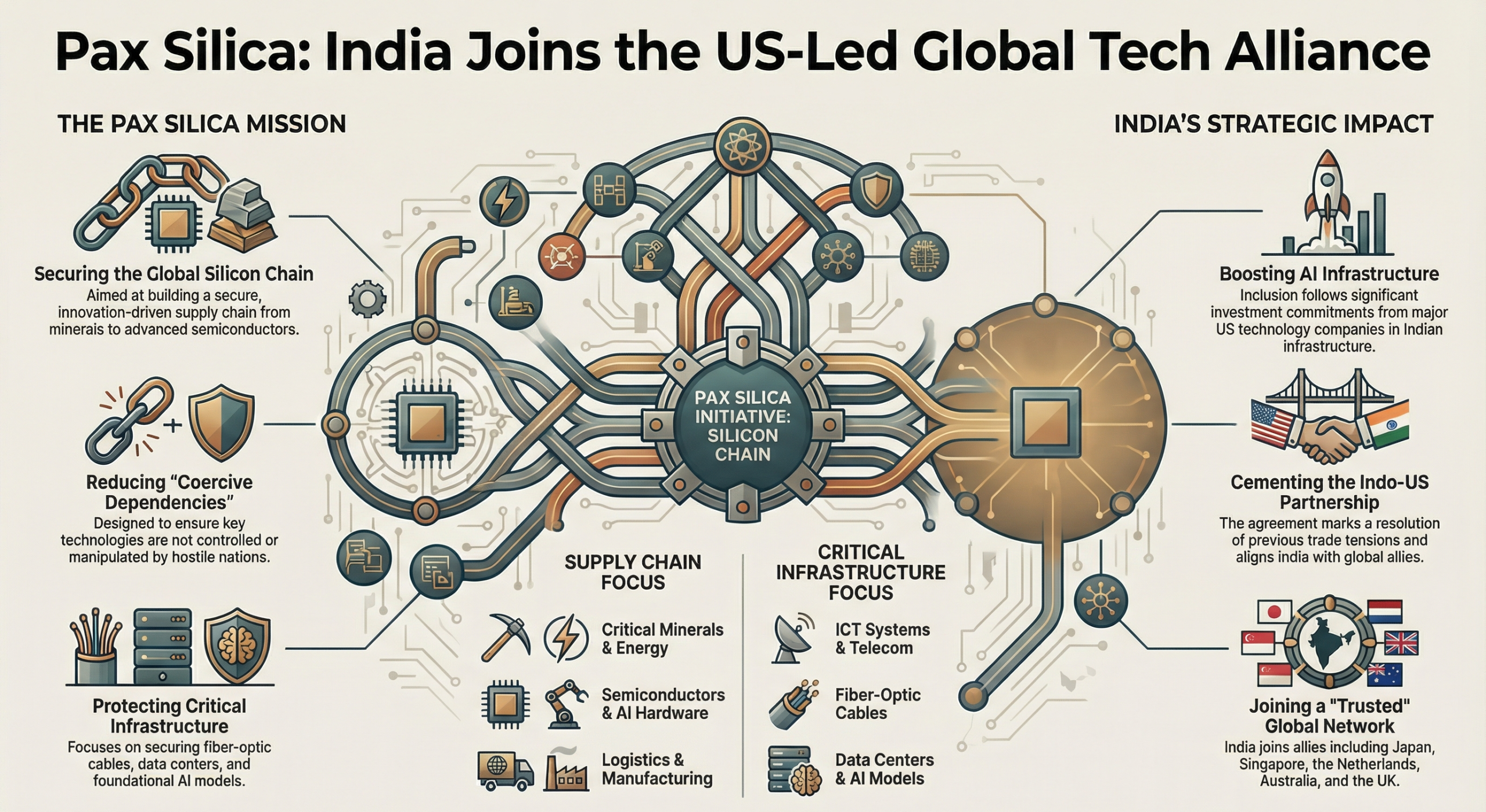
Pax Silica is a US-led strategic initiative designed to create a “secure, prosperous, and innovation-driven silicon supply chain.” According to the United States Department of State, the framework is predicated on the concept of “trusted geography,” bringing together friendly and trusted nations to ensure that critical and emerging technologies—specifically those involving semiconductors and AI—are safe, reliable, and insulated from the influence of hostile actors.
The scope of Pax Silica is comprehensive, covering the entire silicon lifecycle, including:
1. Upstream: Extraction and processing of critical minerals and energy inputs
2. Midstream: Advanced manufacturing and semiconductor fabrication
3. Downstream: AI infrastructure, logistics, and foundational models
4. Critical Infrastructure: Fiber-optic cables, data centers, and Information and Communication Technology (ICT) systems
Background and Context: From Exclusion to Convergence
The initiative was officially launched on December 12, 2025, with an initial membership consisting of allies such as Japan, Republic of Korea, Singapore, Netherlands, United Kingdom, Israel, United Arab Emirates, and Australia. India’s initial exclusion raised concerns among policy analysts regarding a potential trust deficit or trade friction between New Delhi and Washington. However, the arrival of US Ambassador Sergio Gor signaled a dialing down of tensions. The subsequent agreement on a framework for an Indo-US trade deal paved the way for India’s inclusion, reflecting a realization that India’s vast market and growing tech prowess are indispensable to the success of a China-plus-one strategy in the tech sector.
Significance and Importance
1. Countering Coercive Dependencies: The primary strategic objective of Pax Silica is to reduce coercive dependencies on countries of concern, specifically targeting China’s current dominance in global manufacturing supply chains.
2. Securing Critical Infrastructure: By joining this framework, India gains access to a trusted technology ecosystem, vital given long-standing security concerns regarding foreign involvement in sensitive sectors such as telecommunications and ICT.
3. Technological Parity: The initiative places India at the high table of global technology governance, ensuring participation in standards governing foundational AI models and applications.
4. Strategic De-risking: It provides a multilateral platform to de-risk supply chains from geopolitical shocks and unilateral disruptions.
Economic and Governance Aspects
1. Investment Inflow: India’s entry into Pax Silica is synchronized with substantial investment commitments from US tech giants. The participation of leaders like Sundar Pichai and Sam Altman at the AI summit underscores the value global capital places on the Indian AI and semiconductor ecosystem.
2. Catalyst for Domestic Missions: The partnership is expected to provide technological and financial impetus to the India Semiconductor Mission and the country’s AI ambitions.
3. Infrastructure Protection: The framework mandates higher security standards for data centers and fiber-optic cables, which are the backbone of the digital economy.
Key Issues and Challenges
1. Balancing Strategic Autonomy: A major challenge for Indian diplomacy will be participation in a US-led security architecture while preserving strategic autonomy and avoiding technological dependency.
2. Trade Uncertainties: Differences in trade policy can affect strategic cooperation, highlighting the need for regulatory consistency.
3. Implementation Gaps: Transitioning from a late-starter in semiconductors to a global leader requires overcoming domestic bottlenecks in infrastructure and skilled workforce availability.
Constitutional and Legal Dimensions
From a UPSC perspective, Pax Silica aligns with multiple constitutional and legal frameworks:
1. Article 51 (Directive Principles of State Policy): Promotes international peace, security, and honorable relations among nations.
2. Data Sovereignty and Privacy: The initiative intersects with India’s evolving data protection framework, including the Digital Personal Data Protection Act.
3. National Security: The emphasis on trusted ICT systems aligns with regulatory powers under the Information Technology Act, 2000, to block or regulate technologies threatening national security.
Global Comparison: The “Silicon Curtain”
1. Pax Silica represents a shift from globalized open-market tech chains toward geofenced or trusted chains. Unlike the Cold War-era Iron Curtain, the Silicon Curtain reflects selective decoupling rather than total isolation.
2. US Approach: Focus on security and maintaining technological edge over hostile players
3. India’s Approach: Transition from strict strategic autonomy toward selective alignment in critical sectors like telecom and AI
4. Regional Context: Inclusion of Indo-Pacific partners highlights broader regional alignment to secure silicon supply chains
Way Forward
1. Strengthening the Upstream: Secure access to critical minerals such as gallium and germanium essential for semiconductor fabrication
2. R&D and Human Capital: Invest heavily in foundational AI research and talent development to move from consumer to innovator
3. Legislative Harmony: Harmonize domestic tech regulations with Pax Silica standards for seamless integration
4. Incentivizing Private Sector: Translate global partnerships into domestic manufacturing facilities through the India Semiconductor Mission
Conclusion
Prelims question:
Q. Consider the following statements regarding semiconductor supply chains:
1. Semiconductors are critical components for Artificial Intelligence, telecommunications, and defence technologies.
2. The global semiconductor supply chain is concentrated only in raw material extraction and not in fabrication.
3. Supply chain diversification is often pursued to reduce geopolitical risks and coercive dependencies.
Which of the statements given above is/are correct?
(a) 1 and 2 only
(b) 1 and 3 only
(c) 2 and 3 only
(d) 1, 2 and 3
Answer: B
Mains Question:
Q. Discuss the significance of emerging technology alliances such as Pax Silica in shaping global semiconductor supply chains and India’s strategic and digital sovereignty. (250 words)

- RBI’s Shrinking Real-Rate Cushion Amid Rising Inflation and Strong Demand - September 21, 2026
- India’s NGOs at a New Funding Crossroads - September 21, 2026
- Deep-Sea Discovery, Environmental Responsibility - September 19, 2026

No Comments