


28 Jul PM E-DRIVE Scheme: ₹10,900 Cr Boost for Electric Mobility in India
Subject Relevance — Where This Topic Fits
- GS Paper III — Environment and Pollution Control | GS Paper III — Infrastructure: Energy | GS Paper III — Science and Technology — Developments and their Applications and Effects in Everyday Life | GS Paper III — Government Budgeting
- Prelims: FAME-II Scheme, Battery Swapping Policy, National Mission on Transformative Mobility and Battery Storage, Gross Vehicle Weight (GVW), Charging Infrastructure for Electric Vehicles (EVPIS), Production-Linked Incentive (PLI) Scheme for Automobile and Auto Components, National Electric Mobility Mission Plan (NEMMP) 2020, Vehicle Scrappage Policy
- Essay: India’s Energy Transition: Balancing Growth and Sustainability, The Role of Technology in Achieving Sustainable Development Goals
Quick Revision: The PM E-DRIVE Scheme incentivises EV adoption across six segments and phases out subsidies by 2028 to reduce vehicular emissions and enhance energy security.
Why is this in the news?
The PM E-DRIVE (Prime Minister’s Electric Drive Revolution in Innovative Vehicle Enhancement) Scheme, notified on 29 September 2024 and effective from 1 April 2024, has been notified by the Ministry of Heavy Industries. The scheme’s notification coincides with India’s broader decarbonisation targets under the Panchamrit commitments and the ‘LiFE’ (Lifestyle for Environment) initiative. Its implementation is critical for reducing vehicular emissions, enhancing energy security, and fostering domestic EV manufacturing under the ‘Make in India’ initiative.
Background
- India’s transport sector contributes approximately 10% to the country’s total CO₂ emissions, with road transport accounting for over 90% of this share. The adoption of electric vehicles (EVs) is central to India’s strategy to achieve net-zero emissions by 2070 and reduce oil import dependence.
- The National Electric Mobility Mission Plan (NEMMP) 2020, launched in 2013, aimed to achieve 6-7 million EV sales annually by 2020. However, progress was constrained by high upfront costs, limited charging infrastructure, and supply-side bottlenecks.
- The Faster Adoption and Manufacturing of Hybrid and Electric Vehicles (FAME) Scheme was introduced in 2015 under the NEMMP framework. FAME-II (2019–2024) allocated ₹10,000 crore to incentivise EV adoption and charging infrastructure, with a focus on e-2Ws, e-3Ws, e-buses, and e-cars.
- India’s EV ecosystem is supported by the Production-Linked Incentive (PLI) Scheme for Automobile and Auto Components (₹26,058 crore) and the Advanced Chemistry Cell (ACC) Battery Storage Scheme (₹18,100 crore), which aim to reduce import dependence in battery manufacturing.
- The scheme aligns with the ‘Make in India’ initiative and the ‘Atmanirbhar Bharat’ vision, encouraging domestic manufacturing of EVs, batteries, and charging equipment.
What is the PM E-DRIVE Scheme?
- The PM E-DRIVE Scheme is a centrally sponsored programme notified by the Ministry of Heavy Industries to accelerate the adoption of electric vehicles (EVs) in India.
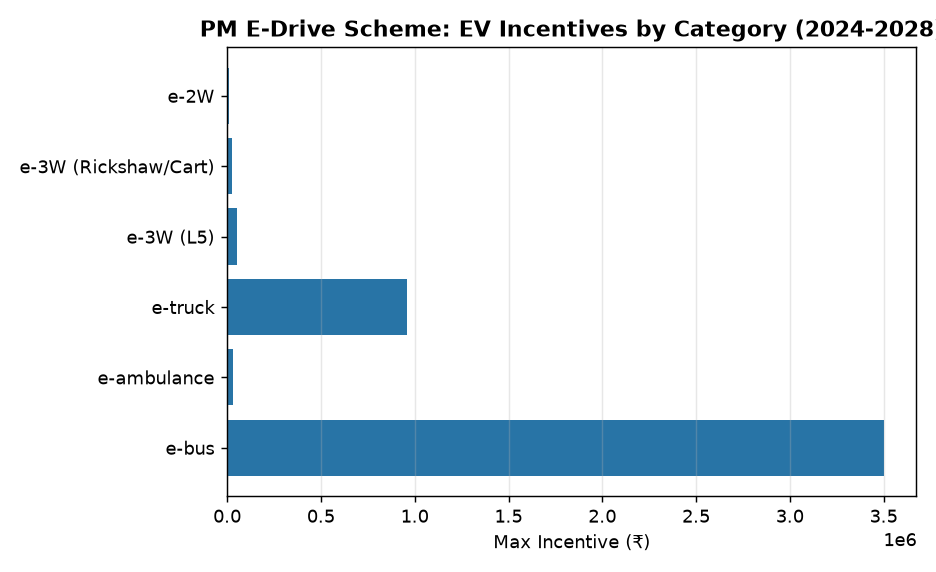
- The scheme categorises EVs into six segments—e-2Ws (electric two-wheelers), e-3Ws (electric three-wheelers including e-rickshaws and e-carts), e-3Ws (L5 category), e-trucks, e-ambulances, and e-buses—each with distinct incentive structures based on battery capacity (kWh) or vehicle cost.
- Incentives for e-2Ws and e-3Ws are provided as demand-side subsidies, capped at 15% of the ex-factory price.
- E-buses receive subsidies of ₹10,000 per kWh, capped at 20% of the vehicle cost as determined by CESL (Convergence Energy Services Ltd.), with additional caps based on bus length (e.g., ₹35 lakh for buses >10m and ≤12m).
- The scheme introduces a phased reduction in subsidies: for e-2Ws and e-3Ws, incentives are halved from FY 2025-26 onwards, while e-3W (L5) incentives were discontinued after 26 December 2025. This reflects a transition from subsidy-driven adoption to market maturity.
- The scheme mandates localisation of battery and EV components under the ‘Make in India’ initiative, with incentives structured to favour domestically manufactured vehicles and batteries.
- Monitoring and evaluation are conducted through the Vahan and Sarathi portals, with real-time data on incentivised vehicles, charging stations, and beneficiary OEMs (Original Equipment Manufacturers) tracked by the Ministry of Heavy Industries.
Key Features
| Feature | Significance |
|---|---|
| Total Financial Outlay | ₹10,900 crore allocated for a 4-year period (2024-28), demonstrating sustained fiscal commitment to EV ecosystem transformation. |
| Vehicle Categories Covered | Includes e-2W, e-3W (passenger and L5), e-trucks, e-ambulances, and e-buses, ensuring broad-based adoption across mobility segments. |
| Incentive Structure | Differential incentives per kWh and per vehicle, with caps based on vehicle type (e.g., ₹5,000/kWh for e-2W, ₹10,000 per e-bus), incentivizing both affordability and scale. |
| Phase-wise Reduction | Gradual reduction in incentives (e.g., e-2W from ₹5,000/kWh to ₹2,500/kWh post-July 2026), designed to wean dependence on subsidies while maintaining momentum. |
| Charging Infrastructure Support | ₹2,000 crore earmarked for public charging stations (EVPCS), addressing a critical bottleneck in EV adoption. |
| Manufacturing Localization | Incentives linked to ex-factory prices and domestic value addition, aligning with ‘Make in India’ objectives for the EV supply chain. |
Why it Matters
Environmental Impact
- Direct reduction in tailpipe emissions through substitution of ICE vehicles with EVs, contributing to India’s NDC targets under the Paris Agreement.
- Decline in fossil fuel consumption, particularly diesel and petrol, reducing import dependency and energy security risks.
- Improved urban air quality due to zero-emission mobility solutions, addressing public health challenges in metropolitan areas.
Economic and Industrial Strategy
- Catalyzes the growth of the EV manufacturing ecosystem, positioning India as a global hub for clean mobility solutions.
- Generates employment across the value chain—battery production, vehicle assembly, charging infrastructure, and recycling sectors.
- Enhances India’s competitiveness in the global EV market, leveraging PLI schemes and FDI inflows for technology transfer.
- Supports ancillary industries (e.g., power electronics, thermal management systems) through backward integration.
Energy Security and Infrastructure
- Reduces reliance on crude oil imports, mitigating fiscal pressures from volatile global energy markets.
- Promotes decentralized energy storage solutions, enabling grid stability and integration of renewable energy sources.
- Accelerates the development of a pan-India charging network, addressing range anxiety and enabling long-distance EV travel.
Social and Governance Outcomes
- Enables equitable access to clean mobility in Tier-II/III cities and aspirational districts through targeted incentives.
- Aligns with the ‘Viksit Bharat @2047’ vision by fostering inclusive, sustainable urban and rural transportation systems.
- Demonstrates policy continuity and long-term vision, critical for investor confidence and public trust in green transitions.
Challenges
1. Battery Supply Chain Dependence
- Heavy reliance on lithium-ion battery imports, exposing India to geopolitical risks and price volatility in critical raw materials.
- Limited domestic battery manufacturing capacity, necessitating strategic partnerships with global players (e.g., Tesla, CATL).
UPSC Link: GS3: Energy security, lithium reserves in India
2. Charging Infrastructure Gaps
- Uneven distribution of public charging stations, with urban-centric deployment leaving rural and remote areas underserved.
- High capital costs for fast-charging infrastructure, requiring innovative financing models (e.g., PPP, viability gap funding).
UPSC Link: GS3: Infrastructure financing, PPP models
3. Affordability and Consumer Adoption
- Upfront cost of EVs remains higher than ICE vehicles despite subsidies, deterring mass adoption in price-sensitive segments.
- Limited awareness and trust in EV technology among consumers, particularly regarding battery life, resale value, and safety.
UPSC Link: GS3: Consumer behavior, behavioral economics
4. Waste Management and Recycling
- Absence of a robust end-of-life battery recycling ecosystem, risking environmental contamination from e-waste.
- Lack of standardized recycling protocols and incentives for formal sector participation in battery recovery.
UPSC Link: GS3: Circular economy, e-waste management rules
5. Grid Integration and Power Demand
- Potential strain on the electricity grid during peak charging hours, necessitating smart grid solutions and demand-side management.
- Inadequate renewable energy penetration in the grid mix, limiting the true ‘green’ credentials of EVs in coal-dominated states.
UPSC Link: GS3: Power sector reforms, smart grids
Challenges — UPSC Perspective
| Issue | Concern |
|---|---|
| Raw Material Imports | 90% of lithium-ion batteries rely on imported lithium, cobalt, and nickel, vulnerable to supply chain disruptions. |
| Charging Desert Problem | Only 10% of India’s 600,000+ fuel stations have EV charging facilities, concentrated in metros. |
| Subsidy Dependency | Post-2026, reduced incentives may stall adoption without parallel cost reductions in battery technology. |
| Grid Stability Risks | Unmanaged EV charging could add 10-15 GW to peak demand by 2030, exceeding current grid capacities in some states. |
| Skill Gaps in Workforce | Shortage of trained technicians for EV maintenance, repair, and battery diagnostics across India. |
| Policy Fragmentation | Overlapping schemes (FAME-II, PLI, PM E-DRIVE) create confusion and administrative inefficiencies. |
Government Initiatives — Must-Memorise for Prelims
- Production-Linked Incentive (PLI) Scheme for Advanced Chemistry Cell (ACC) Battery Storage
- National Mission on Transformative Mobility and Battery Storage
Way Forward
- Scale up domestic battery manufacturing through PLI schemes, targeting 50 GWh capacity by 2030 to reduce import dependence.
- Launch a ‘One District, One Charging Station’ initiative to ensure equitable coverage in Tier-II/III cities and aspirational districts.
- Establish a National EV Recycling Authority to standardize battery recovery, incentivize formal sector participation, and fund R&D in recycling technologies.
- Integrate EV charging infrastructure with renewable energy projects (e.g., solar-powered charging hubs) to enhance grid stability and sustainability.
- Expand skill development programs under PMKVY and ITIs to train 1 million EV technicians by 2028, addressing the workforce gap.
- Rationalize subsidy structures post-2026 by transitioning to performance-based incentives (e.g., per km emission savings) to ensure fiscal sustainability.
- Strengthen inter-ministerial coordination (MoHI, MoP, MNRE) to align EV policies with grid modernization and renewable energy targets.
- Pilot ‘Battery-as-a-Service’ models in e-buses and e-trucks to reduce upfront costs and accelerate fleet electrification.
UPSC Value Addition
Keywords for Mains Answer-Writing
PM e-DRIVE Scheme · Electric Mobility Promotion · FAME India Phase-II · EV Manufacturing Ecosystem · Charging Infrastructure Development · Battery Swapping Policy · Gross Vehicle Weight (GVW) · Make in India in EV Sector · Carbon Emission Reduction · Fossil Fuel Substitution · State-wise EV Adoption Data · Demand Incentives for EVs · Tier-II and Tier-III Cities EV Incentives · Aspirational Districts EV Promotion · EV Battery Recycling Ecosystem
Concept Flow
Fossil fuel dependence → Rising import bills & energy insecurity → PM E-DRIVE scheme launched to promote EV adoption → EV adoption → Reduction in tailpipe emissions → Alignment with India’s NDCs and Paris Agreement commitments → Incentives under PM E-DRIVE → Increased demand for EVs → Expansion of domestic manufacturing (Make in India) → Domestic manufacturing growth → Job creation in battery, auto, and ancillary sectors → Economic growth and industrialization → Charging infrastructure development → Addresses range anxiety → Higher consumer confidence and adoption rates → Battery recycling ecosystem → Mitigates e-waste risks → Circular economy integration → Grid integration challenges → Need for smart grids and renewable energy integration → Energy transition acceleration
Prelims Practice Questions
Q1. Which of the following statements about the PM e-DRIVE Scheme is/are correct? 1) The scheme has a total financial outlay of ₹10,900 crore. 2) It provides incentives for electric trucks based on their Gross Vehicle Weight (GVW). 3) The scheme offers ₹5,000 per kWh incentive for e-2W and e-3W vehicles uniformly across all financial years. 4) The scheme mandates a 20% subsidy cap on the cost of e-buses as per CESL-determined prices.
- 1, 2 and 4 only
- 1, 2 and 3 only
- 2, 3 and 4 only
- 1, 2, 3 and 4
Answer: 1, 2 and 4 only — Statement 1 is correct as the total financial outlay of the PM e-DRIVE Scheme is ₹10,900 crore. Statement 2 is correct because incentives for electric trucks are structured based on their Gross Vehicle Weight (GVW). Statement 3 is incorrect as the incentive for e-2W and e-3W vehicles is not uniform across all financial years; it varies between ₹5,000 per kWh and ₹2,500 per kWh depending on the year. Statement 4 is correct as the scheme caps the subsidy for e-buses at 20% of the vehicle cost as per CESL-determined prices.
Q2. Under the PM e-DRIVE Scheme, which of the following categories of electric vehicles (EVs) is/are eligible for incentives based on their Gross Vehicle Weight (GVW)?
- e-2W and e-3W (L5)
- e-trucks only
- e-buses and e-ambulances
- All categories of EVs
Answer: e-trucks only — The PM e-DRIVE Scheme provides incentives for electric trucks based on their Gross Vehicle Weight (GVW), with varying subsidy amounts for different GVW ranges. Other categories such as e-2W, e-3W (L5), e-buses, and e-ambulances do not have incentives structured based on GVW.
Mains Practice Question
✍ Critically examine the role of the PM e-DRIVE Scheme in accelerating India’s transition towards electric mobility. Assess its impact on domestic EV manufacturing, charging infrastructure development, and carbon emission reduction. Also, discuss the challenges in achieving the scheme’s objectives and suggest measures to enhance its effectiveness.
Approach: Begin by outlining the key features and objectives of the PM e-DRIVE Scheme, including its financial outlay, incentive structures, and target categories of EVs. Analyze its impact on domestic EV manufacturing under the ‘Make in India’ initiative, highlighting how demand-side incentives have stimulated local production. Evaluate the scheme’s contribution to charging infrastructure development, including the allocation of ₹2,000 crore for public charging stations, and its role in addressing range anxiety. Assess the scheme’s potential to reduce carbon emissions by substituting fossil fuel-based vehicles, supported by data on EV adoption and state-wise distribution. Finally, discuss challenges such as high upfront costs, limited charging infrastructure in Tier-II and Tier-III cities, and gaps in battery recycling ecosystems. Conclude with policy recommendations, such as expanding incentives for Tier-II and Tier-III cities, strengthening battery recycling policies, and integrating the scheme with broader urban mobility and renewable energy policies to ensure sustainable electric mobility adoption.
Source: PIB (Press Information Bureau)
Generated by AanyaAi for educational purpose.

- महाराष्ट्र में त्योहार जुलूसों पर बॉम्बे हाईकोर्ट का बड़ा फैसला: पटाखे, लेजर और संगीत पर रोक - September 24, 2026
- Bombay HC Bans Firecrackers, Music in Maharashtra Processions: Key UPSC Analysis - September 24, 2026
- तमिलनाडु में महिला कर्मचारियों के लिए सवैतनिक माहवारी अवकाश नीति पर HC का आदेश - September 24, 2026

No Comments