


12 Mar PM e-Vidya: Catalyzing India’s Digital Education Revolution for Viksit Bharat
This article covers “Daily Current Affairs” and From PM e-Vidya: Catalyzing India’s Digital Education Revolution for Viksit Bharat
SYLLABUS MAPPING
GS- 2- Governance- PM e-Vidya: Catalyzing India’s Digital Education Revolution for Viksit Bharat
FOR PRELIMS
What is PM e-Vidya?
FOR MAINS
What is the role of SWAYAM in higher education?
Why in the news?
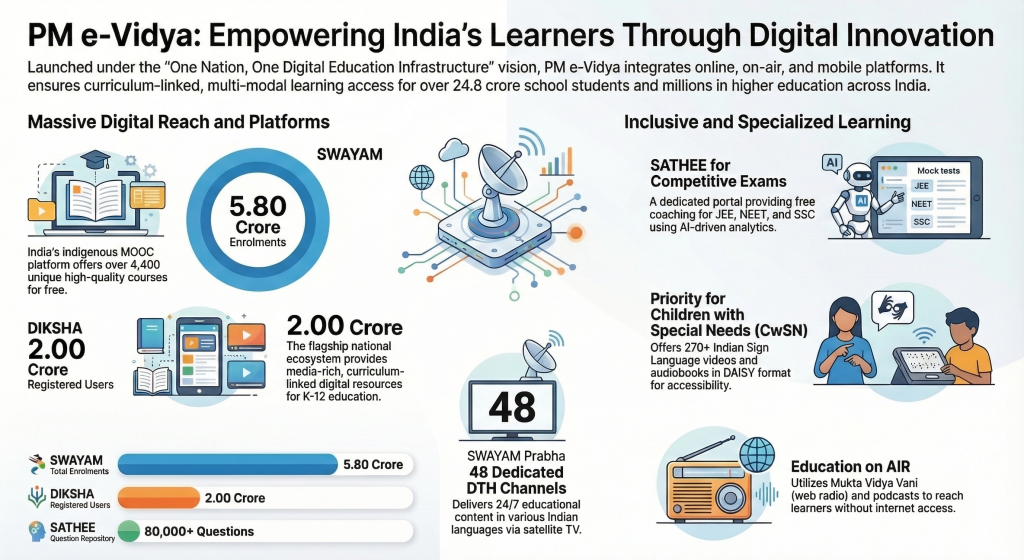
As of March 2026, the PM e-Vidya initiative has reached significant milestones in democratizing education. DIKSHA has surpassed 2.00 crore registered users, while SWAYAM, India’s indigenous MOOC platform, has recorded over 5.80 crore enrollments. Additionally, the expansion of the SWAYAM Prabha network to 48 DTH channels underscores the government’s commitment to providing 24×7 educational access across the country.
Defining PM e-Vidya
PM e-Vidya is a comprehensive, multi-modal digital education program launched under the Atmanirbhar Bharat Abhiyan. It is built on the principle of “One Nation, One Digital Education Infrastructure,” integrating online (DIKSHA, SWAYAM), on-air (SWAYAM Prabha, Radio), and offline channels to ensure universal, equitable, and technology-enabled learning.
Background and Context
1. Genesis: Initially launched on May 17, 2020, as an emergency response to the COVID-19 pandemic, it was later formalized and renamed in August 2020 to align with the National Education Policy (NEP) 2020.
2. Strategic Alignment: The initiative builds upon existing foundations like Digital India, the National Mission on Education through ICT (NMEICT), and SAMAGRA Shiksha.
3. The Problem Statement: India caters to 24.8 crore school-going children and 4.33 crore higher education students, many of whom face barriers such as remote geography, socio-economic compulsions, and a shortage of trained teachers.
Significance and Importance
1. Bridging the Digital Divide: By utilizing DTH channels and radio, it reaches underserved and remote areas where internet dependency is a constraint.
2. Holistic Learning: Aligned with NEP 2020, it promotes multidisciplinary learning, critical thinking, and creativity through media-rich resources like 3D animations and virtual labs.
3. Democratization of Coaching: The SATHEE portal (developed with IIT Kanpur) provides free, high-quality preparation for competitive exams like JEE and NEET, bridging the gap between aspiration and achievement for students who cannot afford private coaching.
Constitutional and Legal Dimensions
1. Right to Education (Article 21A): PM e-Vidya serves as a modern vehicle to realize the fundamental right to free and compulsory education by ensuring “access” is not limited by physical boundaries.
2. UGC Regulations (2021): To institutionalize online learning, the UGC Credit Framework for Online Learning Courses allows higher education institutions to offer up to 40% of credits in a semester through SWAYAM.
3. Inclusivity (Article 15/46): The initiative supports the educational interests of marginalized sections and the differently-abled through specialized content.
Key Pillars of the Ecosystem
1. DIKSHA: The national digital infrastructure for school education (K-12), featuring QR-coded Energised Textbooks.
2. SWAYAM: A MOOC platform providing free high-quality courses curated by premier institutions like IITs, IIMs, and NCERT.
3. SWAYAM Prabha: A suite of 48 DTH channels broadcasting curriculum-based content, including a dedicated channel for Indian Sign Language (ISL).
4. Education on Air: Utilization of Mukta Vidya Vani (Web Radio) and Shiksha Vani (Podcasts) to cater to non-digital and mobile audiences.
Social and Environmental Impact
1. Early Inclusion: The “Barkha” Reading Series employs Universal Design for Learning (UDL), using tactile visuals and high-contrast illustrations to foster foundational literacy among all children, including those with cognitive or motor challenges.
2. Empowering CwSN: The provision of DAISY (Digitally Accessible Information System) format audiobooks and ISL videos ensures that visually and hearing-impaired learners can study independently.
3. Environmental Sustainability: By reducing the dependency on physical infrastructure and printed materials through digital e-books (UNICODE), the initiative aligns with eco-friendly educational practices.
Governance and Institutional Aspects
1. Collaborative Governance: The program is spearheaded by the Ministry of Education, with technical and content support from NCERT, CIET, NIOS, and premier technical institutes like IIT Madras and IIT Kanpur.
2. Teacher Empowerment: Through the NISHTHA program on DIKSHA, the government provides self-paced, certified training to upskill educators nationwide, ensuring they are equipped for the digital era.
Key Issues and Challenges
1. Socio-Economic Barriers: Despite digital access, many students are still constrained by household responsibilities and the need for livelihood activities.
2. Human Resource Gap: The persistent shortage of trained teachers remains a hurdle in translating digital content into improved learning outcomes.
3. Standardization: Maintaining uniform quality across various regional languages and state boards remains an ongoing challenge.
Way Forward
1. Last-Mile Connectivity: Further investment in low-cost e-learning modules and offline digital access points for the most remote tribal belts is essential.
2. AI Integration: Expanding the use of Smart AI features for personalized study plans and performance analytics, as seen in the SATHEE platform, across all K-12 segments.
3. Stakeholder Synergy: Enhancing collaboration between the private sector, NGOs, and the government to innovate content delivery and pedagogy.
4. Continuous Evaluation: Implementing data-informed analytics to identify learning gaps in real-time and provide adaptive assessments.
Conclusion
PM e-Vidya has transitioned from an emergency COVID-19 response to a robust Digital Public Infrastructure that embodies the spirit of Inclusive Growth and Sustainable Development Goal 4 (Quality Education). By prioritizing the “last learner,” it upholds the constitutional values of equity and social justice. As India marches toward Viksit Bharat @ 2047, PM e-Vidya stands as a global benchmark for a future-ready, adaptive, and barrier-free education system that empowers every citizen to realize their full potential.
Best ias coaching in delhi Best ias coaching in chandigar
Prelims question:
Q. Consider the following statements regarding PM e‑Vidya:
1. It was launched in 2020 under the Atmanirbhar Bharat Abhiyan to promote digital education in India.
2. DIKSHA provides digital infrastructure for school education and QR-coded energized textbooks.
3. SWAYAM allows higher education institutions to offer up to 40% of credits in a semester through online courses.
4. SWAYAM Prabha currently operates 48 DTH channels broadcasting educational content across India.
Which of the statements given above are correct?
(a) 1 and 2 only
(b) 1, 2 and 4 only
(c) 2, 3 and 4 only
(d) 1, 2, 3 and 4
Answer: D
Mains Question:
Q. Discuss the role of PM e‑Vidya in transforming India’s digital education ecosystem. Examine its key components, significance in bridging the digital divide, and the challenges that must be addressed to ensure inclusive and equitable learning.
(250 words)

- RBI’s Shrinking Real-Rate Cushion Amid Rising Inflation and Strong Demand - September 21, 2026
- India’s NGOs at a New Funding Crossroads - September 21, 2026
- Deep-Sea Discovery, Environmental Responsibility - September 19, 2026

No Comments