


11 Aug PM Gati Shakti Master Plan: UPSC 2026-27 Polity & Governance Analysis
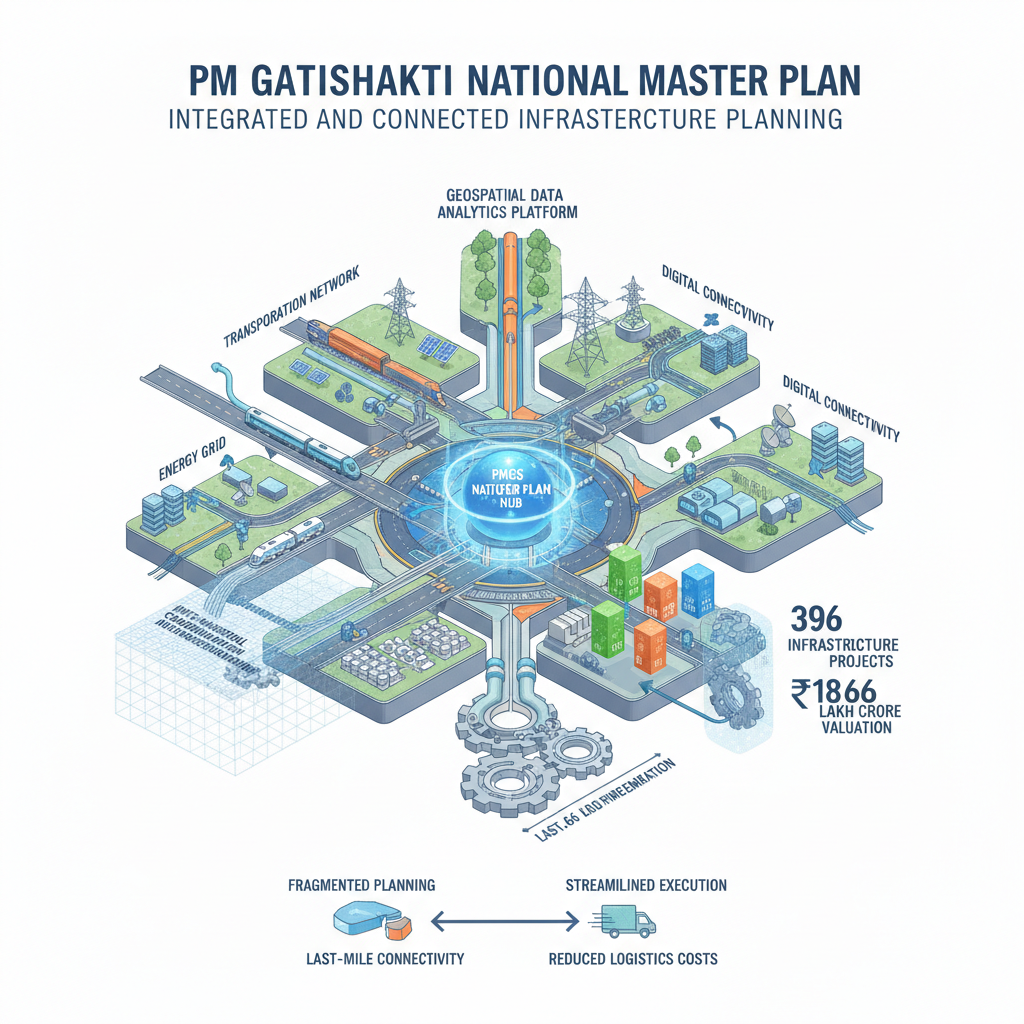
GatiShakti NMPGeospatial data analyticsInter-ministerial coordinationLast-mile connectivityLogistics cost reduction✎ PM GatiShakti NMP is a transformative, data-driven, and multi-sectoral planning framework that integrates existing infrastructure schemes to enhance last-mile connectivity, reduce logistics costs, and improve economic efficiency…
Subject Relevance — Where This Topic Fits
- GS Paper III — Infrastructure: Energy, Ports, Roads, Railways, Airports; Investment Models; Logistics; Multi-modal Connectivity | GS Paper III — Economic Development: Inclusive Growth and Associated Challenges | GS Paper II — Functions and Responsibilities of the Union and the States; Government Policies and Interventions
- Prelims: PM GatiShakti NMP, Multi-modal connectivity, Logistics cost reduction, Network Planning Group (NPG), PM GatiShakti Public Platform, National Logistics Policy, Sagarmala, Pradhan Mantri Gram Sadak Yojana (PMGSY), Dedicated Freight Corridors, National Infrastructure Pipeline (NIP), Ease of Doing Business, Geospatial data integration, Satellite imagery in planning
- Essay: The Role of Integrated Infrastructure Planning in India’s Economic Transformation, Balancing Development and Sustainability: The Case of Multi-modal Connectivity Initiatives
Quick Revision: PM GatiShakti NMP is a transformative, data-driven, and multi-sectoral planning framework that integrates existing infrastructure schemes to enhance last-mile connectivity, reduce logistics costs, and improve economic efficiency without creating a separate budgetary allocation.
Why is this in the news?
The Prime Minister’s GatiShakti National Master Plan (PMGS NMP), launched in October 2021, has achieved a significant milestone with the integration of 396 infrastructure projects valued at approximately ₹18.66 lakh crore, of which 256 have been approved and 198 are under implementation. This development underscores the Plan’s role as a transformative ‘whole-of-government’ approach to streamline multi-sectoral infrastructure planning and execution, leveraging geospatial data analytics and inter-ministerial coordination to enhance last-mile connectivity and reduce logistics costs.
Background
- The PM GatiShakti initiative was launched by the Government of India in October 2021 to address fragmented infrastructure planning across ministries and states, which often led to delays, cost overruns, and suboptimal resource allocation.
- Prior to PM GatiShakti, infrastructure projects in India were largely planned in silos, with limited coordination between sectors such as roads, railways, ports, and aviation, resulting in inefficiencies in logistics and connectivity.
- The initiative aligns with the broader vision of ‘Aatmanirbhar Bharat’ (Self-Reliant India) and the National Infrastructure Pipeline (NIP), aiming to improve India’s global logistics performance and ease of doing business.
- The PM GatiShakti framework is not a standalone budgetary scheme but a strategic planning tool that integrates existing schemes such as Sagarmala (ports), Bharatmala (roads), Dedicated Freight Corridors (railways), and the National Logistics Policy (NLP).
- The plan leverages geospatial technology, including satellite imagery and API integrations, to enable data-driven decision-making in infrastructure development.
What is the PM GatiShakti National Master Plan (NMP)?
- A holistic, cross-sectoral planning framework launched in October 2021 to integrate infrastructure development across ministries, states, and union territories, ensuring seamless multi-modal connectivity.
- It operates as a ‘whole-of-government’ approach, facilitating coordination among ministries and states/UTs to eliminate silos in infrastructure planning and execution.
- The Plan utilises geospatial data analytics, including satellite imagery and API integrations, to monitor, plan, and optimise infrastructure projects in real time, enhancing last-mile connectivity and reducing travel time.
- The Network Planning Group (NPG), a key component of PM GatiShakti, evaluates major infrastructure projects for integrated planning, multi-modality, inter-modality, synergy, and data-driven decision-making, with a focus on comprehensive regional development.
- PM GatiShakti does not allocate separate budgetary provisions; instead, it aligns existing schemes and budgets of ministries and states to ensure efficient utilisation of resources under their respective mandates.
- As of August 2026, 396 projects worth approximately ₹18.66 lakh crore have been evaluated by the NPG, with 256 approved and 198 under implementation, demonstrating the framework’s operational effectiveness.
- The Plan includes sectors such as roads, railways, ports and waterways, power, petroleum and natural gas, civil aviation, telecommunications, and industrial corridors, ensuring a multi-sectoral approach to infrastructure development.
Key Features
| Feature | Significance |
|---|---|
| Holistic ‘Whole-of-Government’ Approach | Integrates planning and execution across 58 central ministries/departments and all 36 states/UTs, eliminating siloed decision-making in infrastructure development. |
| Geospatial Data Integration | Uses satellite imagery, GIS, and API-based data analytics to enable real-time monitoring, planning, and evidence-based decision-making for infrastructure projects. |
| Network Planning Group (NPG) | Evaluates 396 projects (₹18.66 lakh crore) for multi-modal connectivity, inter-ministerial synergy, and end-to-end development, ensuring alignment with national logistics and industrial corridor objectives. |
| PM GatiShakti Public Platform | Provides open-access data analytics to private entities and citizens, fostering transparency, stakeholder collaboration, and participatory infrastructure governance. |
| Multi-Modal Connectivity Framework | Synchronises road, rail, ports, aviation, and logistics infrastructure to reduce travel time, logistics costs, and enhance business competitiveness. |
Why it Matters
Economic Efficiency and Competitiveness
- Reduces logistics costs from 13-14% of GDP (pre-2021) to 7.9% (2025 estimate), aligning with advanced economies and improving export competitiveness.
- National Highway investments yield a 3.2x GDP multiplier effect, as evidenced by IIM Bangalore studies, enhancing regional economic integration.
- Enhances ‘Ease of Doing Business’ by streamlining multi-agency clearances and reducing project gestation periods through integrated planning.
Strategic Infrastructure Development
- Accelerates development of Dedicated Freight Corridors, Industrial Corridors, and Expressways, reducing transit time for goods and passengers.
- Supports ‘Atmanirbhar Bharat’ through synchronized logistics networks, reducing import dependence and enhancing supply chain resilience.
- Facilitates ‘Sagarmala’ and ‘Bharatmala’ initiatives by aligning port, coastal shipping, and road connectivity with hinterland industrial hubs.
Governance and Institutional Synergy
- Institutionalises inter-ministerial coordination via NPG, replacing ad-hoc project approvals with data-driven, cross-sectoral prioritisation.
- Promotes ‘Cooperative Federalism’ by integrating state-level infrastructure plans with national logistics and connectivity frameworks.
- Enhances transparency through the PM GatiShakti Public Platform, enabling citizen oversight and private-sector participation in infrastructure governance.
Sustainability and Inclusivity
- Supports ‘Green Logistics’ by optimising multi-modal transport, reducing carbon footprint through shorter transit distances and modal shifts.
- Enhances last-mile connectivity in rural and tribal regions, aligning with the ‘Sabka Saath, Sabka Vikas’ ethos of inclusive growth.
- Integrates social infrastructure (schools, hospitals) into master planning, ensuring balanced regional development alongside economic corridors.
Challenges
1. Data Standardisation and Interoperability
- Fragmented geospatial datasets across ministries and states hinder seamless integration, requiring robust data governance frameworks.
- API-based systems must ensure real-time updates and compatibility across diverse technological platforms used by central and state agencies.
UPSC Link: GS-III: Infrastructure Development
2. Implementation Bottlenecks
- Land acquisition delays and environmental clearances remain critical hurdles, particularly for linear infrastructure like highways and freight corridors.
- Multi-agency coordination challenges persist despite NPG, necessitating stronger institutional mechanisms for conflict resolution and prioritisation.
UPSC Link: GS-III: Infrastructure Financing
3. Resource Mobilisation Constraints
- Absence of a dedicated budgetary framework under PM GatiShakti necessitates innovative financing models (e.g., PPP, viability gap funding) to sustain large-scale projects.
- State-level fiscal constraints may limit participation in centrally sponsored schemes, requiring incentivised frameworks for alignment.
UPSC Link: GS-III: Public-Private Partnerships
4. Technological and Skill Gaps
- Limited digital literacy among implementing agencies and local contractors may impede adoption of geospatial tools and data analytics.
- Shortage of skilled professionals in GIS, logistics planning, and multi-modal transport engineering poses a long-term capacity challenge.
UPSC Link: GS-III: Science & Technology
5. Regulatory and Legal Hurdles
- Overlapping jurisdictions of central, state, and local authorities create regulatory ambiguities, delaying project approvals.
- Compliance with environmental and forest clearance norms under the Forest (Conservation) Act, 1980 and Environment Protection Act, 1986 adds procedural delays.
UPSC Link: GS-II: Centre-State Relations
Challenges — UPSC Perspective
| Issue | Concern |
|---|---|
| Geospatial Data Fragmentation | Lack of standardised datasets across ministries/states impedes seamless integration and real-time monitoring. |
| Land Acquisition Delays | Protracted legal and administrative processes for land acquisition disrupt project timelines, especially for linear infrastructure. |
| Multi-Agency Coordination Gaps | Despite NPG, inter-ministerial and inter-state conflicts persist, delaying project approvals and execution. |
| Financing Model Limitations | Absence of a dedicated budget under PM GatiShakti necessitates reliance on PPP models, which may not be viable for all projects. |
| Digital Divide in Implementation | Low adoption of geospatial tools among state agencies and local contractors hampers effective utilisation of the framework. |
Government Initiatives — Must-Memorise for Prelims
- PM GatiShakti National Master Plan (PMGS-NMP)
- National Logistics Policy (NLP)
- Sagarmala Programme
- Bharatmala Pariyojana
- Dedicated Freight Corridors (DFC)
- Industrial Corridor Development Programme
Way Forward
- Strengthen the PM GatiShakti Public Platform with AI-driven predictive analytics to forecast infrastructure bottlenecks and optimise resource allocation.
- Establish a dedicated ‘Infrastructure Data Governance Authority’ to standardise geospatial datasets and ensure interoperability across ministries and states.
- Fast-track land acquisition reforms by amending the Right to Fair Compensation and Transparency in Land Acquisition, Rehabilitation and Resettlement Act, 2013, with expedited dispute resolution mechanisms.
- Expand the scope of viability gap funding and blended finance models to attract private investment in multi-modal connectivity projects.
- Launch nationwide capacity-building programmes for state agencies and local contractors in GIS, logistics planning, and project management.
- Harmonise environmental and forest clearance processes by integrating them with the PM GatiShakti framework to reduce procedural redundancies.
- Institutionalise quarterly reviews of NPG-evaluated projects, with mandatory mid-course corrections for underperforming initiatives.
- Promote ‘Green Logistics’ by incentivising modal shifts to coastal shipping and railways, reducing carbon emissions in freight transport.
UPSC Value Addition
Keywords for Mains Answer-Writing
PM GatiShakti National Master Plan (NMP) · holistic infrastructure planning · Network Planning Group (NPG) · integrated multimodal connectivity · logistics cost reduction · National Logistics Policy · geospatial data analytics · multi-ministerial coordination · last-mile connectivity · GDP multiplier effect of infrastructure · PM GatiShakti Public Platform · economic competitiveness · business facilitation
Constitutional & Policy Linkages
- Article 263 (Inter-State Council) – Facilitates cooperative federalism in infrastructure planning.
- Article 292 (Borrowing by the Union) – Enables central financing of inter-state infrastructure projects.
- Seventh Schedule (Union List, State List, Concurrent List) – Defines jurisdictions in infrastructure development (e.g., railways, highways, ports).
Concept Flow
Initiation of PM GatiShakti (2021) as a ‘Whole-of-Government’ approach to integrate infrastructure planning. → Data-driven framework using geospatial analytics to map existing and projected infrastructure gaps. → Network Planning Group (NPG) evaluates and prioritises 396 projects (₹18.66 lakh crore) for multi-modal connectivity. → Approval and execution of projects under respective ministry/state budgets, ensuring alignment with national objectives. → Public platform launch (2025) to enable transparency, stakeholder collaboration, and citizen oversight. → Implementation of projects reduces logistics costs, improves travel time, and enhances economic competitiveness. → Continuous feedback loops and mid-course corrections ensure adaptive governance and sustained impact.
Prelims Practice Questions
Q1. Consider the following statements regarding the PM GatiShakti National Master Plan (NMP):
1. It is a centrally sponsored scheme with a dedicated budget allocation.
2. The Network Planning Group (NPG) evaluates central government infrastructure projects under the PM GatiShakti framework.
3. The PM GatiShakti Public Platform was launched in September 2025 to provide geospatial data analytics to the public.
4. The PM GatiShakti NMP aims to reduce logistics costs to below 5% of GDP by 2030.
How many of the above statements are correct?
- Only one
- Only two
- Only three
- All
Answer: Only three — Statements 2 and 3 are correct. Statement 1 is incorrect as PM GatiShakti does not have a separate budgetary provision. Statement 4 is incorrect as the logistics cost target is not explicitly stated in the framework.
Q2. Assertion (A): The PM GatiShakti National Master Plan (NMP) integrates multimodal connectivity to enhance last-mile connectivity.
Reason (R): The framework uses geospatial data and satellite imagery to monitor and plan infrastructure development.
Options:
A. Both A and R are true, and R is the correct explanation of A.
B. Both A and R are true, but R is not the correct explanation of A.
C. A is true, but R is false.
D. A is false, but R is true.
Answer: ? — Both the Assertion (A) and Reason (R) are true, and R correctly explains A. The integration of multimodal connectivity (A) is facilitated by geospatial data and satellite imagery (R) for monitoring and planning.
Q3. Match the following initiatives with their respective objectives:
Column I (Initiative) | Column II (Objective)
1. PM GatiShakti NMP | A. Reduction of logistics costs and improvement in logistics efficiency
2. National Logistics Policy | B. Development of expressways, national highways, and dedicated freight corridors
3. Sagarmala Programme | C. Integrated and synchronized planning of infrastructure projects across ministries
4. Pradhan Mantri Gram Sadak Yojana | D. Connectivity in rural areas through rural roads
- 1-C, 2-A, 3-B, 4-D
- 1-B, 2-A, 3-C, 4-D
- 1-A, 2-B, 3-C, 4-D
- 1-D, 2-C, 3-B, 4-A
Answer: 1-C, 2-A, 3-B, 4-D — The correct pairing is: 1-C (PM GatiShakti NMP focuses on integrated planning), 2-A (National Logistics Policy aims to reduce logistics costs), 3-B (Sagarmala Programme focuses on port-led development), 4-D (Pradhan Mantri Gram Sadak Yojana aims at rural connectivity).
Mains Practice Question
✍ The PM GatiShakti National Master Plan (NMP) represents a paradigm shift in India’s infrastructure planning paradigm from a siloed to a holistic, data-driven approach. Critically examine its institutional architecture, the role of geospatial technology, and its impact on economic competitiveness. Also, assess the challenges in achieving last-mile connectivity and suggest measures to enhance its effectiveness. (15 Marks)
Approach: MODEL-ANSWER SKELETON:
1. **Institutional Architecture and Multi-Ministerial Coordination** (4 Marks)
– Explain the ‘whole-of-government’ approach under PM GatiShakti NMP.
– Discuss the role of the Network Planning Group (NPG) in evaluating projects (e.g., 396 projects evaluated, 256 approved, 198 under implementation).
– Highlight the inclusion of 58 central ministries/departments and all 36 states/UTs.
– Mention the absence of a separate budgetary provision and reliance on existing schemes.
2. **Geospatial Technology and Data-Driven Planning** (4 Marks)
– Elaborate on the use of geospatial data, satellite imagery, and API integration for monitoring and planning.
– Discuss the PM GatiShakti Public Platform (launched September 2025) for providing data analytics to stakeholders.
– Explain how this technology enables real-time decision-making and reduces planning redundancies.
3. **Impact on Economic Competitiveness** (4 Marks)
– Present data on logistics cost reduction (e.g., logistics cost at 7.9% of GDP in 2025, aligning with advanced economies).
– Cite studies (e.g., IIM Bangalore study showing 1:3.2 GDP multiplier for highway expenditure).
– Discuss improvements in business facilitation, turnaround time, and industrial development.
– Link to initiatives like the National Logistics Policy and Sagarmala Programme.
4. **Challenges in Last-Mile Connectivity** (2 Marks)
– Identify challenges: inter-ministerial coordination gaps, state-level implementation delays, funding constraints, and rural-urban disparities.
– Highlight the need for better rural connectivity (e.g., PMGSY integration).
5. **Measures for Enhanced Effectiveness** (1 Mark)
– Suggest measures: strengthening state-level institutional capacity, leveraging private sector participation, and integrating local governance bodies.
– Emphasize the role of continuous monitoring and feedback loops.
Source: PIB (Press Information Bureau)
Generated by AanyaAi for educational purpose.

- Gurugram’s groundwater extraction exceeds limit by 212%; HC seeks ban - October 4, 2026
- स्वतंत्रता सेनानी श्यामजी कृष्ण वर्मा की जन्म जयंती पर पीएम का श्रद्धांजलि - October 4, 2026
- KWML’s Feasibility Reports for Water Metro in 18 Cities: UPSC & PCS Insights - October 3, 2026

No Comments