


16 Feb PM RAHAT Scheme: Institutionalising the Right to Emergency Healthcare in India
This article covers “Daily Current Affairs” and From PM RAHAT Scheme: Institutionalising the Right to Emergency Healthcare in India
SYLLABUS MAPPING
GS- 2- Governanc- PM RAHAT Scheme: Institutionalising the Right to Emergency Healthcare in India
FOR PRELIMS
What is the PM RAHAT Scheme?
FOR MAINS
Why is the PM RAHAT Scheme important for emergency healthcare in India?
Why in the News?
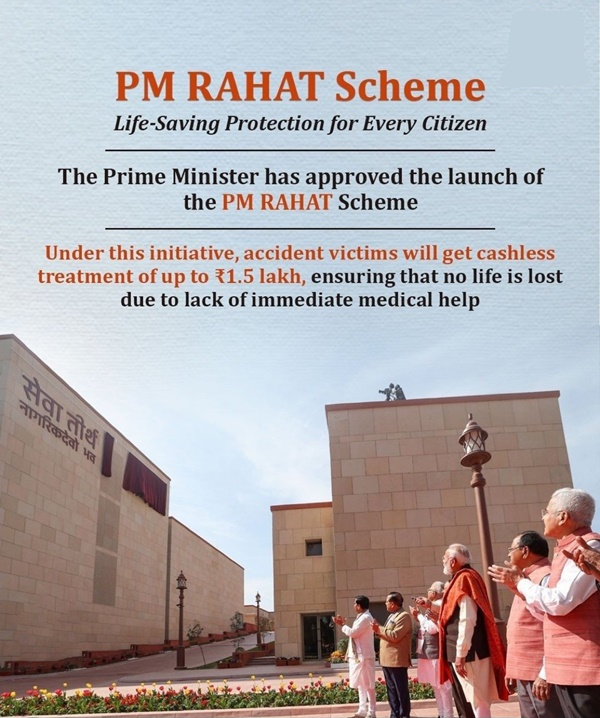
The Union Government has launched the PM RAHAT (Road Accident Victim Hospitalisation and Assured Treatment) Scheme, providing cashless treatment up to ₹1.5 lakh for road accident victims during the critical post-accident period. The scheme operationalises statutory provisions under the Motor Vehicles Act and seeks to reduce preventable deaths by strengthening India’s emergency trauma response framework.
Introduction: Defining the PM RAHAT Scheme
The PM RAHAT Scheme is a centrally supported initiative aimed at guaranteeing immediate, cashless medical treatment to victims of road accidents, particularly during the “golden hour.” It addresses two structural gaps in India’s public health and transport governance systems:
1. Delay in trauma care delivery, and
2. Financial barriers to emergency hospitalization.
The scheme is financed through the Motor Vehicle Accident Fund (MVAF) created under the amended Motor Vehicles Act and integrates digital systems for authentication, hospital empanelment, and reimbursement.
India’s Road Safety Crisis & Legislative Framework
| Dimension | Key Points | Implications for India |
|---|---|---|
| Scale of Crisis | Over 1.5 lakh road accident deaths annually | India accounts for a major share of global road fatalities |
| Age Group Most Affected | 18–45 years (economically productive population) | Direct threat to India’s demographic dividend |
| Structural Issues | Poor trauma care in rural areas | Higher mortality due to delayed treatment |
| Limited ambulance penetration | Increased “golden hour” fatalities | |
| Delays in police reporting & medico-legal procedures | Slows insurance and compensation process | |
| High out-of-pocket medical expenditure | Financial distress for vulnerable families | |
| Legal Basis | Motor Vehicles Act | Provides statutory backing for accident compensation |
| Specific Provision | Section 164A – Cashless treatment for accident victims | Immediate financial relief without upfront payment |
| Financial Mechanism | Motor Vehicle Accident Fund | Centralized funding for compensation & emergency care |
| Policy Alignment (National) | National Road Safety Policy (2010) | Institutional framework for safer road systems |
| Global Alignment | UN Decade of Action for Road Safety | Reducing road fatalities through global cooperation |
| SDG Target | SDG 3.6 | Aim to halve road traffic deaths and injuries |
Constitutional and Legal Dimensions
Article 21: Right to Life and Health
The Supreme Court has consistently interpreted Article 21 as including the right to emergency medical care.
In Parmanand Katara v Union of India, the Court held that preservation of human life is of paramount importance and that every doctor must provide emergency care without waiting for legal formalities.
Similarly, in Paschim Banga Khet Mazdoor Samity v State of West Bengal, the Court emphasized that failure to provide timely medical treatment violates Article 21.
The PM RAHAT Scheme operationalises these judicial principles through a structured reimbursement mechanism.
Significance and Importance of the PM RAHAT Scheme
1. Institutionalising the “Golden Hour” Principle: The scheme formalises the medical concept of the golden hour by ensuring immediate, cashless trauma care. By removing financial hesitation at the time of hospital admission, it increases the probability of survival and reduces long-term disability in severe injury cases.
2. Reducing Catastrophic Health Expenditure: With out-of-pocket expenditure still accounting for a significant share of India’s total health spending, emergency trauma often leads to sudden financial shocks. The scheme prevents distress borrowing, asset liquidation, and medical indebtedness among vulnerable households.
3. Complementing Universal Health Coverage Efforts: While Ayushman Bharat provides insurance coverage to eligible beneficiaries, PM RAHAT ensures emergency care regardless of insurance status. Thus, it strengthens the broader goal of Universal Health Coverage (UHC).
4. Strengthening Road Safety Governance Architecture: The integration of police accident reporting systems, hospital databases, and fund disbursement mechanisms enhances inter-agency coordination. This promotes convergence between transport authorities, healthcare institutions, and law enforcement agencies.
5. Protecting India’s Demographic Dividend: Road accident victims are often part of the working-age population (18–45 years). By reducing premature mortality and disability, the scheme safeguards human capital and productivity, which are essential for sustained economic growth.
6. Advancing Sustainable Development and Viksit Bharat Vision
The scheme contributes to:
SDG 3 (Good Health and Well-being)
SDG 11 (Sustainable Cities and Communities)
Safer mobility systems and resilient emergency healthcare infrastructure are foundational to achieving Viksit Bharat 2047, ensuring inclusive and sustainable development.
Economic and Social Impact of Road Safety Cashless Treatment Framework
I. Economic Impact
| Dimension | Key Elements | Broader Impact on Economy |
|---|---|---|
| Productivity Gains | Victims often primary breadwinners | Prevents household income collapse |
| Timely trauma treatment | Reduces long-term disability | |
| Faster medical intervention | Minimizes workdays lost | |
| Early recovery | Protects national economic output & labour force participation | |
| Reduced Litigation & Insurance Burden | Statutory clarity under Motor Vehicles Act | Reduces compensation disputes |
| Defined compensation mechanism | Decreases court case pendency | |
| Streamlined claim process | Lowers insurance settlement delays | |
| Reduced medico-legal friction | Improves ease of doing insurance business | |
| Fiscal Implications | Higher short-term public expenditure | Immediate fiscal pressure on government |
| Reduced long-term disability burden | Savings in social welfare & healthcare spending | |
| Lower mortality among working population | Higher tax base & sustained economic productivity | |
| Preventive public spending model | Long-term cost-benefit advantage |
II. Social Impact
| Dimension | Key Elements | Societal Outcomes |
|---|---|---|
| Equity Enhancement | Coverage irrespective of income status | Universal access to emergency care |
| Benefits vulnerable users (pedestrians, cyclists, migrant workers) | Reduces socio-economic disparities | |
| Cashless mechanism | Protects poor households from medical debt | |
| Inclusive safety net | Strengthens social justice framework | |
| Trust in Public Institutions | Guaranteed emergency treatment | Builds confidence in public healthcare system |
| Legal backing under statute | Reinforces rule of law | |
| Transparent compensation mechanism | Reduces corruption & arbitrariness | |
| Visible welfare intervention | Enhances legitimacy of welfare governance |
Governance and Institutional Aspects
| Theme | Sub-Component | Key Provisions | Governance Significance |
|---|---|---|---|
| Digital Integration | Online accident documentation | Real-time digital recording of accident details | Reduces procedural delays and improves transparency |
| Digital hospital empanelment | Standardized online registration of hospitals | Ensures accountability and quality control | |
| Direct benefit reimbursement | Digital transfer of funds to hospitals | Minimizes leakages and middlemen | |
| Monitoring dashboards | Centralized digital tracking | Enables data-driven policy decisions | |
| Policy Alignment | Linked with Digital India | Strengthens e-governance architecture | |
| Centre–State Coordination | Constitutional division | Health – State List; Motor Vehicles – Concurrent List | Requires cooperative federalism |
| Cost-sharing formula | Defined fiscal responsibility | Prevents financial disputes | |
| Uniform guidelines | Standard operating procedures across states | Ensures national consistency | |
| Inter-governmental cooperation | Centre–State coordination mechanisms | Smooth policy implementation | |
| Role of Hospitals | Immediate stabilization | Emergency care without upfront payment | Protects golden-hour survival |
| Digital uploading | Real-time submission of treatment details | Enhances transparency | |
| Transparent billing | Standardized rates and procedures | Prevents overcharging | |
| Audit mechanisms | Financial and procedural audits | Ensures accountability | |
| Public-private participation | Inclusion of empanelled private hospitals |
Key Challenges in Implementation of the PM RAHAT Scheme
1. Inadequate Trauma Infrastructure: Many districts lack fully equipped trauma centres, advanced ICUs, and trained emergency personnel. Poor ambulance networks and weak referral systems, especially in rural and highway regions, may dilute the “golden hour” objective.
2. Regional and Urban–Rural Disparities: Empanelled hospitals are largely urban-centric. Victims in remote or underserved areas face delays in transport and limited access to specialist care, leading to unequal outcomes.
3. Administrative Bottlenecks: The scheme requires seamless coordination between police, hospitals, and fund authorities. Delays in accident verification, medico-legal formalities, and claim settlement may discourage hospital participation.
4. Digital and Data Integration Gaps: Dependence on digital platforms for authentication and reimbursement may face challenges such as interoperability issues, weak IT infrastructure, and cybersecurity risks.
5. Risk of Fraud and Moral Hazard: Possibilities of inflated billing, false claims, or collusion could strain the Motor Vehicle Accident Fund. Strong audit systems and real-time monitoring are essential to ensure fiscal integrity.
6. Low Public Awareness: Limited awareness about entitlements, cashless provisions, and the 112 emergency helpline may restrict utilisation. Behavioral hesitation among bystanders further weakens emergency response efficiency.
Way Forward
1. Build a Robust Trauma Care Ecosystem: Establish Level-1 trauma centres at the district level, strengthen highway emergency networks, expand ambulance services through PPP models, and integrate air ambulances in geographically difficult regions to operationalise the golden hour principle effectively.
2. Ensure Technology-Driven Transparency and Accountability: Adopt AI-based claim verification systems, real-time digital dashboards, and public performance indicators to monitor fund utilisation, reduce fraud, and improve administrative efficiency.
3. Strengthen Emergency Response Capacity: Train police personnel and first responders in trauma management, institutionalise community first-aid programmes, and incentivise Good Samaritans to encourage timely assistance at accident sites.
4. Promote Fiscal Sustainability: Introduce a dedicated road safety cess, expand insurance pooling mechanisms, and ensure periodic parliamentary oversight of the Motor Vehicle Accident Fund to maintain long-term financial viability.
5. Strengthen Legal and Regulatory Framework: Codify strict reimbursement timelines, penalise denial of emergency treatment by hospitals, and reinforce oversight mechanisms under the Motor Vehicles Act to ensure enforceability.
6. Deepen Centre–State Coordination: Institutionalise cooperative federal mechanisms between transport, health, and law enforcement agencies to ensure uniform implementation across states and reduce regional disparities.
Conclusion
The PM RAHAT Scheme represents a shift from a compensation-based model to a rights-based emergency healthcare framework in India’s road safety governance. By ensuring cashless treatment during the critical post-accident period, it gives practical effect to the Motor Vehicles Act and strengthens the constitutional guarantee of Article 21 — the Right to Life and Dignity. Supreme Court judgments such as Parmanand Katara v Union of India and Paschim Banga Khet Mazdoor Samity v State of West Bengal have affirmed that timely medical care is integral to the right to life. PM RAHAT operationalises these principles through a structured financial and digital mechanism, ensuring that lack of money or procedural delays do not result in avoidable deaths.
Best ias coaching in delhi Best ias coaching in chandigar
Prelims question:
Q. With reference to the PM RAHAT Scheme, consider the following statements:
1. It provides cashless treatment up to ₹1.5 lakh for road accident victims during the initial post-accident period.
2. The scheme is funded through the Motor Vehicle Accident Fund constituted under the Motor Vehicles Act.
3. It applies only to beneficiaries covered under Ayushman Bharat.
4. Section 164A of the Motor Vehicles Act provides statutory backing for cashless treatment of accident victims.
Which of the statements given above are correct?
(a) 1 and 2 only
(b) 1, 2 and 4 only
(c) 2 and 3 only
(d) 1, 3 and 4 only
Answer: B
Mains Question:
Q. Discuss the objectives and significance of the PM RAHAT Scheme in strengthening emergency healthcare and road safety governance in India
(250 words)

- RBI’s Shrinking Real-Rate Cushion Amid Rising Inflation and Strong Demand - September 21, 2026
- India’s NGOs at a New Funding Crossroads - September 21, 2026
- Deep-Sea Discovery, Environmental Responsibility - September 19, 2026

No Comments