


29 Jul PM-SEETU Scheme: 1000 ITIs Upgraded for Skill Development & Employment
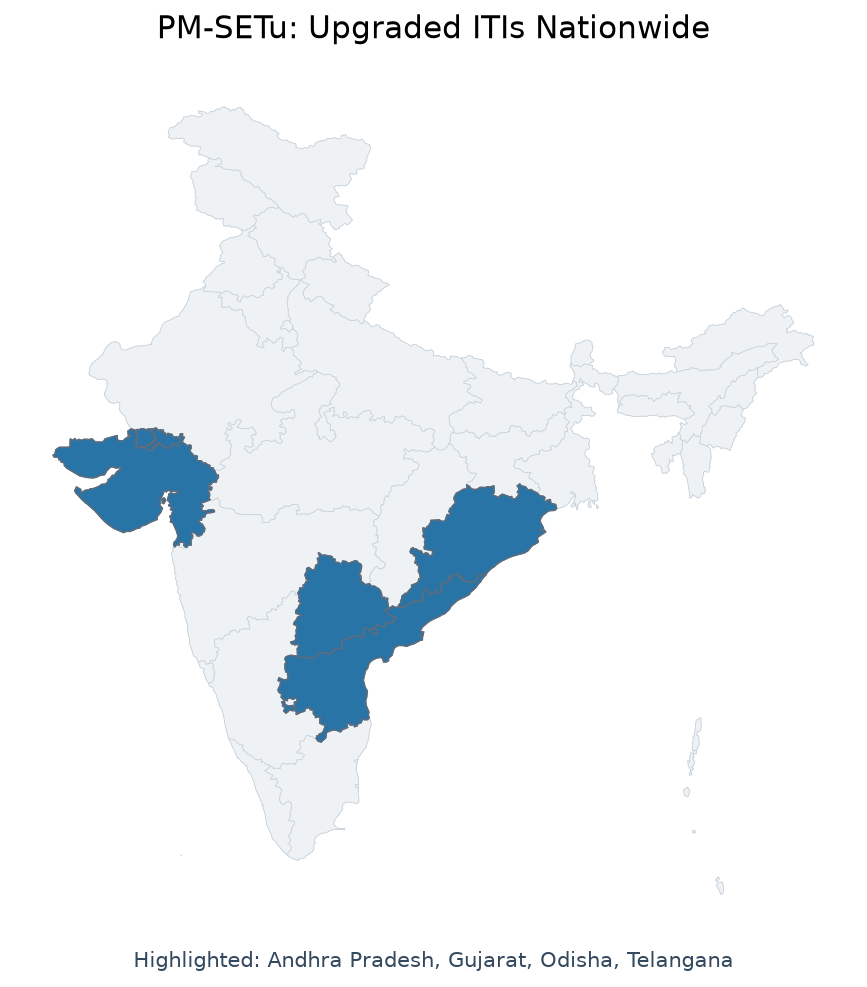
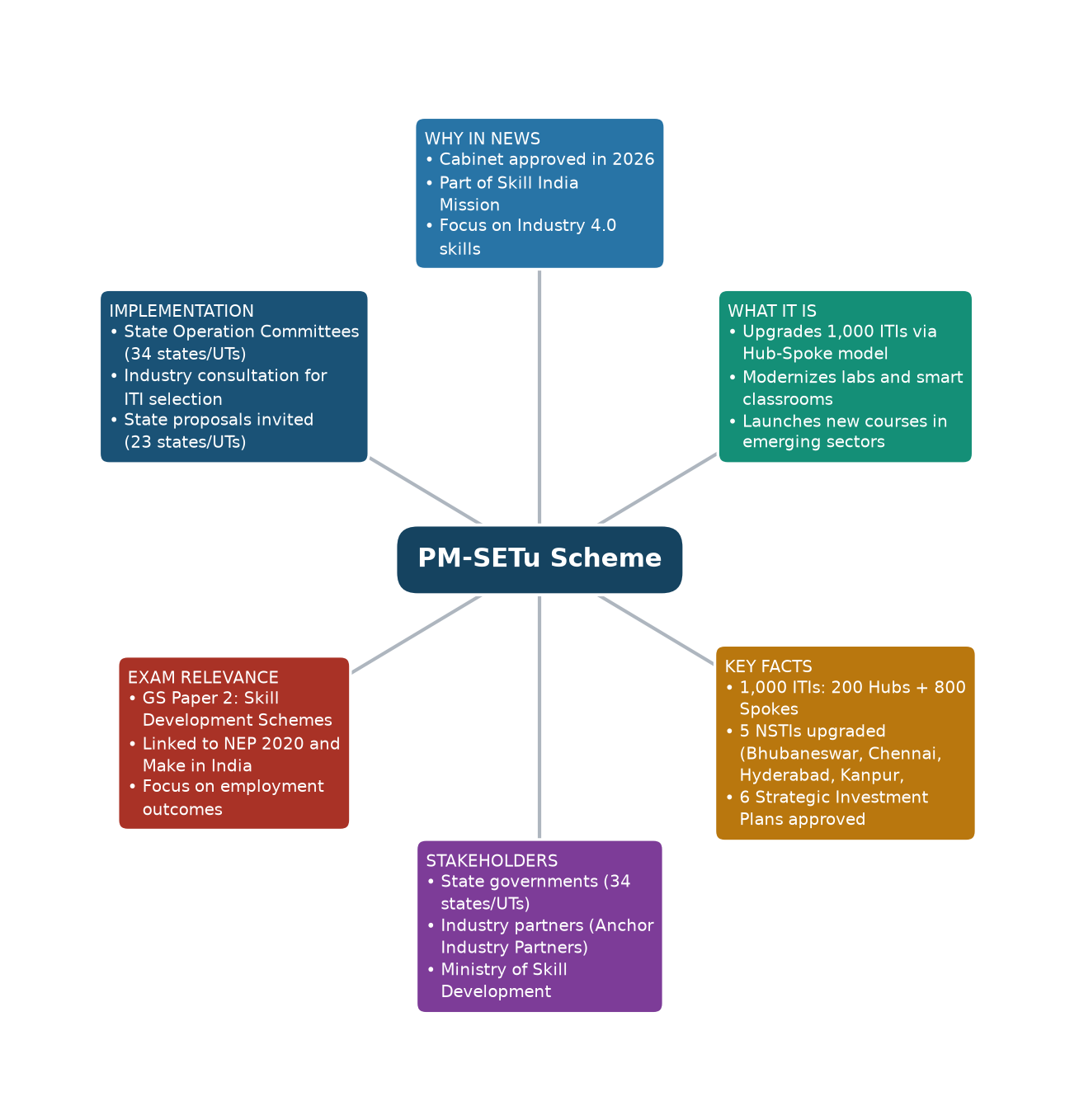
Map & concept mind-map: PM-SETu: Upgraded ITIs Nationwide
Subject Relevance — Where This Topic Fits
- GS Paper II — Government Policies and Interventions for Development in various sectors and Issues arising out of their Design and Implementation | GS Paper III — Indian Economy and issues relating to Planning, Mobilization of Resources, Growth, Development and Employment; Skill Development
- Prelims: PM-SETU Scheme, Industrial Training Institutes (ITIs), National Skill Training Institutes (NSTIs), Hub and Spoke Model, Directorate General of Training (DGT), Craftsman Training Scheme (CTS)
- Essay: Skill Development as a Catalyst for Economic Growth and Social Inclusion, The Role of Public-Private Partnerships in Enhancing Vocational Training in India
Quick Revision: The PM-SETU scheme is a government initiative to upgrade Industrial Training Institutes (ITIs) and National Skill Training Institutes (NSTIs) through modern infrastructure, industry-aligned curricula, and enhanced industry linkages, operating on a Hub and Spoke model to improve vocational training quality and employability across India.
Why is this in the news?
The Pradhan Mantri Skill and Employability Transformation through Upgraded ITIs (PM-SETU) Scheme is currently in the implementation phase, with state governments and Union Territories actively engaging in the selection and upgradation of ITIs. Several State Steering Committees (SSCs) have been constituted, and proposals for upgrading identified ITI clusters are being submitted. The National Steering Committee (NSC) has also approved Strategic Investment Plans (SIPs) from anchor industry partners, indicating significant progress in the scheme’s operationalisation and its continued relevance in national skill development initiatives.
Background
- India faces a significant challenge in skilling its large young population to meet the demands of a rapidly evolving global economy.
- Traditional vocational training infrastructure, particularly ITIs, often lags behind contemporary industrial requirements in terms of technology, curriculum, and pedagogy.
- The National Skill Development Mission, launched in 2015, aims to create an ecosystem for skill development in India, with schemes like PM-SETU contributing to its objectives.
- The ‘Make in India’ initiative necessitates a skilled workforce capable of operating advanced machinery and adopting modern manufacturing processes.
- Previous skill development programmes have highlighted the need for stronger industry linkages and a demand-driven approach to vocational training.
- The Directorate General of Training (DGT) under the Ministry of Skill Development and Entrepreneurship is the apex organisation for development and coordination of vocational training.
What is the PM-SETU Scheme?
- The PM-SETU scheme aims to enhance the overall quality and relevance of vocational training in India through upgraded ITIs, modern machinery, advanced laboratories, and industry-aligned curricula.
- It seeks to improve the quality of training delivery in Industrial Training Institutes (ITIs) and National Skill Training Institutes (NSTIs).
- The scheme focuses on modernising infrastructure and equipment to meet industry standards and introducing industry-relevant long-term and short-term courses, particularly in innovative and emerging sectors.
- A key objective is to strengthen linkages with industries to ensure demand-based skill development and improved employability outcomes for trainees.
- The scheme comprises two components: Component-I involves the upgradation of 1,000 Government ITIs (200 Hub ITIs and 800 Spoke ITIs) under a Hub and Spoke model, incorporating smart classrooms, modern labs, and digital learning materials.
- Component-II focuses on capacity enhancement of five National Skill Training Institutes (NSTIs) located in Bhubaneswar, Chennai, Hyderabad, Kanpur, and Ludhiana, including the establishment of sector-specific National Centres of Excellence for advanced trainer training with global collaboration.
- ITIs are selected by respective State/UT Governments in consultation with industries to align with emerging skill requirements and local industrial potential.
- Industry-driven Special Purpose Vehicles (SPVs) play a crucial role in the upgradation of ITIs, proposing measures related to curriculum restructuring, training delivery models, infrastructure upgrades, and practical industry experience.
Key Features
| Feature | Significance |
|---|---|
| Hub & Spoke Model for ITIs | Ensures equitable distribution of advanced infrastructure and resources across 1,000 government ITIs, with 200 hub ITIs acting as centres of excellence and 800 spoke ITIs as satellite units. |
| Modernisation of Infrastructure | Upgrades include smart classrooms, advanced laboratories, and digital learning materials aligned with Industry 4.0 standards, enhancing practical training quality. |
| Industry-Aligned Curricula | Introduction of long-term and short-term courses in emerging sectors (e.g., AI, robotics, green energy) to bridge skill gaps and improve employability. |
| Strengthened Industry-Academia Linkages | Mandates collaboration with anchor industry partners for curriculum design, apprenticeships, and placements, ensuring demand-driven skill development. |
| Capacity Building of Trainers | Enhanced training for instructors at five upgraded NSTIs, including global partnerships and establishment of National Centres of Excellence for sector-specific upskilling. |
Why it Matters
Economic Growth & Employment
- Directly addresses the dual challenge of skill shortages and unemployment by aligning vocational training with industrial requirements, thereby enhancing labour productivity and economic output.
- Reduces structural unemployment by equipping youth with industry-relevant competencies, particularly in high-growth sectors such as renewable energy, electronics, and advanced manufacturing.
- Promotes inclusive growth by prioritising ITI upgrades in states with lower industrial penetration, ensuring regional balance in skill development infrastructure.
Industrial Competitiveness
- Facilitates the transition of India’s workforce from low-skilled to high-skilled roles, aligning with the ‘Atmanirbhar Bharat’ vision and reducing dependence on imported labour.
- Supports the ‘Make in India’ initiative by fostering a skilled workforce capable of driving domestic manufacturing, particularly in electronics, automotive, and defence sectors.
- Enhances global competitiveness by adopting international best practices in vocational training, including digital literacy and green skills, to meet export-oriented industry demands.
Social Development & Governance
- Strengthens the role of state governments in skill development through decentralised planning and monitoring via State Operation Committees (SOCs), ensuring localised relevance.
- Promotes gender inclusivity by integrating women-centric trades (e.g., beauty and wellness, healthcare) and providing equal access to advanced training facilities.
- Improves transparency and accountability in skill development governance through multi-stakeholder oversight by the National Operation Committee (NOC) and third-party impact assessments.
Challenges
1. Industry-Academia Mismatch
- Persistent disconnect between educational curricula and industry needs, exacerbated by rapid technological advancements in sectors like AI and automation.
- Limited participation of MSMEs in curriculum design and apprenticeship programmes due to resource constraints and lack of awareness about the scheme’s benefits.
UPSC Link: GS3: Skill Development & Employment
2. Infrastructure & Resource Gaps
- Uneven distribution of ITIs across states, with significant disparities in access to advanced training facilities, particularly in aspirational districts.
- High capital expenditure required for modernisation, including procurement of high-end machinery and digital tools, which may strain state budgets.
UPSC Link: GS2: Centre-State Relations
3. Quality Assurance & Trainer Shortages
- Inadequate training of instructors in emerging technologies, leading to suboptimal delivery of advanced courses despite upgraded infrastructure.
- Lack of standardised assessment mechanisms to evaluate the effectiveness of training programmes and ensure consistent quality across ITIs.
UPSC Link: GS3: Education & Human Resource Development
4. Monitoring & Implementation Bottlenecks
- Delays in fund disbursement and procurement processes at the state level, hindering timely execution of infrastructure upgrades and course rollouts.
- Weak coordination between central and state agencies, including DGT, NCVT, and state skill development missions, leading to fragmented implementation.
UPSC Link: GS2: Governance & Public Policy
5. Equity & Inclusivity Challenges
- Limited outreach to marginalised communities, including SC/ST, OBC, and Persons with Disabilities (PwDs), due to socio-economic barriers and lack of targeted interventions.
- Urban-centric focus of ITI upgrades may exacerbate rural-urban disparities in access to quality vocational training.
UPSC Link: GS1: Social Justice & Inclusive Growth
Challenges — UPSC Perspective
| Issue | Concern |
|---|---|
| Curriculum Relevance | Outdated syllabi fail to address emerging skill demands in sectors like AI, IoT, and green technologies. |
| State-Level Coordination | Fragmented implementation due to varying priorities and administrative capacities across states. |
| Trainer Competency | Insufficient upskilling of instructors in pedagogical methods and industry-specific tools. |
| Industry Participation | Low engagement of private enterprises in apprenticeship programmes and curriculum design. |
| Digital Divide | Limited access to digital infrastructure in rural and remote ITIs, hindering adoption of smart classrooms. |
| Fund Utilisation | Delays in release and utilisation of central funds due to procedural bottlenecks and audit concerns. |
Government Initiatives — Must-Memorise for Prelims
- Pradhan Mantri Kaushal Vikas Yojana (PMKVY)
- Skill India Mission
- National Apprenticeship Promotion Scheme (NAPS)
Way Forward
- Establish a dedicated ‘Industry-Academia Collaboration Cell’ at the DGT level to streamline partnerships between ITIs and anchor industries for curriculum co-design and apprenticeships.
- Introduce a ‘Trainer Exchange Programme’ with global vocational institutions (e.g., Germany’s Dual System) to enhance instructor competencies in advanced technologies.
- Expand the ‘Hub & Spoke Model’ to include private ITIs and polytechnics, leveraging public-private partnerships for infrastructure sharing and resource optimisation.
- Launch a ‘Skill Voucher Scheme’ to provide financial incentives to marginalised groups (SC/ST, PwDs) for enrolling in high-demand courses at upgraded ITIs.
- Develop a ‘National Skill Credential Framework’ to standardise assessments and recognise prior learning, facilitating mobility across formal and informal sectors.
- Strengthen the role of State Operation Committees (SOCs) by mandating quarterly reviews with industry representatives to address local skill gaps proactively.
- Integrate PM-SETu with existing schemes like PMKVY and NAPS to avoid duplication and ensure seamless transition for trainees from training to employment.
- Conduct a ‘Third-Party Impact Assessment’ annually to evaluate the scheme’s outcomes, with findings publicly disseminated to enhance transparency and accountability.
UPSC Value Addition
Keywords for Mains Answer-Writing
Skill development · Vocational training · Industrial Training Institutes (ITIs) · National Skill Training Institutes (NSTIs) · PM-SETU scheme · Industry-academia collaboration · Hub and Spoke model · Skill India Mission · Employment generation · Economic growth
Concept Flow
Rapid technological advancements in industry → Increased demand for skilled workforce → Identification of skill gaps in existing ITI curricula. → Government intervention via PM-SETu scheme → Upgradation of 1,000 ITIs with modern infrastructure and industry-aligned courses. → Strengthening of industry-academia linkages → Introduction of apprenticeship programmes and anchor industry partnerships. → Capacity building of trainers → Enhanced pedagogical skills and adoption of digital tools in vocational training. → Improved employability outcomes → Higher placement rates in organised sectors, particularly for youth in aspirational districts. → Economic growth and industrial competitiveness → Contribution to ‘Atmanirbhar Bharat’ and reduction in structural unemployment.
Prelims Practice Questions
Q1. Consider the following statements regarding the PM-SETU scheme:
1. The scheme aims to upgrade Industrial Training Institutes (ITIs) and National Skill Training Institutes (NSTIs).
2. It incorporates a Hub and Spoke model for the upgradation of 1,000 Government ITIs.
3. The scheme mandates the establishment of National Centres of Excellence for advanced trainer training with global participation.
How many of the above statements are correct?
- Only one
- Only two
- Only three
- None
Answer: Only three — Statement 1 is correct: PM-SETU aims to enhance the quality and relevance of vocational training in ITIs and NSTIs. Statement 2 is correct: Component-I of the scheme involves the upgradation of 1,000 Government ITIs (200 Hub ITIs and 800 Spoke ITIs) under a Hub and Spoke model. Statement 3 is correct: Component-II includes capacity enhancement of five NSTIs, establishing sector-specific National Centres of Excellence for advanced trainer training with global participation.
Q2. Which of the following are key objectives of the PM-SETU (Prime Minister’s Skilling and Employability Transformation through Upgraded ITIs) scheme?
1. Improving the quality of training delivery in ITIs and NSTIs.
2. Modernizing infrastructure and equipment to meet industry standards.
3. Introducing industry-relevant long-term and short-term courses, especially in innovative and emerging areas.
4. Strengthening linkages with industries to ensure demand-based skill development and better employment outcomes.
Select the correct answer using the code given below:
- 1 and 2 only
- 2, 3 and 4 only
- 1, 3 and 4 only
- 1, 2, 3 and 4
Answer: 1, 2, 3 and 4 — All four statements represent key objectives of the PM-SETU scheme as outlined in the official press release. The scheme comprehensively addresses various facets of vocational training enhancement.
Mains Practice Question
✍ The PM-SETU scheme aims to strengthen vocational training through upgraded ITIs and NSTIs. Critically examine the significance of this initiative in addressing the skill gap and enhancing employability in India. (15 Marks)
Approach: MODEL-ANSWER SKELETON:
1. Introduction: Briefly define PM-SETU (Prime Minister’s Skilling and Employability Transformation through Upgraded ITIs) and its primary objective of enhancing vocational training quality and relevance.
2. Significance/Objectives of PM-SETU:
a. Quality Improvement: Upgradation of ITIs/NSTIs, modern labs, advanced machinery.
b. Industry Relevance: Introduction of industry-aligned long/short-term courses, especially in emerging sectors.
c. Infrastructure Modernization: Smart classrooms, digital learning materials.
d. Industry Linkages: Strengthening collaboration with industries for demand-driven skill development.
e. Trainer Capacity Building: Enhancing NSTI capacity for advanced trainer training, National Centres of Excellence.
f. Hub and Spoke Model: Explain its role in wider outreach and resource sharing (200 Hub ITIs, 800 Spoke ITIs).
3. Addressing Skill Gap and Enhancing Employability:
a. Bridging Industry-Academia Divide: Ensuring training aligns with current and future industry needs.
b. Future-Ready Workforce: Focus on innovative and emerging areas (e.g., new-age trades under CTS).
c. Localized Skill Development: State/UT-level selection of ITIs based on local industrial potential.
d. Industry-Driven Governance: Role of Anchor Industry Partners (AIPs) and Special Purpose Vehicles (SPVs) in curriculum redesign and infrastructure.
e. Youth Empowerment: Providing relevant skills for better employment outcomes and entrepreneurship.
f. Economic Contribution: Boosting productivity and competitiveness of the Indian workforce.
4. Critical Examination/Challenges:
a. Implementation Effectiveness: Ensuring uniform quality across all upgraded ITIs.
b. Industry Participation: Sustaining active and meaningful engagement of industries.
c. Trainer Availability and Quality: Addressing the shortage of highly skilled trainers.
d. Funding and Resource Allocation: Ensuring adequate and timely financial support.
e. Monitoring and Evaluation: Robust mechanisms for impact assessment and course correction (National/State Steering Committees).
f. Adaptability: Continuous updating of courses to keep pace with rapid technological changes.
5. Conclusion: Summarize the potential of PM-SETU to transform India’s skill ecosystem, contributing to ‘Skill India’ and ‘Make in India’ initiatives, while acknowledging the need for sustained efforts to overcome implementation challenges.
Source: PIB (Press Information Bureau)
Generated by AanyaAi for educational purpose.

- दिल्ली में 99% पीजी में नहीं है फायर एनओसी, 30% को नहीं मिला लेआउट अप्रूवल: एमसीडी सर्वे - September 15, 2026
- महत्वपूर्ण: MSC एल्सा 3 जहाज के डूबने के दीर्घकालिक प्रभावों का आकलन करेगा केंद्र, जानिए पूरा मामला - September 15, 2026
- केरल की इकोसेंस छात्रवृत्तियां: 46,000 छात्रों को अपशिष्ट प्रबंधन में सशक्त बना रही हैं - September 14, 2026

No Comments