


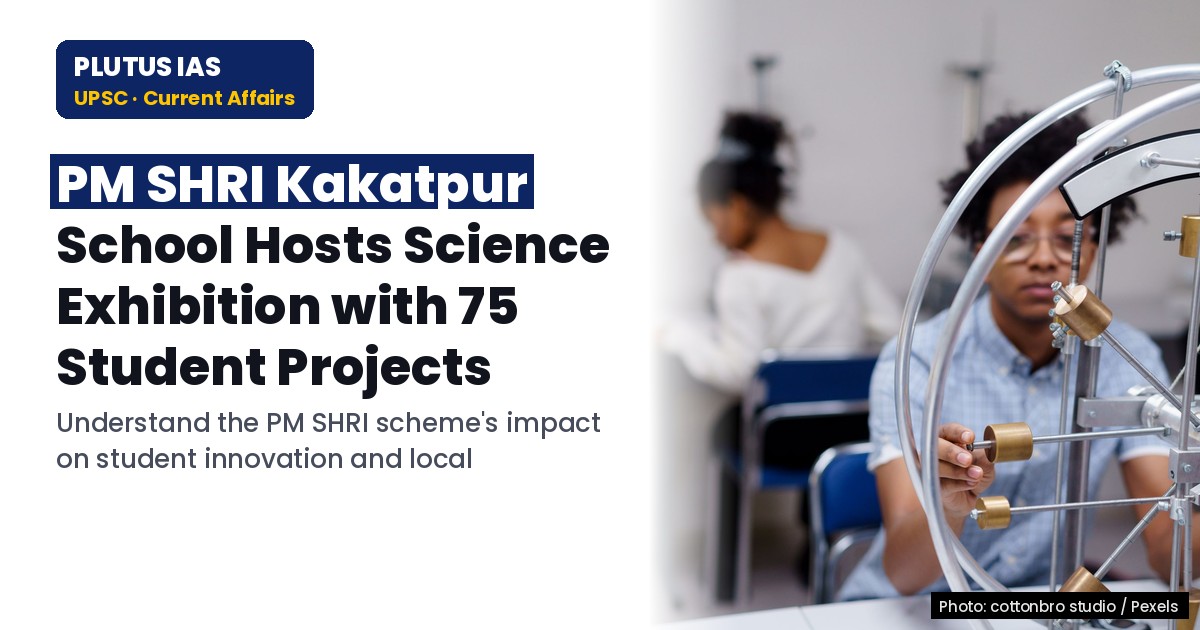
06 Nov PM SHRI School Science Exhibition: Innovation & Problem-Solving
✎ The PM SHRI scheme is a centrally sponsored initiative to upgrade existing schools into model institutions that embody the principles of the National Education Policy 2020, focusing on experiential learning and holistic…
Subject Relevance — Where This Topic Fits
- GS Paper II — Social Justice (Education, Human Resource Development) | GS Paper III — Science and Technology (Developments and their applications and effects in everyday life)
- Prelims: PM SHRI Scheme, National Education Policy 2020, Scientific temper, Experiential learning, STEM education, Innovation ecosystem
- Essay: The role of education in fostering innovation and national development, Cultivating scientific temper for a progressive society
Quick Revision: The PM SHRI scheme is a centrally sponsored initiative to upgrade existing schools into model institutions that embody the principles of the National Education Policy 2020, focusing on experiential learning and holistic development.
Why is this in the news?
A science exhibition was recently organised at a PM SHRI Nodal High School in Kakatpur, Odisha. The event showcased 75 student-led projects covering diverse themes such as artificial intelligence, healthcare, mathematics, and emerging technologies, with a particular emphasis on real-world problem-solving and addressing local and global challenges like mangrove conservation and natural disaster mitigation. This initiative highlights the practical implementation of the PM SHRI scheme’s objectives in promoting experiential learning and scientific inquiry among students.
Background
- The National Education Policy (NEP) 2020 advocates for a comprehensive transformation of the Indian education system, emphasising holistic development, critical thinking, and experiential learning.
- The PM SHRI (PM Schools for Rising India) scheme was launched to implement key aspects of the NEP 2020, aiming to upgrade existing schools into model institutions.
- These model schools are envisioned to deliver high-quality education, foster an inquiry-driven learning environment, and equip students with 21st-century skills.
- Science exhibitions serve as crucial platforms for students to apply theoretical knowledge, develop innovative solutions, and enhance their scientific understanding and problem-solving abilities.
- Such initiatives are integral to cultivating a scientific temper, which is a fundamental duty enshrined in the Constitution of India under Article 51A(h).
About the PM SHRI Scheme
- PM SHRI stands for PM Schools for Rising India, a centrally sponsored scheme launched by the Government of India.
- The scheme aims to upgrade and develop over 14,500 existing schools across states and union territories into model schools.
- These schools are intended to be exemplar institutions, showcasing the full spirit of the National Education Policy (NEP) 2020.
- Key features include a focus on experiential, holistic, integrated, play/toy-based, inquiry-driven, and discovery-oriented learning pedagogies.
- PM SHRI schools will also emphasise green school initiatives, promoting environmental sustainability and climate action among students.
- The scheme seeks to provide high-quality education in an equitable, inclusive, and joyful school environment, preparing students for diverse challenges.
- It also aims to foster critical thinking, creativity, and problem-solving skills, aligning with the demands of the 21st century.
- The schools are expected to become ‘lighthouse’ institutions, mentoring and leading other schools in their vicinity.
Key Features
| Feature | Significance |
|---|---|
| Student-led Projects | Fosters independent inquiry, critical thinking, and practical application of theoretical knowledge among students. |
| Diverse Thematic Coverage | Encompasses Artificial Intelligence, healthcare, mathematics, and emerging technologies, promoting interdisciplinary learning and comprehensive scientific understanding. |
| Real-world Problem Solving | Projects address critical local and global challenges such as mangrove conservation, coastal biodiversity, natural disaster mitigation, and drone technology applications, linking education to societal needs. |
| Platform for Innovation | Provides a dynamic environment for young minds to showcase creativity, develop original ideas, and explore innovative solutions. |
| Interaction with Dignitaries | Offers students opportunities to present their work, receive feedback, and gain encouragement from experts and community leaders, enhancing their communication and presentation skills. |
Why it Matters
Educational Significance
- Promotes experiential learning and hands-on scientific exploration, moving beyond rote memorisation.
- Cultivates scientific temper, critical thinking, and problem-solving abilities from an early age.
- Encourages interdisciplinary approaches to learning, integrating various scientific and technological fields.
- Provides a platform for students to develop and showcase innovative solutions to contemporary challenges.
Societal Significance
- Inspires future generations to pursue careers in Science, Technology, Engineering, and Mathematics (STEM) fields, contributing to national development.
- Addresses local and global challenges through student-led projects, fostering a sense of civic responsibility and environmental consciousness.
- Highlights the role of education in nurturing creative and visionary thinkers essential for navigating complex societal and environmental hurdles.
- Strengthens community engagement in education through the participation of local dignitaries and organisations.
Governance Significance
- Demonstrates the effective implementation of educational policies aimed at enhancing quality learning environments, such as the PM SHRI scheme.
- Showcases the government’s commitment to fostering innovation and scientific inquiry at the school level.
- Supports the National Education Policy (NEP) 2020’s emphasis on holistic, experiential, and inquiry-based learning.
- Contributes to the broader national goal of developing a knowledge-based economy and a scientifically literate citizenry.
Challenges
1. Ensuring Equitable Access to Quality STEM Education
- Disparities in infrastructure, resources, and qualified educators across different regions and socio-economic strata can limit participation in such initiatives.
- Lack of exposure to advanced scientific concepts and practical applications in underserved schools can hinder student engagement and innovation.
UPSC Link: GS-II: Social Justice; GS-III: Science & Technology
2. Sustaining and Scaling Innovative Educational Practices
- Maintaining the momentum and quality of science exhibitions and similar initiatives requires continuous funding, teacher training, and administrative support.
- Scaling successful models to a larger number of schools while ensuring consistent quality and impact poses logistical and financial challenges.
UPSC Link: GS-II: Government Policies & Interventions
3. Integrating Real-world Problem Solving into Curriculum
- Curriculum rigidity and examination-centric approaches often leave limited scope for project-based learning and addressing contemporary issues.
- Developing effective pedagogical methods that encourage students to identify, research, and propose solutions to real-world problems requires significant effort.
UPSC Link: GS-II: Education; GS-IV: Ethics & Human Interface
4. Bridging the Gap Between Academia and Industry/Research
- Limited opportunities for students to interact with scientists, researchers, and industry professionals can restrict their understanding of practical applications and career pathways.
- Lack of mentorship and guidance from experts can impede the development of high-quality, impactful student projects.
UPSC Link: GS-III: Science & Technology; GS-II: Education
Challenges — UPSC Perspective
| Issue | Concern |
|---|---|
| Resource Disparity | Unequal distribution of laboratory facilities, equipment, and qualified science teachers impacts the quality of scientific education across schools. |
| Curriculum Rigidity | Traditional, syllabus-driven teaching often limits the scope for hands-on experimentation and project-based learning, essential for fostering innovation. |
| Teacher Training | Insufficient training for educators in modern pedagogical techniques and emerging scientific fields can hinder their ability to guide student projects effectively. |
| Assessment Methods | Current assessment systems may not adequately evaluate creativity, critical thinking, and problem-solving skills developed through science exhibitions. |
| Funding for Innovation | Limited financial support for student projects, materials, and exhibition logistics can restrict the scale and ambition of scientific initiatives. |
Government Initiatives — Must-Memorise for Prelims
- PM SHRI (PM Schools for Rising India)
Way Forward
- Strengthen the implementation of PM SHRI scheme to ensure all beneficiary schools have adequate infrastructure and resources for STEM education.
- Develop comprehensive teacher training programmes focused on experiential learning, project-based pedagogy, and integration of emerging technologies.
- Incorporate real-world problem-solving and interdisciplinary projects more formally into the school curriculum, aligning with NEP 2020 objectives.
- Establish mentorship programmes connecting students with scientists, researchers, and industry experts to provide guidance and exposure.
- Create a national platform for showcasing student innovations, facilitating knowledge exchange and peer learning across schools.
- Increase public-private partnerships to secure funding and resources for science exhibitions and STEM-related initiatives in schools.
- Reform assessment methodologies to recognise and reward creativity, critical thinking, and practical application of scientific knowledge.
UPSC Value Addition
Keywords for Mains Answer-Writing
PM SHRI Scheme · National Education Policy 2020 · STEM Education · Experiential Learning · Innovation Ecosystem · Skill Development · Sustainable Development Goals · Public-Private Partnerships in Education
Constitutional & Policy Linkages
- Article 21A: Right to Education for children aged six to fourteen years.
- Article 51A(h): Duty to develop scientific temper, humanism and spirit of inquiry and reform.
Concept Flow
PM SHRI School hosts science exhibition → Students showcase innovative projects → Focus on real-world problem-solving → Cultivates scientific temper and critical thinking → Inspires future innovators and STEM careers → Contributes to national development and knowledge economy
Prelims Practice Questions
Q1. Consider the following statements regarding the PM SHRI Scheme:
1. The scheme aims to upgrade existing schools into ‘PM SHRI Schools’ which will deliver quality education and foster holistic development.
2. These schools are intended to be green schools, incorporating environment-friendly features and promoting a sustainable lifestyle.
3. The scheme is implemented by the Ministry of Education and covers schools managed by Central, State, UT Governments, and local bodies.
How many of the above statements are correct?
- Only one
- Only two
- Only three
- None
Answer: Only three — Statement 1 is correct: The PM SHRI (PM Schools for Rising India) scheme focuses on upgrading existing schools to deliver quality education and foster holistic development, aligning with the National Education Policy 2020. Statement 2 is correct: A key feature of PM SHRI schools is their emphasis on being ‘green schools,’ promoting environmental sustainability. Statement 3 is incorrect: While implemented by the Ministry of Education, the scheme specifically targets schools managed by Central, State, UT Governments, and local bodies, but does not cover all schools managed by these entities; it selects specific existing schools for upgrade.
Q2. Which of the following best describes the primary objective of promoting science exhibitions in schools, particularly under initiatives like PM SHRI?
- To assess students’ theoretical knowledge in science subjects.
- To encourage rote learning and memorization of scientific facts.
- To foster scientific temper, innovation, and practical application of knowledge.
- To prepare students exclusively for competitive examinations in science.
Answer: To foster scientific temper, innovation, and practical application of knowledge. — The primary objective of science exhibitions is to foster scientific temper, encourage innovation, and provide a platform for students to apply theoretical knowledge to practical, real-world problems. This aligns with the experiential learning approach advocated by the National Education Policy 2020.
Mains Practice Question
✍ The PM SHRI scheme aims to transform existing schools into exemplars of the National Education Policy 2020. Discuss how the scheme, through initiatives like science exhibitions, can foster an innovation ecosystem and contribute to skill development among students. (15 Marks)
Approach: A comprehensive answer should first outline the core objectives and features of the PM SHRI scheme, particularly its alignment with NEP 2020 principles such as holistic development, experiential learning, and competency-based education. The discussion should then elaborate on how specific initiatives, like science exhibitions, serve as practical mechanisms for fostering an innovation ecosystem by promoting critical thinking, problem-solving, and creativity. Concurrently, the answer must detail the direct and indirect contributions of such activities to skill development, including scientific temper, digital literacy, collaboration, and communication skills. Reference to the scheme’s ‘green school’ component and emphasis on local challenges (e.g., mangrove conservation, disaster mitigation) would strengthen the argument regarding real-world problem-solving and sustainable development. Conclude by briefly touching upon the potential long-term impact on India’s human capital and innovation landscape.
Source: orissapost.com
Generated by AanyaAi for educational purpose.
Related guides on our sites
- How to prepare for GS paper 1 for UPSC CSE mains exam
- Best schools in India
- Best UPSC coaching for IFOS exam
- Best mentorship programme for upsc

- PM SHRI School Science Exhibition: Innovation & Problem-Solving - November 6, 2026
- विशेष अभियान-6: उर्वरक विभाग की प्रशासनिक सुधार में प्रगति - November 6, 2026
- Uttarakhand Police Awarded President’s Colour by Amit Shah - November 6, 2026

No Comments