


23 Jul PM SVANidhi Scheme: Impact, Expansion, and Digital Adoption for Street Vendors
Subject Relevance — Where This Topic Fits
- GS Paper II — Government Policies and Interventions for Development in various sectors and issues arising out of their Design and Implementation | GS Paper III — Indian Economy and issues relating to Planning, Mobilization of Resources, Growth, Development and Employment; Inclusive Growth and issues arising from it
- Prelims: PM SVANidhi Scheme, Ministry of Housing and Urban Affairs, Street Vendors Act, 2014, Micro-credit facilities, Digital payments, Financial inclusion, Urban Local Bodies (ULBs), RuPay Credit Card
- Essay: The role of government schemes in fostering financial inclusion and economic empowerment for vulnerable sections of society., Leveraging digital infrastructure for inclusive growth and socio-economic development in India.
Quick Revision: PM SVANidhi is a micro-credit scheme by the Ministry of Housing and Urban Affairs, providing collateral-free working capital loans to street vendors, fostering financial inclusion, digital payments, and socio-economic upliftment across urban, peri-urban, and census town areas.
Why is this in the news?
The Ministry of Housing and Urban Affairs recently provided an update on the implementation of the PM SVANidhi scheme, highlighting its expansion beyond urban areas to include peri-urban and census towns. The update also referenced impact assessments conducted by the Indian School of Business (ISB), Hyderabad, which indicate significant improvements in beneficiaries’ business profits, digital payment adoption, and overall quality of life, underscoring the scheme’s role in formalising credit access for street vendors.
Background
- The informal sector constitutes a significant portion of the Indian economy, with street vendors playing a crucial role in urban and semi-urban livelihoods.
- Historically, street vendors have faced challenges in accessing formal credit, often relying on informal lenders with high interest rates, which impedes business growth and perpetuates financial vulnerability.
- The COVID-19 pandemic severely impacted the livelihoods of street vendors, necessitating targeted government intervention to facilitate their economic recovery and integration into the formal financial system.
- The ‘Street Vendors (Protection of Livelihood and Regulation of Street Vending) Act, 2014’ provides a legal framework for regulating street vending and protecting the rights of vendors, including their right to livelihood.
- Financial inclusion, a key policy objective, aims to provide accessible and affordable financial services to all sections of society, including those traditionally excluded from formal banking channels.
- Digitalisation of financial transactions is a strategic imperative for India, promoting transparency, efficiency, and broader participation in the formal economy.
What is PM SVANidhi?
- PM SVANidhi (Prime Minister Street Vendor’s AtmaNirbhar Nidhi) is a Central Sector Scheme launched by the Ministry of Housing and Urban Affairs in June 2020.
- The scheme aims to provide affordable working capital collateral-free loans to street vendors to help them resume their livelihoods, which were adversely affected by the COVID-19 pandemic.
- Initially implemented in urban areas, its scope has been expanded to cover vendors in peri-urban areas and census towns, ensuring broader geographical outreach.
- Beneficiaries can avail a working capital loan of up to ₹10,000 in the first tranche, followed by ₹20,000 and ₹50,000 in subsequent tranches upon timely repayment, with an interest subsidy of 7% per annum.
- The scheme promotes digital transactions among street vendors through a cashback incentive and facilitates the development of a credit history, enabling access to further formal credit.
- Eligibility for the scheme extends to all street vendors, including seasonal, itinerant, women, and tourism-dependent vendors, provided they meet the prescribed criteria as per scheme guidelines.
- Identification of eligible street vendors is conducted through surveys by States/UTs under the provisions of the Street Vendors Act, 2014, with Urban Local Bodies (ULBs) responsible for issuing Certificates of Vending.
Key Features
| Feature | Significance |
|---|---|
| Expanded Geographical Scope | Initially confined to urban areas, the scheme’s eligibility has been progressively extended to include street vendors in peri-urban and rural areas, specifically census towns and the geographical limits of Urban Local Bodies (ULBs). This expansion aims to ensure broader inclusion of the informal sector workforce. |
| First-Time Credit Access | Studies indicate that for approximately 95% of beneficiaries, the PM SVANidhi loan represented their inaugural access to formal credit. This highlights the scheme’s crucial role in financial inclusion for a demographic traditionally underserved by conventional banking channels. |
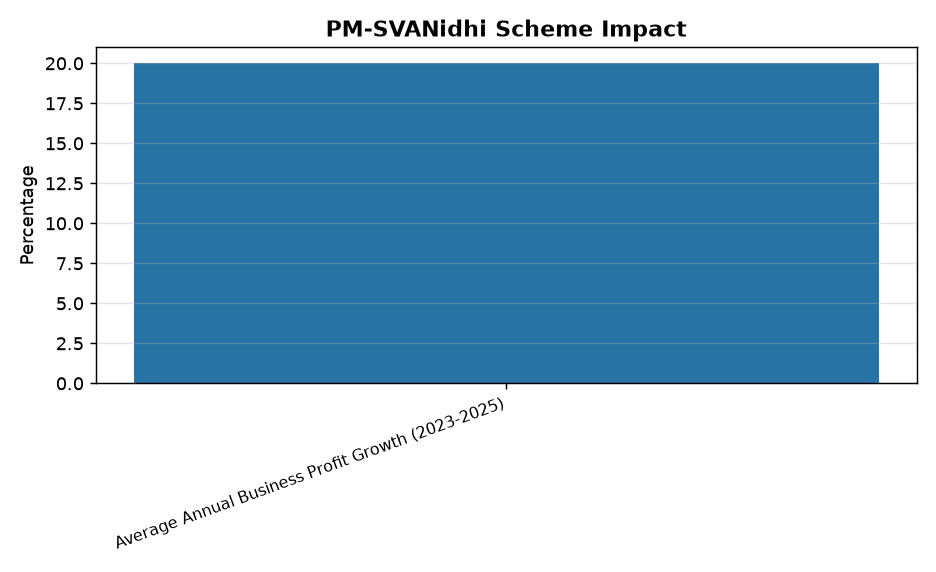
| Business Growth and Digital Adoption | Beneficiaries experienced an average annual business profit increase of around 20% between 2023 and 2025. Concurrently, there was a notable surge in the adoption of digital payments among street vendors, signifying a move towards formalisation and modernisation of their business practices. |
| Credit History Development | The scheme facilitates the creation of a credit history for street vendors, with about 30% of borrowers reporting additional loans beyond PM SVANidhi. This demonstrates its effectiveness in integrating vendors into the formal credit ecosystem, enhancing their future borrowing capacity. |
| Holistic Socio-Economic Impact | Beyond business revival, the scheme contributes to improved living standards, enhanced food security, better access to healthcare, and support for children’s education among vendor families. This underscores its multi-dimensional impact on poverty alleviation and social welfare. |
| UPI-Linked RuPay Credit Card | The introduction of UPI-linked RuPay Credit Cards for beneficiaries who have repaid their second loan instalment provides a digital, convenient, and secure payment instrument. This further promotes digital financial transactions and offers an additional credit avenue. |
Why it Matters
Economic Empowerment and Financial Inclusion
- PM SVANidhi addresses the critical need for affordable working capital credit for street vendors, a segment largely excluded from formal financial systems. By providing collateral-free loans, it enables them to restart and expand their businesses, thereby fostering economic resilience.
- The scheme’s role in facilitating first-time access to formal credit for a significant majority of beneficiaries is pivotal. It helps integrate the informal economy into the mainstream financial sector, reducing reliance on exploitative moneylenders.
- The observed increase in average annual business profits and the adoption of digital payments signify a positive shift towards formalisation and modernisation of micro-enterprises. This enhances productivity and contributes to the broader economic growth.
Social Upliftment and Poverty Alleviation
- Beyond direct financial assistance, PM SVANidhi contributes to improved living standards, food security, healthcare access, and educational support for vendor families. This holistic impact addresses multiple dimensions of poverty and vulnerability.
- By stabilising household incomes and expenditures, the scheme empowers vendors to invest in their families’ well-being, breaking cycles of intergenerational poverty.
- The scheme’s inclusive approach, covering seasonal, itinerant, female, and tourism-dependent vendors, ensures that support reaches diverse segments of the informal workforce, promoting equitable development.
Governance and Digital Transformation
- The scheme leverages technology for efficient implementation, from application processing to digital payment promotion. The average loan approval time of 23 days indicates a streamlined process.
- The introduction of UPI-linked RuPay Credit Cards for repeat borrowers signifies a commitment to digital financial innovation and further integrates vendors into the digital economy.
- The emphasis on awareness campaigns and provision of Information, Education, and Communication (IEC) materials in local languages demonstrates a proactive approach to ensuring scheme accessibility and outreach.
Challenges
1. Identification and Certification of Street Vendors
- The responsibility for surveying and issuing Certificates of Vending (CoV) lies with State/UT governments and Urban Local Bodies (ULBs). Inconsistent or slow progress in this crucial initial step can impede eligible vendors from accessing scheme benefits.
- Lack of comprehensive and updated surveys can lead to exclusion of genuine street vendors, particularly those in newly expanded geographical areas or those with itinerant vending patterns.
UPSC Link: Social Justice: Vulnerable sections
2. Digital Literacy and Adoption
- While digital payment adoption has increased, a segment of street vendors may still lack the necessary digital literacy or access to smartphones, posing a barrier to fully leveraging digital financial tools like UPI-linked RuPay Credit Cards.
- Ensuring equitable access to digital financial services requires continuous training and support mechanisms to bridge the digital divide among beneficiaries.
UPSC Link: Economy: Digitalisation; Social Justice: Vulnerable sections
3. Credit History Development for All
- While the scheme helps build credit history, a significant portion of borrowers (approximately 70% in the studies) still rely solely on PM SVANidhi loans. Further efforts are needed to facilitate their transition to broader formal credit avenues.
- The challenge lies in ensuring that the credit history developed through PM SVANidhi translates into access to larger, more diverse financial products from mainstream institutions.
UPSC Link: Economy: Financial inclusion
4. Sustained Outreach and Awareness
- Despite awareness campaigns, ensuring that all eligible street vendors, especially in newly included areas (census towns, peri-urban), are aware of the scheme and its benefits remains a continuous challenge.
- The transient nature of some vending activities and high mobility of vendors necessitate innovative and sustained outreach strategies beyond traditional media.
UPSC Link: Social Justice: Government schemes
Challenges — UPSC Perspective
| Issue | Concern |
|---|---|
| Incomplete Vendor Surveys | Many ULBs struggle with timely and comprehensive surveys under the Street Vendors Act, 2014, leading to exclusion of eligible beneficiaries from the scheme. |
| Digital Divide | A segment of street vendors lacks the necessary digital literacy or access to smartphones, hindering their full participation in digital payment ecosystems and advanced financial products. |
| Limited Formal Credit Diversification | While PM SVANidhi provides initial credit, many vendors still do not access other formal credit products, indicating a need for further integration into mainstream financial systems. |
| Geographical Expansion Challenges | Ensuring effective outreach and implementation in newly included census towns and peri-urban areas requires significant administrative capacity building and localised awareness campaigns. |
| Monitoring and Grievance Redressal | Ensuring robust monitoring mechanisms and accessible grievance redressal for vendors, particularly in remote areas, is crucial for effective scheme implementation and trust-building. |
Government Initiatives — Must-Memorise for Prelims
- PM SVANidhi (Prime Minister Street Vendor’s AtmaNirbhar Nidhi)
Way Forward
- Expedite and standardise the process of surveying and issuing Certificates of Vending (CoV) by Urban Local Bodies (ULBs) across all eligible areas, including newly expanded geographical scopes, to ensure comprehensive coverage.
- Intensify digital literacy and financial awareness programmes specifically tailored for street vendors, focusing on the benefits and usage of digital payment platforms and UPI-linked RuPay Credit Cards.
- Develop structured pathways and provide financial counselling to help vendors transition from PM SVANidhi loans to a wider range of formal credit products from mainstream financial institutions, leveraging their established credit history.
- Strengthen inter-ministerial coordination and collaboration between the Ministry of Housing and Urban Affairs, State/UT governments, and financial institutions to streamline scheme implementation and address bottlenecks.
- Utilise local community organisations, self-help groups (SHGs), and Non-Governmental Organisations (NGOs) for effective last-mile outreach, awareness generation, and application assistance, especially in peri-urban and rural areas.
- Enhance the capacity of ULB officials and bank staff through regular training programmes on scheme guidelines, digital tools, and empathetic engagement with street vendors.
- Establish robust, easily accessible, and multilingual grievance redressal mechanisms to promptly address issues faced by beneficiaries, ensuring transparency and accountability in scheme implementation.
- Explore partnerships with FinTech companies to innovate financial products and services that cater specifically to the evolving needs of street vendors, further promoting their financial inclusion and business growth.
UPSC Value Addition
Keywords for Mains Answer-Writing
PM SVANidhi Scheme · Street Vendors Act 2014 · Financial Inclusion · Digital Payments Adoption · Micro-credit Facilities · Urban Local Bodies (ULBs) · Socio-economic Empowerment · Formal Credit System · Livelihood Protection · Vulnerable Sections
Constitutional & Policy Linkages
- Article 19(1)(g): Right to practice any profession, or to carry on any occupation, trade or business.
- Article 21: Right to life and personal liberty, encompassing the right to livelihood.
- Article 38: State to secure a social order for the promotion of welfare of the people.
- Article 39(a): State to direct its policy towards securing adequate means of livelihood for all citizens.
- Article 243W: Powers, authority and responsibilities of Municipalities, including economic development and social justice.
Concept Flow
Informal vendors lack formal credit access. → PM SVANidhi provides collateral-free micro-credit. → Vendors gain working capital, build credit history. → Business profits increase, digital payments adopted. → Improved livelihoods, food security, education access.
Prelims Practice Questions
Q1. Consider the following statements regarding the PM SVANidhi scheme:
1. The scheme was initially launched for street vendors within urban areas only.
2. The eligibility criteria have been expanded to include vendors in peri-urban and rural areas.
3. The scheme aims to facilitate formal credit access, thereby reducing reliance on informal lending sources.
Which of the statements given above is/are correct?
- 1 and 2 only
- 2 and 3 only
- 1 and 3 only
- 1, 2 and 3
Answer: 1, 2 and 3 — Statement 1 is correct: The scheme was initially implemented in urban areas. Statement 2 is correct: Its scope has been extended to include vendors in peri-urban areas and census towns. Statement 3 is correct: The scheme’s primary objective is to provide formal credit, enabling vendors to build credit histories and reduce dependence on informal channels.
Q2. With reference to the PM SVANidhi scheme, which of the following statements is/are correct?
1. The scheme is implemented by the Ministry of Rural Development.
2. Beneficiaries who repay their second loan tranche are eligible for a UPI-linked RuPay Credit Card.
3. The identification of street vendors and issuance of vending certificates fall under the purview of Urban Local Bodies and State/UT Governments.
Select the correct answer using the code given below:
- 1 and 2 only
- 2 and 3 only
- 3 only
- 1, 2 and 3
Answer: 3 only — Statement 1 is incorrect: The scheme is implemented by the Ministry of Housing and Urban Affairs. Statement 2 is correct: A UPI-linked RuPay Credit Card is introduced for beneficiaries who have repaid their second loan tranche. Statement 3 is correct: The identification of street vendors and issuance of vending certificates are responsibilities of the concerned Urban Local Bodies and State/UT Governments, as per the Street Vendors (Protection of Livelihood and Regulation of Street Vending) Act, 2014.
Mains Practice Question
✍ The PM SVANidhi scheme has been instrumental in fostering financial inclusion and socio-economic empowerment among street vendors. Critically analyse the scheme’s impact, highlighting its successes in expanding formal credit access and promoting digital payments, while also discussing the challenges in its implementation and suggesting measures for further enhancement. (250 words)
Approach: Candidates should begin by introducing the PM SVANidhi scheme and its primary objective. The analysis should then focus on its positive impacts, such as facilitating first-time formal credit, improving business profits, fostering credit history development, and increasing digital payment adoption. Additionally, discuss the broader socio-economic benefits like improved living standards and access to healthcare and education. Subsequently, address potential challenges in implementation, such as ensuring comprehensive coverage, streamlining the application process, and overcoming awareness gaps. Conclude with forward-looking suggestions for strengthening the scheme’s reach and effectiveness, drawing upon the insights from the provided news.
Source: PIB (Press Information Bureau)
Generated by AanyaAi for educational purpose.


No Comments