


01 Aug PM-VEBRY: 3.5 Crore Jobs by 2027 for UPSC & State PCS Aspirants
✎ PMRPY is a two-year (2025-27) employment-linked incentive scheme with ₹99,446 crore outlay, targeting 3.5 crore formal jobs, including 1.92 crore for first-time job seekers, administered via EPFO to formalise India’s workforce…
Subject Relevance — Where This Topic Fits
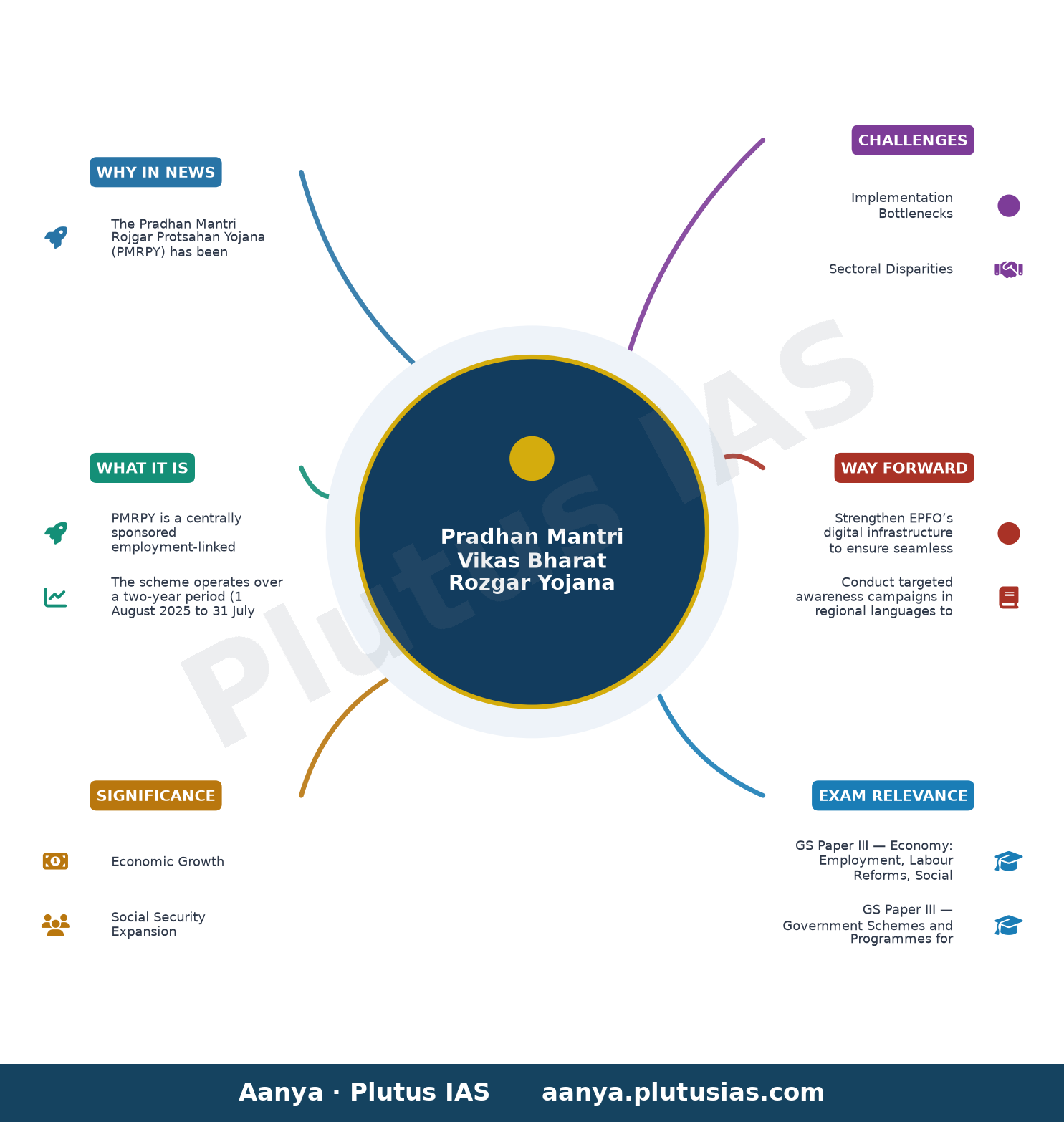
- GS Paper III — Economy: Employment, Labour Reforms, Social Security, and Inclusive Growth | GS Paper III — Government Schemes and Programmes for Employment Generation | GS Paper III — Role of EPFO in Formalising the Workforce
- Prelims: Pradhan Mantri Vikas Bharat Rozgar Yojana (PM-VBKY), EPFO, Formalisation of workforce, Social security coverage, First-time job seekers, Employment-linked incentives, Demographic dividend, Atmanirbhar Bharat, National Manufacturing Mission, Financial inclusion through EPFO
- Essay: India’s demographic dividend: Leveraging youth for sustainable and inclusive growth, Role of formal employment in realising the vision of ‘Viksit Bharat 2047’
Quick Revision: PMRPY is a two-year (2025-27) employment-linked incentive scheme with ₹99,446 crore outlay, targeting 3.5 crore formal jobs, including 1.92 crore for first-time job seekers, administered via EPFO to formalise India’s workforce and expand social security.
Why is this in the news?
The Pradhan Mantri Rojgar Protsahan Yojana (PMRPY) has been highlighted in a recent Press Information Bureau (PIB) release as a flagship initiative to accelerate the formalisation of India’s workforce and expand social security coverage. Launched on 1 August 2025 with a financial outlay of ₹99,446 crore over two years, the scheme aims to generate over 3.5 crore formal employment opportunities, including for 1.92 crore first-time job seekers, thereby aligning with the vision of ‘Viksit Bharat 2047’. The scheme’s implementation milestone of one year on 1 August 2026 underscores its significance in India’s economic transformation agenda.
Background
- India’s demographic dividend presents a unique opportunity, with over 65% of the population below 35 years of age, necessitating structured employment generation to harness this potential for sustainable growth.
- The informal sector constitutes approximately 80% of India’s workforce, highlighting the critical need for formalisation to ensure social security, wage security, and productivity enhancement.
- The Employees’ Provident Fund Organisation (EPFO), established under the Employees’ Provident Funds and Miscellaneous Provisions Act, 1952, plays a pivotal role in extending social security to the organised workforce through provident fund, pension, and insurance schemes.
- The Atmanirbhar Bharat initiative and the National Manufacturing Mission underscore the government’s commitment to boosting domestic manufacturing and employment generation, particularly in labour-intensive sectors.
- The Union Budget 2023-24 emphasised the expansion of social security coverage and formal employment as key pillars for achieving inclusive growth and economic resilience.
- The vision of ‘Viksit Bharat 2047’ aims to position India as a developed nation by 2047, with formal employment and social security expansion serving as critical enablers.
What is the Pradhan Mantri Rojgar Protsahan Yojana (PMRPY)?
- PMRPY is a centrally sponsored employment-linked incentive scheme launched on 1 August 2025 to formalise India’s workforce and expand social security coverage, aligning with the vision of ‘Viksit Bharat 2047’.
- The scheme operates over a two-year period (1 August 2025 to 31 July 2027) with a total financial outlay of ₹99,446 crore, targeting the generation of over 3.5 crore formal employment opportunities.
- A dual incentive framework is employed: Part A provides incentives to first-time job seekers, while Part B offers support to employers for creating additional formal employment.
- The scheme is administered through a technology-driven framework linked with the EPFO, ensuring transparency, efficiency, and seamless integration with existing social security mechanisms.
- PMRPY complements the National Manufacturing Mission by promoting employment in labour-intensive manufacturing sectors, thereby enhancing industrial growth and job creation.
- The scheme is designed to enhance financial inclusion by encouraging EPFO registration, thereby extending provident fund, pension, and insurance benefits to a broader segment of the workforce.
Key Features
| Feature | Significance |
|---|---|
| Dual Incentive Framework | Provides separate incentives for first-time job seekers (Part A) and employers (Part B), ensuring balanced participation and mutual benefit. |
| EPFO Integration | Leverages EPFO’s transparent, technology-driven platform to formalise employment and expand social security coverage. |
| Financial Inclusion Linkage | Mandates investment of a portion of incentives into designated savings instruments, fostering long-term financial security for workers. |
| Sectoral Focus | Prioritises labour-intensive manufacturing and emerging industries, aligning with the National Manufacturing Mission. |
| Two-Year Implementation Window | Designed for rapid scalability with a ₹99,446 crore outlay, ensuring sustained employment generation till July 2027. |
Why it Matters
Economic Growth
- Converts demographic dividend into a productive workforce by formalising employment for 3.5 crore individuals, including 1.92 crore first-time job seekers.
- Stimulates labour-intensive sectors, particularly manufacturing, to absorb India’s expanding youth workforce.
- Enhances labour productivity through social security integration, reducing attrition and fostering skill development.
Social Security Expansion
- Expands the scope of social security to unorganised and semi-organised sectors via EPFO registration, ensuring financial protection.
- Mandates contributions to provident funds and designated savings instruments, reducing vulnerability to economic shocks.
- Promotes financial literacy through structured training programmes integrated into the incentive mechanism.
Governance and Transparency
- Utilises EPFO’s digital infrastructure for real-time monitoring, reducing leakages and ensuring targeted delivery of benefits.
- Implements a phased disbursement model (two instalments) to verify sustained employment and adherence to compliance norms.
- Aligns with the vision of ‘Viksit Bharat 2047’ by institutionalising a culture of formal employment and accountability.
Demographic Dividend Utilisation
- Addresses the challenge of underemployment and informality by incentivising formal sector entry for young workers.
- Reduces the risk of a ‘youth bulge’ translating into unemployment or low-productivity employment.
- Supports the transition from a labour surplus to a skilled, formalised workforce, critical for sustained GDP growth.
Challenges
1. Implementation Bottlenecks
- Risk of delays in EPFO registration due to bureaucratic hurdles or digital divide in rural and semi-urban areas.
- Potential mismatch between job creation targets and actual labour market demand in certain sectors.
- Need for robust grievance redressal mechanisms to address disputes over incentive disbursement or eligibility.
UPSC Link: GS3: Employment
2. Sectoral Disparities
- Limited impact on high-skilled or service-sector employment, which may not qualify for EPFO incentives.
- Concentration of benefits in labour-intensive industries could exacerbate regional imbalances in industrial development.
- Dependence on manufacturing growth may face headwinds from global supply chain disruptions or automation.
UPSC Link: GS3: Industrial Policy
3. Financial Sustainability
- Long-term fiscal burden of ₹99,446 crore outlay, requiring efficient utilisation to avoid resource misallocation.
- Need for periodic reviews to assess cost-effectiveness and adjust incentive structures based on outcomes.
- Potential crowding-out effect on existing employment schemes if not integrated with complementary policies.
UPSC Link: GS3: Fiscal Policy
4. Awareness and Compliance
- Low awareness among first-time job seekers and small employers about eligibility criteria and benefit structures.
- Risk of non-compliance by employers who may underreport wages or avoid EPFO registration to evade incentives.
- Requires multi-stakeholder collaboration (government, industry, civil society) for effective outreach and enforcement.
UPSC Link: GS2: Governance
5. Technological and Infrastructure Gaps
- Dependence on digital infrastructure for EPFO registration and incentive disbursement may exclude marginalised groups.
- Need for upskilling EPFO staff and employers on the scheme’s digital processes to ensure smooth implementation.
- Cybersecurity risks associated with handling sensitive employment and financial data.
UPSC Link: GS3: Science & Tech
Challenges — UPSC Perspective
| Issue | Concern |
|---|---|
| Digital Divide | Exclusion of rural and semi-urban workers due to limited internet access or digital literacy. |
| Eligibility Ambiguity | Uncertainty among stakeholders about qualifying criteria for incentives, leading to underutilisation. |
| Sectoral Mismatch | Over-reliance on manufacturing may not address service-sector employment needs or regional disparities. |
| Fiscal Strain | Sustainability of ₹99,446 crore outlay over two years without measurable economic returns. |
| Compliance Deficit | Risk of employers exploiting loopholes to claim incentives without genuine job creation. |
| Monitoring Gaps | Lack of real-time data on employment status and incentive utilisation hinders course correction. |
Way Forward
- Strengthen EPFO’s digital infrastructure to ensure seamless registration and disbursement of incentives, including offline support for rural areas.
- Conduct targeted awareness campaigns in regional languages to educate first-time job seekers and small employers about eligibility and benefits.
- Integrate PM-VBRY with existing skilling initiatives (e.g., PMKVY) to enhance employability in high-demand sectors.
- Establish a dedicated grievance redressal portal with multi-tier monitoring to address disputes and ensure transparency.
- Introduce performance-based incentives for states to encourage regional balance in employment generation.
- Collaborate with industry associations to identify sector-specific bottlenecks and tailor incentives accordingly.
- Mandate regular third-party audits of EPFO data to verify employment claims and prevent fraud.
- Align the scheme with the National Employment Policy to ensure complementarity with broader labour market reforms.
UPSC Value Addition
Keywords for Mains Answer-Writing
Pradhan Mantri Vikas Bharat Rozgar Yojana (PM-VBRY) · formal employment expansion · EPFO registration incentives · demographic dividend utilisation · labour force formalisation · social security coverage · youth employment generation · Viksit Bharat 2047 vision · employee provident fund incentives · employer subsidy mechanism
Concept Flow
Demographic Dividend → Youth workforce enters labour market → Informal employment dominates → Low productivity and social insecurity → PM-VBRY incentivises formal employment → EPFO registration expands social security → Financial inclusion and savings culture develop → Productivity and economic growth accelerate → Sustainable development goals (Viksit Bharat 2047) achieved.
Prelims Practice Questions
Q1. Consider the following statements regarding the Pradhan Mantri Vikas Bharat Rozgar Yojana (PM-VBRY):
1. The scheme provides a one-time incentive of up to ₹15,000 to first-time employees registered with EPFO.
2. The incentive is disbursed in two instalments: after six months and twelve months of continuous service.
3. The scheme offers a monthly subsidy of ₹3,000 to employers for each eligible employee for a period of two years.
How many of the above statements are correct?
- Only one
- Only two
- All three
- None
Answer: All three — Statements 1 and 2 are correct. Statement 3 is incorrect as the employer subsidy is ₹3,000 per eligible employee per month for two years, but the eligibility criteria specify a maximum salary threshold of ₹1,00,000 per month.
Q2. Assertion (A): The Pradhan Mantri Vikas Bharat Rozgar Yojana (PM-VBRY) aims to incentivise the formalisation of India’s workforce.
Reason (R): The scheme mandates that all beneficiaries must be registered with the Employees’ Provident Fund Organisation (EPFO).
- Both A and R are true, and R is the correct explanation of A
- Both A and R are true, but R is not the correct explanation of A
- A is true, but R is false
- A is false, but R is true
Answer: A is true, but R is false — Assertion (A) is true as PM-VBRY incentivises formal employment. Reason (R) is false because while EPFO registration is encouraged, it is not mandatory for all beneficiaries; the scheme targets first-time employees and employers creating formal jobs.
Q3. Match the following provisions of the Pradhan Mantri Vikas Bharat Rozgar Yojana (PM-VBRY) with their respective beneficiaries:
Column I (Provision) | Column II (Beneficiary)
———————————————–|—————————
1. One-time incentive of up to ₹15,000 | A. Employer
2. Monthly subsidy of ₹3,000 for two years | B. First-time employee
3. EPFO registration requirement | C. Both employer and employee
4. Incentive linked to financial literacy | D. Employee
- 1-B, 2-A, 3-D, 4-C
- 1-D, 2-A, 3-B, 4-C
- 1-B, 2-A, 3-C, 4-D
- 1-D, 2-C, 3-B, 4-A
Answer: 1-B, 2-A, 3-D, 4-C — The correct match is: 1-B (one-time incentive to first-time employees), 2-A (monthly subsidy to employers), 3-D (EPFO registration requirement for employees), 4-C (financial literacy incentive applies to both).
Mains Practice Question
✍ The Pradhan Mantri Vikas Bharat Rozgar Yojana (PM-VBRY) represents a strategic intervention to harness India’s demographic dividend through formal employment generation. Critically examine the design and potential impact of this scheme in achieving its stated objectives. Also, analyse the challenges in its implementation and suggest measures to enhance its effectiveness. (15 Marks)
Approach: MODEL-ANSWER SKELETON:
1. **Introduction (2 Marks)**
– Context: India’s demographic dividend and the need for formal employment (Viksit Bharat 2047 vision).
– Objective of PM-VBRY: Incentivise first-time employment and formal job creation.
2. **Design and Provisions (4 Marks)**
– **Employee Incentives (Part A):**
– One-time incentive of up to ₹15,000 for first-time employees earning ≤₹1,00,000/month.
– Disbursement in two instalments (6 months and 12 months of service) with financial literacy linkage.
– Encourages EPFO registration and formal sector entry.
– **Employer Incentives (Part B):**
– Monthly subsidy of ₹3,000 per eligible employee for two years.
– Targets new and expanding industries, particularly labour-intensive manufacturing.
– **Administrative Framework:**
– EPFO-managed, technology-driven implementation for transparency and efficiency.
3. **Potential Impact (4 Marks)**
– **Positive Outcomes:**
– Expansion of formal employment (target: 3.5 crore jobs, including 1.92 crore first-time employees).
– Enhanced social security coverage and financial inclusion.
– Alignment with National Manufacturing Mission and labour reforms.
– **Critique:**
– Limited coverage: Salary cap of ₹1,00,000/month excludes higher-skilled jobs.
– Short-term nature: Two-year subsidy may not sustain long-term formalisation.
– Regional disparities: Manufacturing hubs may benefit disproportionately.
4. **Challenges in Implementation (3 Marks)**
– **Awareness and Outreach:** Low awareness among target groups (youth, small enterprises).
– **Bureaucratic Hurdles:** Delays in disbursement and EPFO registration processes.
– **Monitoring Gaps:** Ensuring compliance and preventing misuse of subsidies.
– **Sectoral Bias:** Over-reliance on manufacturing; neglect of services and gig economy.
5. **Measures for Enhancement (2 Marks)**
– **Expanding Coverage:** Raise salary cap and include gig workers under EPFO.
– **Long-term Incentives:** Introduce performance-based subsidies beyond two years.
– **Digital Integration:** Leverage Aadhaar and GSTN for seamless verification and disbursement.
– **Skill Development Linkage:** Integrate with PMKVY or NSDC to upskill beneficiaries.
**Conclusion (2 Marks)**
– PM-VBRY is a commendable step toward formal employment expansion but requires structural reforms to address long-term sustainability and inclusivity.
Source: PIB (Press Information Bureau)
Generated by AanyaAi for educational purpose.

- हिमाचल में डिजिटल भुगतान क्रांति: बिलासपुर अव्वल, महिलाओं की भागीदारी 93% तक पहुंची - September 23, 2026
- Himachal Pradesh Leads in Digital Payments: Bilaspur Tops, Women’s Role Rises - September 23, 2026
- केरल लोक सेवा आयोग ने उच्च न्यायालय में दायर किया मामला, सदस्यों के खिलाफ मामला रद्द करने की मांग - September 23, 2026

No Comments