


29 Jul PM Vidyalakshmi Scheme: Interest-Free Loans for Meritorious Students in Top Institutes
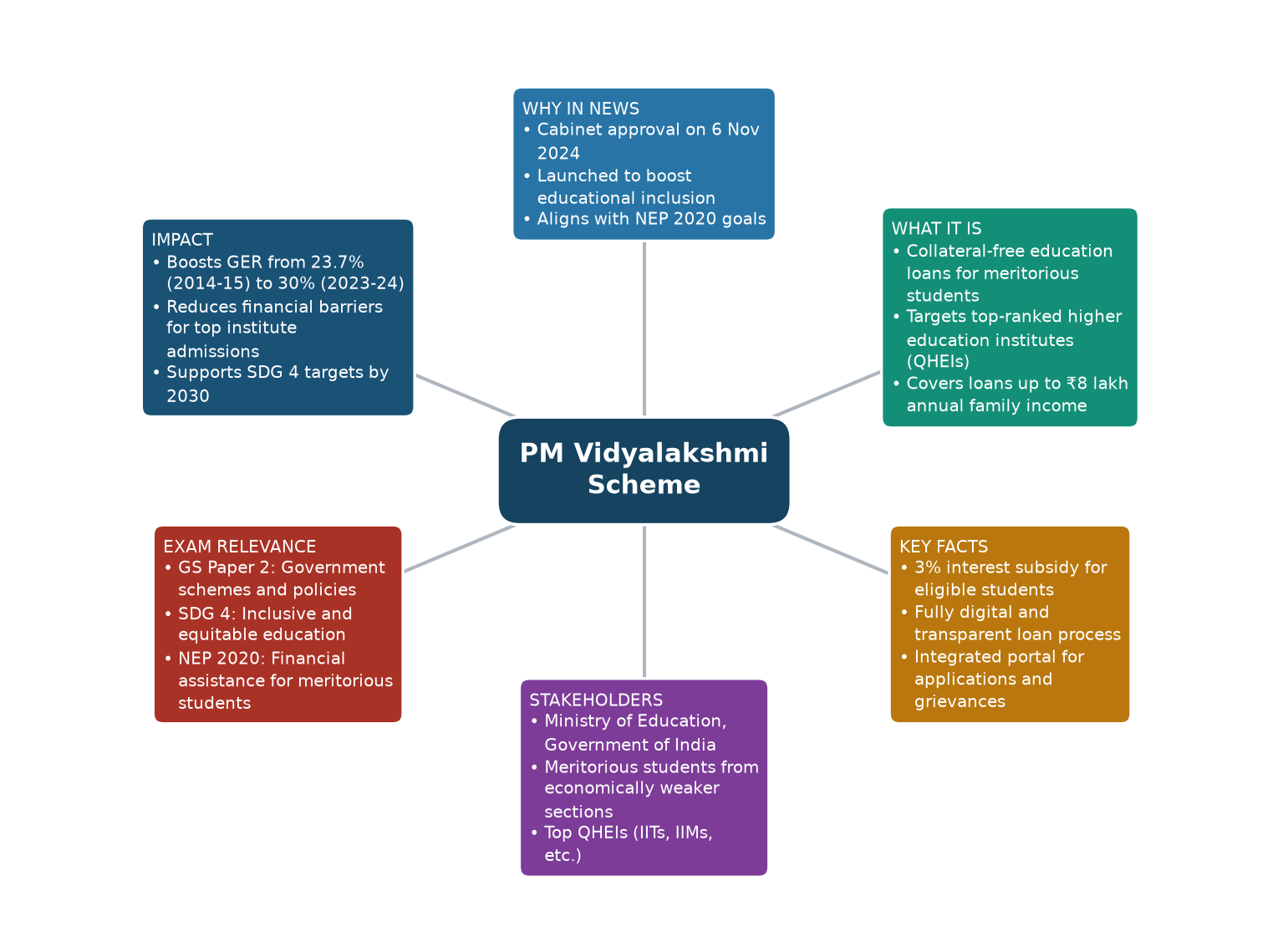
Map & concept mind-map: PM Vidyalakshmi Scheme Overview
Subject Relevance — Where This Topic Fits
- GS Paper II — Social Justice and Governance | GS Paper III — Growth, Development and Employment | GS Paper IV — Ethics in Governance
- Prelims: Pradhan Mantri Vidya Lakshmi Yojana, Credit Guarantee Scheme for Education Loans, Gross Enrolment Ratio (GER) in Higher Education, Sustainable Development Goal 4 (SDG 4), National Education Policy (NEP) 2020
- Essay: The role of government in ensuring equitable access to education: A case study of PM Vidya Lakshmi Yojana, Balancing fiscal prudence and social welfare: Lessons from India’s education financing models
Why is this in the news?
The Pradhan Mantri Vidya Lakshmi Yojana (PMVLY) has been approved by the Union Cabinet on 6 November 2024 as a mission-mode initiative under the Ministry of Education to address financial barriers faced by meritorious students seeking admission to top-ranked higher education institutions (QHEIs) in India. This initiative is aligned with the Sustainable Development Goal 4 (SDG 4) of the United Nations, aiming to ensure inclusive and equitable quality education and promote lifelong learning opportunities.
Background
- India’s Gross Enrolment Ratio (GER) in higher education increased from 23.7% in 2014-15 to 30.0% in 2023-24, reflecting progress in access to higher education.
- Despite rising enrolment, economic barriers persist, particularly for students from low-income households aspiring to study in premier institutions like IITs, IIMs, and other QHEIs.
- Traditional education loans often require collateral or third-party guarantees, which many economically disadvantaged students cannot provide, leading to exclusion from quality higher education.
- The National Education Policy (NEP) 2020 emphasizes financial support for meritorious students to ensure no talented individual is deprived of quality education due to financial constraints.
- The scheme is designed to complement existing education financing mechanisms, such as the Central Sector Interest Subsidy (CSIS) Scheme for students with annual family income up to ₹4.5 lakh.
What is the Pradhan Mantri Vidya Lakshmi Yojana (PMVLY)?
- A centrally sponsored mission-mode scheme launched by the Ministry of Education to facilitate collateral-free and guarantee-free education loans for meritorious students admitted to QHEIs in India.
- Eligible institutions include 1,425 public and private QHEIs, excluding management quota, NRI quota, and other non-merit-based admissions.
- The scheme aligns with the objectives of Sustainable Development Goal 4 (SDG 4) by promoting inclusive and equitable quality education and lifelong learning opportunities.
- The scheme is a direct intervention to address the financial exclusion of meritorious students from economically weaker sections, ensuring they are not deprived of opportunities in premier institutions due to economic constraints.
Key Features
| Feature | Significance |
|---|---|
| Collateral-free and guarantee-free education loans | Eliminates financial barriers for meritorious students by removing the need for collateral or third-party guarantees, thereby enhancing accessibility to top-tier higher education institutions. |
| Interest subsidy of 3% for annual family income up to ₹8 lakh | Reduces the effective cost of education loans, making higher education financially viable for economically weaker sections of society. |
| Integration with 1,425 Quality Higher Education Institutions (QHEIs) | Expands the reach of the scheme to both public and private premier institutions, ensuring broad-based inclusion. |
| Digital and transparent application process via an integrated portal | Facilitates ease of access, real-time tracking, and grievance redressal, reducing administrative delays and enhancing user experience. |
| Credit guarantee cover of 75% for loans up to ₹7.5 lakh | Encourages banks to extend loans without hesitation by mitigating their risk, thereby increasing loan disbursement under the scheme. |
Why it Matters
Alignment with National Education Policy (NEP) 2020
- Implements NEP 2020’s recommendation to provide financial assistance to meritorious students for admission to both public and private higher education institutions.
- Ensures no meritorious student is deprived of quality education due to financial constraints, promoting equity and inclusion in higher education.
Contribution to Sustainable Development Goal (SDG) 4
- Advances SDG 4.3 (equal access to affordable technical, vocational, and higher education) by removing financial barriers to quality higher education.
- Supports SDG 4.5 (eliminate gender disparities and ensure equal access for vulnerable groups) by targeting economically disadvantaged meritorious students.
Economic and Social Impact
- Enhances human capital formation by enabling skilled individuals to access top-tier education, thereby contributing to India’s economic growth and innovation.
- Reduces intergenerational poverty by providing a pathway for economically weaker sections to access high-paying careers through quality education.
Institutional and Systemic Benefits
- Strengthens the higher education ecosystem by incentivizing participation of QHEIs, fostering competition and excellence.
- Promotes financial inclusion by integrating education loans into the formal banking system, with government-backed risk mitigation.
Challenges
1. Limited Coverage of Institutions
- Exclusion of admissions under management quotas, NRI quotas, and other non-merit-based categories restricts the scheme’s reach to only a segment of higher education institutions.
- May inadvertently create a two-tier system where students admitted through non-merit routes do not benefit from the scheme, potentially undermining its inclusivity objective.
UPSC Link: GS2: Higher Education
2. Bureaucratic and Administrative Delays
- Despite the digital portal, delays in loan disbursement, subsidy claims, and grievance redressal could deter eligible students from availing the scheme.
- Dependence on multiple stakeholders (banks, institutions, government agencies) may lead to coordination gaps and inefficiencies.
UPSC Link: GS2: Governance
3. Sustainability of Interest Subsidy Mechanism
- The 3% interest subsidy for families earning up to ₹8 lakh imposes a fiscal burden on the exchequer, raising questions about long-term financial viability.
- Fluctuations in interest rates or policy changes could alter the subsidy’s effectiveness, requiring periodic reviews and adjustments.
UPSC Link: GS3: Fiscal Policy
4. Awareness and Outreach Gaps
- Meritorious students from rural or underprivileged backgrounds may remain unaware of the scheme due to limited awareness campaigns.
- Lack of guidance on application processes and eligibility criteria could exclude deserving candidates.
UPSC Link: GS2: Social Justice
5. Banking Sector Reluctance
- Despite the 75% credit guarantee, banks may still perceive higher education loans as high-risk, leading to stringent lending norms or reduced disbursements.
- Mismatch between loan disbursement timelines and academic admission deadlines could create logistical challenges for students.
UPSC Link: GS3: Financial Inclusion
Challenges — UPSC Perspective
| Issue | Concern |
|---|---|
| Exclusion of non-merit-based admissions | May limit the scheme’s impact to a subset of institutions, reducing its inclusivity. |
| Fiscal sustainability of interest subsidies | Long-term affordability of the subsidy mechanism for the government. |
| Digital divide and awareness gaps | Risk of exclusion for students from digitally or socio-economically disadvantaged backgrounds. |
| Coordination among stakeholders | Potential delays and inefficiencies due to multi-stakeholder involvement. |
| Banking sector risk perception | Possible reluctance of banks to disburse loans despite credit guarantees. |
Government Initiatives — Must-Memorise for Prelims
- PM Vidya Lakshmi Scheme
- National Education Policy (NEP) 2020
- Central Sector Interest Subsidy (CSIS) Scheme – for education loans
Way Forward
- Strengthen outreach programs in rural and semi-urban areas to ensure maximum awareness among target beneficiaries.
- Streamline the digital portal to reduce processing times for loan disbursements, subsidy claims, and grievance redressal.
- Expand the list of QHEIs to include more institutions, particularly those catering to STEM, medical, and emerging fields.
- Introduce a mentorship program pairing beneficiaries with alumni or industry experts to enhance employability post-graduation.
- Conduct periodic reviews of the interest subsidy mechanism to assess fiscal sustainability and adjust thresholds as needed.
- Collaborate with state governments to integrate the scheme with local scholarship programs for holistic financial support.
- Enhance coordination between banks, institutions, and government agencies to minimize administrative delays.
- Publish success stories and data on beneficiaries to build public trust and demonstrate the scheme’s impact.
UPSC Value Addition
Keywords for Mains Answer-Writing
PM Vidyalakshmi Karyakram · education loan scheme for meritorious students · collateral-free education loans · interest subsidy on education loans · Gross Enrolment Ratio in Higher Education · Sustainable Development Goal 4 (SDG 4) · National Education Policy (NEP) 2020 · credit guarantee for education loans · quality higher education institutions (QHEIs) · financial inclusion in education
Concept Flow
Economic constraints → Limited access to quality higher education → Introduction of PM Vidya Lakshmi Scheme → Collateral-free loans and interest subsidies → Increased enrollment in QHEIs → Enhanced human capital formation → Contribution to SDG 4 and NEP 2020 objectives → Socio-economic mobility.
Prelims Practice Questions
Q1. Consider the following statements regarding the PM Vidyalakshmi Yojana:
1. It provides collateral-free education loans to meritorious students for admission to top-ranked higher education institutions.
2. The scheme offers a 3% interest subsidy on loans up to ₹10 lakh for students with annual family income up to ₹8 lakh.
3. The scheme covers admissions under management quota and NRI quota in higher education institutions.
4. The Government of India provides a 75% credit guarantee on loans up to ₹7.5 lakh.
How many of the above statements are correct?
- Only one
- Only two
- Only three
- All four
Answer: Only three — Statements 1, 2, and 4 are correct. Statement 3 is incorrect as the scheme does not cover admissions under management quota or NRI quota.
Q2. Assertion (A): The PM Vidyalakshmi Yojana aims to enhance financial inclusion in higher education by providing collateral-free loans.
Reason (R): The scheme is aligned with the Sustainable Development Goal 4 (SDG 4) to ensure inclusive and equitable quality education.
Options:
A. Both A and R are true, and R is the correct explanation of A.
B. Both A and R are true, but R is NOT the correct explanation of A.
C. A is true, but R is false.
D. A is false, but R is true.
Answer: ? — Both A and R are true. The scheme provides collateral-free loans to promote financial inclusion in higher education, and it is aligned with SDG 4 to ensure equitable access to quality education. R correctly explains A.
Q3. Match the following columns related to the PM Vidyalakshmi Yojana:
Column I (Feature) | Column II (Description)
——————————————–|—————————————-
1. Collateral-free loans | A. Provided for loans up to ₹7.5 lakh
2. Credit guarantee | B. Available for students with annual family income up to ₹8 lakh
3. Interest subsidy | C. Covers 75% of the loan amount
4. Integrated digital portal | D. Allows students to apply for loans and track applications
Options:
A. 1-A, 2-C, 3-B, 4-D
B. 1-C, 2-A, 3-D, 4-B
C. 1-D, 2-B, 3-A, 4-C
D. 1-B, 2-D, 3-C, 4-A
Answer: ? — Correct matches: 1-C (Collateral-free loans), 2-A (Credit guarantee for loans up to ₹7.5 lakh), 3-B (Interest subsidy for income up to ₹8 lakh), 4-D (Integrated digital portal).
Mains Practice Question
✍ The PM Vidyalakshmi Yojana represents a significant intervention to address financial barriers in accessing quality higher education in India. Critically analyse the scheme’s design, its alignment with the Sustainable Development Goal 4 (SDG 4), and the challenges it may face in achieving its objectives. (15 Marks)
Approach: MODEL-ANSWER SKELETON:
1. **Introduction (2 marks)**
– Briefly introduce the PM Vidyalakshmi Yojana: its launch, objectives, and target beneficiaries (meritorious students facing financial constraints).
– Mention its alignment with SDG 4 (inclusive and equitable quality education) and NEP 2020.
2. **Design and Key Features (4 marks)**
– Collateral-free loans for admission to top-ranked higher education institutions (QHEIs).
– 3% interest subsidy on loans up to ₹10 lakh for students with annual family income up to ₹8 lakh.
– Government-provided 75% credit guarantee on loans up to ₹7.5 lakh.
– Integrated digital portal for seamless application, tracking, and grievance redressal.
– Exclusion of management/NRI quota admissions.
3. **Alignment with SDG 4 (3 marks)**
– SDG 4.3: Equal access to affordable technical, vocational, and higher education.
– SDG 4.4: Increase the number of youth and adults with relevant skills for employment.
– SDG 4.5: Eliminate gender disparities and ensure equal access for vulnerable groups.
– Discuss how the scheme contributes to these targets by removing financial barriers.
4. **Challenges and Limitations (4 marks)**
– **Awareness and Outreach**: Potential lack of awareness among target beneficiaries, especially in rural and marginalised communities.
– **Bureaucratic Hurdles**: Complexity in documentation, eligibility verification, and disbursement processes.
– **Institutional Constraints**: Limited participation of private institutions due to stringent criteria or reluctance to comply with scheme provisions.
– **Sustainability**: Financial sustainability of interest subsidies and credit guarantees over the long term.
– **Monitoring and Evaluation**: Need for robust monitoring to prevent misuse and ensure equitable distribution.
5. **Conclusion (2 marks)**
– Summarise the scheme’s potential to democratise access to quality higher education.
– Suggest measures such as targeted awareness campaigns, simplification of processes, and partnerships with civil society organisations to enhance effectiveness.
– Emphasise the need for periodic reviews to address emerging challenges and ensure alignment with evolving educational and economic needs.
Source: PIB (Press Information Bureau)
Generated by AanyaAi for educational purpose.

- Tamil Nadu Expands Breakfast Scheme to Classes 6-8: 15.30 Lakh Students Benefit - September 22, 2026
- राज्यसभा उपचुनाव उत्तराखंड: 16 अक्तूबर को मतदान, जानें पूरा कार्यक्रम और महत्व - September 22, 2026
- राज्यसभा उपचुनाव उत्तराखंड: 16 अक्टूबर को मतदान, जानें प्रक्रिया और महत्व - September 22, 2026

No Comments