


04 Aug PMFBY: Wild Animal Attacks Now Covered Under Crop Insurance
✎ PMFBY provides crop insurance against non-preventable natural disasters, with recent expansions including wildlife damage (as an optional add-on) and waterlogging for all notified crops, excluding hydrophylic varieties.
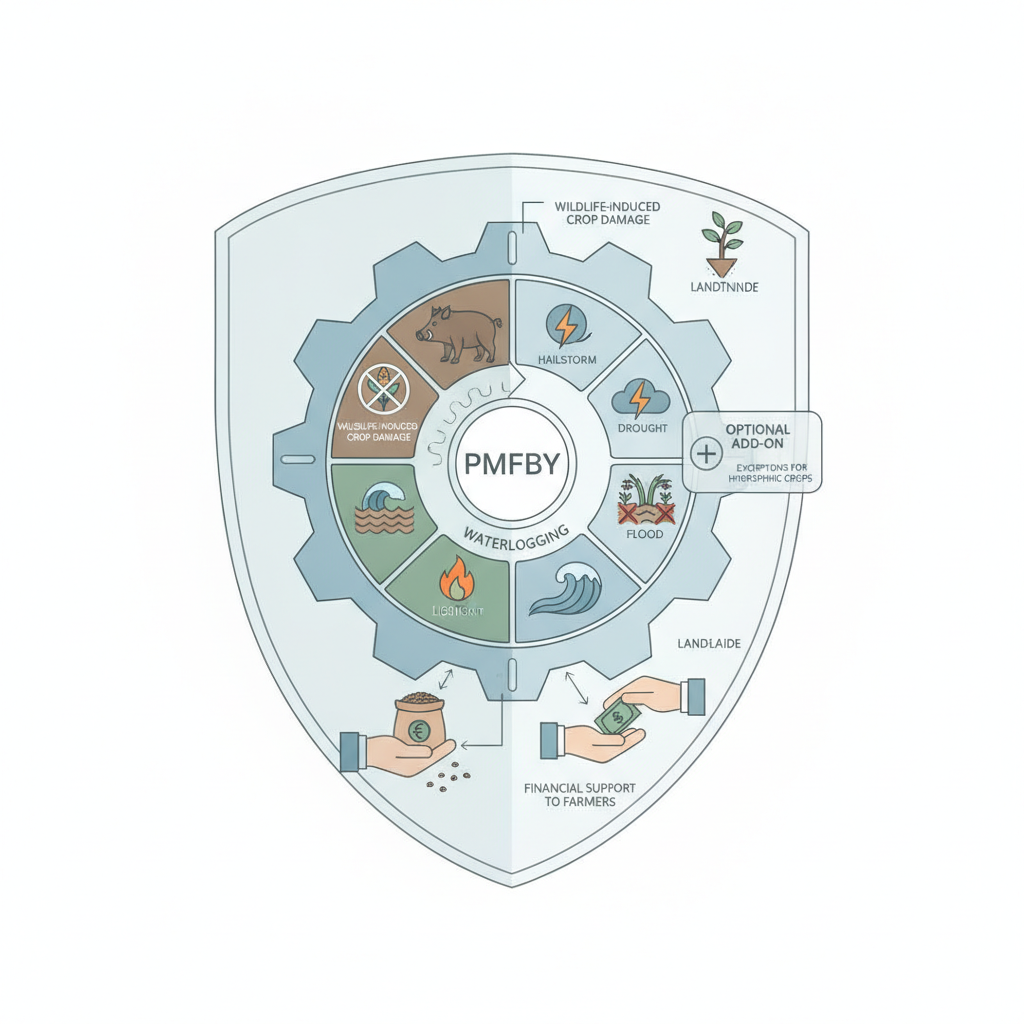 Wildlife damage coverWaterlogging riskNon-preventable disastersCrop insurance schemeFarmer financial support
Subject Relevance — Where This Topic Fits
- GS Paper III — Agriculture
- Prelims: Pradhan Mantri Fasal Bima Yojana (PMFBY), crop insurance, wildlife damage, waterlogging, hydrophylic crops, notified crops, premium subsidy, claim settlement
Quick Revision: PMFBY provides crop insurance against non-preventable natural disasters, with recent expansions including wildlife damage (as an optional add-on) and waterlogging for all notified crops, excluding hydrophylic varieties.
Why is this in the news?
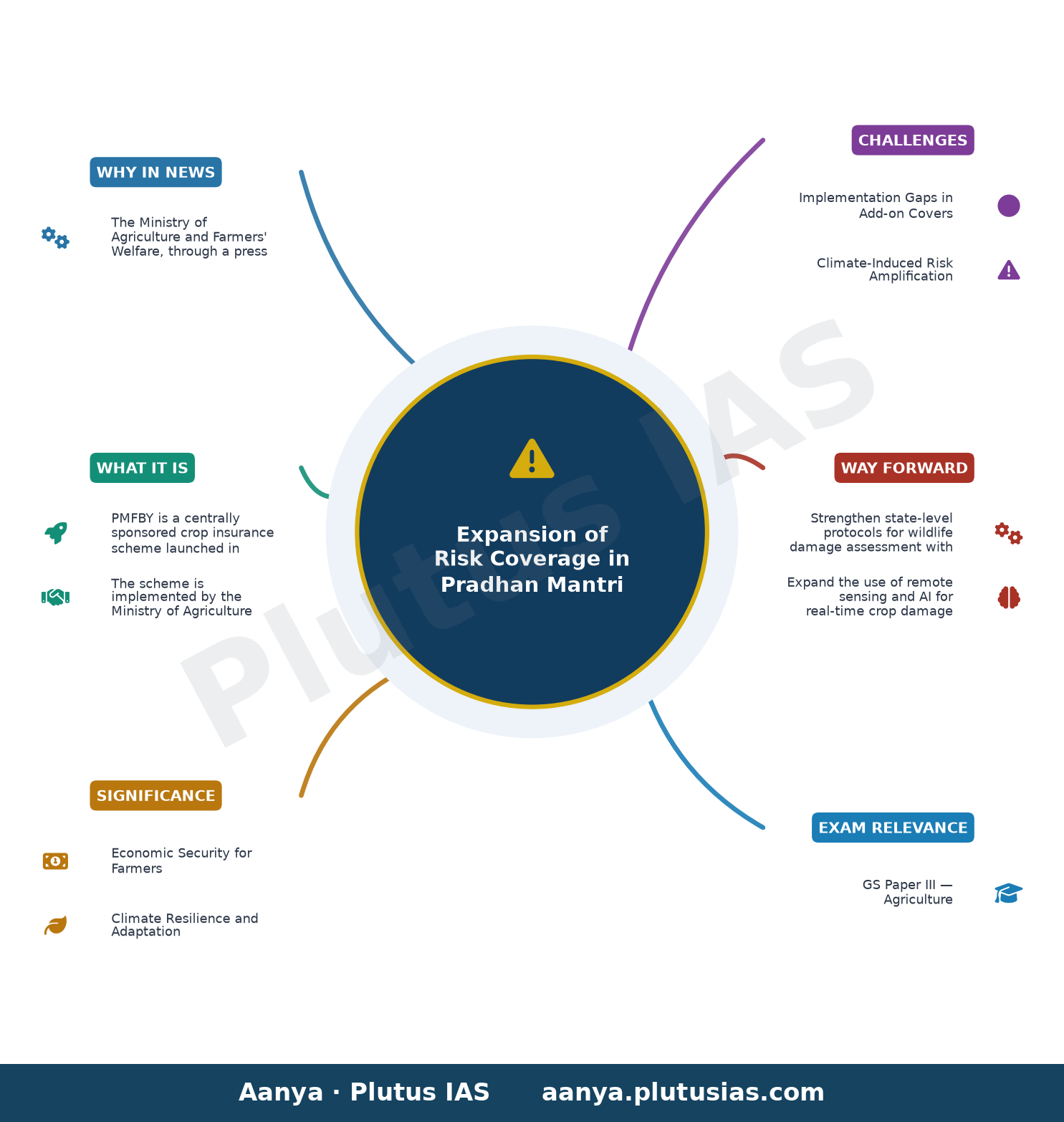
The Ministry of Agriculture and Farmers’ Welfare, through a press release dated 04 August 2026, announced modifications to the coverage under the Pradhan Mantri Fasal Bima Yojana (PMFBY). Key changes include the inclusion of wildlife-induced crop damage as an optional add-on cover and the expansion of waterlogging as a covered risk for all notified crops, with exceptions for hydrophylic crops such as paddy, jute, mesta, and sugarcane. This development is significant as it addresses long-standing demands from state governments and aligns with ecological and agricultural sustainability concerns.
Background
- PMFBY was launched in 2016-17 as a flagship crop insurance scheme to provide financial support to farmers against crop losses due to non-preventable natural disasters.
- The scheme is implemented on a voluntary basis for both states and farmers, covering notified crops from pre-sowing to post-harvest stages.
- Initially, PMFBY did not cover crop losses caused by wildlife, as these were considered preventable and thus not classified under ‘non-preventable natural disasters’.
- States had repeatedly requested the inclusion of wildlife damage due to increasing human-wildlife conflict and its economic impact on farmers.
- The Ministry of Environment, Forest and Climate Change (MoEFCC) and state governments played a pivotal role in advocating for the inclusion of wildlife damage as an add-on cover.
What is Pradhan Mantri Fasal Bima Yojana (PMFBY)?
- PMFBY is a centrally sponsored crop insurance scheme launched in 2016-17 to mitigate the financial impact of crop losses on farmers due to non-preventable natural disasters.
- The scheme is implemented by the Ministry of Agriculture and Farmers’ Welfare in collaboration with state governments and insurance companies.
- Coverage is provided from pre-sowing to post-harvest stages for notified crops in notified areas, with premiums subsidised up to 90% for farmers.
- The premium rates are 2% for kharif crops, 1.5% for rabi crops, and 5% for commercial and horticultural crops, with the balance subsidised by the Central and State Governments.
- PMFBY operates on the ‘Area Approach’ for most crops, where claims are based on yield data from a defined area rather than individual farm assessments.
- The scheme includes coverage for risks such as drought, dry spells, flood, inundation, pests and diseases, landslides, natural fire, hailstorms, and cyclones.
- Claims are settled through a transparent process involving crop cutting experiments (CCEs) to assess yield losses.
- The scheme aims to provide timely compensation to farmers, reduce indebtedness, and encourage adoption of modern agricultural practices.
- Inclusion of wildlife damage as an add-on cover marks a significant expansion of the scheme’s risk coverage, addressing a critical gap in farmer protection.
- Waterlogging is now explicitly included as a covered risk for all notified crops, with specific protocols for claim settlement, particularly for hydrophylic crops.
Key Features
| Feature | Significance |
|---|---|
| Voluntary participation for states and farmers | Enhances flexibility while maintaining broad coverage across notified crops and regions. |
| Coverage from pre-sowing to post-harvest stage | Provides comprehensive risk mitigation for farmers against yield loss due to non-preventable natural calamities. |
| Add-on cover for wildlife damage (state-funded) | Expands coverage to include preventable losses from wild animals, subject to state-specific protocols and assessments. |
| Inclusion of waterlogging as a covered risk | Addresses a critical climate-induced risk, particularly relevant for low-lying agricultural regions. |
| Exclusion of hydrophilic crops from waterlogging cover (except local claims) | Ensures actuarial viability by excluding inherently flood-tolerant crops like paddy, jute, mesta, and sugarcane from waterlogging-specific provisions. |
Why it Matters
Economic Security for Farmers
- Reduces financial vulnerability of small and marginal farmers by compensating for crop losses due to natural disasters.
- Encourages investment in agriculture by mitigating risk, thereby supporting rural livelihoods and food security.
- State-funded add-on covers for wildlife damage enhance localized risk management without imposing additional burden on farmers.
Climate Resilience and Adaptation
- Inclusion of waterlogging as a covered risk aligns with increasing climate variability, particularly in monsoon-dependent regions.
- Expansion to include wildlife damage reflects growing human-wildlife conflict due to habitat encroachment and climate-induced migration.
- Supports adaptive agricultural practices by reducing the economic disincentive to adopt climate-resilient crops.
Policy Integration and Governance
- Demonstrates inter-ministerial coordination, as seen in the inclusion of wildlife damage cover following requests from the Ministry of Environment, Forest and Climate Change.
- Highlights the role of state governments in tailoring coverage to local agro-ecological conditions through notified protocols.
- Ensures transparency and accountability via detailed operational guidelines for add-on covers.
Sustainability of Crop Insurance Ecosystem
- Balances inclusivity with actuarial prudence by excluding inherently flood-tolerant crops from waterlogging-specific provisions.
- Promotes risk-based pricing by allowing states to assess and fund localized risks like wildlife damage.
- Supports the viability of the PMFBY model by addressing emerging risks without compromising its financial sustainability.
Challenges
1. Implementation Gaps in Add-on Covers
- State-specific protocols for wildlife damage assessment may lead to inconsistent coverage and delayed claim settlements.
- Lack of standardized methodologies for quantifying preventable losses from wildlife damage could result in disputes.
- Limited awareness among farmers about the availability and process for availing add-on covers.
UPSC Link: GS-III: Agricultural Insurance
2. Climate-Induced Risk Amplification
- Increasing frequency of extreme weather events (e.g., waterlogging, droughts) strains the financial viability of PMFBY.
- Hydrophilic crops excluded from waterlogging cover may still face yield losses due to localized flooding, creating inequities.
- Human-wildlife conflict is projected to intensify with climate change, necessitating scalable solutions beyond state-funded add-ons.
UPSC Link: GS-III: Climate Change and Agriculture
3. Financial Sustainability of PMFBY
- High claim-to-premium ratios in disaster-prone regions may deter private insurers from participating, reducing competition.
- State governments’ fiscal capacity to fund add-on covers varies, leading to disparities in coverage across regions.
- Premium subsidies and administrative costs require continuous evaluation to prevent over-reliance on public funds.
UPSC Link: GS-III: Agricultural Finance
4. Data and Technology Gaps
- Inadequate real-time data on crop damage (e.g., wildlife attacks) hampers accurate claim assessment.
- Limited use of remote sensing and AI in damage assessment for timely and transparent payouts.
- Fragmented digital infrastructure across states complicates integration with PMFBY’s claim settlement processes.
UPSC Link: GS-III: Technology in Agriculture
Challenges — UPSC Perspective
| Issue | Concern |
|---|---|
| Inconsistent state protocols for wildlife damage assessment | Leads to disparities in coverage and claim settlement timelines. |
| Exclusion of hydrophilic crops from waterlogging cover | Creates inequities for farmers cultivating inherently flood-tolerant crops. |
| High claim ratios in disaster-prone regions | Undermines financial sustainability of the PMFBY model. |
| Limited farmer awareness about add-on covers | Reduces uptake of available risk mitigation measures. |
| Climate-induced intensification of risks | Strains the adaptive capacity of PMFBY and state governments. |
| Fragmented digital infrastructure for claim assessment | Delays payouts and reduces transparency in damage verification. |
Way Forward
- Strengthen state-level protocols for wildlife damage assessment with standardized methodologies and grievance redressal mechanisms.
- Expand the use of remote sensing and AI for real-time crop damage assessment to enhance accuracy and reduce claim settlement delays.
- Conduct farmer awareness campaigns to educate stakeholders about the availability, eligibility, and process for availing add-on covers.
- Pilot climate-resilient crop insurance models that integrate localized risk assessments, including hydro-meteorological and wildlife-related threats.
- Enhance inter-ministerial coordination to address emerging risks (e.g., human-wildlife conflict) through targeted policy interventions.
- Evaluate the financial sustainability of PMFBY by revisiting premium structures and subsidy mechanisms in high-risk regions.
- Develop a centralized digital platform for seamless integration of state-level data on crop damage, claims, and payouts.
- Promote public-private partnerships to improve risk assessment capabilities and expand the insurer base for PMFBY.
UPSC Value Addition
Keywords for Mains Answer-Writing
Pradhan Mantri Fasal Bima Yojana (PMFBY) · Crop Insurance Scheme · Non-preventable Natural Calamities · Wildlife Damage Coverage · Add-on Crop Insurance · Hydrophilic Crops · Flood Risk Coverage · Agricultural Risk Mitigation · State Government Discretion · Kisan Kalyan · Agricultural Insurance · Disaster Risk Management
Concept Flow
Climate change and habitat encroachment → Increased human-wildlife conflict → Farmers face preventable crop losses → Demand for expanded PMFBY coverage → Ministry of Environment, Forest and Climate Change requests inclusion of wildlife damage as an add-on cover → States assess and notify local risks → PMFBY operational guidelines updated → Farmers receive compensation for wildlife damage (state-funded) → Enhanced agricultural risk mitigation. → Monsoon variability and extreme weather events → Frequent waterlogging in agricultural regions → Farmers face yield losses → PMFBY includes waterlogging as a covered risk → Hydrophilic crops excluded from waterlogging-specific provisions (except local claims) → Actuarial viability maintained → Targeted coverage for non-tolerant crops. → PMFBY implementation (2016-17) → Voluntary participation by states and farmers → Coverage from pre-sowing to post-harvest → Compensation for non-preventable natural calamities → Financial security for farmers → Reduced rural vulnerability → Support for food security and rural livelihoods.
Prelims Practice Questions
Q1. Consider the following statements regarding the Pradhan Mantri Fasal Bima Yojana (PMFBY):
1. PMFBY is mandatory for both states and farmers.
2. It covers crop losses due to non-preventable natural calamities from pre-sowing to post-harvest stages.
3. Wildlife damage to crops is now covered under PMFBY as an add-on cover.
4. Hydrophilic crops like paddy and sugarcane are excluded from flood risk coverage under PMFBY.
How many of the above statements are correct?
- Only one
- Only two
- Only three
- All four
Answer: Only three — Statement 1 is incorrect as PMFBY is voluntary for both states and farmers. Statement 2 is correct as it covers non-preventable natural calamities from pre-sowing to post-harvest stages. Statement 3 is correct as wildlife damage can now be covered as an add-on cover. Statement 4 is incorrect as hydrophilic crops are covered for flood risk except in localised claim cases.
Q2. Assertion (A): The Pradhan Mantri Fasal Bima Yojana (PMFBY) covers crop losses due to wild animal attacks.
Reason (R): Wild animal attacks are classified as preventable risks under PMFBY and are now covered as an add-on component.
In the context of the above two statements, which one of the following is correct?
- Both A and R are true and R is the correct explanation of A
- Both A and R are true but R is NOT the correct explanation of A
- A is true but R is false
- A is false but R is true
Answer: A is true but R is false — Assertion (A) is true as PMFBY now covers wildlife damage as an add-on cover. Reason (R) is also true but it incorrectly states that wild animal attacks are classified as preventable risks. The coverage is allowed as an add-on based on state government discretion and assessment, not because they are classified as preventable risks.
Q3. Which of the following crops are EXCLUDED from flood risk coverage under the Pradhan Mantri Fasal Bima Yojana (PMFBY)?
- Paddy and Jute
- Wheat and Maize
- Sugarcane and Cotton
- Groundnut and Soybean
Answer: Paddy and Jute — Paddy and Jute are hydrophilic crops and are excluded from flood risk coverage under PMFBY, except in cases of localised claims.
Mains Practice Question
✍ Critically examine the scope and limitations of risk coverage under the Pradhan Mantri Fasal Bima Yojana (PMFBY) in mitigating agricultural distress caused by natural calamities. Also, analyse the recent expansion of coverage to include wildlife damage and its implications for farmers and the insurance framework. (15 Marks)
Approach: MODEL-ANSWER SKELETON:
1. **Introduction (2 Marks)**
– Brief background of PMFBY: Launched in 2016-17 as a voluntary scheme for states and farmers, providing comprehensive risk insurance against non-preventable natural calamities.
– Objective: To stabilise farm incomes and ensure food security by reducing the adverse impact of natural disasters.
2. **Scope of Risk Coverage under PMFBY (4 Marks)**
– **Non-preventable Natural Calamities**: Covers drought, flood, cyclone, hailstorm, fire, landslide, etc., from pre-sowing to post-harvest stages.
– **Flood Risk**: Available for all notified crops, except hydrophilic crops (paddy, jute, mesta, sugarcane) in localised claim cases.
– **Wildlife Damage**: Initially excluded; now permitted as an add-on cover based on state government discretion and assessment, with the state bearing the cost.
– **Exclusions**: Preventable risks (e.g., pest attacks, wilful negligence) and localised risks not covered under the scheme.
3. **Limitations and Challenges (4 Marks)**
– **Voluntary Nature**: Low participation due to lack of awareness, administrative complexities, and perceived inadequacy of compensation.
– **State Discretion**: Variability in coverage and implementation across states, leading to inequities.
– **Exclusions**: Hydrophilic crops and localised risks remain inadequately covered, leaving gaps in risk mitigation.
– **Wildlife Damage**: Add-on coverage is state-dependent and may not address the scale of damage in high-risk areas.
4. **Recent Expansion: Wildlife Damage Coverage (3 Marks)**
– **Rationale**: Increasing human-wildlife conflict necessitates broader risk mitigation for farmers.
– **Mechanism**: States can notify wildlife damage as an add-on cover, with costs borne by the state government.
– **Implications**: Enhances farmer protection but may strain state budgets; requires robust assessment protocols to prevent misuse.
5. **Conclusion and Way Forward (2 Marks)**
– **Balancing Act**: PMFBY has improved agricultural risk mitigation but requires streamlining for universal coverage.
– **Recommendations**:
– Mandate uniform coverage across states to reduce disparities.
– Expand coverage for hydrophilic crops and localised risks.
– Strengthen assessment protocols for wildlife damage claims.
– Enhance awareness and participation through targeted campaigns.
**Key Terms to Use**: PMFBY, non-preventable natural calamities, hydrophilic crops, add-on cover, state discretion, agricultural distress, risk mitigation.
Source: PIB (Press Information Bureau)
Generated by AanyaAi for educational purpose.

- Kerala HC rules delay cannot quash Domestic Violence Act proceedings - September 20, 2026
- नासा-इसरो सहयोग: अंतरिक्ष अनुसंधान में नया मोड़, जानिए क्या है अगला कदम? - September 20, 2026
- NASA highlights ISRO partnership for future space missions in UPSC focus - September 20, 2026

No Comments