


07 Aug POCSO Cases in Kerala Rise: Key Findings & UPSC Exam Relevance 2026
✎ The rising trend in POCSO cases in Kerala, while partly driven by improved reporting, reveals critical vulnerabilities among children, particularly girls and those aged 15–18, necessitating a multi-pronged approach combining…
Subject Relevance — Where This Topic Fits
- GS Paper I — Social Issues and Vulnerable Sections | GS Paper II — Governance, Transparency and Accountability | GS Paper III — Challenges to Internal Security and Role of Institutions
- Prelims: Protection of Children from Sexual Offences (POCSO) Act, 2012, Kerala State Commission for Protection of Child Rights (KSCPCR), State Crime Records Bureau (SCRB), Child Sexual Abuse (CSA), Vulnerable age groups under POCSO, Gender disparity in child abuse cases
- Essay: Ethical and legal dimensions of child protection in contemporary India, The paradox of rising reported cases amidst strengthened safeguards: A reflection on systemic gaps
Quick Revision: The rising trend in POCSO cases in Kerala, while partly driven by improved reporting, reveals critical vulnerabilities among children, particularly girls and those aged 15–18, necessitating a multi-pronged approach combining legal enforcement, awareness campaigns, and life-skills education to address systemic gaps.
Why is this in the news?
The Kerala State Commission for Protection of Child Rights (KSCPCR) has released its annual report for 2025–26, highlighting a continued rise in reported cases under the Protection of Children from Sexual Offences (POCSO) Act in Kerala. While the increase in numbers is partly attributed to improved reporting mechanisms and legal literacy, the report underscores persistent vulnerabilities among children, particularly girls and those in the 15–18 age group. The data also reveals disturbing patterns regarding the locations of offences and the profiles of offenders, necessitating a re-evaluation of preventive and punitive measures under the POCSO framework.
Background
- The Protection of Children from Sexual Offences (POCSO) Act, 2012, was enacted to address sexual offences against persons below 18 years of age, providing a comprehensive legal framework for protection, reporting, and rehabilitation.
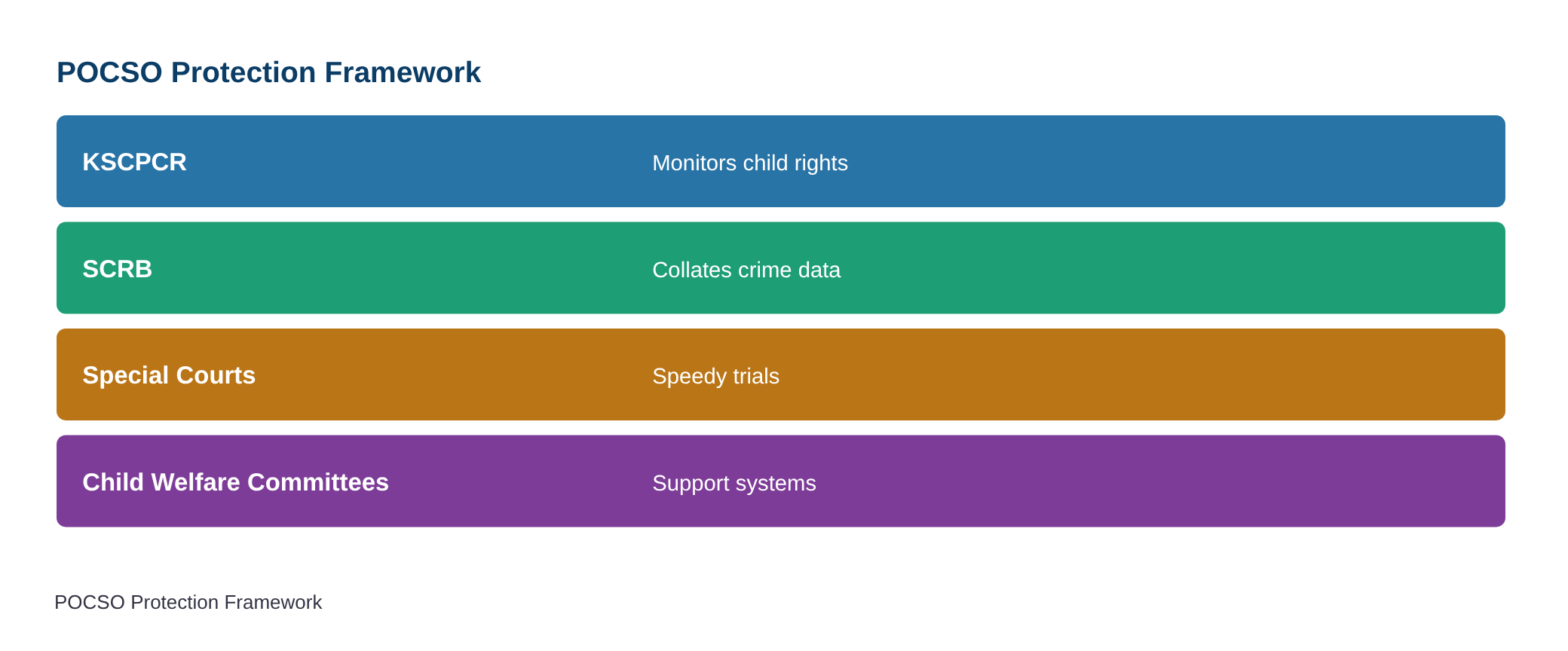
- The Act mandates stringent punishments for offenders and establishes Special Courts for speedy trial of POCSO cases, with provisions for child-friendly procedures and support systems such as the appointment of Child Welfare Committees and Special Public Prosecutors.
- Kerala established the Kerala State Commission for Protection of Child Rights (KSCPCR) in 2013 under the Commissions for Protection of Child Rights Act, 2005, to monitor the implementation of child rights and investigate complaints related to violations.
- The State Crime Records Bureau (SCRB) in Kerala plays a critical role in collating and analysing crime data, including POCSO cases, to inform policy and enforcement strategies.
- Despite legislative and institutional safeguards, child sexual abuse remains a pervasive issue in India, with underreporting historically attributed to social stigma, familial pressure, and lack of awareness.
- The rise in reported cases in Kerala reflects a broader national trend, where improved reporting mechanisms and legal literacy have led to increased visibility of such crimes, challenging the assumption that rising numbers solely indicate an increase in incidence.
What is the Protection of Children from Sexual Offences (POCSO) Act, 2012?
- The POCSO Act, 2012, is a comprehensive legislation enacted to protect children from offences of sexual assault, sexual harassment, and pornography while providing a child-friendly system for the trial of these offences.
- It defines a child as any person below the age of 18 years and categorises sexual offences into penetrative and non-penetrative assaults, sexual harassment, and pornography-related crimes.
- The Act mandates the establishment of Special Courts for the speedy trial of POCSO cases, ensuring that the judicial process is sensitive to the needs of the child victim.
- It introduces the concept of ‘child-friendly procedures’ during investigation and trial, including the use of audio-visual means, the presence of support persons, and the avoidance of confrontational cross-examination.
- The Act imposes stringent punishments, ranging from rigorous imprisonment to life imprisonment for penetrative assault, and includes provisions for the punishment of abetment and failure to report offences.
- It requires the mandatory reporting of POCSO offences by individuals in positions of authority, such as teachers, doctors, and police officers, under Section 21 of the Act.
- The Act also provides for the establishment of Child Welfare Committees and the appointment of Special Public Prosecutors to ensure the welfare and legal representation of child victims.
- The POCSO Act operates in conjunction with the Juvenile Justice (Care and Protection of Children) Act, 2015, which addresses the rehabilitation and reintegration of child victims and offenders.
Key Features
| Feature | Significance |
|---|---|
| Rising POCSO cases in Kerala (2025: 4,765 vs 2024: 4,607) | Indicates improved reporting mechanisms rather than a proportional increase in actual crimes, reflecting enhanced legal literacy and reduced reporting hesitancy. |
| Highest cases in Thiruvananthapuram (689 in 2025) | Attributed to urbanisation, population density, and better access to reporting mechanisms, highlighting regional disparities in child protection infrastructure. |
| Gender distribution (86% girls, 13% boys) | Demonstrates systemic gendered vulnerability, with girls disproportionately affected, necessitating targeted prevention and rehabilitation strategies. |
| Age-wise vulnerability (55% in 15-18 years) | Adolescents face heightened risk due to physical independence and exposure, requiring age-specific awareness and protection measures. |
| Offender proximity (22% in survivor’s home, 13% in offender’s home) | Underscores the prevalence of familial and familiar-space abuse, demanding life-skills education and community-based interventions. |
Why it Matters
Social Justice
- Exposes systemic failure in safeguarding children despite legislative frameworks like POCSO Act, 2012, necessitating a re-evaluation of implementation mechanisms.
- Highlights the intersection of gender and age-based vulnerabilities, requiring intersectional policy responses in child protection.
- Reinforces the need for community-level awareness campaigns to dismantle social taboos around reporting sexual crimes against children.
Governance & Administration
- Illustrates the dual challenge of improving reporting systems while ensuring their equitable distribution across districts to address regional disparities.
- Demonstrates the role of State Commissions for Child Rights in monitoring and advocating for child protection, aligning with constitutional obligations under Article 15(3) and Directive Principles.
Legal & Judicial
- Emphasises the importance of fast-track courts and sensitised judicial processes to handle POCSO cases, reducing trial delays and secondary victimisation.
- Underscores the need for stricter enforcement of Section 44 of the POCSO Act, mandating periodic review of child protection mechanisms by state authorities.
Challenges
1. Underreporting and Reporting Bias
- Despite improved reporting, stigma and fear of social ostracisation persist, particularly in rural and marginalised communities.
- Gender disparity in reporting (86% girls) may reflect societal norms rather than actual crime prevalence, skewing policy priorities.
UPSC Link: GS2: Vulnerable Sections (Children)
2. Regional Disparities in Protection Infrastructure
- Urban districts like Thiruvananthapuram report higher cases due to better access to reporting mechanisms, while rural areas may face underreporting.
- Lack of dedicated child protection officers and counselling centres in low-reporting districts exacerbates the gap.
UPSC Link: GS2: Governance (Public Service Delivery)
3. Familial and Familiar-Space Abuse
- 22% of cases occurring in survivors’ homes and 13% in offenders’ homes indicate systemic failure in familial trust networks.
- Cultural norms prioritising family honour over child safety impede reporting and intervention.
UPSC Link: GS1: Social Issues (Child Abuse)
4. Adolescent Vulnerability (15-18 years)
- 55% of survivors in this age group face heightened risk due to increased independence and exposure to unsupervised environments.
- Existing child protection mechanisms often focus on younger children, leaving adolescents underserved.
UPSC Link: GS2: Social Justice (Child Protection Policies)
5. Differently-Abled Children (3% of survivors)
- Increased reporting (3% in 2025 vs 2% in 2024) may reflect growing awareness but also highlights systemic neglect in their protection.
- Barriers such as communication difficulties and lack of accessible reporting mechanisms persist.
UPSC Link: GS2: Vulnerable Sections (Persons with Disabilities)
Challenges — UPSC Perspective
| Issue | Concern |
|---|---|
| Stigma and Social Ostracisation | Deters victims and families from reporting crimes, perpetuating underreporting and impunity. |
| Urban-Rural Divide in Reporting | Urban areas report higher cases due to better access, while rural areas may face systemic neglect in child protection. |
| Familial Abuse Dynamics | Perpetrators often known to victims, exploiting trust and cultural norms to avoid detection. |
| Adolescent-Specific Risks | Inadequate focus on 15-18 age group in protection policies, leaving them exposed to risks in unsupervised spaces. |
| Differently-Abled Children | Systemic barriers in reporting and protection mechanisms exacerbate their vulnerability. |
| Delayed Judicial Processes | Prolonged trials under POCSO Act lead to secondary victimisation and low conviction rates. |
Government Initiatives — Must-Memorise for Prelims
- POCSO Act, 2012 (Protection of Children from Sexual Offences Act)
- One Stop Centre Scheme (for integrated support to survivors)
- Child Protection Services (CPS) Scheme under Mission Vatsalya
Way Forward
- Strengthen district-level child protection units with dedicated staff for POCSO cases, ensuring equitable coverage across urban and rural areas.
- Expand life-skills education in schools and communities, focusing on consent, bodily autonomy, and reporting mechanisms for children and parents.
- Establish fast-track courts with sensitised judges and forensic support to expedite POCSO trials and reduce secondary victimisation.
- Launch targeted awareness campaigns in high-risk districts (e.g., Thiruvananthapuram, Kollam) to address underreporting and stigma.
- Mandate periodic reviews of child protection mechanisms by State Commissions for Child Rights, with public disclosure of findings.
- Enhance reporting infrastructure for differently-abled children, including accessible helplines, sign-language interpreters, and braille materials.
- Promote intersectoral collaboration between schools, healthcare providers, and law enforcement to identify and intervene in high-risk cases early.
UPSC Value Addition
Keywords for Mains Answer-Writing
Protection of Children from Sexual Offences (POCSO) Act, 2012 · Kerala State Commission for Protection of Child Rights · Sexual offences against children · Child rights and protection mechanisms · Legal literacy and awareness · Gender vulnerability in POCSO cases · Age-wise distribution of child survivors · Offender-victim relationship in child sexual abuse · Life skills education for children · Cyber sexual offences against minors
Constitutional & Policy Linkages
- Article 15(3): Special provisions for children and women in protection laws.
- Article 39(f): Directive Principle mandating state protection for children against exploitation.
- Article 21: Right to life and personal liberty, including protection from sexual abuse.
Concept Flow
Rising POCSO cases in Kerala → Improved legal literacy and reduced reporting hesitancy → Enhanced data accuracy but not necessarily crime increase → Better reporting mechanisms in urban districts → Higher reported cases in Thiruvananthapuram/Kollam → Regional disparities in child protection infrastructure → Gendered vulnerability (86% girls) → Systemic gender bias in abuse and reporting → Need for targeted prevention strategies → Familial and familiar-space abuse (35% cases) → Exploitation of trust networks → Requires life-skills education and community interventions → Adolescent vulnerability (55% in 15-18 years) → Increased independence and exposure → Gaps in age-specific protection policies → Delayed judicial processes under POCSO Act → Secondary victimisation and low conviction rates → Need for fast-track courts and sensitised judiciary → State Commission for Child Rights report → Advocacy for systemic reforms → Alignment with constitutional obligations (Articles 15(3), 39(f), 21)
Prelims Practice Questions
Q1. Consider the following statements regarding the Protection of Children from Sexual Offences (POCSO) Act, 2012:
1. The Act defines a child as any person below the age of 18 years.
2. It mandates the establishment of Special Courts for the trial of offences under the Act.
3. The Act does not cover offences committed in cyberspace.
4. The Act requires mandatory reporting of sexual offences against children.
How many of the above statements are correct?
- Only one
- Only two
- Only three
- All four
Answer: Only three — Statements 1, 2, and 4 are correct. Statement 3 is incorrect as the POCSO Act, 2012, was amended in 2019 to include cyber offences under its ambit.
Q2. Assertion (A): The rise in POCSO cases in Kerala is solely due to an increase in the number of sexual offences against children.
Reason (R): Improved legal literacy and awareness have led to better reporting of such offences.
Options:
A. Both A and R are true, and R is the correct explanation of A.
B. Both A and R are true, but R is not the correct explanation of A.
C. A is true, but R is false.
D. A is false, but R is true.
- A
- B
- C
- D
Answer: ? — The assertion (A) is false because the rise in POCSO cases is attributed to better reporting mechanisms, not solely an increase in crimes. The reason (R) is true as improved legal literacy and awareness contribute to increased reporting.
Q3. Match the following districts of Kerala with their respective number of POCSO cases reported in 2025 as per the Kerala State Commission for Protection of Child Rights report:
Column I (Districts) | Column II (Number of Cases)
1. Thiruvananthapuram | A. 502
2. Kollam | B. 465
3. Malappuram | C. 689
4. Kozhikode | D. 460
- 1-C, 2-A, 3-B, 4-D
- 1-A, 2-C, 3-D, 4-B
- 1-B, 2-D, 3-C, 4-A
- 1-D, 2-B, 3-A, 4-C
Answer: 1-C, 2-A, 3-B, 4-D — The correct matches are: Thiruvananthapuram (689 cases), Kollam (502 cases), Malappuram (465 cases), and Kozhikode (460 cases).
Mains Practice Question
✍ The increase in the number of POCSO cases reported in Kerala reflects not merely a rise in child sexual abuse but a systemic failure in child protection mechanisms. Critically examine this proposition with reference to the POCSO Act, 2012, and the role of the Kerala State Commission for Protection of Child Rights. (15 Marks)
Approach: Introduction: Define POCSO Act, 2012, its objectives, and the role of the Kerala State Commission for Protection of Child Rights in monitoring compliance and reporting mechanisms. Data Analysis: Highlight the rise in POCSO cases in Kerala (2013: 1,002 cases; 2025: 4,765 cases) and attribute the increase to better reporting, legal literacy, and awareness rather than a proportional rise in crimes. Systemic Failures: Discuss gaps in child protection mechanisms, including underreporting, lack of awareness in rural areas, and delays in judicial proceedings under POCSO. Role of State Commission: Evaluate the Commission’s functions (monitoring, awareness campaigns, and data compilation) and its limitations in ensuring timely justice and rehabilitation. Critical Examination: Argue that while better reporting is a positive development, it exposes systemic vulnerabilities such as inadequate infrastructure for child-friendly courts, lack of trained personnel, and insufficient life-skills education for children. Conclusion: Suggest measures such as strengthening Special Courts under POCSO, enhancing life-skills education, and improving inter-departmental coordination to address systemic failures.
Source: The Hindu
Generated by AanyaAi for educational purpose.

- केरल उच्च न्यायालय ने नौसेना नियमों में न्यायाधिकरण नियुक्त करने के नियम को बरकरार रखा - September 24, 2026
- Kerala HC upholds Navy rule: IO can be prosecutor in court-martial cases - September 24, 2026
- उत्तराखंड में मतदाता सूची मिलान: डीएसई-पीएसई अभियान शुरू, जानें प्रक्रिया - September 24, 2026

No Comments