

Police Commemoration Day 2025: Honouring the Sentinels of Internal Security

Police Commemoration Day 2025: Honouring the Sentinels of Internal Security

This  article covers “Daily Current Affairs” and the Topic Police Commemoration Day 2025: Honouring the Sentinels of Internal Security 

SYLLABUS MAPPING:   

GS-3-  Internal Security – Police Commemoration Day 2025: Honouring the Sentinels of Internal Security

FOR PRELIMS

 What are the main problems faced by the police in India?

FOR MAINS

What are the major challenges faced by India’s police forces in the 21st century? 

Why in the News?

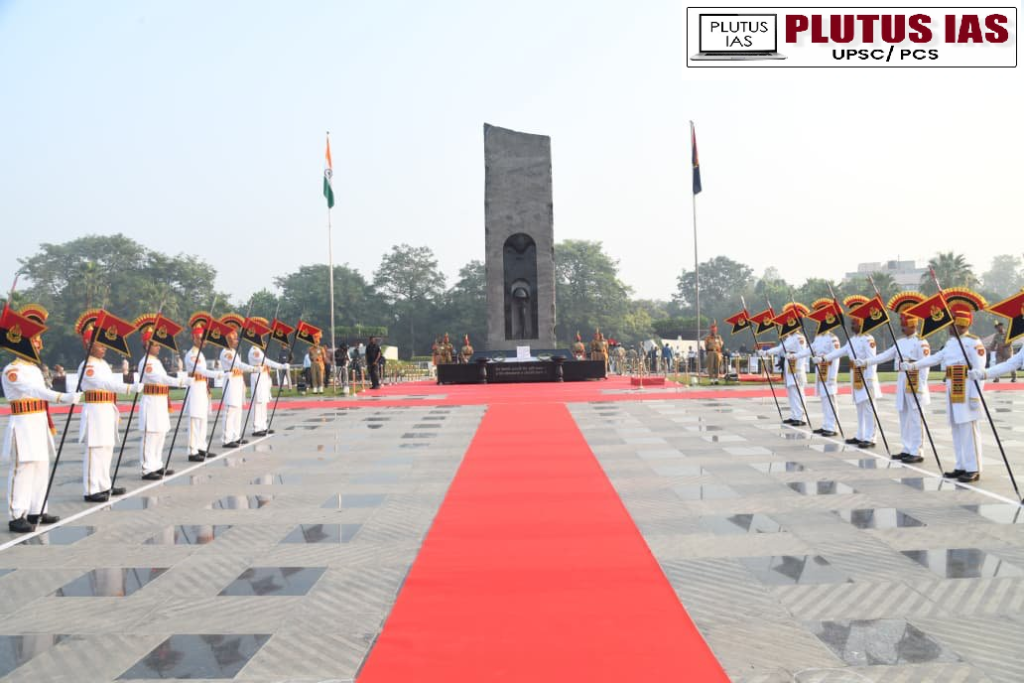
Raksha Mantri Rajnath Singh laid a wreath at the National Police Memorial in New Delhi on the occasion of Police Commemoration Day. The day marks the sacrifice of 10 brave policemen who lost their lives in an ambush by Chinese troops at Hot Springs, Ladakh, in 1959. In his address, the Defence Minister paid tributes to the fallen heroes and expressed gratitude to the police and paramilitary forces for their service to the nation. He described the armed forces and police as twin pillars of national security, safeguarding the country’s external and internal integrity, respectively.
Police Force Statistics in India

India has approximately 22 lakh police personnel, making it one of the largest police forces in the world.
As per the Bureau of Police Research and Development (BPR&D) 2023 data, the police-to-population ratio stands at around 152 police personnel per lakh population, below the UN recommended standard of 222.
The vacancy rate remains high — around 20–25% across states.
The share of women in the police has increased but is still only about 12% of total strength.
Expenditure on police accounts for about 3% of total state budgets, indicating limited resource allocation for modernization and welfare.

Police as the First Respondent

The police act as the first line of response to crime, emergencies, law and order disturbances, disasters, and even terrorism.
They maintain public order, ensure citizen safety, and serve as the primary link between the state and society.
In times of crisis—such as natural disasters, riots, protests, or cyberattacks—the police are the first to respond and last to leave.
The police also play a key role in intelligence gathering, community policing, and countering misinformation in the digital age.

Issues and Rising Challenges in Police Forces

Manpower Shortage: Persistent vacancies, overburdened personnel, and long working hours reduce efficiency and morale.
Training and Skill Gaps: Inadequate exposure to modern technologies like cyber forensics, AI-based surveillance, and digital evidence handling.
Political Interference: Undue influence in postings and investigations undermines autonomy and professionalism.
Inadequate Infrastructure: Poor housing, obsolete communication systems, and lack of mobility resources affect operational readiness.
Public Trust Deficit: Cases of custodial violence, corruption, and misuse of power have dented credibility in some regions.
Rising Complexity of Crimes: Emergence of cybercrime, financial fraud, terrorism, and organised crime has made policing more technology-intensive.
Mental Health and Stress: High workload, lack of rest, and emotional strain contribute to mental health issues and suicides among police personnel.

Way Forward

1. Supreme Court’s Prakash Singh Judgment (2006): Set up State Security Commissions to insulate police from political influence. Ensure fixed tenure for senior officers to promote stability. Separate law and order from investigation for better efficiency.
2. Second Administrative Reforms Commission (ARC): Promote community policing and citizen-centric reforms. Use technology and e-governance for transparency. Strengthen training, ethics, and accountability frameworks.
3. Police Modernisation Scheme: Encourage smart policing through CCTNS and ICJS integration. Upgrade infrastructure, cyber capabilities, and communication systems. Equip forces with modern tools, forensics, and data systems.
4. National Police Mission: Enhance forensic support, specialised units, and mental health systems. Increase women’s participation and promote gender-sensitive policing.
5. Community Engagement: Build trust and cooperation through awareness drives and participatory policing. Ensure transparency and accountability to strengthen public confidence.

Conclusion

The police force is the backbone of internal security and social harmony in India. As the nation progresses toward Viksit Bharat by 2047, the police must evolve from a force-centric to a service-oriented institution—modern, accountable, and citizen-friendly. Strengthening capacity, morale, and public trust through continuous reforms and technology-driven policing will be crucial to ensuring peace, justice, and national unity in the decades ahead.

Prelims question:

Q. With reference to Police Commemoration Day, consider the following statements:
1. Police Commemoration Day is observed every year on October 21 to honour police personnel who laid down their lives in the line of duty.
2. The day commemorates the sacrifice of policemen who were killed during an ambush by Chinese troops at Hot Springs in Ladakh in 1959.
3. The National Police Memorial is located in New Delhi and is dedicated to all police personnel martyred since independence.
Which of the statements given above are correct?
(a) 1 and 2 only
(b) 2 and 3 only
(c) 1 and 3 only
(d) 1, 2, and 3

Answer: D

Mains Question:

Q. Police forces play a pivotal role as the first line of defence for internal security, yet they face multiple challenges in fulfilling this duty. Discuss the major issues confronting the Indian police and suggest reforms for making them more efficient, accountable, and citizen-centric.


                                                                                                                                                                       (250  words)

No Comments

Post A Comment
