


11 Apr Port-Led Development in India: Achievements and Impact of Sagarmala
This article covers “Daily Current Affairs” and From Port-Led Development in India: Achievements and Impact of Sagarmala
SYLLABUS MAPPING
GS– 3- Infrastructure – Port-Led Development in India: Achievements and Impact of Sagarmala
FOR PRELIMS
What is the Sagarmala Programme?
FOR MAINS
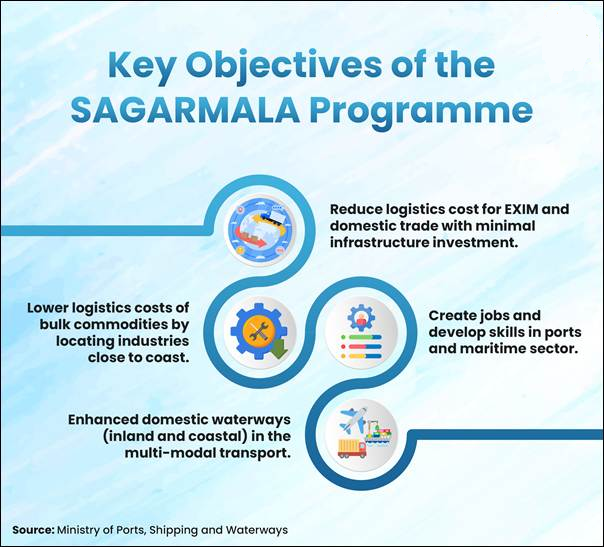
What are the main objectives of Sagarmala?
Why in the News?
India’s maritime sector plays a vital role in driving trade and economic growth. With a coastline of approximately 11,099 kilometres and around 14,500 kilometres of potentially navigable waterways, the country is well-positioned to leverage sea-based transportation. Coastal regions host major ports that connect India to global shipping routes, facilitating the movement of goods and passengers.
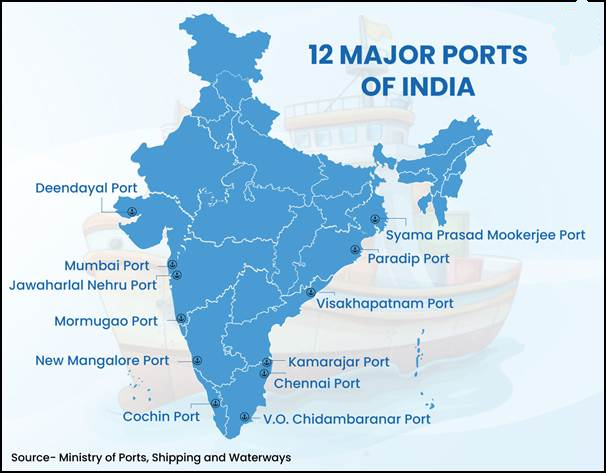
Nearly 95% of India’s trade by volume and about 70% by value is carried through maritime transport. The country has 12 major ports and over 200 non-major ports. While major ports are governed by the Ministry of Ports, Shipping and Waterways, non-major ports fall under the jurisdiction of State Governments or Maritime Boards. These ports handle diverse cargo such as crude oil, coal, containers, fertilizers, and agricultural products, making them central to India’s logistics network.
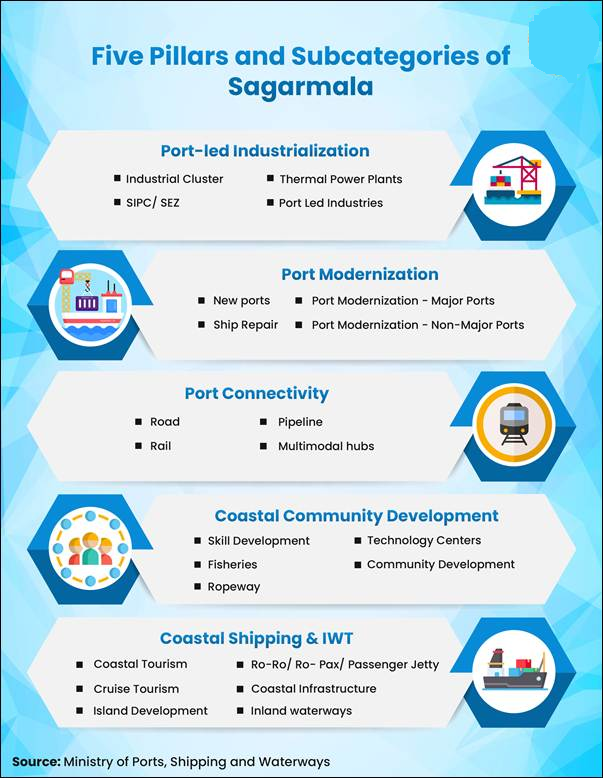
Key Components of the Sagarmala Programme
1. Port Modernization and New Port Development: This focuses on upgrading existing ports and building new ones to increase capacity and efficiency. It includes modernization, mechanization, and adoption of digital systems to improve port operations.
2. Port Connectivity Enhancement: This aims to improve connectivity between ports and the hinterland through integrated transport networks, including road, rail, coastal shipping, and inland waterways, ensuring seamless cargo movement.
3. Port-Led Industrialization: Industrial clusters are being developed near ports to boost manufacturing and economic activity. Proximity to ports helps reduce logistics costs and enhances access to markets.
4. Coastal Community Development: This pillar emphasizes improving livelihoods in coastal areas through skill development, fisheries support, and promotion of coastal tourism.
5. Coastal Shipping and Inland Waterways Transport: The programme promotes the use of waterways as cost-effective and environmentally sustainable alternatives to road and rail transport, helping reduce congestion and logistics costs.
Achievements and Milestones of the Sagarmala Programme
| Category | Details |
|---|---|
| Project Implementation | 845 projects worth ₹6.06 lakh crore identified. 315 projects (₹1.57 lakh crore) completed. 210 projects under implementation. 320 projects in planning stage. |
| Infrastructure & Capacity Development | 11 fishing harbour projects (₹1,057 crore) completed, benefiting 30,000+ fishermen. 7 coastal berth projects (₹494 crore) added 9.84 MTPA capacity. Modernization of Bascule Bridge (Kolkata) and firefighting systems at Mumbai Port underway. |
| Improved Port Performance | Record cargo handling of 915.17 million tonnes in FY 2025–26. Vessel turnaround time reduced from 96 hours (2014) to 49.5 hours (2025). Several Indian ports ranked among global top 100. Inland waterway cargo increased from 18.10 MTPA to 145.50 MTPA (~700% growth). |
| Passenger Transport & Connectivity | 29 Ro-Pax and ferry projects initiated; 17 completed. Ghogha–Hazira and Mumbai–Mandwa routes reduced travel time and congestion significantly. |
| Employment & Skill Development | Over 7,600 individuals trained; 3,100+ placements achieved. Estimated employment potential of ~1 crore jobs (direct + indirect). |
Institutional Framework
1. National Sagarmala Apex Committee (NSAC): Provides overall policy guidance.
2. Maritime States Development Council (MSDC): Ensures coordination between the Centre and States.
3. State Sagarmala Committees (SSCs): Handle project identification and implementation at the state level.
4. Sagarmala Finance Corporation Limited (SMFCL): Acts as a dedicated financial institution for maritime sector funding, addressing critical financing needs.
Sagarmala 2.0: The Next Phase
1. Transform India into a global maritime hub
2. Enhance port infrastructure and connectivity
3. Promote sustainable development and innovation
4. Strengthen coastal communities and island development
The proposed phase includes a budgetary support of ₹85,482 crore and a total investment of ₹3.6 lakh crore, focusing on ports, waterways, coastal infrastructure, maritime services, and research.
Conclusion
Q. With reference to the Sagarmala Programme, consider the following statements:
1. It aims to promote port-led development in India.
2. It focuses only on modernization of major ports and excludes inland waterways.
3. Coastal community development is one of its key components.
Which of the statements given above is/are correct?
(a) 1 only
(b) 1 and 3 only
(c) 2 and 3 only
(d) 1, 2 and 3
Answer: B
Q. The Sagarmala Programme has emerged as a key driver of port-led development in India. Discuss its major achievements and evaluate its role in improving logistics efficiency and coastal economic development
(250 words)

- RBI’s Shrinking Real-Rate Cushion Amid Rising Inflation and Strong Demand - September 21, 2026
- India’s NGOs at a New Funding Crossroads - September 21, 2026
- Deep-Sea Discovery, Environmental Responsibility - September 19, 2026

No Comments