Ruby Fresh Snacks in Ernakulam, Kerala, tells the story of how a small dream became a thriving enterprise. Founded by Mr. P M Jaleel in 2011 with groundnut laddoos, the unit grew with the support of the PM Formalisation of Micro Food Processing Enterprises Scheme. A loan of over 3 lakh rupees in 2021 helped him buy new machines, double production, and expand his product range. Daily profits rose from about 12,000 rupees to nearly 20,000, and his turnover crossed 32 lakh rupees in 2021-22. Today, Ruby Fresh Snacks is not only a source of quality local treats but also a symbol of how government support can transform small entrepreneurs into inspiring success stories.
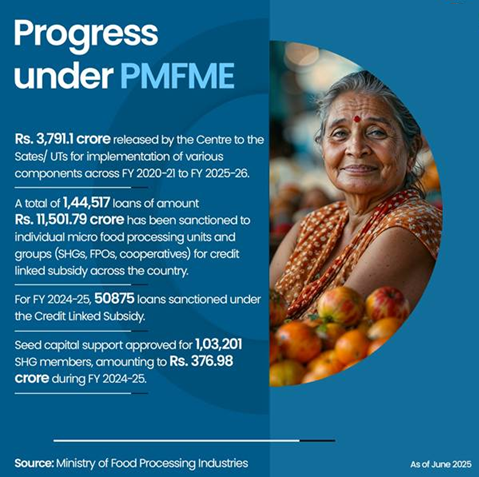
The Pradhan Mantri Formalisation of Micro Food Processing Enterprises Scheme was launched on 29 June 2020. It is a Centrally Sponsored Scheme that focuses on the growth and formalisation of micro food units across the country. The scheme is part of the Atmanirbhar Bharat Abhiyaan and supports the Vocal for Local vision in the food processing sector. It provides financial, technical, and business assistance to entrepreneurs for setting up new units or upgrading existing ones. The scheme runs from 2020-21 to 2025-26 with an outlay of Rs. 10,000 crores. Its goal is to make micro enterprises more competitive, bring them into the organised sector, and unlock new opportunities for growth.
The expenditure under the scheme is to be shared in 60:40 ratio between the Central and State Governments, in 90:10 ratio with North Eastern and Himalayan States, 60:40 ratio with UTs with legislature and 100% by the Center for other UTs.
The scheme aims to provide direct support to 2 lakh micro food processing units through credit-linked subsidies. It also seeks to create common infrastructure and strengthen institutional support to drive faster growth in the sector.
India’s food processing industry has seen a remarkable growth over the past 11 years, shaped by its strong farm base, growing demand, and supportive government policies. The country is set to become a global leader in this sector, with steady growth ahead. Agriculture remains the backbone of food processing, while the sector itself has become vital to the economy through its rising share in GDP, jobs, and exports.
As of July 2025, for FY 2024-25, agriculture and processed food exports reached approximately USD 49.4 billion with processed food exports constituting around 20.4%, positioning India as a rising global leader in food processing. The number of registered food business operators has expanded from 25 lakh to 64 lakh, reflecting growing formalisation. Infrastructure has also strengthened with establishment 24 mega food parks, 22 agro-processing clusters and completion 289 cold chain projects and 305 processing and preservation units, creating significant additional capacity. Further, 10 projects under Operation Greens have enhanced value addition, while 225 R&D projects have yielded 20 patents and 52 commercialised technologies.
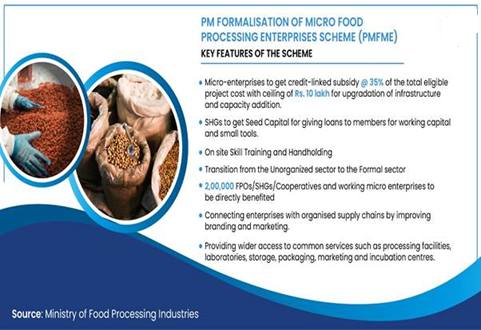
Key Components of the Scheme
| Component |
Target Group |
Type of Support |
Key Features |
| Support for Individual Units |
Individual micro-enterprises |
Credit-linked capital subsidy |
– 35% of the project cost subsidised
– Max ₹10 lakh per unit
– 10% beneficiary contribution
– Balance through a bank loan |
| Support for Self-Help Groups (SHGs) |
SHG members |
Seed capital support |
– ₹40,000 per member for working capital & tools
– Priority to ODOP-based SHGs
– Disbursed at the federation level as a repayable loan |
| Support for FPOs & Co-operatives |
Farmer-Producer Organisations & Producer Co-operatives |
Grant support with training |
– 35% grant with credit linkage
– Training & capacity building provided
– Funding capped as per scheme norms |
| Branding & Marketing Support |
Groups of FPOs, SHGs, Co-operatives, SPVs |
Marketing, branding & quality improvement |
– Based on ODOP approach (State/regional level)
– Fully funded marketing training
– Common brand, packaging & standardisation
– Tie-ups with retail chains & state institutions
– Quality control measures enforced |
Detailed Project Reports (DPRs)
| Aspect |
Details |
| Purpose |
Required for proposals under the scheme. |
| Contents |
– Product profile & strategy
– Quality control measures
– Aggregation of produce
– Packaging & branding plan
– Pricing & promotion strategies
– Storage and marketing channels
– Sales growth projections |
| Financial Support |
Up to ₹5 lakh from State Nodal Agency (SNA) for preparing DPRs related to branding & marketing. |
| Flow Chart Requirement |
Must show activities from raw material procurement → marketing with quality control checkpoints. |
| Five-Year Plan |
Should include:
– Promotional work
– Expansion of producer participation
– Turnover growth |
| Guidelines Support |
Ministry provides Model DPRs with templates, technical terms of reference, and formats to help entrepreneurs, FPOs, SHGs, cooperatives, SPVs prepare structured proposals. |
Support for Common Infrastructure
| Infrastructure Type |
Details of Support |
| Assaying & Storage Facilities |
Facilities for assaying agricultural produce, sorting, grading, warehousing, cold storage at the farm gate. |
| Common Processing Units |
Dedicated processing units for ODOP (One District One Product) produce. |
| Incubation Centres |
– One or more product lines
– Available to small units on a hire basis
– May also be used partly for training
– All incubation centres to be run on a commercial basis |
PMFME Scheme – Component-wise Approved Units (till 30th June 2025)
| S. No. |
Component |
No. of Applications Sanctioned |
Amount Sanctioned (₹ in Crore) |
| 1 |
Credit-Linked Subsidy |
1,44,517 |
11,501.79 |
| 2 |
Seed Capital |
3,48,907 |
1,182.48 |
| 3 |
Common Infrastructure |
93 |
187.20 |
| 4 |
Branding & Marketing |
27 |
82.82 |
Capacity Building & Research
Capacity building and training form an essential part of upgrading technology and bringing micro food processing units into the formal system. At the national level, the National Institute for Food Technology Entrepreneurship and Management (NIFTEM) and Indian Institute of Food Processing Technology (IIFPT) lead capacity building and research, with financial support provided for these activities. In collaboration with State-level technical institutes, they offer training and research support to selected enterprises, groups, and clusters. Specialised institutions under ICAR, CSIR, and premier institutes like Defence Food Research Laboratory (DFRL) and Central Food Technological Research Institute (CFTRI) also partner in delivering product-specific training and research across the country.
ODOP focus
The scheme follows the One District One Product (ODOP) approach to scale up procurement, services, and marketing. States identify products, with priority on perishables such as fruits, vegetables, spices, fisheries, and traditional foods like honey and turmeric. Support is focused on processing, storage, branding, and reducing wastage. Capital investment is prioritised for ODOP units, while new enterprises are eligible only for ODOP products. The approach complements cluster-based initiatives under the Agriculture Export Policy and Agriculture Ministry, ensuring stronger value chains and common facilities.
Conclusion
The PMFME Scheme marks a major step in strengthening micro food enterprises and unlocking the potential of local produce. Through its ODOP focus, common infrastructure, skill training, and access to credit, it provides small entrepreneurs with the tools to grow and compete. By reducing wastage, improving value addition, and promoting branding, the scheme not only boosts farmers’ and producers’ incomes but also creates jobs and supports rural development. It stands as a bridge between tradition and modern markets, driving sustainable and inclusive growth in the food processing sector.
Prelims Questions





No Comments