Road infrastructure is a foundational pillar of rural development, facilitating access to markets, education, healthcare, and employment opportunities while contributing significantly to poverty reduction. As it completes 25 years in 2025, the Pradhan Mantri Gram Sadak Yojana (PMGSY) stands out as one of India’s most impactful rural infrastructure initiatives. Launched on 25 December 2000, the programme aimed to provide all-weather road connectivity to previously unconnected rural habitations. Over the years, PMGSY has emerged as a catalyst for agricultural growth, employment generation, market integration, and socio-economic transformation, thereby reinforcing inclusive and sustainable rural development.
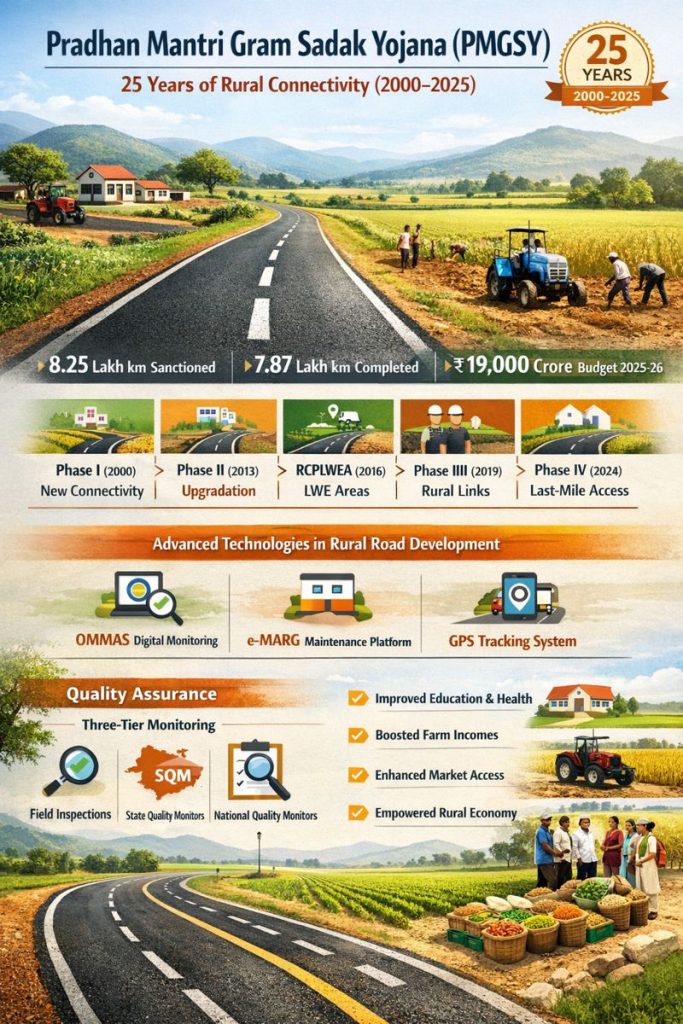
From Connectivity to Consolidation: Phased Progress under PMGSY
Since its inception, PMGSY has sanctioned 8,25,114 km of rural roads, of which 7,87,520 km have been completed, reflecting nearly 95% physical progress as of December 2025. The government’s sustained commitment is reflected in the ₹19,000 crore allocation for FY 2025–26, underscoring the priority accorded to rural connectivity as a driver of economic opportunity and social inclusion.
Phase-wise Evolution of PMGSY
| Phase / Intervention |
Launch Year |
Primary Objective |
Target / Coverage |
Funding Pattern (Centre:State) |
| PMGSY-I |
2000 |
New Connectivity: Providing all-weather roads to unconnected habitations. |
1,63,339 habitations (based on Census 2001). |
100% Central (initially); 60:40 (since 2015) |
| PMGSY-II |
2013 |
Upgradation: Improving existing rural roads to enhance transport efficiency. |
50,000 km of the existing rural road network. |
75:25 (initially); 60:40 (since 2015) |
| RCPLWEA |
2016 |
Security & Development: Connectivity in Naxal-affected areas. |
44 severely LWE-affected districts across 9 states. |
60:40 |
| PMGSY-III |
2019 |
Consolidation: Linking habitations to Markets (GrAMs), Schools, and Hospitals. |
1,25,000 km of Through Routes & Major Rural Links. |
60:40 (90:10 for NE/Himalayan) |
| PMGSY-IV |
2024 |
Last-Mile Connectivity: Reaching habitations newly eligible due to population growth. |
25,000 habitations via 62,500 km of new roads. |
60:40 (90:10 for NE/Himalayan) |
Application of Advanced Technologies in Rural Road Development
Digital Monitoring and Transparency
1. Online Management, Monitoring, and Accounting System (OMMAS):
Enables real-time monitoring of the physical and financial progress of PMGSY projects.
Integrates the Project Management Information System (PMIS) for effective project execution.
Captures quality inspections conducted by National Quality Monitors (NQMs) and State Quality Monitors (SQMs).
Uses geo-tagged photographs uploaded through the Quality Monitoring System (QMS) mobile application.
Enhances transparency, accountability, and quality assurance in rural road construction.
2. e-MARG (Electronic Maintenance of Rural Roads):
Ensures systematic monitoring of road maintenance during the five-year Defect Liability Period (DLP).
Links maintenance payments to performance outcomes, promoting accountability.
Improves maintenance standards and long-term durability of PMGSY road assets.
3. GPS-enabled Vehicle Tracking System (VTS):
Mandatory since May 2022 for PMGSY-III works.
Enables continuous monitoring of vehicles, machinery, and equipment deployment.
Tracks construction duration and operational efficiency.
Ensures adherence to prescribed construction processes and quality standards.
Robust Technical Standards and Sustainability
The programme promotes the use of eco-friendly and climate-resilient materials, guided by standards formulated by the Indian Roads Congress (IRC). Materials such as fly ash, waste plastic, slag, crumb rubber modified bitumen, geosynthetics, and bio-bitumen are increasingly being adopted, subject to feasibility.
Innovation and Climate Resilience
Innovative techniques such as cold mix technology, Full Depth Reclamation, and plastic waste utilisation have been employed in over 1.24 lakh km of roads (as of July 2025), reflecting a strategic shift towards sustainable rural infrastructure.
Three-Tier Quality Monitoring Mechanism
To ensure construction quality and durability, PMGSY follows a robust three-tier monitoring system:
Tier 1: Field-level checks by executing agencies
Tier 2: Independent inspections by State Quality Monitors (SQMs)
Tier 3: Surprise audits by National Quality Monitors (NQMs)
All assessments are monitored in real time through OMMAS.
Conclusion
As PMGSY completes 25 years in 2025, it stands as a cornerstone of India’s rural development strategy. With nearly 96% of sanctioned road length completed, the programme has transformed rural accessibility, strengthened market linkages, enhanced access to education and healthcare, and accelerated inclusive growth. Its phased evolution—from basic connectivity to network consolidation and universal last-mile access—combined with advanced digital monitoring, robust quality assurance, and climate-resilient practices, has ensured transparency, durability, and sustainability. Aligned with the Sustainable Development Goals, PMGSY transcends infrastructure creation to foster poverty reduction, environmental sustainability, and inclusive rural transformation.
Prelims question:
Q. With reference to the Pradhan Mantri Gram Sadak Yojana (PMGSY), consider the following statements:
1. PMGSY was launched to provide all-weather road connectivity to unconnected rural habitations.
2. PMGSY-III focuses on connecting rural habitations with Gramin Agricultural Markets, higher secondary schools, and healthcare facilities.
3. The e-MARG platform links maintenance payments of PMGSY roads to performance during the Defect Liability Period.
4. PMGSY is fully funded by the Central Government in all its phases.
Which of the statements given above are correct?
A. 1, 2 and 3 only
B. 1 and 4 only
C. 2 and 3 only
D. 1, 2, 3 and 4
Answer: A





No Comments