


15 Jan PRAGATI: A Paradigm Shift Towards Real-Time, Accountable and Cooperative Governance
This article covers “Daily Current Affairs” and From PRAGATI: A Paradigm Shift Towards Real-Time, Accountable and Cooperative Governance
SYLLABUS MAPPING
GS-2- Polity- PRAGATI: A Paradigm Shift Towards Real-Time, Accountable and Cooperative Governance
FOR PRELIMS
What is PRAGATI? Explain its objectives and key features.
FOR MAINS
What role does technology play in PRAGATI?
Why in the News?
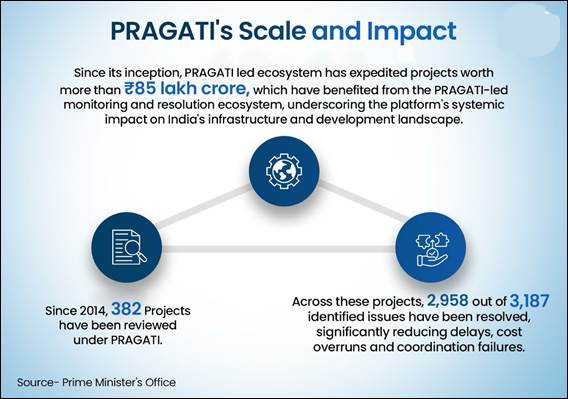
PRAGATI (Pro-Active Governance and Timely Implementation), launched in 2015, represents one of India’s most transformative governance innovations. Designed as a technology-enabled, high-level decision and monitoring platform, PRAGATI enables the Prime Minister to directly review and resolve bottlenecks in critical infrastructure projects, flagship schemes, and citizen grievances in real time, in partnership with States and Union Ministries. More than a review mechanism, PRAGATI reflects a fundamental shift in India’s governance culture—from fragmented, process-driven administration to time-bound, outcome-oriented and accountable execution. By breaking bureaucratic inertia and institutional silos, it operationalises the spirit of “Minimum Government, Maximum Governance”.
Why PRAGATI Was Needed
India’s public project ecosystem was historically characterised by:
1. Chronic time and cost overruns
2. Multi-agency and Centre–State coordination failures
3. Delays due to land acquisition, forest clearances and litigation
4. Weak accountability for decision-making and follow-up
Several nationally significant projects—conceived as early as the 1990s—remained stalled for decades. PRAGATI emerged as a systemic corrective, placing accountability at the highest political level and ensuring that delays were addressed through coordinated, time-bound action rather than procedural diffusion.
What Is PRAGATI: Concept and Design
PRAGATI is a distinctive, integrated and interactive digital governance platform that combines:
1. Digital dashboards
2. Video conferencing
3. Geo-spatial (GIS) technologies
This allows the Prime Minister to:
1. Access real-time project data
2. Visually verify on-ground progress
3. Directly engage with responsible officials
4. Fix responsibilities and timelines instantly
PRAGATI also integrates national digital platforms such as PM GatiShakti, PARIVESH, PM Ref Portal and the Project Monitoring Group (PMG), creating a single source of truth for project monitoring and grievance redressal.
Origin and Evolution: From SWAGAT to PRAGATI
PRAGATI draws inspiration from SWAGAT, launched in Gujarat in 2003 when Narendra Modi was Chief Minister. SWAGAT pioneered:
1. Online grievance submission and tracking
2. Video-based citizen–government interaction
3. Monthly reviews chaired by the Chief Minister
4. Transparency and accountability in public service delivery
After assuming office as Prime Minister in 2014, this discipline of technology-backed accountability was scaled nationally. PRAGATI expanded the scope from individual grievances to complex, multi-agency projects, particularly those stalled due to Centre–State or inter-ministerial dependencies.
Thus, PRAGATI represents not merely a digital upgrade, but a structural reform in governance execution.
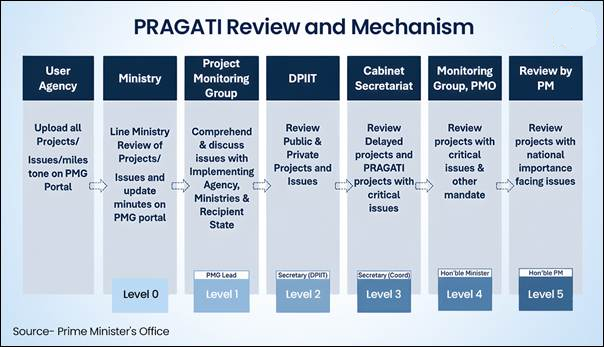
Institutional Architecture and Review Mechanism
| Component | Details |
|---|---|
| Apex-Level Leadership | PRAGATI meetings are chaired by the Prime Minister of India |
| Participants | Chief Secretaries of States and Secretaries of Union Ministries participate through video conferencing |
| Structured Follow-Up | Cabinet Secretariat monitors major infrastructure projects |
| Line Ministries oversee schemes and grievance redressal | |
| Prime Minister’s Office (PMO) ensures continuous supervision and follow-up | |
| Issue Escalation Mechanism | Routine matters are resolved at the Ministry/Department level |
| Complex and critical issues are escalated to the PRAGATI platform | |
| Decision Tracking | Decisions are digitally recorded, with fixed timelines and clearly assigned accountability |
Strengthening Cooperative Federalism
PRAGATI institutionalises cooperative federalism in practice, not merely in principle:
1. Centre and States deliberate on a single platform
2. Officials are answerable in real time
3. Ownership of outcomes replaces fragmented responsibility
This has significantly improved:
1. Inter-ministerial coordination
2. Centre–State trust
3. Speed of decision-making in large public projects
Impact Across Infrastructure and Social Sectors
PRAGATI has accelerated progress across:
1. Roads, highways and economic corridors
2. Railways and strategic connectivity projects
3. Power generation and transmission
4. Airports, ports and logistics infrastructure
5. Gas pipelines and energy networks
6. Healthcare infrastructure, including AIIMS
7. Water resources and irrigation projects
Projects delayed for 10–25 years—such as Bogibeel Bridge, Navi Mumbai International Airport, Jammu–Srinagar rail link, AIIMS Jammu and Guwahati, Mumbai Trans Harbour Link and major thermal power projects—were unlocked through sustained PRAGATI oversight.
PRAGATI as a Multi-Dimensional Instrument of Sustainable Development (Economic, Social, and Environmental Impact)
| Dimension | Role of PRAGATI | Key Outcomes / Impact |
|---|---|---|
| Economic Dimension | • Reduces cost overruns caused by project delays • Brings productive infrastructure assets online faster • Improves efficiency and returns on public investment • Supports logistics efficiency and balanced regional growth |
• Faster economic multiplier effects • Increased employment generation • Higher private investment confidence |
| Social Dimension | • Ensures faster delivery of infrastructure projects • Improves last-mile connectivity, especially in remote and border areas • Enhances access to social infrastructure |
• Better access to healthcare and education • Improved livelihood opportunities • Reduction in regional and social disparities |
| Environmental Dimension | • Fast-tracks environmental clearances without compromising safeguards • Uses PM GatiShakti’s GIS-based planning to map forests, wildlife corridors and eco-sensitive zones • Enables early alignment corrections and mitigation planning • Promotes digital governance through virtual reviews |
• Minimised environmental conflicts • Reduced carbon emissions due to digital reviews • Ensures rapid yet responsible development |
Governance and Administrative Culture
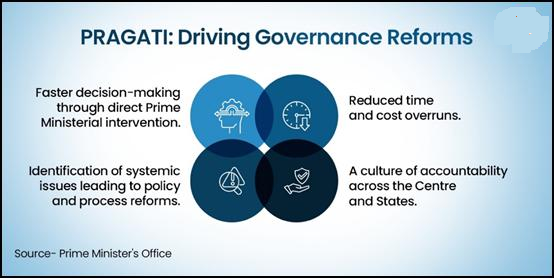
PRAGATI has strengthened governance by:
1. Enforcing transparency and time-bound accountability
2. Encouraging inter-government collaboration
3. Promoting outcome-based administration
4. Creating a culture of delivery rather than procedural compliance
PRAGATI @ 50: A Governance Milestone
The 50th PRAGATI meeting symbolises a decade of governance transformation:
1. Review of projects worth over ₹40,000 crore
2. Coverage across roads, railways, power, water resources and coal
3. Participation of multiple States under a unified framework
Conclusion
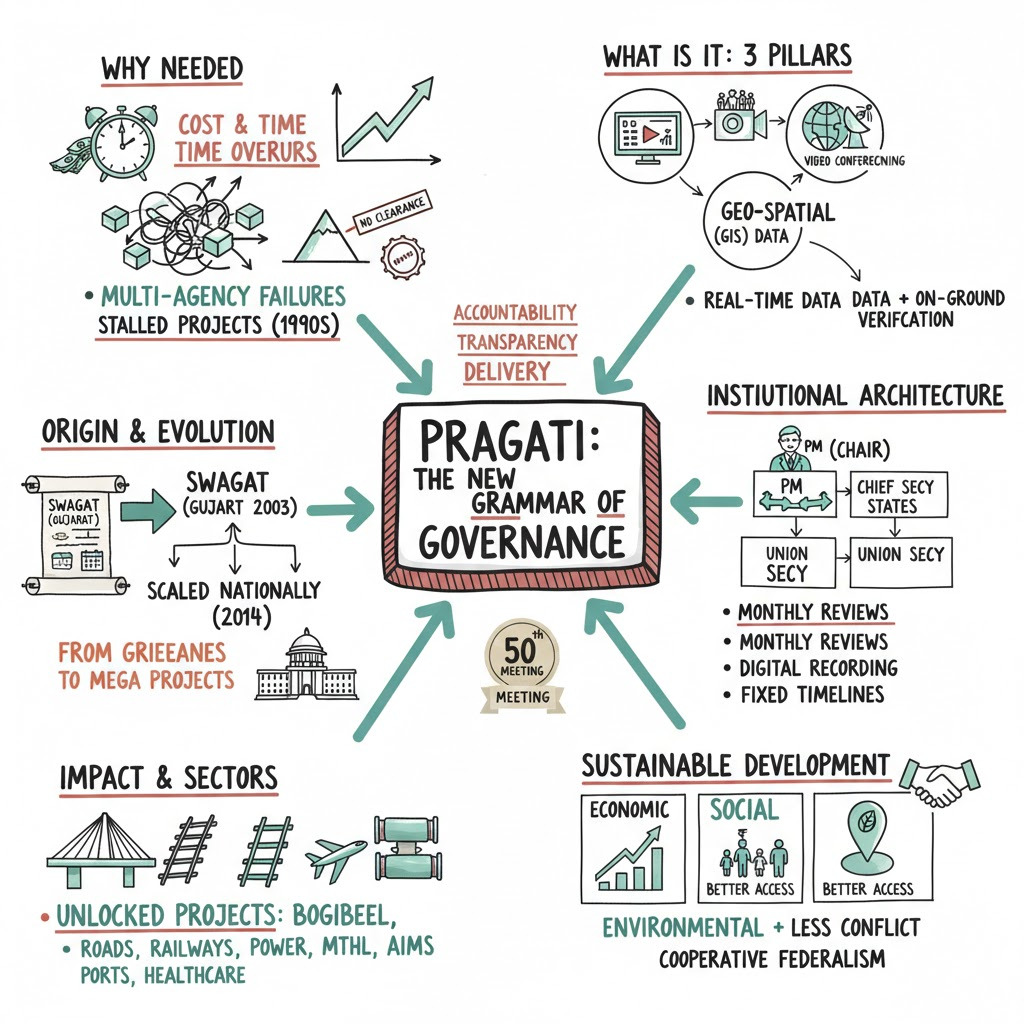
PRAGATI stands as a defining example of technology-enabled, leadership-driven and cooperative governance. By combining political authority, digital tools and federal collaboration, it has converted stalled ambitions into completed assets and restored public confidence in the State’s capacity to deliver. In essence, PRAGATI is not merely a platform—it is a new grammar of governance, where decisions are timely, accountability is visible, and outcomes matter.
Best ias coaching in delhi Best ias coaching in chandigarh
Prelims question:
Q. With reference to PRAGATI (Pro-Active Governance and Timely Implementation), consider the following statements:
1. PRAGATI is a digital governance platform that enables real-time monitoring of projects and grievance redressal by the Prime Minister.
2. It integrates digital tools such as GIS mapping, video conferencing and online dashboards.
3. PRAGATI meetings are conducted exclusively for Central Government projects without State participation.
4. It was launched in 2015 to improve coordination, accountability and timely execution of public projects.
Which of the statements given above are correct?
(a) 1, 2 and 4 only
(b) 1 and 3 only
(c) 2 and 4 only
(d) 1, 2, 3 and 4
Answer: A
Q. PRAGATI represents a shift from process-oriented governance to outcome-based governance in India. Discuss its role in strengthening cooperative federalism, accountability and project implementation.
(250 words)

- RBI’s Shrinking Real-Rate Cushion Amid Rising Inflation and Strong Demand - September 21, 2026
- India’s NGOs at a New Funding Crossroads - September 21, 2026
- Deep-Sea Discovery, Environmental Responsibility - September 19, 2026

No Comments