


11 Aug Premature Redemption of SGB 2018-19 Series VI: Key Details for UPSC Aspirants
✎ Sovereign Gold Bonds (SGBs) allow premature redemption after five years, with the price determined by the simple average of the closing price of 999 purity gold for the three business days preceding the redemption date, as…
Subject Relevance — Where This Topic Fits
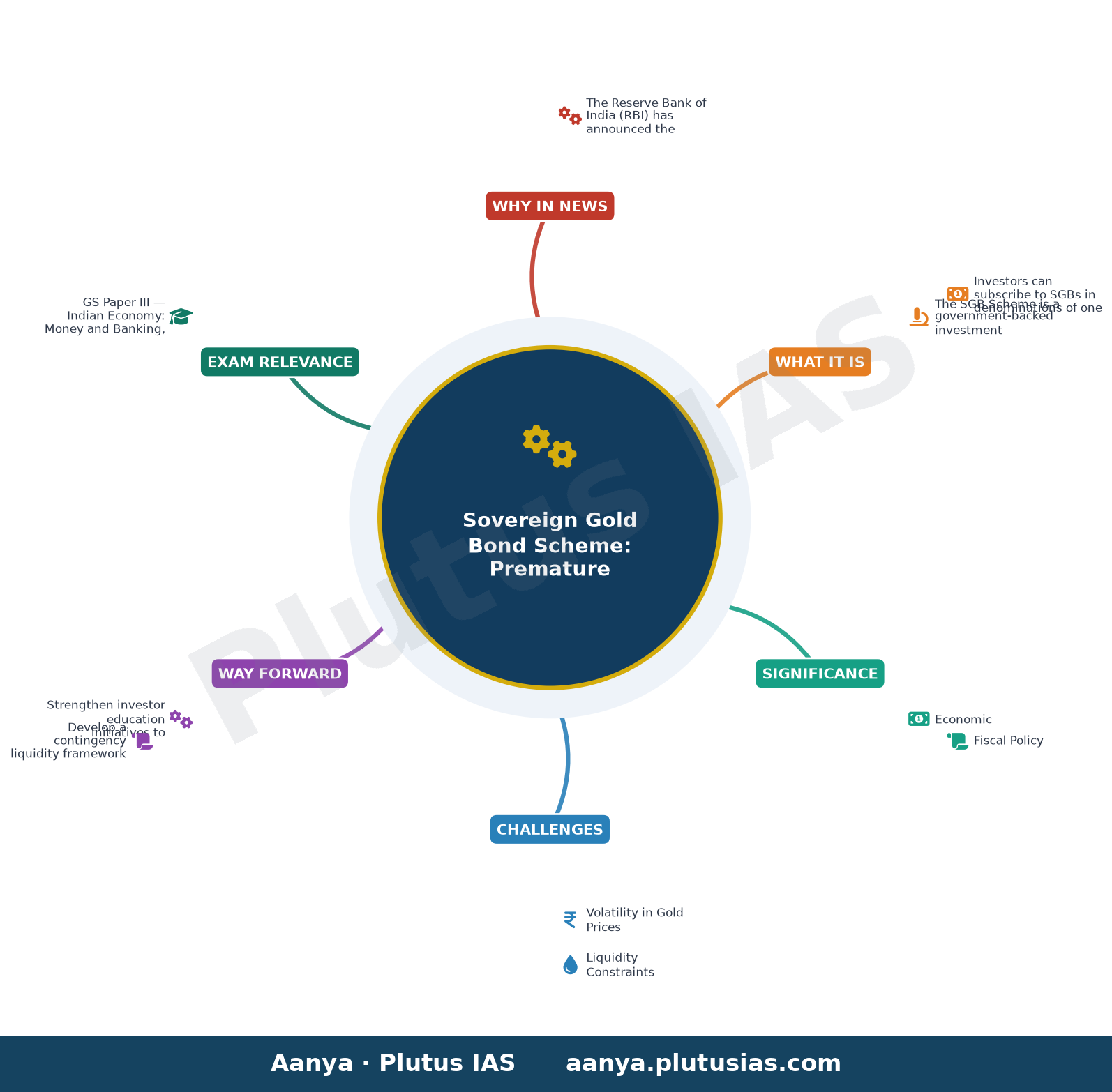
- GS Paper III — Indian Economy: Money and Banking, Capital Markets
- Prelims: Sovereign Gold Bond (SGB), premature redemption, IBJA, gold pricing, RBI, GOI notification, 999 purity gold, capital gains tax exemption on SGB, lock-in period, redemption price calculation
- Essay: Role of gold in India’s financial system and policy instruments for gold monetisation
Quick Revision: Sovereign Gold Bonds (SGBs) allow premature redemption after five years, with the price determined by the simple average of the closing price of 999 purity gold for the three business days preceding the redemption date, as published by IBJA.
Why is this in the news?
The Reserve Bank of India (RBI) has announced the redemption price for the premature redemption of the Sovereign Gold Bond (SGB) 2018-19 Series VI, scheduled for August 12, 2026. This development is significant as it highlights the operational aspects of the SGB scheme, including the pricing mechanism for early exits, which is tied to the prevailing market price of gold as published by the India Bullion and Jewellers Association Ltd (IBJA).
Background
- The Sovereign Gold Bond (SGB) Scheme was launched in 2015 by the Government of India in collaboration with the RBI to reduce the demand for physical gold and shift a portion of the domestic savings into financial savings.
- The scheme allows investors to buy gold in a dematerialised form, eliminating the risks associated with holding physical gold such as storage and purity concerns.
- Premature redemption of SGBs is permitted after the completion of the fifth year from the date of issue, subject to the terms and conditions specified in the GOI notification.
- The redemption price is determined based on the simple average of the closing price of 999 purity gold for the three business days preceding the redemption date, as published by IBJA.
- The SGB scheme also offers an annual interest rate of 2.5% on the issue price, payable semi-annually, in addition to the capital appreciation linked to gold prices.
- The scheme is aimed at providing a safe and convenient alternative to physical gold investment while also contributing to the reduction of the country’s gold imports.
What is the Sovereign Gold Bond (SGB) Scheme?
- The SGB Scheme is a government-backed investment instrument introduced by the Government of India in November 2015 to mobilise gold held by households and institutions into the financial system.
- Investors can subscribe to SGBs in denominations of one gram of gold and multiples thereof, with a minimum investment limit of one gram and a maximum limit of 4 kg for individuals and HUFs, and 20 kg for trusts and similar entities per fiscal year.
- SGBs are issued by the RBI on behalf of the Government of India and are traded on stock exchanges, providing liquidity to investors.
- The bonds carry a fixed interest rate of 2.5% per annum, payable semi-annually, which is credited directly to the investor’s bank account.
- The maturity period of SGBs is eight years, but premature redemption is allowed after the fifth year, subject to the terms of the scheme.
- The redemption price is linked to the prevailing market price of gold, ensuring that investors benefit from any appreciation in gold prices during the holding period.
- SGBs offer capital gains tax exemption if held till maturity, making them a tax-efficient investment compared to physical gold or gold ETFs.
- The scheme also aims to reduce the country’s reliance on gold imports, thereby contributing to the improvement of the current account deficit.
Key Features
| Feature | Significance |
|---|---|
| Premature Redemption Eligibility | Permits redemption after the fifth year from the date of issue, providing liquidity to investors while maintaining the long-term nature of the scheme. |
| Redemption Price Calculation | Based on the simple average of the closing price of 999 purity gold for the three business days preceding redemption, as published by IBJA, ensuring transparency and market-linked valuation. |
| Issue Date and Tranche | SGB 2018-19 Series VI was issued on February 12, 2019, with the next premature redemption due on August 12, 2026, marking a seven-year cycle from issuance. |
| Government Notification Basis | The redemption framework is governed by GOI notification F.No.4(22)-B(W&M)/2018 dated October 08, 2018, under the Sovereign Gold Bond Scheme, 2018. |
| Investor Protection Mechanism | The structured redemption process, including fixed eligibility and transparent pricing, safeguards investor interests while balancing fiscal prudence. |
Why it Matters
Economic
- Enhances liquidity in the gold market by allowing premature redemption, thereby supporting investor flexibility without compromising the scheme’s long-term objectives.
- Provides a market-linked exit option, reducing dependency on physical gold sales and promoting financial inclusion through accessible gold-backed instruments.
- Contributes to the government’s objective of reducing gold imports by channeling investment into domestically issued gold bonds, thereby improving the current account balance.
Fiscal Policy
- Aligns with the government’s strategy to monetize gold holdings by offering a structured redemption mechanism, thereby reducing the fiscal burden of maintaining high gold reserves.
- Ensures fiscal discipline by linking redemption pricing to market benchmarks (IBJA gold prices), preventing arbitrary pricing and ensuring fairness.
Investor Perspective
- Offers a secure and regulated investment avenue for retail investors seeking exposure to gold without the risks associated with physical storage and purity concerns.
- Provides an inflation hedge and portfolio diversification tool, particularly for small and medium investors who may lack access to alternative investment avenues.
Market Development
- Strengthens the secondary market for gold bonds by introducing a predictable redemption cycle, thereby enhancing market depth and liquidity.
- Encourages broader participation in sovereign-backed financial instruments, fostering trust in government securities among retail investors.
Challenges
1. Volatility in Gold Prices
- Fluctuations in gold prices may lead to significant variations in redemption amounts, potentially affecting investor confidence and the attractiveness of the scheme.
- Requires robust risk management mechanisms to mitigate adverse impacts on investor returns during periods of high volatility.
UPSC Link: GS3: Commodity Markets
2. Liquidity Constraints
- Premature redemption may strain the liquidity of the scheme if a large number of investors opt to exit simultaneously, particularly during economic downturns.
- Demands proactive liquidity management by the government and RBI to ensure timely payouts without compromising fiscal stability.
UPSC Link: GS3: Financial Markets
3. Investor Awareness Gaps
- Limited understanding of the redemption process, eligibility criteria, and pricing mechanisms may deter potential investors from participating in the scheme.
- Highlights the need for targeted financial literacy campaigns to educate investors about the benefits and operational aspects of SGBs.
UPSC Link: GS2: Financial Inclusion
4. Regulatory Compliance Burden
- Ensuring strict adherence to redemption rules, pricing benchmarks, and payout timelines requires robust regulatory oversight and coordination between RBI and GOI.
- Increases administrative costs and complexity, particularly in cases of disputed or delayed redemptions.
UPSC Link: GS2: Regulatory Bodies
5. Substitution Effect on Physical Gold Demand
- While SGBs reduce gold imports, premature redemptions may lead to a temporary surge in physical gold demand, offsetting some of the intended benefits.
- Requires balanced policy interventions to sustain long-term reduction in gold imports without disrupting domestic demand dynamics.
UPSC Link: GS3: Balance of Payments
Challenges — UPSC Perspective
| Issue | Concern |
|---|---|
| Gold Price Volatility | Exposure of investors to market risks affecting redemption payouts. |
| Liquidity Management | Risk of simultaneous redemption requests overwhelming the scheme’s liquidity. |
| Investor Awareness | Low participation due to lack of understanding of redemption terms and benefits. |
| Regulatory Oversight | Complexity in ensuring compliance with redemption rules and pricing mechanisms. |
| Policy Coherence | Potential conflict between reducing gold imports and sustaining domestic demand. |
Way Forward
- Strengthen investor education initiatives to enhance awareness about the redemption process, eligibility, and pricing mechanisms under the SGB scheme.
- Develop a contingency liquidity framework to manage potential surges in redemption requests, ensuring timely payouts without fiscal strain.
- Introduce flexible redemption options, such as staggered payouts or partial redemptions, to balance investor flexibility with scheme sustainability.
- Enhance transparency in gold price benchmarks by collaborating with multiple industry associations to ensure accurate and representative pricing.
- Promote the use of digital platforms for redemption requests to streamline the process and reduce administrative bottlenecks.
- Conduct periodic reviews of the SGB scheme to assess its impact on gold imports, investor participation, and market development, with a focus on long-term sustainability.
- Collaborate with financial institutions to offer advisory services to investors on optimal redemption timing, balancing returns and market conditions.
UPSC Value Addition
Keywords for Mains Answer-Writing
Sovereign Gold Bond Scheme · SGB premature redemption · Reserve Bank of India · Government of India gold bonds · IBJA gold price benchmarking · financial instruments for retail investors · monetisation of gold holdings · capital market instruments · gold monetisation scheme · financial inclusion through gold bonds · investment avenues for small investors · commodity-linked financial products
Concept Flow
Introduction of Sovereign Gold Bond Scheme (2018) under GOI notification → → Issue of SGB 2018-19 Series VI on February 12, 2019 → → Eligibility for premature redemption after fifth year from issue → → Redemption price calculation based on IBJA gold prices (three-day average) → → Redemption due on August 12, 2026, with payout of ₹15,102 per unit → → Market feedback and policy adjustments to enhance scheme effectiveness.
Prelims Practice Questions
Q1. Consider the following statements regarding the Sovereign Gold Bond (SGB) Scheme:
1. Premature redemption is permitted only after the fifth year from the date of issue.
2. The redemption price is calculated as the simple average of the closing price of 999 purity gold for the previous three business days.
3. The redemption price is published by the Securities and Exchange Board of India (SEBI).
How many of the above statements are correct?
- Only one
- Only two
- All three
- None
Answer: Only two — Statement 1 is correct as premature redemption is allowed after the fifth year. Statement 2 is correct as the redemption price is based on the simple average of gold prices published by IBJA. Statement 3 is incorrect as the price is published by the India Bullion and Jewellers Association Ltd (IBJA), not SEBI.
Q2. Assertion (A): The Sovereign Gold Bond Scheme was introduced to reduce the demand for physical gold in India.
Reason (R): The scheme provides an alternative investment avenue for retail investors to invest in gold without holding physical gold.
(a) Both A and R are true, and R is the correct explanation of A
(b) Both A and R are true, but R is not the correct explanation of A
(c) A is true, but R is false
(d) A is false, but R is true
- a
- b
- c
- d
Answer: b — Assertion (A) is true as the SGB scheme aims to reduce the demand for physical gold by offering a financial instrument. Reason (R) is also true and correctly explains the assertion, as the scheme provides an alternative investment avenue for retail investors.
Q3. Match the following columns related to the Sovereign Gold Bond Scheme:
Column I
1. Issue date of SGB 2018-19 Series VI
2. Authority publishing redemption price
3. Minimum investment amount in SGB
4. Tenure of SGB
Column II
A. February 12, 2019
B. India Bullion and Jewellers Association Ltd (IBJA)
C. ₹1 gram of gold
D. 8 years (with exit option from 5th year)
- 1-A, 2-B, 3-C, 4-D; 1-B, 2-A, 3-D, 4-C; 1-C, 2-D, 3-A, 4-B; 1-D, 2-C, 3-B, 4-A
- answer
Answer: 1-A, 2-B, 3-C, 4-D; 1-B, 2-A, 3-D, 4-C; 1-C, 2-D, 3-A, 4-B; 1-D, 2-C, 3-B, 4-A — 1-A: The issue date of SGB 2018-19 Series VI was February 12, 2019. 2-B: The redemption price is published by the India Bullion and Jewellers Association Ltd (IBJA). 3-C: The minimum investment amount in SGB is ₹1 gram of gold. 4-D: The tenure of SGB is 8 years with an exit option from the 5th year.
Mains Practice Question
✍ Critically examine the design and objectives of the Sovereign Gold Bond (SGB) Scheme, highlighting its role in financial inclusion and monetisation of gold holdings in India. Also, discuss the significance of the redemption price mechanism for investors. (15 Marks)
Approach: MODEL-ANSWER SKELETON:
1. **Introduction (2 marks)**
– Brief background: SGB scheme introduced in 2015 under the Gold Monetisation Scheme to reduce physical gold demand and channelise gold holdings into productive investments.
– Objectives: Monetise gold holdings, provide a safe and lucrative investment avenue, reduce import dependency, and promote financial inclusion.
2. **Design and Structure (4 marks)**
– Issued by RBI on behalf of GOI; denominated in grams of gold; minimum investment ₹1 gram.
– Tenure: 8 years with exit option from the 5th year; interest paid annually at a fixed rate (e.g., 2.5% p.a. in 2018-19 Series VI).
– Premature redemption: Allowed after the 5th year on interest payment dates; price based on simple average of IBJA’s 999 purity gold closing prices for the previous three business days.
– Taxation: Exempt from capital gains tax if held till maturity; interest taxable as per slab.
3. **Role in Financial Inclusion and Monetisation (5 marks)**
– **Financial Inclusion**: Targets retail investors, including small and marginal savers, by offering a low-ticket, paper-based gold investment, reducing storage and security risks.
– **Monetisation of Gold**: Encourages holders of idle gold to monetise holdings without selling physical gold, thereby reducing import demand and supporting current account stability.
– **Alternative to Physical Gold**: Provides a regulated, transparent, and liquid investment avenue, reducing reliance on informal gold markets.
– **Government Revenue**: Generates non-tax revenue for the government through issuance and interest payments.
4. **Redemption Price Mechanism (4 marks)**
– **Transparency**: Price based on IBJA’s benchmark, ensuring market-linked valuation and reducing arbitrage risks.
– **Investor Protection**: Simple average of three days’ prices mitigates volatility and manipulation risks.
– **Fair Valuation**: Reflects real-time market conditions, ensuring investors receive fair value at redemption.
– **Critique**: Potential for price volatility due to gold market fluctuations; redemption price may not always align with long-term investment horizons.
5. **Conclusion (2 marks)**
– SGB scheme is a well-designed instrument that balances investor protection, market efficiency, and macroeconomic objectives.
– Suggested improvements: Enhance liquidity through secondary market listings, introduce flexible redemption options, and expand investor awareness campaigns.
Source: RBI
Generated by AanyaAi for educational purpose.

- Piyush Goyal Attends G20 Trade Ministers’ Meeting in Milwaukee - October 1, 2026
- विशेष अभियान-6: कोल इंडिया लिमिटेड की तैयारी पर केंद्र सरकार की निगरानी - October 1, 2026
- ECL’s Action Plan for Special Campaign 6: A UPSC Governance Case Study - October 1, 2026

No Comments