


11 Aug Premature Redemption of SGB 2018-19 Series VI: Key Facts for UPSC 2026
✎ Sovereign Gold Bonds (SGBs) are government securities denominated in grams of gold, offering a fixed interest rate of 2.50% per annum, with premature redemption permitted after the fifth year from the date of issue, and…
Subject Relevance — Where This Topic Fits
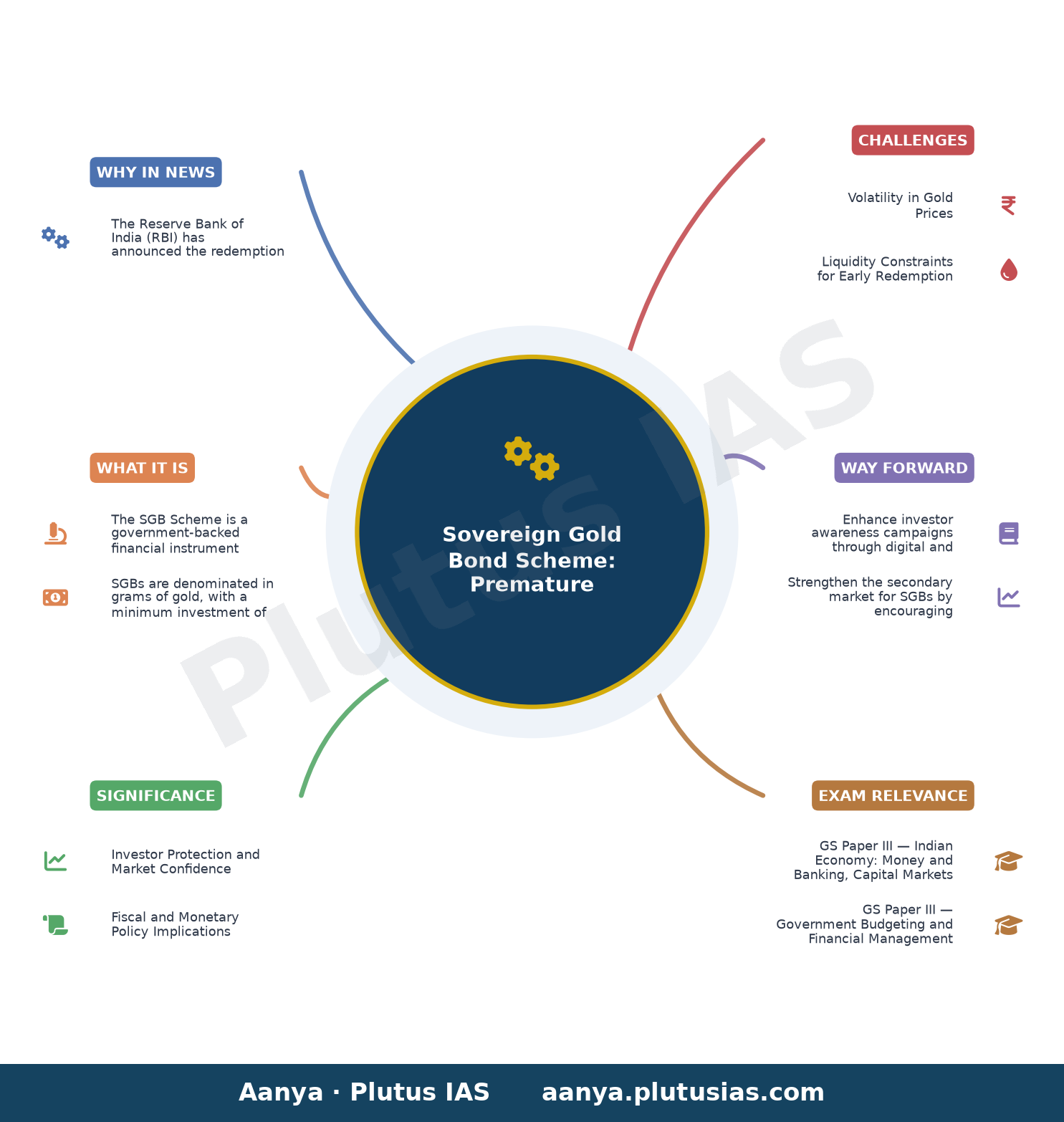
- GS Paper III — Indian Economy: Money and Banking, Capital Markets | GS Paper III — Government Budgeting and Financial Management
- Prelims: Sovereign Gold Bond (SGB), premature redemption, IBJA, redemption price, gold pricing mechanism, RBI press release, financial instruments, capital market instruments, gold standard, RBI notification
- Essay: Role of gold in India’s financial system and macroeconomic stability, Evolution of sovereign debt instruments in India’s fiscal policy
Quick Revision: Sovereign Gold Bonds (SGBs) are government securities denominated in grams of gold, offering a fixed interest rate of 2.50% per annum, with premature redemption permitted after the fifth year from the date of issue, and redemption price determined by the simple average of IBJA’s three-day closing gold prices.
Why is this in the news?
The Reserve Bank of India (RBI) has announced the redemption price for the premature redemption of Sovereign Gold Bond (SGB) 2018-19 Series VI, scheduled for August 12, 2026. This development is significant as it highlights the operational aspects of the SGB scheme, including the eligibility criteria for premature redemption, the pricing mechanism, and the institutional framework governing such transactions. For civil services aspirants, understanding the SGB scheme is crucial given its dual role in promoting gold monetisation and providing an alternative investment avenue to physical gold.
Background
- The Sovereign Gold Bond (SGB) Scheme was launched in November 2015 by the Government of India in collaboration with the Reserve Bank of India (RBI) to reduce the demand for physical gold and shift a portion of the domestic savings into financial savings.
- The scheme aims to mobilise gold held by households and institutions into productive assets while offering investors an interest-bearing alternative to physical gold.
- SGBs are government securities denominated in grams of gold, with a fixed interest rate payable semi-annually, and are issued by the RBI on behalf of the Government of India.
- The scheme provides an exit option through premature redemption after the fifth year from the date of issue, subject to the terms and conditions specified in the scheme guidelines.
- The pricing of SGBs at the time of issue and redemption is linked to the prevailing market price of gold, ensuring transparency and market-linked returns for investors.
- The India Bullion and Jewellers Association Ltd (IBJA) serves as the benchmarking authority for gold prices in India, providing standardised pricing data for financial instruments linked to gold.
What is the Sovereign Gold Bond (SGB) Scheme?
- The SGB Scheme is a government-backed financial instrument introduced to reduce the reliance on physical gold holdings and promote financial savings in India.
- SGBs are denominated in grams of gold, with a minimum investment of one gram and a maximum limit of 4 kg for individuals and Hindu Undivided Families (HUFs), and 20 kg for trusts and similar entities per fiscal year.
- Investors receive a fixed interest rate of 2.50% per annum on the issue price, payable semi-annually, providing a steady income stream in addition to potential capital gains.
- SGBs have a tenor of eight years, with an option for premature redemption after the fifth year from the date of issue, subject to the terms and conditions of the scheme.
- The redemption price for SGBs is determined based on the simple average of the closing price of gold of 999 purity for the three business days preceding the redemption date, as published by the India Bullion and Jewellers Association Ltd (IBJA).
- SGBs are tradable on stock exchanges, providing liquidity to investors who wish to exit before maturity or premature redemption eligibility.
- The scheme is governed by the Government of India’s notification under the Government Securities Act, 2006, and is implemented by the RBI, ensuring sovereign backing and creditworthiness.
- Investments in SGBs are exempt from capital gains tax if held till maturity, and the interest income is taxable as per the Income Tax Act, 1961.
Key Features
| Feature | Significance |
|---|---|
| Premature Redemption Eligibility | Permits redemption after the fifth year from the issue date, providing liquidity flexibility to investors while maintaining long-term holding incentives. |
| Redemption Price Calculation | Based on the simple average of the closing price of 999 purity gold over the three preceding business days, ensuring market-linked valuation without volatility spikes. |
| Issue Date and Tranche | SGB 2018-19 Series VI was issued on February 12, 2019, with the next premature redemption window falling on August 12, 2026, marking a seven-year cycle. |
| Government Notification Basis | Governed by GOI notification F.No.4(22)-B(W&M)/2018 dated October 8, 2018, which formalizes the operational framework for premature redemption. |
| Price Determination Authority | Relies on IBJA (India Bullion and Jewellers Association Ltd) data, ensuring transparency and benchmarking against industry-standard gold pricing. |
Why it Matters
Investor Protection and Market Confidence
- Provides a structured exit mechanism for investors, reducing perceived illiquidity risks associated with gold bonds.
- Ensures fair valuation through transparent, market-based pricing mechanisms, enhancing trust in the Sovereign Gold Bond Scheme.
- Balances long-term investment incentives with liquidity needs, making SGBs an attractive alternative to physical gold.
Fiscal and Monetary Policy Implications
- Reduces the fiscal burden on the government by avoiding forced redemptions at suboptimal prices during market downturns.
- Supports monetary policy objectives by maintaining a stable and predictable redemption framework for gold-linked instruments.
- Contributes to the formalization of the gold market by linking redemption prices to IBJA benchmarks, reducing informal gold trade.
Macroeconomic and Trade Impact
- Promotes financial savings in gold through a regulated instrument, reducing reliance on physical gold imports and associated trade deficits.
- Encourages household financialization by offering a risk-free, government-backed investment option with periodic interest payouts.
- Supports the development of gold price discovery mechanisms in India, aligning with global best practices.
Regulatory and Institutional Strengthening
- Demonstrates the robustness of the Sovereign Gold Bond Scheme as a long-term policy instrument, reinforcing investor confidence.
- Highlights the role of IBJA in price benchmarking, underscoring the importance of self-regulatory organizations in financial markets.
- Sets a precedent for future tranches of SGBs, ensuring consistency in redemption policies across issuances.
Challenges
1. Volatility in Gold Prices
- Fluctuations in international and domestic gold prices may lead to significant variations in redemption values, impacting investor expectations.
- Short-term volatility around redemption dates could deter risk-averse investors, despite the long-term stability of the scheme.
UPSC Link: GS3: Commodity Markets and Price Volatility
2. Liquidity Constraints for Early Redemption
- Premature redemption is permitted only after the fifth year, limiting liquidity for investors with urgent cash requirements.
- Secondary market liquidity for SGBs remains underdeveloped, restricting exit options for investors before the redemption window.
UPSC Link: GS3: Financial Market Liquidity
3. Awareness and Accessibility Gaps
- Limited awareness among retail investors about the premature redemption facility and its operational details.
- Geographical and digital divide may restrict access to redemption mechanisms, particularly in rural and semi-urban areas.
UPSC Link: GS2: Financial Inclusion and Digital Divide
4. Interest Rate Sensitivity
- Rising interest rates in the economy may reduce the attractiveness of SGBs, which offer fixed interest payouts over the bond’s tenure.
- Opportunity cost of holding SGBs versus other high-yielding debt instruments could deter potential investors.
UPSC Link: GS3: Monetary Policy and Investment Decisions
5. Operational and Logistical Challenges
- Ensuring seamless redemption processes across multiple financial intermediaries, including banks and post offices.
- Addressing potential delays or discrepancies in the calculation and disbursement of redemption proceeds.
UPSC Link: GS2: Governance and Service Delivery
Challenges — UPSC Perspective
| Issue | Concern |
|---|---|
| Price Volatility | Exposure to short-term gold price fluctuations may erode investor confidence in long-term returns. |
| Liquidity Timing | Premature redemption is permitted only after five years, limiting flexibility for urgent liquidity needs. |
| Awareness Deficit | Insufficient dissemination of redemption policies may lead to underutilization of the facility. |
| Interest Rate Risk | Fixed interest payouts may become less attractive in a rising interest rate environment. |
| Operational Delays | Potential bottlenecks in redemption processing across diverse financial channels. |
| Secondary Market Underdevelopment | Limited trading volumes in the secondary market restrict exit options before maturity. |
Government Initiatives — Must-Memorise for Prelims
- Sovereign Gold Bond (SGB) Scheme
Way Forward
- Enhance investor awareness campaigns through digital and traditional media to educate potential and existing SGB holders about premature redemption facilities.
- Strengthen the secondary market for SGBs by encouraging participation from institutional investors and market makers to improve liquidity.
- Explore the introduction of a graded redemption pricing mechanism for early exits before the fifth year, balancing investor needs with scheme objectives.
- Integrate SGB redemption processes with digital payment systems to ensure faster and more transparent disbursement of proceeds.
- Collaborate with state governments and rural banks to improve accessibility of redemption services in underserved regions.
- Conduct periodic reviews of redemption pricing mechanisms to ensure alignment with evolving market dynamics and investor expectations.
- Develop a standardized grievance redressal framework for redemption-related disputes to enhance trust in the scheme.
- Promote research and analysis on the impact of SGBs on household savings and gold import substitution to inform future policy adjustments.
UPSC Value Addition
Keywords for Mains Answer-Writing
Sovereign Gold Bond Scheme (SGB) · premature redemption · Reserve Bank of India (RBI) · gold pricing mechanism · India Bullion and Jewellers Association Ltd (IBJA) · Government of India (GoI) · financial instruments · capital market instruments · gold monetisation · monetary policy instruments · financial inclusion · investment avenues · gold purity standards · financial savings · capital market regulations
Concept Flow
Issue of SGB 2018-19 Series VI on February 12, 2019, under GOI notification F.No.4(22)-B(W&M)/2018. → Eligibility for premature redemption after the fifth year from the issue date, i.e., August 12, 2026. → Redemption price determination based on the simple average of IBJA’s closing gold prices over three preceding business days. → Publication of redemption price (₹15,102 per unit) on August 11, 2026, for the August 12, 2026, redemption date. → Disbursement of redemption proceeds to eligible investors, ensuring market-linked and transparent valuation. → Potential reinvestment or reallocation of proceeds by investors, influencing household financial behavior and gold market dynamics.
Prelims Practice Questions
Q1. Consider the following statements about the Sovereign Gold Bond (SGB) Scheme:
1. Premature redemption is permitted after the fifth year from the date of issue.
2. The redemption price is based on the closing price of gold of 999 purity published by the London Bullion Market Association (LBMA).
3. The SGB Scheme was notified by the Government of India under the Gold Bonds (India) Act, 1925.
How many of the above statements are correct?
- Only one
- Only two
- All three
- None
Answer: Only two — Statement 1 is correct as premature redemption is permitted after the fifth year. Statement 2 is incorrect as the price is based on the India Bullion and Jewellers Association Ltd (IBJA) data, not LBMA. Statement 3 is incorrect as the scheme is notified under the Government Securities Act, 2006.
Q2. Assertion (A): The Sovereign Gold Bond Scheme aims to reduce the demand for physical gold in India.
Reason (R): The scheme provides an alternative investment avenue that offers returns linked to gold prices without the need for physical holding.
Options:
A. Both A and R are true, and R is the correct explanation of A.
B. Both A and R are true, but R is not the correct explanation of A.
C. A is true, but R is false.
D. A is false, but R is true.
- A
- B
- C
- D
Answer: A — Both A and R are true. The SGB Scheme reduces physical gold demand by offering a paper-based alternative. R correctly explains A.
Q3. Match the following columns regarding the Sovereign Gold Bond Scheme:
Column I (Feature)
1. Issuance Authority
2. Premature Redemption Eligibility
3. Redemption Price Basis
4. Purity Standard
Column II (Details)
A. After fifth year from issue date
B. 999 purity
C. Reserve Bank of India
D. Simple average of closing price of gold of previous three business days as published by IBJA
Options:
1-A, 2-B, 3-C, 4-D
1-C, 2-A, 3-D, 4-B
1-D, 2-C, 3-B, 4-A
1-B, 2-D, 3-A, 4-C
- 1-C, 2-A, 3-D, 4-B
- 1-A, 2-B, 3-C, 4-D
- 1-D, 2-C, 3-B, 4-A
- 1-B, 2-D, 3-A, 4-C
Answer: 1-C, 2-A, 3-D, 4-B — Correct matching: 1-C (Issuance Authority – RBI), 2-A (Premature Redemption Eligibility – after fifth year), 3-D (Redemption Price Basis – IBJA average), 4-B (Purity Standard – 999).
Mains Practice Question
✍ The Sovereign Gold Bond (SGB) Scheme represents a strategic shift in India’s approach to gold monetisation and financial inclusion. Critically examine the objectives, operational framework, and challenges associated with the SGB Scheme. Also, analyse its role in reducing the country’s reliance on physical gold imports.(15 Marks)
Approach: MODEL-ANSWER SKELETON:
1. Objectives of SGB Scheme:
– Reduce physical gold demand and imports (e.g., India’s gold imports ~$30 billion annually).
– Provide a risk-free, government-backed investment avenue.
– Encourage financial savings and inclusion by offering a paper-based alternative.
– Monetise existing gold holdings without selling physical gold.
2. Operational Framework:
– Issued by RBI on behalf of GoI under Government Securities Act, 2006.
– Denominated in grams of gold with a purity of 999.
– Fixed interest rate (e.g., 2.5% p.a.) paid semi-annually.
– Premature redemption permitted after fifth year; price based on IBJA’s 3-day average.
– Tax benefits: Capital gains tax exemption if held till maturity.
3. Role in Reducing Physical Gold Imports:
– Direct substitution: Investors shift from physical gold to SGBs.
– Indirect substitution: Reduced demand for gold jewellery and investment bars.
– Data: SGB issuances have cumulatively mobilised over ₹50,000 crore since 2015.
4. Challenges and Criticisms:
– Liquidity constraints: Secondary market trading is limited.
– Interest rate differential: Returns may be lower than other financial instruments during high gold price volatility.
– Awareness gaps: Rural and semi-urban investors remain underpenetrated.
– Market risks: Gold price fluctuations impact redemption value.
5. Way Forward:
– Enhance secondary market liquidity via exchange-traded mechanisms.
– Expand awareness campaigns targeting Tier-II/III cities.
– Introduce flexible redemption options (e.g., partial redemption).
– Align tax benefits with other capital market instruments for parity.
Source: RBI
Generated by AanyaAi for educational purpose.

- DEPwAM partners MSME’s MSTC for E-waste Auction under Swachh Campaign 6.0 - September 30, 2026
- हिमाचल में लेक्चररों से अतिरिक्त भत्तों की वसूली: सुप्रीम कोर्ट के फैसले का असर - September 30, 2026
- India’s IIP June 2026: Net Claims Rise by $16.5 Billion - September 30, 2026

No Comments