


25 Sep President Returns West Bengal Anti-Goonda Bill Over NDPS Act Conflict
✎ Article 254 of the Constitution deals with repugnancy between Union and State laws.
Subject Relevance — Where This Topic Fits
- GS Paper II — Polity and Governance — Constitutional Framework and Centre-State Relations | GS Paper III — Security Challenges and Governance — Preventive Detention and Law and Order
- Prelims: Article 254 of the Constitution, NDPS Act, 1985, Preventive Detention, Repugnancy Doctrine, PITNDPS Act, 1988, President’s Assent, State List vs Concurrent List
- Essay: Federalism in India: Balancing State Autonomy and Central Override, Preventive Detention: Safeguarding Society or Eroding Rights?
Quick Revision: Article 254 of the Constitution deals with repugnancy between Union and State laws.
Why is this in the news?
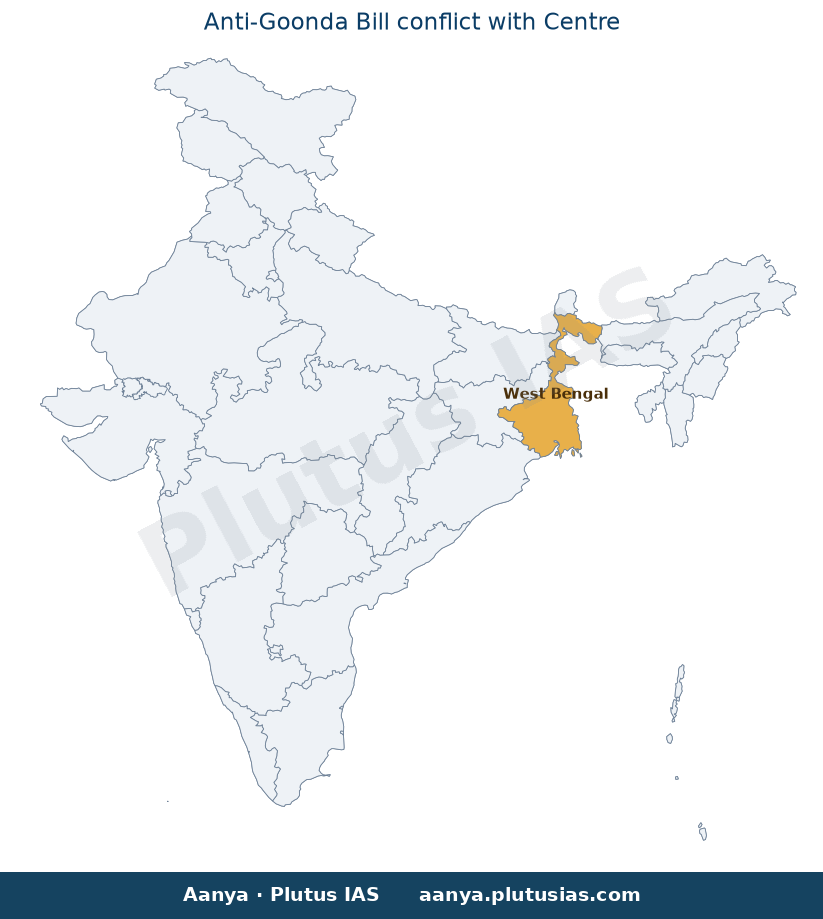
The President of India returned the West Bengal Public Safety and Control of Anti-Social Activities Bill, 2026, for reconsideration due to an alleged conflict with the Narcotic Drugs and Psychotropic Substances (NDPS) Act, 1985, and the Prevention of Illicit Traffic in Narcotic Drugs and Psychotropic Substances Act, 1988 (PITNDPS). The Centre’s objection highlighted potential repugnancy under Article 254 of the Constitution, raising critical questions about the constitutional limits of state legislation in matters overlapping with central laws.
Background
- Preventive detention laws empower authorities to detain individuals without trial to prevent imminent threats to public order or security, a power exercised by both the Union and state governments.
- The NDPS Act, 1985, is a central legislation regulating narcotic drugs and psychotropic substances, while the PITNDPS Act, 1988, provides a framework for preventive detention of individuals involved in illicit drug trafficking.
- State governments often introduce legislation to address local law and order challenges, but such laws must align with the constitutional framework and existing central statutes.
- The West Bengal Bill, introduced in June 2026, sought to define and curb ‘anti-social activities’ and ‘goonda’ activities, including provisions for preventive removal and restrictions on movement.
- The Bill’s provisions on preventive detention for drug-related offences were flagged as overlapping with the PITNDPS Act, 1988, necessitating presidential scrutiny.
What is the West Bengal Public Safety and Control of Anti-Social Activities Bill, 2026?
- The Bill defines ‘anti-social activities’ and ‘goonda’ as individuals engaging in or likely to engage in such activities, with a focus on curbing organised crime and public disorder.
- It empowers district magistrates, police commissioners, and senior police officers to issue orders for the preventive removal of ‘goondas’ from specified areas for up to one year.
- The Bill includes provisions for reporting movements and prohibiting entry into restricted areas, aiming to prevent recidivism and maintain local order.
- A key provision defines a ‘goonda’ to include individuals involved in offences under the NDPS Act, 1985, which was flagged as conflicting with the PITNDPS Act, 1988.
- The Bill was introduced amid concerns over rising crime and public safety, reflecting the state government’s intent to strengthen local law enforcement.
- The Bill’s preventive detention provisions are subject to judicial review, ensuring constitutional safeguards against arbitrary detention.
- The President’s return of the Bill underscores the constitutional principle that state legislation must not undermine or duplicate central laws.
- The Bill’s provisions on preventive detention are distinct from regular criminal law, as they focus on pre-emptive action rather than punishment.
Key Features
| Feature | Significance |
|---|---|
| Definition of ‘Goonda’ | Expands the ambit of ‘anti-social activities’ to include drug-related offences under the NDPS Act, 1985, thereby broadening the scope of preventive detention. |
| Preventive Detention Mechanism | Empowers district magistrates and police officers to issue orders restricting movement of individuals deemed ‘goonda’ for up to one year, with reporting obligations. |
| Geographical Restrictions | Allows imposition of area-specific bans, prohibiting entry into specified districts or areas, to curb anti-social activities. |
| Overlap with Central Legislation | Includes provisions that may duplicate or conflict with the Preventive Detention framework under the PITNDPS Act, 1988, for drug-related offences. |
| Reconsideration Provision | Mandates state legislature to revise the Bill to address conflicts with Central laws before resubmission for Presidential assent. |
Why it Matters
Constitutional and Legal
- Demonstrates the application of Article 254 of the Constitution, which addresses repugnancy between state and Central laws, particularly in concurrent subjects.
- Highlights the tension between state autonomy in lawmaking and the supremacy of Central legislation in areas of concurrent jurisdiction.
- Illustrates the role of the President as a constitutional authority in ensuring compliance with the legislative framework and avoiding duplication.
- Emphasises the need for harmonious interpretation of state and Central laws to prevent legal conflicts and ensure uniformity in governance.
Governance and Administration
- Underscores the challenges in state-level law enforcement when overlapping with Central statutes, particularly in areas like narcotics control.
- Raises questions about the efficacy of state-specific preventive detention mechanisms in the presence of Central frameworks.
- Demonstrates the procedural delays and legal hurdles in implementing state legislation that conflicts with existing Central laws.
- Highlights the importance of inter-governmental coordination to avoid legal ambiguities and ensure smooth governance.
Societal and Political
- Reflects the broader debate on the balance between preventive detention measures and individual liberties in the context of anti-social activities.
- Shows the political implications of state governments introducing legislation perceived as contentious or overlapping with Central laws.
- Illustrates the role of judicial review in scrutinising the constitutionality and fairness of state-level preventive detention provisions.
- Underscores the need for transparency and accountability in the implementation of laws aimed at curbing anti-social behaviour.
Challenges
1. Legal Repugnancy and Constitutional Conflict
- The Bill’s inclusion of NDPS Act offences within the definition of ‘goonda’ creates a potential conflict with the PITNDPS Act, 1988, leading to legal repugnancy under Article 254.
- States must ensure their legislation does not encroach upon areas exclusively governed by Central laws, particularly in concurrent subjects like public order and narcotics control.
- The President’s referral for reconsideration underscores the need for states to align their laws with Central frameworks to avoid constitutional challenges.
UPSC Link: Article 254 – Repugnancy between Union and State laws
2. Overlap in Preventive Detention Mechanisms
- The Bill introduces a state-level preventive detention framework that may duplicate or conflict with the Central framework under the PITNDPS Act, 1988.
- This overlap risks creating parallel legal mechanisms, leading to confusion in enforcement, legal challenges, and potential misuse of preventive detention powers.
- States must carefully delineate the scope of their preventive detention laws to avoid encroaching on Central jurisdictions.
UPSC Link: Preventive Detention – Constitutional and Statutory Framework
3. Implementation and Enforcement Challenges
- The Bill’s provisions, such as geographical restrictions and reporting obligations, may face practical difficulties in enforcement, particularly in densely populated or border areas.
- The requirement for district magistrates and police officers to issue orders based on apprehensions of anti-social activities introduces subjectivity, raising concerns about fairness and consistency.
- The need for periodic reporting and monitoring may strain administrative resources, particularly in states with limited governance capacity.
UPSC Link: Public Order – State vs. Concurrent List
4. Judicial Scrutiny and Legal Challenges
- The Bill’s provisions are likely to face judicial scrutiny, particularly on grounds of proportionality, necessity, and adherence to fundamental rights under Articles 14, 19, and 21.
- The Calcutta High Court’s intervention in reviewing the Bill’s constitutionality highlights the role of the judiciary in ensuring laws comply with constitutional principles.
- Legal challenges may arise from individuals or organisations challenging the Bill’s provisions as arbitrary, excessive, or violative of fundamental rights.
UPSC Link: Fundamental Rights – Articles 14, 19, 21
5. Coordination Between State and Central Governments
- The conflict between the Bill and Central laws underscores the need for robust inter-governmental coordination to avoid legal duplication and ensure policy coherence.
- States must engage in pre-legislative consultations with the Centre to align their laws with existing Central frameworks, particularly in areas of concurrent jurisdiction.
- Failure to coordinate may lead to legal disputes, delays in implementation, and erosion of public trust in governance institutions.
UPSC Link: Inter-State Relations – Cooperative Federalism
Challenges — UPSC Perspective
| Issue | Concern |
|---|---|
| Legal Repugnancy | Conflict with Central laws under Article 254 may render the Bill unconstitutional or inoperative. |
| Preventive Detention Overlap | Parallel mechanisms risk confusion, legal challenges, and potential misuse of detention powers. |
| Enforcement Difficulties | Geographical restrictions and reporting obligations may strain administrative resources and face practical challenges. |
| Judicial Scrutiny | Provisions may be struck down as arbitrary or violative of fundamental rights, leading to legal uncertainty. |
| Federal Coordination | Lack of alignment with Central frameworks may result in delays, disputes, and erosion of governance efficacy. |
Way Forward
- The West Bengal government must revise the Bill to remove or clarify the overlap with the NDPS Act, 1985, and the PITNDPS Act, 1988, to avoid repugnancy under Article 254.
- Conduct inter-governmental consultations with the Central government to ensure alignment with existing Central frameworks in areas of concurrent jurisdiction.
- Clarify the scope and application of preventive detention provisions to prevent duplication and ensure adherence to constitutional principles.
- Strengthen safeguards against arbitrary detention by defining ‘anti-social activities’ with precision and ensuring judicial oversight.
- Enhance transparency in the implementation of the Bill by mandating periodic reviews and public disclosures of orders issued under its provisions.
- Address concerns of potential misuse by incorporating independent review mechanisms and grievance redressal systems for affected individuals.
- Engage with civil society and legal experts to refine the Bill’s provisions and ensure compliance with fundamental rights and constitutional norms.
- Explore alternative mechanisms, such as enhanced policing and community-based interventions, to address anti-social activities without relying solely on preventive detention.
UPSC Value Addition
Keywords for Mains Answer-Writing
Preventive detention · Repugnancy under Article 254 of the Constitution · Narcotic Drugs and Psychotropic Substances (NDPS) Act, 1985 · Prevention of Illicit Traffic and Narcotic Drugs and Psychotropic Substances (PITNDPS) Act, 1988 · Overlap between state and central legislation · President’s power of reconsideration under Article 200 · Constitutional scheme of distribution of legislative powers · Doctrine of pith and substance · Federalism in India · Administrative law and delegated legislation · Public order and police powers · Judicial review of preventive detention laws
Constitutional & Policy Linkages
- Article 254 – Repugnancy between Union and State laws
- Articles 14, 19, 21 – Fundamental Rights and Preventive Detention
- Concurrent List – Seventh Schedule, Entry 1 (Public Order)
Concept Flow
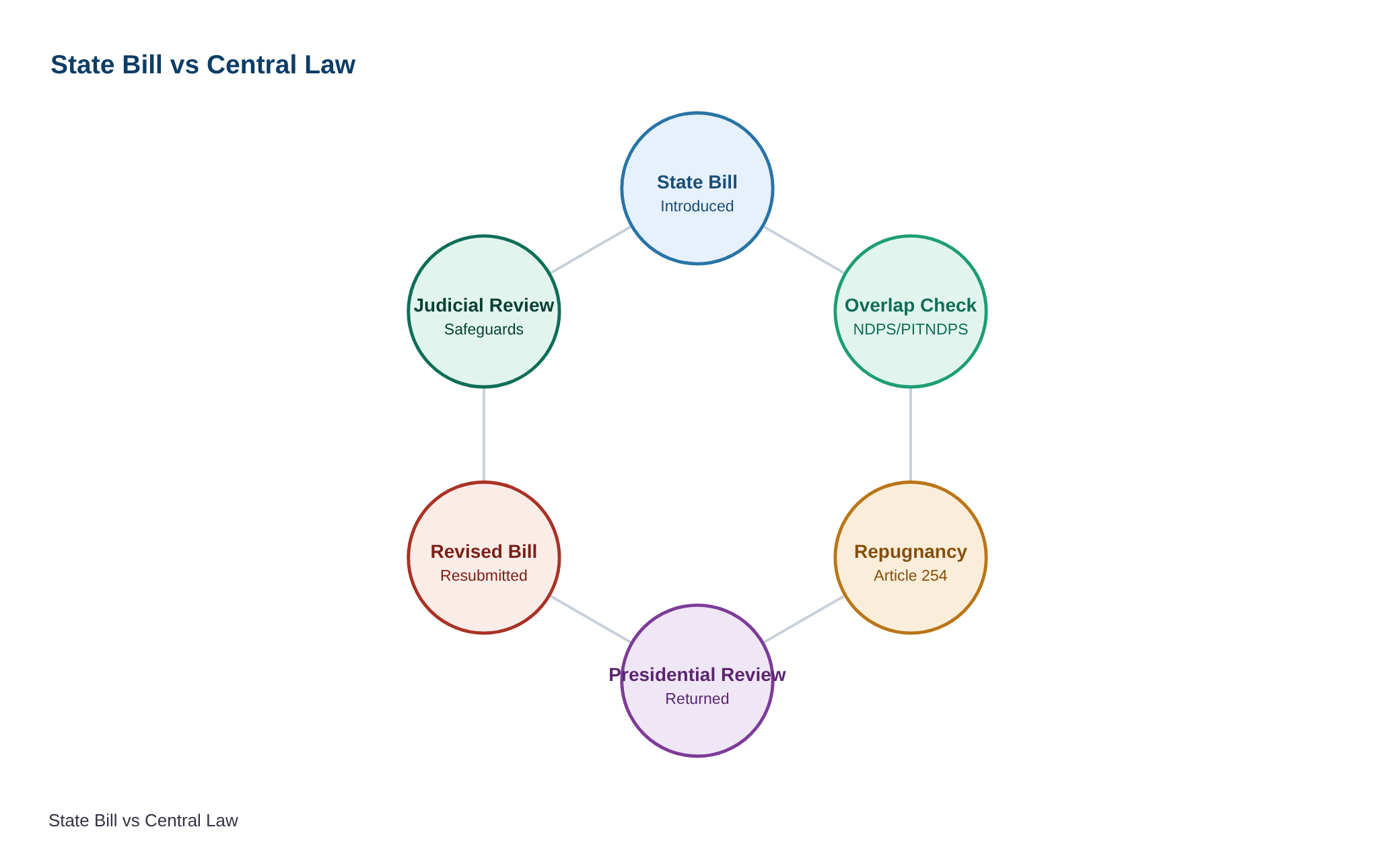
Introduction of state Bill to curb anti-social activities → Inclusion of NDPS Act offences in ‘goonda’ definition → Central government raises repugnancy concern under Article 254 → President refers Bill for reconsideration → State government revises Bill to address overlap → Resubmission for Presidential assent → Judicial review of revised Bill → Implementation with safeguards.
Prelims Practice Questions
Q1. Consider the following statements regarding the Narcotic Drugs and Psychotropic Substances (NDPS) Act, 1985 and the Prevention of Illicit Traffic and Narcotic Drugs and Psychotropic Substances (PITNDPS) Act, 1988:
1. The NDPS Act, 1985 primarily deals with the regulation of narcotic drugs and psychotropic substances, including their production, manufacture, possession, sale, purchase, consumption, and export.
2. The PITNDPS Act, 1988 empowers the Central Government to detain persons involved in illicit traffic in narcotic drugs and psychotropic substances for a period up to two years.
3. The PITNDPS Act, 1988 provides for preventive detention, which is a measure to detain a person without trial to prevent him from acting in a manner prejudicial to the maintenance of public order.
How many of the above statements are correct?
- Only one
- Only two
- All three
- None
Answer: All three — Statements 1 and 2 are correct. Statement 3 is incorrect as the PITNDPS Act, 1988 provides for preventive detention to prevent illicit traffic in narcotic drugs, not for the maintenance of public order in general.
Q2. Assertion (A): The President of India may return a State Bill for reconsideration under Article 200 of the Constitution if it is in conflict with a Union law.
Reason (R): The doctrine of repugnancy under Article 254 of the Constitution empowers the President to withhold assent to a State law that is repugnant to a Union law in a Concurrent List subject.
Options:
A. Both A and R are true, and R is the correct explanation of A.
B. Both A and R are true, but R is not the correct explanation of A.
C. A is true, but R is false.
D. A is false, but R is true.
Answer: ? — Both the assertion and reason are true. The President can return a State Bill for reconsideration under Article 200 if it is in conflict with a Union law. The reason correctly explains the constitutional basis for this power under Article 254.
Q3. Match the following pairs:
Column I (Legislative Provision) | Column II (Relevant Article/Act)
——————————————————————–|—————————————————
1. Power of the President to return a State Bill for reconsideration | A. Article 254 (Repugnancy)
2. Doctrine of pith and substance | B. Article 200
3. Overlap between State and Union laws | C. Article 246
4. Distribution of legislative powers between Union and States | D. Doctrine of colourable legislation
Options:
A. 1-B, 2-D, 3-A, 4-C
B. 1-A, 2-B, 3-C, 4-D
C. 1-C, 2-D, 3-A, 4-B
D. 1-D, 2-A, 3-B, 4-C
- A
- B
- C
- D
Answer: A — 1-B: The President’s power to return a State Bill for reconsideration is under Article 200. 2-D: The doctrine of pith and substance is used to determine the true nature of a legislation. 3-A: Overlap between State and Union laws is addressed under Article 254 (repugnancy). 4-C: The distribution of legislative powers is outlined in Article 246.
Mains Practice Question
✍ The President of India returned the West Bengal Public Safety and Control of Anti-Social Activities Bill, 2026 for reconsideration on the ground of repugnancy with the Narcotic Drugs and Psychotropic Substances (NDPS) Act, 1985. Critically examine the constitutional framework governing the relationship between State and Union legislation in India, with particular reference to the doctrine of repugnancy and the role of the President under Article 200. Also, analyse the implications of such overlaps for federalism in India. (15 Marks)
Approach: MODEL-ANSWER SKELETON:
1. **Introduction (2 Marks)**:
– Briefly state the constitutional scheme of distribution of legislative powers between the Union and States under the Seventh Schedule (Union, State, and Concurrent Lists).
– Mention the role of the President in the legislative process under Article 200.
2. **Doctrine of Repugnancy (4 Marks)**:
– Define repugnancy under Article 254 of the Constitution.
– Explain the conditions under which a State law becomes repugnant to a Union law (when both occupy the same field and the Union law is exhaustive).
– Cite the Supreme Court’s interpretation in cases such as *M. Karunanidhi v. Union of India* (1979) and *Zameer Ahmed Latifur Rehman Sheikh v. State of Maharashtra* (2010).
3. **Role of the President (3 Marks)**:
– Explain the President’s power to return a Bill for reconsideration under Article 200.
– Discuss the significance of the President’s role in maintaining the federal balance.
– Reference the *Shayara Bano v. Union of India* (2017) judgment on the President’s discretionary powers.
4. **Implications for Federalism (4 Marks)**:
– Analyse how overlaps between State and Union laws can undermine federalism.
– Discuss the principle of *pith and substance* and its role in resolving conflicts.
– Highlight the need for cooperative federalism and inter-governmental coordination.
5. **Conclusion (2 Marks)**:
– Summarise the importance of maintaining a balance between State autonomy and Union supremacy.
– Suggest measures to avoid legislative conflicts, such as consultations between the Union and States.
Source: The Indian Express
Generated by AanyaAi for educational purpose.
Related guides on our sites
- Current affairs for upsc 2026
- Best PSIR optional coaching for upsc
- Best PSIR optional teacher for upsc
- Best teacher of PSIR optional for upsc

- PM Modi Praises Youth-Led Nasha Mukt Yuva Abhiyan Momentum - September 27, 2026
- राजनाथ सिंह का बड़ा बयान: भारत किसी की ज़मीन कब्ज़ा नहीं करेगा, लेकिन सुरक्षा पर होगा कठोर - September 27, 2026
- Exercise Tarang Shakti 2026: India’s Mega Multi-Nation Air Power Showcase - September 27, 2026

No Comments