


07 Aug Production Linked Incentive Scheme for Pharmaceutical Sector: Key Facts for UPSC & State PCS
✎ The Press Information Bureau (PIB) released an official statement on 7 August 2026 detailing the progress of Production-Linked Incentive (PLI) schemes for the pharmaceutical and medical devices sectors.
Subject Relevance — Where This Topic Fits
- GS Paper III — Indian Economy: Issues relating to Planning, Mobilization of Resources, Growth, Development and Employment | GS Paper III — Effects of Liberalization on the Economy, Changes in Industrial Policy and their Effects on Industrial Growth
- Prelims: Production-Linked Incentive (PLI) Scheme, Pharmaceutical PLI Scheme, Bulk Drugs PLI Scheme, Medical Devices PLI Scheme, Atmanirbhar Bharat, Fermentation-based bulk drugs, Component-linked incentive, Union Budget 2021-22
- Essay: India’s Pharmaceutical Sector: From Dependence to Self-Reliance, Balancing Incentives and Regulation: The Case of India’s PLI Schemes
Why is this in the news?
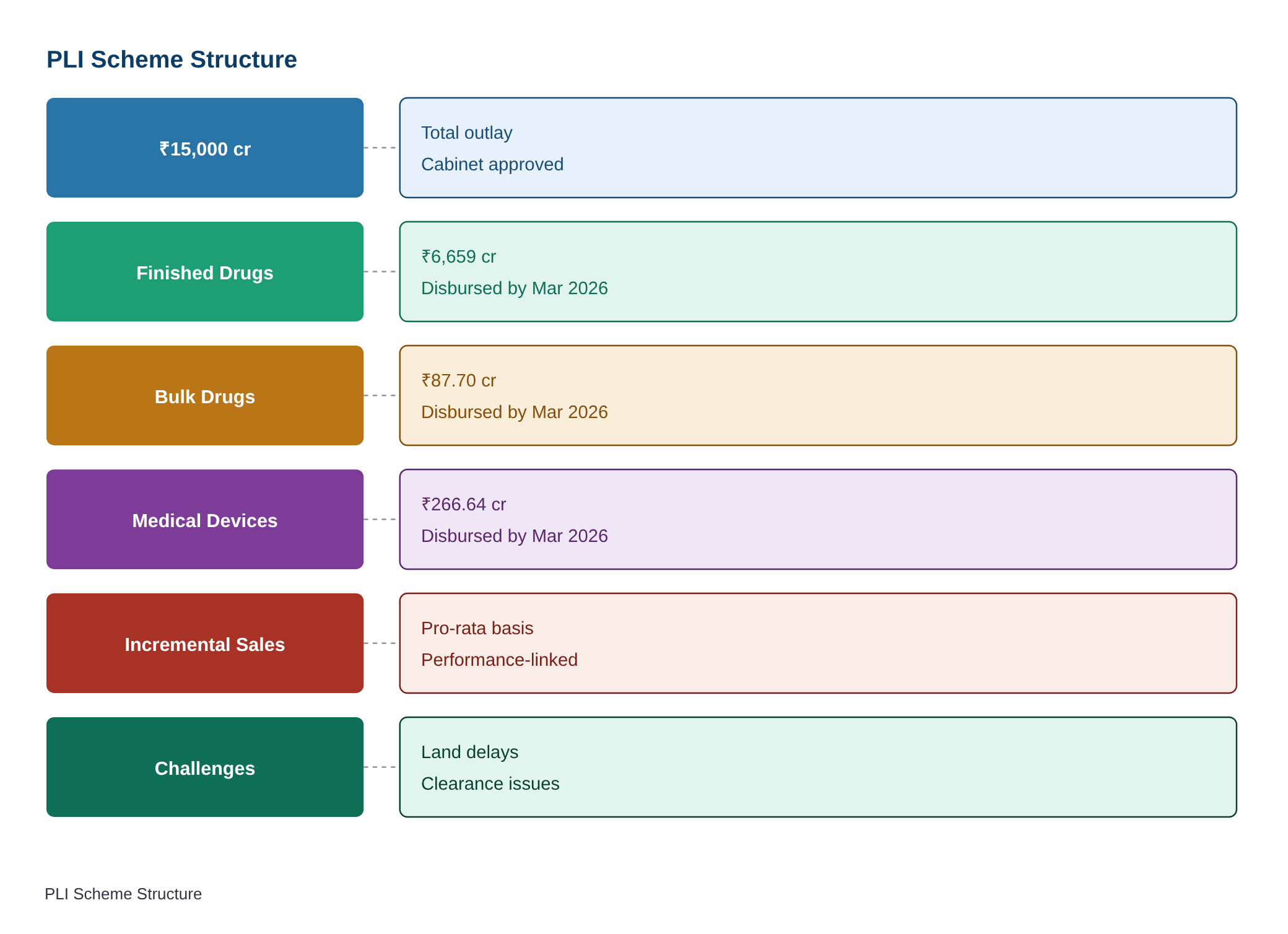
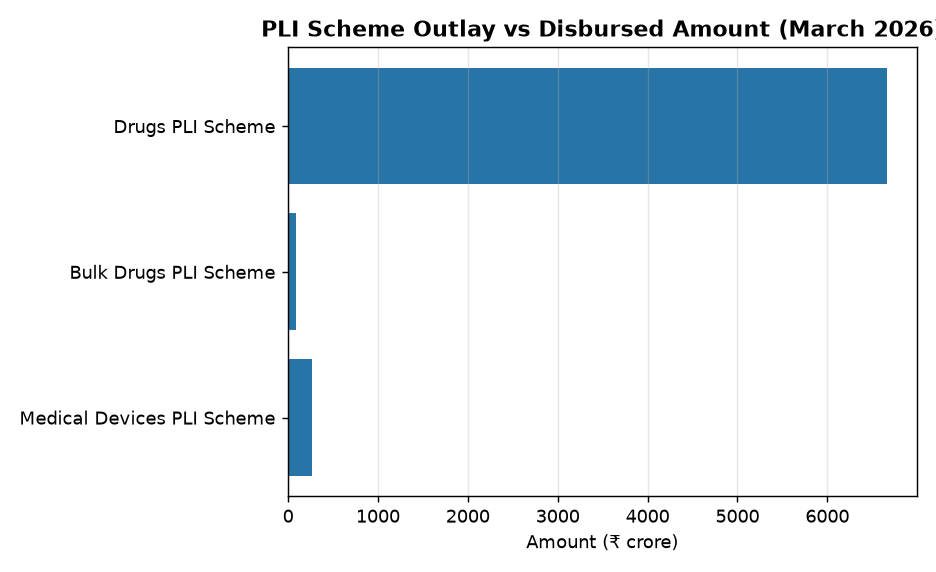
The Press Information Bureau (PIB) released an official statement on 7 August 2026 detailing the progress of Production-Linked Incentive (PLI) schemes for the pharmaceutical and medical devices sectors. The report highlights the disbursement of ₹6,659 crore under the Drugs PLI Scheme, ₹87.70 crore under the Bulk Drugs PLI Scheme, and ₹266.64 crore under the Medical Devices PLI Scheme as of March 2026. It also underscores operational challenges such as land acquisition delays, environmental clearances, and the prolonged manufacturing timelines for fermentation-based bulk drugs, which have impeded the timely realization of incentives.
Background
- The scheme aims to enhance India’s self-reliance (Atmanirbhar Bharat) by incentivizing large-scale production of high-value goods with significant export potential.
- The pharmaceutical sector in India is the world’s third-largest by volume and contributes substantially to global generic drug supply, yet faces challenges in bulk drug production due to reliance on imports.
- The medical devices sector, valued at over $11 billion, is heavily import-dependent, with nearly 80% of devices sourced from abroad, necessitating targeted interventions like PLI.
- The PLI framework is structured to disburse incentives based on incremental sales of eligible products, ensuring fiscal prudence and outcome-based funding.
- The scheme operates alongside other initiatives such as the Jan Aushadhi Scheme and the Pharma Vision 2024 to strengthen the domestic pharmaceutical ecosystem.
What is the Production-Linked Incentive (PLI) Scheme for Pharmaceuticals and Medical Devices?
- The PLI scheme for pharmaceuticals and medical devices is a performance-linked subsidy mechanism designed to incentivize domestic manufacturing of high-value, high-technology products, thereby reducing import dependence and enhancing export competitiveness.
- The scheme operates under the aegis of the Department of Pharmaceuticals, Ministry of Chemicals and Fertilizers, with financial outlays approved by the Union Cabinet for a tenure of six years (2021-22 to 2026-27).
- For pharmaceuticals, two distinct PLI schemes exist: (a) the Drugs PLI Scheme with a total outlay of ₹15,000 crore, and (b) the Bulk Drugs PLI Scheme with a total outlay of ₹6,940 crore, targeting active pharmaceutical ingredients (APIs) and key starting materials (KSMs).
- Incentives are disbursed as a percentage of incremental sales (over a base year) of eligible products, with rates varying by product category and investment threshold, ensuring fiscal sustainability and targeted support.
- The scheme prioritizes fermentation-based bulk drugs (e.g., antibiotics, steroids) due to their strategic importance in reducing import dependence, though their production is constrained by biological processes requiring extended manufacturing timelines.
- Unlike chemical synthesis, fermentation relies on living microbial cultures, whose growth is governed by biological constraints, leading to longer production cycles and higher operational costs.
Key Features
| Feature | Significance |
|---|---|
| Production-Linked Incentive (PLI) Scheme for Pharmaceuticals | Aims to enhance domestic manufacturing of pharmaceuticals, reduce import dependence, and boost self-reliance in critical drug production. |
| Financial Outlay of ₹15,000 crore | Provides substantial fiscal support to incentivize large-scale investment in pharmaceutical manufacturing. |
| Incentive Disbursement Mechanism | Pro-rata distribution of incentives based on incremental sales of eligible products, ensuring performance-linked support. |
| Dual Focus: Finished Drugs and Bulk Drugs | Covers both high-value finished formulations and essential bulk drugs, including fermentation-based APIs. |
| Component-Linked Incentive (CLI) for Medical Devices | Introduces a hybrid incentive model to attract manufacturers of medical devices, aligning with global supply chain diversification. |
Why it Matters
Economic and Industrial
- Enhances India’s position as a global pharmaceutical hub by incentivizing high-value drug manufacturing.
- Reduces import dependency for critical APIs and formulations, particularly in fermentation-based drugs.
- Promotes backward integration in the pharmaceutical value chain, strengthening domestic production ecosystems.
- Attracts foreign direct investment (FDI) and encourages technology transfer in high-tech pharmaceutical processes.
Strategic and Geopolitical
- Mitigates supply chain vulnerabilities exposed during global crises (e.g., COVID-19 pandemic).
- Supports India’s ‘Atmanirbhar Bharat’ initiative by fostering self-sufficiency in essential medicines.
- Aligns with global trends of reshoring pharmaceutical production to reduce geopolitical risks in supply chains.
Public Health and Access
- Ensures availability of affordable and high-quality pharmaceuticals for domestic consumption.
- Encourages production of essential bulk drugs, reducing reliance on imports for critical healthcare inputs.
- Supports the development of fermentation-based APIs, which are often precursors for life-saving drugs.
Challenges
1. Implementation Bottlenecks in Bulk Drug PLI
- Prolonged land acquisition processes delay project timelines, particularly in industrial corridors.
- Environmental clearances for fermentation-based plants are time-consuming due to stringent regulatory norms.
- High utility costs (e.g., electricity, water) for fermentation processes erode profit margins.
- Biological constraints in fermentation-based manufacturing limit production scalability and increase lead times.
- Incentive disbursement delays due to slow project rollout, as payouts are tied to incremental sales.
UPSC Link: GS3: Industrial Policy
2. Performance-Based Disbursement Model
- Ties incentives to sales performance, which may disadvantage newer entrants with slower ramp-up periods.
- Creates liquidity constraints for manufacturers during initial phases of production.
- Risk of uneven disbursement across sectors, with finished drugs receiving higher allocations than bulk drugs.
UPSC Link: GS3: Public Finance
3. Technology and R&D Gaps
- Limited domestic R&D in fermentation-based drug synthesis compared to chemical synthesis methods.
- High capital expenditure for setting up fermentation infrastructure deters small and medium enterprises (SMEs).
- Dependence on imported fermentation strains and bioreactors increases production costs.
UPSC Link: GS3: Science & Technology
4. Supply Chain and Logistics
- Inadequate cold-chain infrastructure for temperature-sensitive pharmaceuticals in rural and remote areas.
- Logistics bottlenecks in transporting bulk drugs from manufacturing hubs to formulation units.
UPSC Link: GS3: Logistics
5. Regulatory and Compliance Hurdles
- Stringent Good Manufacturing Practices (GMP) compliance requirements increase operational costs.
- Delays in obtaining drug approvals from the Central Drugs Standard Control Organization (CDSCO) for new products.
UPSC Link: GS2: Health Governance
Challenges — UPSC Perspective
| Issue | Concern |
|---|---|
| Land Acquisition Delays | Prolonged approval processes and litigation risks delay project timelines. |
| Environmental Clearances | Stringent norms and public scrutiny slow down the establishment of fermentation plants. |
| High Utility Costs | Escalates operational expenses, reducing competitiveness of fermentation-based production. |
| Biological Constraints in Fermentation | Natural growth cycles of microbial strains limit production speed and scalability. |
| Incentive Disbursement Lag | Performance-based payouts create liquidity gaps for manufacturers during initial phases. |
| Regulatory Compliance Costs | GMP and CDSCO approvals increase capital and operational expenditures. |
| Supply Chain Inefficiencies | Inadequate logistics infrastructure hampers distribution of bulk drugs to formulation units. |
Government Initiatives — Must-Memorise for Prelims
- Production-Linked Incentive (PLI) Scheme for Pharmaceuticals
- Production-Linked Incentive (PLI) Scheme for Medical Devices
- Production-Linked Incentive (PLI) Scheme for Bulk Drugs
Way Forward
- Streamline land acquisition and environmental clearance processes for fermentation-based plants through single-window clearances.
- Introduce staggered disbursement of incentives to alleviate liquidity constraints for manufacturers during initial production phases.
- Enhance R&D funding for fermentation-based drug synthesis to bridge technology gaps and reduce import dependence.
- Develop dedicated cold-chain and logistics infrastructure for bulk drugs to improve supply chain efficiency.
- Simplify regulatory compliance for GMP and CDSCO approvals to reduce operational costs and timelines.
- Promote public-private partnerships (PPPs) for setting up fermentation-based manufacturing hubs in industrial corridors.
- Expand the scope of the PLI scheme to include incentives for ancillary industries (e.g., bioreactors, fermentation media).
- Conduct periodic reviews of incentive disbursement mechanisms to ensure equitable distribution across sectors.
UPSC Value Addition
Keywords for Mains Answer-Writing
Production Linked Incentive (PLI) Scheme · Pharmaceutical Sector · Bulk Drugs · Fermentation-based Medicines · Land Acquisition · Environmental Clearances · Component-Linked Incentive (CLI) · Medical Devices PLI · Production-Based Incentives · Manufacturing Sector Reforms · Public Investment in Pharmaceuticals · Regulatory Bottlenecks in Drug Manufacturing · Union Government Schemes · Pharmaceutical Policy Framework
Concept Flow
Government identifies pharmaceutical self-reliance as a strategic priority under ‘Atmanirbhar Bharat’. → Cabinet approves PLI Scheme for Pharmaceuticals with a financial outlay of ₹15,000 crore to incentivize domestic manufacturing. → PLI Scheme is bifurcated into finished drugs and bulk drugs, with fermentation-based APIs included under bulk drugs. → Manufacturers apply for incentives, but face delays due to land acquisition, environmental clearances, and high utility costs. → Incentives are disbursed pro-rata based on incremental sales, creating liquidity constraints for delayed projects. → Performance gaps in bulk drug PLI lead to underutilization of allocated funds, necessitating policy corrections. → Government introduces hybrid incentive models (e.g., CLI for medical devices) to attract diverse manufacturers. → Long-term outcomes include reduced import dependence, enhanced domestic production, and improved public health access.
Prelims Practice Questions
Q1. Consider the following statements regarding the Production Linked Incentive (PLI) Scheme for the Pharmaceutical Sector:
1. The PLI Scheme for Pharmaceuticals was launched in the fiscal year 2022-23.
2. The total financial outlay for the PLI Scheme for Pharmaceuticals is ₹15,000 crore.
3. The PLI Scheme for Bulk Drugs has a financial outlay of ₹6,940 crore.
4. The PLI Scheme for Medical Devices follows a mixed incentive framework combining PLI and Component-Linked Incentives.
How many of the above statements are correct?
- Only one
- Only two
- Only three
- All four
Answer: Only three — Statements 1, 2, and 3 are correct. Statement 4 is incorrect as the PLI Scheme for Medical Devices does not follow a mixed incentive framework combining PLI and Component-Linked Incentives.
Q2. Assertion (A): Fermentation-based bulk drug manufacturing relies on the biological activity of living cells, which inherently limits the speed of production.
Reason (R): Unlike chemical synthesis, fermentation processes are constrained by the natural growth rate of microorganisms, leading to longer production cycles.
Options:
A. Both A and R are true, and R is the correct explanation of A.
B. Both A and R are true, but R is not the correct explanation of A.
C. A is true, but R is false.
D. A is false, but R is true.
Answer: ? — Both Assertion (A) and Reason (R) are true, and Reason (R) correctly explains Assertion (A). Fermentation-based production is slower due to biological constraints, unlike chemical synthesis.
Mains Practice Question
✍ Critically examine the efficacy of the Production Linked Incentive (PLI) Scheme for the Pharmaceutical Sector in achieving its stated objectives. Also, analyse the key challenges faced in the implementation of the scheme, particularly in the context of bulk drug manufacturing. (15 Marks)
Approach: MODEL-ANSWER SKELETON:
1. **Introduction (2 marks)**: Define the PLI Scheme and its objectives in the pharmaceutical sector, highlighting its role in promoting domestic manufacturing and reducing import dependence.
2. **Efficacy of the PLI Scheme (5 marks)**:
– Discuss the financial outlay (₹15,000 crore) and its allocation across drugs, bulk drugs, and medical devices.
– Highlight the disbursement of ₹6,659 crore for drugs, ₹87.70 crore for bulk drugs, and ₹266.64 crore for medical devices by March 2026.
– Assess the scheme’s impact on reducing import dependence and enhancing self-reliance in critical pharmaceutical ingredients.
– Reference the need for long-term sustainability and scalability of the scheme.
3. **Key Challenges in Implementation (6 marks)**:
– **Regulatory Bottlenecks**: Land acquisition delays and environmental clearances for bulk drug projects.
– **Technological Constraints**: Limitations of fermentation-based manufacturing, including longer production cycles and higher utility costs.
– **Financial Disbursement Mechanism**: Linkage of incentives to sales of manufactured products, which delays fund distribution in slow-starting projects.
– **Comparison with Chemical Synthesis**: Highlight the inherent advantages of chemical synthesis over fermentation in terms of speed and cost-efficiency.
4. **Conclusion (2 marks)**: Summarise the need for targeted reforms, such as expedited clearances and financial support mechanisms, to address these challenges. Emphasise the importance of balancing incentives with regulatory ease to achieve the scheme’s objectives.
Source: PIB (Press Information Bureau)
Generated by AanyaAi for educational purpose.

- Piyush Goyal Attends G20 Trade Ministers’ Meeting in Milwaukee - October 1, 2026
- विशेष अभियान-6: कोल इंडिया लिमिटेड की तैयारी पर केंद्र सरकार की निगरानी - October 1, 2026
- ECL’s Action Plan for Special Campaign 6: A UPSC Governance Case Study - October 1, 2026

No Comments