


17 Sep Rajasthan OBC Reservation in Local Body Polls: HC Arguments Explained for UPSC
✎ OBC reservation in local body elections must be backed by empirical data and cannot exceed the 50% ceiling unless justified by exceptional circumstances, as per Supreme Court rulings.
Subject Relevance — Where This Topic Fits
- GS Paper II — Polity and Governance (Constitutional Provisions, Local Governance) | GS Paper II — Fundamental Rights (Reservation Policies) | GS Paper IV — Ethics (Social Justice and Inclusion)
- Prelims: Article 243D, Article 243T, 93rd Constitutional Amendment Act, 2005, Indra Sawhney Case (1992), K. Krishna Murthy Case (2010), OBC Commission, Local Body Elections, Reservation Policy, 50% Ceiling on Reservation
- Essay: Social Justice and Inclusive Governance: The Role of Reservation Policies in Local Self-Governance
Quick Revision: OBC reservation in local body elections must be backed by empirical data and cannot exceed the 50% ceiling unless justified by exceptional circumstances, as per Supreme Court rulings.
Why is this in the news?
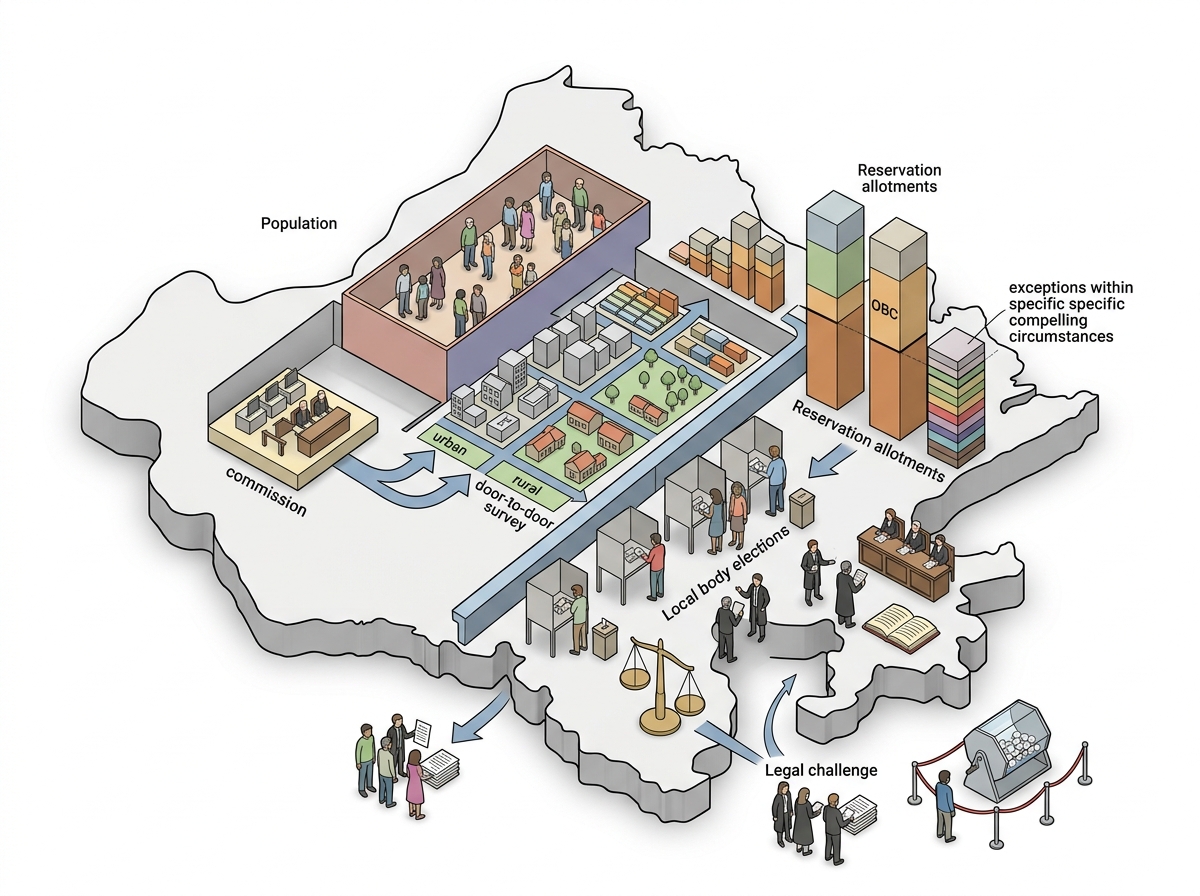
The Rajasthan government has defended the constitutionality of OBC reservation in local body elections before the High Court, citing a comprehensive door-to-door survey by the OBC Commission and adherence to the 50% reservation ceiling. This issue has gained prominence following a legal challenge to the reservation allotment in district-level posts, which led to the temporary suspension of lottery processes for reserved seats.
Background
- The Supreme Court, in the *Indra Sawhney v. Union of India* (1992) case, established the 50% ceiling on reservation, subject to exceptions based on compelling circumstances.
- The *K. Krishna Murthy v. Union of India* (2010) case further clarified that reservations in local bodies must not exceed the 50% limit unless justified by extraordinary data.
- Rajasthan, like other states, conducts door-to-door surveys through its OBC Commission to determine the quantum of reservation for OBCs in local body elections.
- The current dispute arose when the reservation for OBCs in district-level posts was challenged in the High Court, leading to the temporary halting of lottery processes for reserved seats.
- The state government has argued that the reservation was determined based on empirical data and the constitutional mandate, ensuring compliance with the 50% ceiling.
OBC Reservation in Local Body Elections: Constitutional and Procedural Framework
- The 73rd and 74th Constitutional Amendments (1992) empower state legislatures to provide for reservation of seats for SCs, STs, and OBCs in local bodies, including panchayats and municipalities.
- The Supreme Court, in the *Indra Sawhney* case, held that reservations exceeding 50% are constitutionally impermissible unless justified by exceptional circumstances, such as a historical lack of representation.
- States must conduct empirical surveys to determine the quantum of OBC reservation, as mandated by the Supreme Court in the *K. Krishna Murthy* case. This ensures that reservations are based on data rather than arbitrary assumptions.
- The OBC Commission in Rajasthan conducted a door-to-door survey to collect socio-economic data, which formed the basis for determining the reservation percentage for OBCs in local body elections.
- The state government has argued that the reservation for OBCs (16%) in district-level posts adheres to the 50% ceiling, with SCs (18.51%) and STs (17.09%) also receiving reservations, totaling 48.78% of the posts.
- The Supreme Court’s 50% ceiling is a guiding principle, but states may justify deviations in exceptional cases where empirical data demonstrates the need for higher reservations.
- The High Court’s decision on this matter will set a precedent for how states determine and implement OBC reservations in local body elections, balancing social justice with constitutional limits.
Key Features
| Feature | Significance |
|---|---|
| OBC Reservation in Local Body Elections | Ensures representation of Other Backward Classes in democratic decentralisation, aligning with constitutional principles of social justice and equity. |
| Commission-Based Survey (House-to-House) | Provides empirical data for reservation policy, ensuring evidence-based decision-making rather than arbitrary allocation. |
| Reservation within 50% Limit | Adheres to the Supreme Court’s ceiling on total reservations, balancing social justice with administrative efficiency. |
| Lottery Process for Seat Allocation | Introduces randomness in reservation implementation, reducing discretionary bias in seat distribution. |
| High Court Proceedings | Demonstrates judicial scrutiny of executive actions in reservation policies, reinforcing the rule of law in governance. |
Why it Matters
Constitutional & Legal
- Reinforces the principle of proportional representation in local governance as envisaged under Article 243D and 243T of the Constitution.
- Validates the use of empirical data (OBC Commission survey) for policy formulation, ensuring fairness and transparency in reservation allocation.
- Demonstrates adherence to the Supreme Court’s 50% reservation ceiling, balancing affirmative action with constitutional limits.
Administrative & Governance
- Highlights the role of district-level administrative bodies (zilla parishads) in implementing reservation policies through structured processes.
- Showcases the use of data-driven governance tools (house-to-house surveys) to inform policy decisions, setting a precedent for evidence-based administration.
- Illustrates the interplay between judicial review and executive action in resolving disputes over reservation policies.
Social & Political
- Underscores the importance of OBC representation in local self-governance, addressing historical underrepresentation in democratic institutions.
- Demonstrates the dynamic nature of reservation policies, which must adapt to demographic and administrative changes (e.g., district reorganisation).
- Reflects the broader discourse on social justice in India’s electoral democracy, where reservation policies are continuously evaluated for fairness and effectiveness.
Challenges
1. Judicial Scrutiny of Reservation Policies
- Reservations must withstand judicial review, requiring governments to justify policies with robust data and constitutional compliance.
- Disputes over reservation percentages or implementation methods can lead to litigation, delaying electoral processes.
- The 50% ceiling imposed by the Supreme Court limits flexibility in expanding reservations, even if demographic or administrative changes warrant it.
UPSC Link: GS-II: Constitutional Provisions
2. Data Accuracy and Survey Methodology
- House-to-house surveys are resource-intensive and must be meticulously conducted to avoid errors in reservation calculations.
- Discrepancies in data collection can lead to legal challenges, as seen in the controversy over OBC reservation percentages.
- Ensuring data privacy and accuracy in large-scale surveys is a persistent administrative challenge.
UPSC Link: GS-II: Governance
3. Balancing Reservations with Administrative Efficiency
- Excessive reservations can dilute the effectiveness of local governance, particularly in smaller administrative units.
- The lottery system, while fair, may not always align with demographic realities, leading to underrepresentation in certain areas.
- Frequent changes in reservation policies (e.g., due to district reorganisation) can create administrative uncertainty.
UPSC Link: GS-II: Local Governance
4. Public Perception and Political Contestations
- Reservation policies often become subjects of political debate, with stakeholders demanding either expansion or rollback.
- Misinterpretation of reservation data can fuel public distrust or allegations of bias in policy implementation.
- Balancing competing demands (e.g., OBC vs. general category representation) requires careful negotiation and transparency.
UPSC Link: GS-II: Social Justice
Challenges — UPSC Perspective
| Issue | Concern |
|---|---|
| Judicial Review of Reservations | Risk of policy invalidation due to non-compliance with constitutional limits or procedural errors. |
| Data Collection Errors | Potential inaccuracies in house-to-house surveys leading to incorrect reservation percentages. |
| Administrative Delays | Litigation and policy disputes can postpone electoral processes, disrupting local governance. |
| Balancing Representation | Ensuring reservations do not disproportionately disadvantage other marginalised groups (e.g., SCs, STs). |
| Public Trust and Transparency | Perceived lack of fairness in reservation allocation can erode public confidence in governance. |
| Dynamic Demographic Changes | Frequent administrative reorganisation (e.g., new districts) complicates reservation policy consistency. |
Way Forward
- Conduct periodic reviews of reservation policies using updated demographic and administrative data to ensure relevance and fairness.
- Strengthen the methodology of house-to-house surveys by incorporating digital tools for real-time data validation and error reduction.
- Establish a dedicated grievance redressal mechanism for stakeholders to address concerns over reservation allocations without recourse to litigation.
- Enhance inter-departmental coordination between the OBC Commission, district administrations, and electoral bodies to streamline reservation implementation.
- Promote transparency by publishing detailed reports on survey findings and reservation calculations for public scrutiny.
- Explore alternative models (e.g., cumulative reservation) to address underrepresentation without exceeding the 50% ceiling.
- Invest in capacity-building for local officials to handle reservation-related disputes and electoral processes efficiently.
- Encourage research on the long-term impact of reservations on local governance and social cohesion to inform future policy adjustments.
UPSC Value Addition
Keywords for Mains Answer-Writing
Local Government · OBC Reservation · 73rd and 74th Constitutional Amendments · Indira Sawhney Judgment · Constitutional Limits on Reservation · State Election Commission · District Planning Committee · Backward Class Commission · Reservation Policy in Panchayati Raj Institutions · Judicial Review of Reservation Policies
Constitutional & Policy Linkages
- Article 15(4): Special provisions for socially and educationally backward classes.
- Article 16(4): Reservation in public employment and services.
- Article 243D: Reservation for SCs, STs, and women in Panchayats.
- Article 243T: Reservation for SCs, STs, and women in Municipalities.
Concept Flow
Constitutional mandate for social justice and representation → Supreme Court’s 50% reservation ceiling → State governments implement OBC reservations in local bodies → OBC Commission conducts house-to-house surveys → Data-driven reservation allocation → Lottery process for seat distribution → Judicial scrutiny of policy → Legal disputes and high court proceedings → Policy refinements and administrative adjustments.
Prelims Practice Questions
Q1. Consider the following statements regarding reservation in local body elections in India: 1. Reservation for Other Backward Classes (OBC) in local body elections is mandated by the 73rd and 74th Constitutional Amendments. 2. The Supreme Court in the Indira Sawhney case (1992) capped the total reservation at 50% for any category. 3. The State Election Commission is responsible for conducting local body elections and implementing reservation policies. 4. The Rajasthan government has cited the Backward Class Commission’s report to justify OBC reservation in local body elections. How many of the above statements are correct?
- Only one
- Only two
- Only three
- All four
Answer: All four — Statements 1, 3, and 4 are correct. Statement 2 is incorrect as the 50% cap was reiterated by the Supreme Court in the Indira Sawhney case but is not explicitly mandated by the 73rd and 74th Amendments.
Q2. Assertion (A): The Rajasthan government has justified OBC reservation in local body elections by citing a house-to-house survey conducted by the Backward Class Commission. Reason (R): The Supreme Court has consistently upheld that reservation policies must be based on empirical data and not arbitrary decisions.
- Both A and R are true, and R is the correct explanation of A
- Both A and R are true, but R is not the correct explanation of A
- A is true, but R is false
- A is false, but R is true
Answer: Both A and R are true, and R is the correct explanation of A — Both A and R are true. The Rajasthan government has indeed cited empirical data from the Backward Class Commission’s survey to justify OBC reservation. The Supreme Court has repeatedly emphasized that reservation policies must be grounded in empirical evidence, making R the correct explanation of A.
Q3. Match the following provisions with their respective constitutional amendments: Column I (Provision) Column II (Amendment) A. Reservation for SCs/STs in local bodies 1. 74th Amendment Act, 1992 B. Reservation for OBCs in local bodies 2. 73rd Amendment Act, 1992 C. Formation of District Planning Committees 3. 73rd and 74th Amendment Acts, 1992 D. Empowerment of State Election Commissions 4. 73rd Amendment Act, 1992 Select the correct match:
- A-1, B-2, C-3, D-4; A-2, B-3, C-1, D-4; A-2, B-1, C-3, D-4; A-4, B-3, C-2, D-1
- answer_mapper_list_indexed_answers_only_inside_options_array_above
- explain_list_indexed_explanations_only_inside_explain_key
- explain_list_indexed_explanations_only_inside_explain_key
- format_explanation_only_inside_explain_key_list_indexed_explanations_only_inside_explain_key_list_indexed_explanations_only_inside_explain_key_list_indexed_explanations_only_inside_explain_key_list_indexed_explanations_only_inside_explain_key_list_indexed_explanations_only_inside_explain_key_list_indexed_ex
- format_match
- explain_list_indexed_explanations_only_inside_explain_key_list_indexed_explanations_only_inside_explain_key_list_indexed_explanations_only_inside_explain_key_list_indexed_explanations_only_inside_explain_key_list_indexed_explanations_only_inside_explain_key_list_indexed_ex
Answer: A-1, B-2, C-3, D-4; A-2, B-3, C-1, D-4; A-2, B-1, C-3, D-4; A-4, B-3, C-2, D-1 —
Q4. Which of the following best describes the role of the State Election Commission in the context of local body elections in India?
- Conducts elections to the State Legislature and implements reservation policies
- Conducts elections to local bodies and ensures compliance with reservation policies as per constitutional provisions
- Formulates reservation policies for local bodies and allocates seats to political parties
- Reviews the performance of local bodies and recommends dissolution of councils
Answer: Conducts elections to local bodies and ensures compliance with reservation policies as per constitutional provisions — The State Election Commission is constitutionally mandated to conduct elections to local bodies (Panchayats and Municipalities) and ensure compliance with reservation policies as prescribed by the 73rd and 74th Constitutional Amendments.
Mains Practice Question
✍ The reservation of seats for Other Backward Classes (OBC) in local body elections is a subject of ongoing judicial scrutiny and policy debate. Critically examine the constitutional and judicial framework governing OBC reservation in local bodies, with reference to the 73rd and 74th Constitutional Amendments, the Indira Sawhney judgment, and recent judicial pronouncements. Also, assess the implications of empirical data-driven reservation policies for democratic representation in local governance. (15 Marks)
Approach: 1. Constitutional Framework: Discuss the 73rd (Panchayats) and 74th (Municipalities) Constitutional Amendments, highlighting Articles 243D, 243T, and the enabling provisions for reservation of seats for SCs/STs and OBCs. Mention the discretion left to state legislatures in prescribing OBC reservation. 2. Judicial Framework: Analyse the Indira Sawhney (1992) judgment’s 50% cap on reservations and its application to local bodies. Reference recent Supreme Court judgments (e.g., Jaipur Development Authority v. State of Rajasthan, 2020) on OBC reservation in local elections. 3. Empirical Basis: Explain the role of Backward Class Commissions and State Election Commissions in conducting surveys and collecting data for reservation policies. Reference the Rajasthan government’s argument in the present case. 4. Democratic Representation: Discuss the balance between social justice and democratic representation, citing thinkers like Ambedkar on reservation as a tool for inclusion. 5. Implications: Assess how empirical data-driven policies ensure proportional representation without undermining local governance efficiency. Conclude with a balanced view on the necessity of empirical grounding in reservation policies.
Source: amarujala.com
Rajasthan PCS (RPSC / RAS) — State PCS Practice
Prelims: As per the recent developments in Rajasthan, which constitutional body conducted a door-to-door survey to assess the OBC reservation requirements for urban local body elections?
- A. Rajasthan Public Service Commission (RPSC)
- B. State Election Commission (SEC)
- C. Rajasthan Human Rights Commission
- D. National Commission for Backward Classes (NCBC)
Answer: B. State Election Commission (SEC) — The State Election Commission (SEC) of Rajasthan conducted a door-to-door survey to assess the OBC reservation requirements for urban local body elections.
Mains: Critically examine the constitutional and legal implications of the Rajasthan government’s decision to implement OBC reservation in urban local body elections based on the State Election Commission’s survey. Discuss the role of the State Election Commission in this process and the challenges faced in ensuring equitable representation.
Generated by AanyaAi for educational purpose.
Related guides on our sites
- Current affairs for upsc 2026
- Best PSIR optional coaching for upsc
- Best economics optional coaching for upsc
- Best PSIR optional teacher for upsc

- Rajasthan OBC Reservation in Local Body Polls: HC Arguments Explained for UPSC - September 17, 2026
- डीएमके सरकार का ऐतिहासिक प्रस्ताव: किंग्स बैरक के स्थान पर विरासत संरचना निर्माण - September 17, 2026
- DMK Proposes Heritage Structure at Fort St. George’s King’s Barracks - September 17, 2026

No Comments