


07 Aug Rajya Sabha Passes Appropriation Bill 2026: ₹54,067 Crore Expenditure Explained for UPSC
✎ The Appropriation Bill, mandated by Article 114, authorises government expenditure from the Consolidated Fund of India, including excess grants scrutinised by the Public Accounts Committee, and is a critical instrument for…
Subject Relevance — Where This Topic Fits
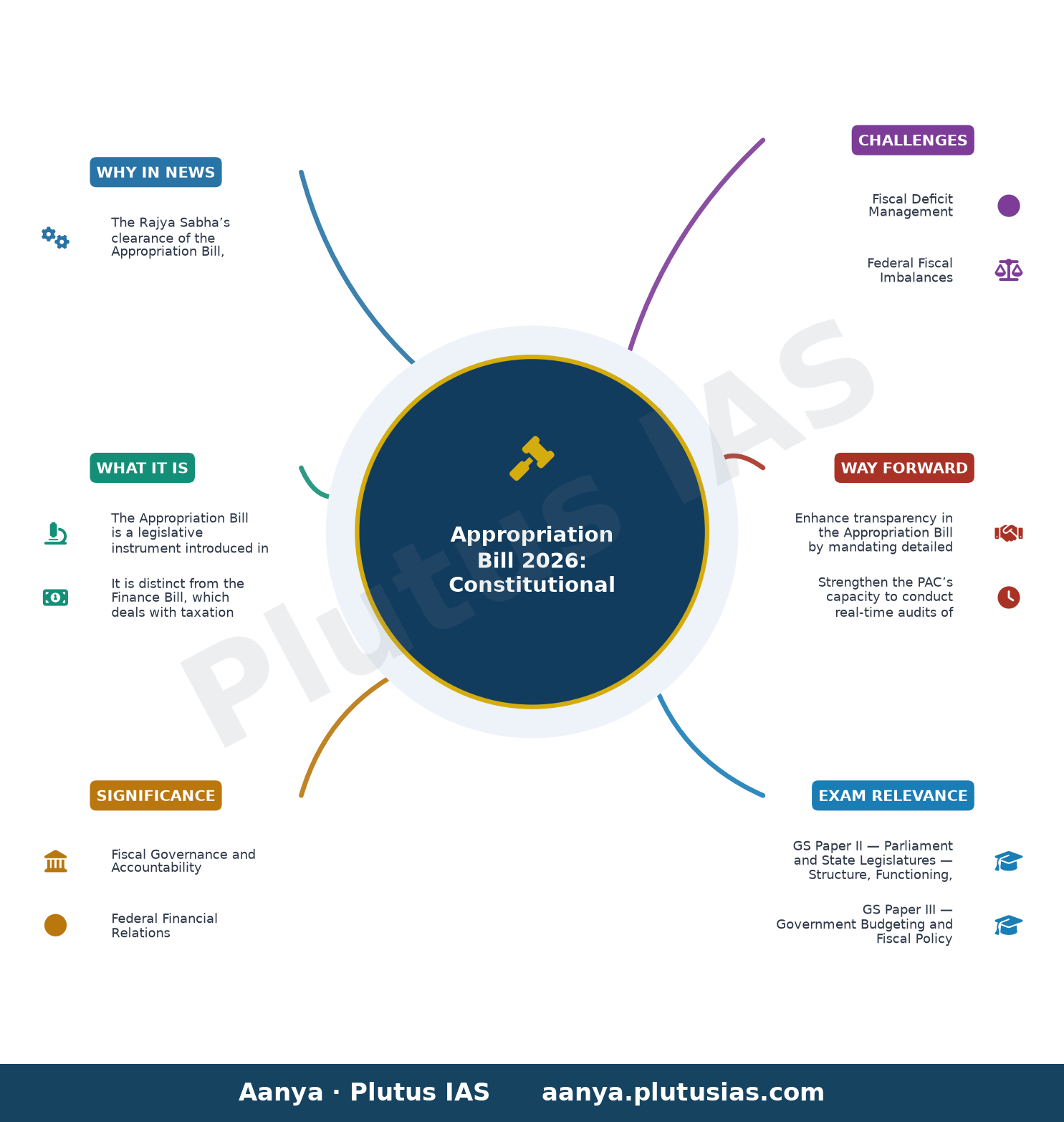
- GS Paper II — Parliament and State Legislatures — Structure, Functioning, Conduct of Business, Powers & Privileges | GS Paper III — Government Budgeting and Fiscal Policy
- Prelims: Appropriation Bill, Public Accounts Committee (PAC), Article 114 of the Constitution, Fiscal Deficit, Excess Grant, Jammu & Kashmir Reorganisation Act 2019, Article 370 abrogation, Debt Restructuring, Union Budget, Parliamentary Proceedings
- Essay: The Role of Parliament in Fiscal Discipline and Democratic Accountability, Federalism and Financial Autonomy: Balancing Centre-State Fiscal Relations
Quick Revision: The Appropriation Bill, mandated by Article 114, authorises government expenditure from the Consolidated Fund of India, including excess grants scrutinised by the Public Accounts Committee, and is a critical instrument for parliamentary fiscal oversight.
Why is this in the news?
The Rajya Sabha’s clearance of the Appropriation Bill, 2026, allowing expenditure of ₹54,067 crore incurred during 2022-23, underscores critical constitutional and fiscal processes in India’s parliamentary democracy. The Bill’s passage amid Opposition protests highlights procedural challenges in fiscal oversight, while the Finance Minister’s remarks on debt repayment and Jammu & Kashmir’s financial management reflect broader themes of federal fiscal policy and post-abrogation administrative restructuring. This development is significant for UPSC aspirants as it intersects constitutional provisions, fiscal federalism, and parliamentary accountability.
Background
- The Appropriation Bill is a constitutional requirement under Article 114 of the Constitution, authorising withdrawal of funds from the Consolidated Fund of India for government expenditure.
- Excess expenditure exceeding the approved budget is permissible under Article 115 but requires parliamentary scrutiny via the Public Accounts Committee (PAC) and subsequent legislative approval.
- The PAC, a parliamentary committee, examines excess grants and reports its findings to Parliament, ensuring fiscal accountability for deviations from budgetary allocations.
- The Union government’s financial commitments to Jammu & Kashmir post-abrogation of Article 370 (2019) include assuming the state’s debt, restructuring liabilities, and providing annual fiscal support for salaries, pensions, and developmental needs.
- Debt repayment of ₹53,871 crore in the excess expenditure reflects India’s sovereign borrowing strategy and fiscal consolidation efforts, particularly in the aftermath of economic disruptions such as the COVID-19 pandemic.
- Parliamentary disruptions during the Monsoon Session 2026 underscore the tension between legislative oversight and political accountability, a recurring theme in fiscal governance debates.
What is the Appropriation Bill, and how does it function within India’s fiscal framework?
- The Appropriation Bill is a legislative instrument introduced in Parliament to authorise withdrawal of funds from the Consolidated Fund of India (CFI) for government expenditure during a financial year, as mandated by Article 114 of the Constitution.
- It is distinct from the Finance Bill, which deals with taxation proposals, and the Demand for Grants, which are sectoral requests for funds by ministries.
- Under Article 115, excess expenditure beyond the approved budget can be incurred if necessitated by unforeseen circumstances, but such amounts require subsequent parliamentary approval via an Appropriation Bill.
- The Public Accounts Committee (PAC) plays a pivotal role in scrutinising excess expenditure, examining causes, and recommending corrective measures to Parliament.
- The PAC’s 39th Report (2026) examined the excess demands, including the ₹53,871 crore debt repayment and ₹196.44 crore Railway-related court order liability, ensuring transparency in fiscal deviations.
- The Bill’s passage in the Rajya Sabha, despite Opposition protests, demonstrates the constitutional mandate of legislative approval for government spending, even in contentious political contexts.
- The Appropriation Bill reinforces the principle of parliamentary control over public finance, a cornerstone of India’s democratic governance and fiscal federalism.
Key Features
| Feature | Significance |
|---|---|
| Appropriation Bill, 2026 | A legislative instrument authorising the Union government to incur expenditure exceeding the original budgetary estimates for the financial year 2022-23, as per Article 114(3) of the Constitution. |
| Excess expenditure of ₹54,067 crore | Represents unanticipated financial obligations, including debt repayment (₹53,871 crore) and court-ordered liabilities (₹196.44 crore), necessitating legislative approval for compliance with fiscal discipline. |
| Public Accounts Committee (PAC) scrutiny | The PAC’s 39th Report (presented April 2026) examined the excess demands, ensuring accountability and transparency in public expenditure. |
| Jammu and Kashmir financial support | The Union government bears the entire salary and pension of J&K Police (₹13,000 crore annually) and has restructured J&K’s debt post-Article 370 abrogation, with additional annual allocations of ₹5,000 crore for 2024-25 and 2025-26. |
| Parliamentary procedures in Rajya Sabha | The Bill’s passage amid Opposition protests and adjournments underscores the procedural and political dynamics in legislative scrutiny of financial matters. |
Why it Matters
Fiscal Governance and Accountability
- The Appropriation Bill exemplifies the constitutional mechanism (Article 114) for authorising excess expenditure, ensuring adherence to parliamentary oversight and fiscal prudence.
- Scrutiny by the PAC reinforces the role of Parliament in examining executive financial decisions, aligning with the principles of the Constitution’s fiscal framework.
- The breakdown of excess expenditure—predominantly debt repayment—highlights the structural challenges in managing fiscal deficits and public debt sustainability.
Federal Financial Relations
- The Union government’s assumption of J&K Police salaries and pensions post-Article 370 abrogation reflects the Centre’s fiscal federalism approach in managing regional financial burdens.
- Debt restructuring for J&K and Ladakh demonstrates the Centre’s interventionist role in stabilising fiscally stressed regions, though it raises questions about long-term fiscal autonomy.
- Additional allocations (₹5,000 crore annually) for J&K underscore the Centre’s commitment to addressing post-abrogation administrative and developmental gaps.
Parliamentary Democracy and Opposition Dynamics
- The Opposition’s walkout and demand for the Home Minister’s presence reflect the political tensions in legislative functioning, particularly on issues of governance and accountability.
- Adjournments during critical financial discussions highlight the procedural challenges in ensuring uninterrupted parliamentary scrutiny of fiscal matters.
- The Finance Minister’s response to Opposition queries on J&K’s financial needs illustrates the executive’s obligation to justify fiscal decisions in the legislature.
Judicial and Executive Interactions
- The excess expenditure of ₹196.44 crore arising from a court order (Ministry of Railways) underscores the judiciary’s role in influencing fiscal commitments of the executive.
- Such judicial interventions necessitate legislative approval for expenditure, demonstrating the interplay between the judiciary and Parliament in fiscal governance.
Challenges
1. Fiscal Deficit Management
- The dominance of debt repayment (₹53,871 crore) in excess expenditure raises concerns about the sustainability of fiscal deficits and the Centre’s debt trajectory.
- High public debt levels may constrain future fiscal space for developmental expenditures, necessitating prudent debt management strategies.
UPSC Link: GS-III: Fiscal Policy and Budgetary Process
2. Federal Fiscal Imbalances
- The Centre’s assumption of J&K’s police salaries and pensions post-Article 370 abrogation places a significant financial burden on the Union exchequer, potentially distorting fiscal federalism.
- Long-term fiscal autonomy for erstwhile J&K remains a challenge, as additional allocations may not address structural revenue gaps.
UPSC Link: GS-II: Centre-State Relations
3. Parliamentary Scrutiny and Political Polarisation
- Ongoing protests and adjournments during financial discussions highlight the erosion of constructive parliamentary debates, impacting fiscal oversight.
- Politicisation of financial bills risks undermining the sanctity of legislative scrutiny and executive accountability.
UPSC Link: GS-II: Parliament and State Legislatures
4. Judicial Overreach in Fiscal Matters
- Court-ordered expenditures (e.g., ₹196.44 crore for Railways) challenge the executive’s fiscal planning and may lead to unplanned liabilities.
- Balancing judicial directives with fiscal discipline remains a critical governance challenge.
UPSC Link: GS-II: Judiciary and Constitutional Framework
5. Transparency in Excess Expenditure
- The PAC’s role in examining excess demands is commendable, but the opacity in the breakdown of ₹54,067 crore demands further granularity for public scrutiny.
- Ensuring detailed disclosures in such bills can enhance trust in fiscal governance.
UPSC Link: GS-III: Public Finance Management
Challenges — UPSC Perspective
| Issue | Concern |
|---|---|
| Dominance of debt repayment in excess expenditure | Risk of unsustainable fiscal deficits and reduced fiscal space for developmental spending. |
| Centre’s assumption of J&K’s police salaries and pensions | Potential distortion in fiscal federalism and long-term financial autonomy for J&K. |
| Political disruptions during financial discussions | Erosion of parliamentary scrutiny and accountability in fiscal governance. |
| Judicial interventions leading to unplanned expenditures | Challenges in balancing judicial directives with fiscal discipline and executive planning. |
| Lack of granularity in excess expenditure breakdown | Reduced transparency and public trust in fiscal decision-making. |
Way Forward
- Enhance transparency in the Appropriation Bill by mandating detailed disclosures of excess expenditure heads, including judicial liabilities and debt restructuring components.
- Strengthen the PAC’s capacity to conduct real-time audits of excess expenditures, ensuring timely and comprehensive scrutiny.
- Develop a fiscal federalism framework to address the Centre’s financial commitments in post-abrogation J&K, balancing support with long-term fiscal autonomy.
- Institutionalise mechanisms to minimise parliamentary disruptions during critical financial discussions, ensuring uninterrupted legislative scrutiny.
- Formulate a debt management strategy to address the structural challenges posed by high public debt, aligning with the Fiscal Responsibility and Budget Management (FRBM) Act.
- Clarify the criteria for judicial interventions in fiscal matters to ensure alignment with executive fiscal planning and parliamentary oversight.
- Conduct periodic reviews of the Union government’s financial support to J&K and Ladakh to assess the efficacy and sustainability of additional allocations.
UPSC Value Addition
Keywords for Mains Answer-Writing
Appropriation Bill · Parliamentary financial procedures · Public Accounts Committee (PAC) · excess expenditure under Article 115 · debt repayment under Article 292 · Jammu & Kashmir fiscal restructuring · Article 370 abrogation and financial implications · Union Budget and supplementary demands · Parliamentary accountability mechanisms · fiscal federalism and Union-State financial relations
Concept Flow
Excess expenditure arises from unanticipated liabilities (e.g., debt repayment, court orders) → Executive seeks parliamentary approval via Appropriation Bill → PAC scrutinises demands → Parliament debates and clears the Bill → Fiscal governance and federal relations are impacted → Challenges in sustainability, transparency, and parliamentary scrutiny emerge.
Prelims Practice Questions
Q1. Consider the following statements regarding the Appropriation Bill in India:
1. The Appropriation Bill authorises the withdrawal of funds from the Consolidated Fund of India.
2. Excess expenditure under Article 115 of the Constitution requires prior parliamentary approval.
3. The Public Accounts Committee (PAC) examines excess expenditure after it has been incurred.
4. The Appropriation Bill is introduced in the Lok Sabha only.
How many of the above statements are correct?
- Only one
- Only two
- Only three
- All four
Answer: Only three — Statements 1 and 3 are correct. The Appropriation Bill authorises withdrawal from the Consolidated Fund (Article 114), and the PAC examines excess expenditure post-incurrence. Statement 2 is incorrect as excess expenditure under Article 115 requires *post-facto* parliamentary approval via the Appropriation Bill, not prior. Statement 4 is incorrect as the Appropriation Bill is considered by both Houses of Parliament.
Q2. Assertion (A): The Union Finance Minister stated that an excess expenditure of ₹53,871 crore was towards debt repayment.
Reason (R): Debt repayment is a charged expenditure under Article 292 of the Constitution and does not require parliamentary approval.
In the context of the above statements, which of the following is correct?
- Both A and R are true, and R is the correct explanation of A.
- Both A and R are true, but R is not the correct explanation of A.
- A is true but R is false.
- A is false but R is true.
Answer: Both A and R are true, but R is not the correct explanation of A. — Assertion (A) is true: the excess expenditure of ₹53,871 crore was indeed for debt repayment. Reason (R) is also true: debt repayment is a charged expenditure under Article 292 and does not require parliamentary approval, making R the correct explanation of A.
Q3. Match the following pairs related to parliamentary financial procedures:
Column I (Constitutional Provision)
A. Article 114
B. Article 115
C. Article 292
D. Article 116
Column II (Description)
1. Authorises withdrawal from the Consolidated Fund of India
2. Deals with supplementary or excess grants
3. Governs debt repayment by the Union Government
4. Relates to votes on account and votes on credit
Select the correct match:
- A-1, B-2, C-3, D-4
- A-2, B-1, C-4, D-3
- A-3, B-4, C-1, D-2
- A-4, B-3, C-2, D-1
Answer: A-1, B-2, C-3, D-4 — Correct matches: A-1 (Article 114 authorises withdrawal from the Consolidated Fund), B-2 (Article 115 deals with supplementary or excess grants), C-3 (Article 292 governs debt repayment by the Union Government), and D-4 (Article 116 relates to votes on account and votes on credit).
Mains Practice Question
✍ The Appropriation Bill, 2026, authorising expenditure of ₹54,067 crore, exemplifies the parliamentary mechanism for financial accountability in India. Critically examine the constitutional and institutional framework governing excess expenditure and supplementary demands for grants. Also, analyse the implications of such excess expenditure on fiscal federalism and Union-State financial relations. (15 Marks)
Approach: MODEL-ANSWER SKELETON:
1. **Constitutional Framework for Excess Expenditure**:
– Article 115: Supplementary or excess grants. Examine the requirement for parliamentary approval *post-facto* via the Appropriation Bill.
– Article 116: Votes on account, votes on credit, and exceptional grants. Highlight the distinction between charged and voted expenditure.
– Article 292: Debt repayment as a charged expenditure (no parliamentary approval required).
2. **Institutional Mechanisms for Accountability**:
– Role of the Public Accounts Committee (PAC): Post-incurrence examination of excess expenditure (e.g., the 39th Report cited by the Finance Minister).
– Comptroller and Auditor General (CAG): Auditing excess expenditure and submitting reports to Parliament.
– Parliamentary scrutiny: Discussion and debate in both Houses (e.g., the Rajya Sabha’s consideration of the Appropriation Bill).
3. **Case Study of Excess Expenditure (2022-23)**:
– Breakdown of the ₹54,067 crore: ₹196.44 crore (Railways, court order) and ₹53,871 crore (debt repayment).
– Legal basis for court-ordered expenditure: Judicial directives under Article 32/226.
– Debt repayment: Charged expenditure under Article 292; no parliamentary approval required.
4. **Fiscal Federalism and Union-State Financial Relations**:
– Implications of excess expenditure on fiscal discipline: Potential strain on Union finances and State shares.
– Jammu & Kashmir example: Union government’s assumption of salary and pension liabilities (₹13,000 crore annually) post-Article 370 abrogation. Analyse the restructuring of J&K’s debt and additional financial support (₹5,000 crore annually for 2024-25 and 2025-26).
– Balance of power: Centralised fiscal interventions vs. State autonomy in financial management.
5. **Critical Analysis and Way Forward**:
– Strengths: Post-incurrence scrutiny by PAC and CAG enhances accountability.
– Weaknesses: Lack of prior parliamentary approval for charged expenditures (e.g., debt repayment) may reduce fiscal discipline.
– Suggestions: Strengthening pre-emptive parliamentary scrutiny for all excess expenditures, including those arising from judicial orders. Emphasise the need for a balanced approach between fiscal federalism and Union control.
Source: The Hindu
Generated by AanyaAi for educational purpose.

- मध्य प्रदेश: हाईकोर्ट ने बलात्कार मामले में आरोपी को डीएनए सबूत के आधार पर किया दोषमुक्त - September 21, 2026
- MP High Court Acquits Rape Convict Due to Negative DNA Evidence - September 21, 2026
- Odisha Launches Shree Jagannath Darshan Yojana for Senior Citizens Pilgrimage - September 21, 2026

No Comments