


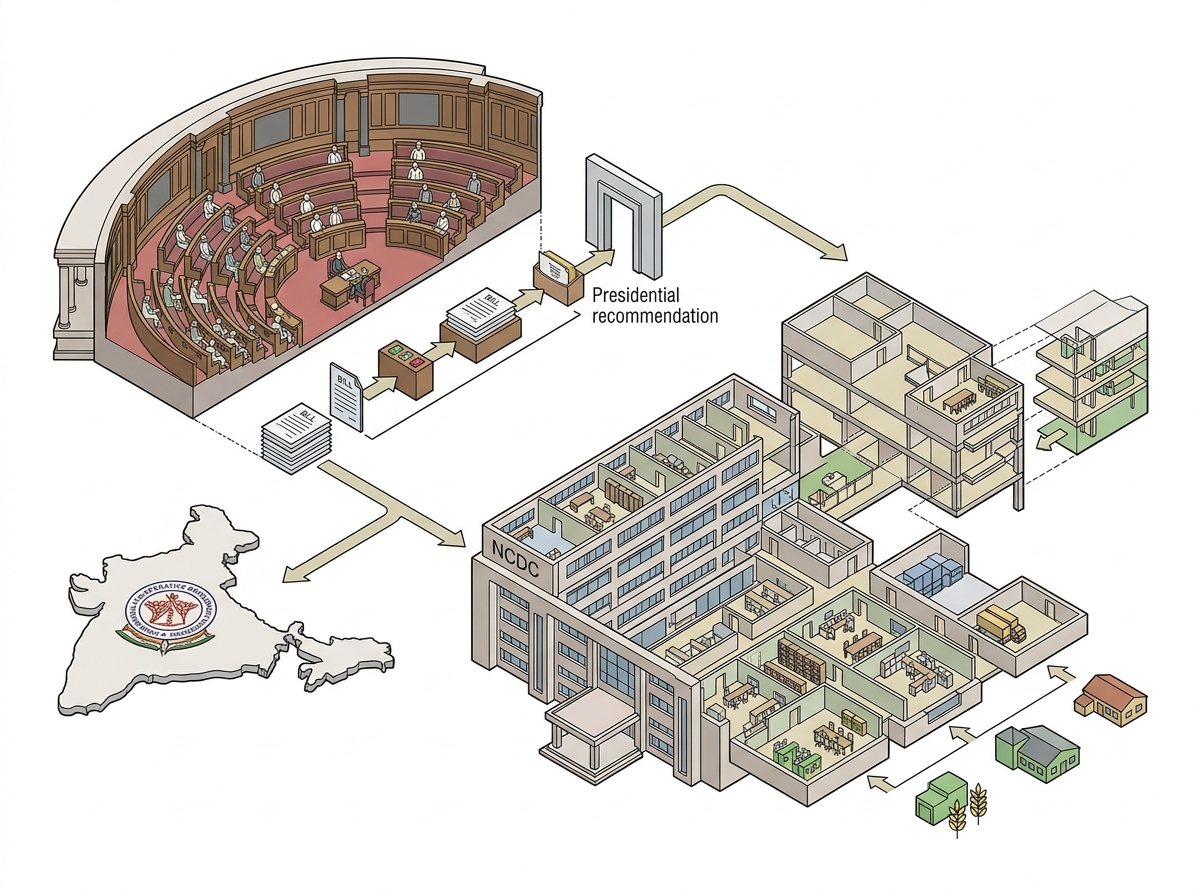
12 Aug Rajya Sabha Passes Bill to Rename Kerala as Keralam: Key UPSC Polity Insights
Rajya SabhaBillsPresidentNCDC✎ The renaming of a State in India requires a State Legislature’s resolution, a parliamentary Bill under Article 3 of the Constitution, and the President’s assent, while the NCDC Amendment Bill, 2026, aims to modernize cooperative…
Subject Relevance — Where This Topic Fits
- GS Paper II — Polity and Governance | GS Paper III — Economic Development
- Prelims: State Reorganisation Act, 1956, Article 3 of the Constitution, National Co-operative Development Corporation (NCDC), Cooperative Societies (Amendment) Bill, Keralam, Veer Savarkar, Malayalam Language Bill
- Essay: The Role of Constitutional Amendments in State Identity and Governance, Cooperative Federalism: Balancing Autonomy and Central Oversight
Quick Revision: The renaming of a State in India requires a State Legislature’s resolution, a parliamentary Bill under Article 3 of the Constitution, and the President’s assent, while the NCDC Amendment Bill, 2026, aims to modernize cooperative sector governance by expanding the NCDC’s mandate.
Why is this in the news?
The Rajya Sabha recently passed two significant Bills: the Kerala (Alteration of Name) Bill, 2026, which proposes to rename the State of Kerala to Keralam, and the National Co-operative Development Corporation (Amendment) Bill, 2026, aimed at expanding the mandate of the NCDC. These developments highlight the constitutional mechanisms for state renaming and the evolving framework for cooperative sector governance in India.
Background
- The Constitution of India, under Article 3, empowers Parliament to alter the name of a State by law, subject to the President’s recommendation and the State Legislature’s prior resolution.
- The State of Kerala, in 2024, passed a resolution urging the Union Government to initiate the process for renaming the State to ‘Keralam’, reflecting linguistic and cultural identity.
- The National Co-operative Development Corporation (NCDC), established in 1963 under the NCDC Act, 1962, serves as the apex statutory body for promoting and developing cooperative societies in India.
- The NCDC Amendment Bill, 2026, seeks to broaden the Corporation’s mandate to include new areas such as digital cooperatives, start-up cooperatives, and multi-state cooperative societies.
- The Monsoon Session of Parliament, 2026, has witnessed the passage of multiple Bills, including those related to cooperative sector reforms and state name changes, underscoring the legislative priorities of the current session.
- The debate surrounding the renaming of Kerala to Keralam also intersects with broader discussions on linguistic identity, cultural pride, and the preservation of historical narratives.
Key Aspects of the Bills and Related Processes
- **Constitutional Framework for State Renaming**: Under Article 3 of the Constitution, Parliament may, by law, alter the name of a State. The process requires the State Legislature to pass a resolution requesting such alteration, followed by a parliamentary Bill and the President’s assent.
- The Kerala (Alteration of Name) Bill, 2026, proposes to rename the State of Kerala to ‘Keralam’, aligning with the State Assembly’s resolution of 2024. The renaming reflects the State’s linguistic and cultural identity, as ‘Keralam’ is the Malayalam name for the State.
- The National Co-operative Development Corporation (Amendment) Bill, 2026, seeks to amend the NCDC Act, 1962, to expand the Corporation’s scope. Key amendments include provisions for digital cooperatives, start-up cooperatives, and multi-state cooperative societies, thereby modernizing the cooperative sector.
- The NCDC, established in 1963, functions under the Ministry of Cooperation, Government of India. It provides financial and technical assistance to cooperative societies to promote their growth and sustainability.
- The debate on the Bills also highlighted the role of cooperative societies in India’s economic development, particularly in sectors such as agriculture, dairy, and rural credit.
- The passage of these Bills underscores the importance of cooperative federalism, where the Centre and States collaborate to address governance challenges while respecting State autonomy.
- The renaming of Kerala to Keralam also reflects broader trends in India where States are revisiting their names to align with linguistic and cultural identities, such as the renaming of Orissa to Odisha in 2011.
Key Features
| Feature | Significance |
|---|---|
| Kerala (Alteration of Name) Bill, 2026 | Formalises the renaming of the State from ‘Kerala’ to ‘Keralam’ as per the Kerala Assembly’s 2024 resolution, reflecting linguistic and cultural identity. |
| Process of State Renaming | Demonstrates the constitutional mechanism for altering a State’s name, involving State Assembly resolution and Parliamentary approval under Article 3 of the Constitution. |
| National Co-operative Development Corporation (Amendment) Bill, 2026 | Expands the mandate of NCDC to enhance the cooperative sector’s role in economic development, aligning with constitutional provisions for cooperative societies (Article 43B). |
| Parliamentary Procedure | Highlights the legislative process in Rajya Sabha, including debates, amendments, and the role of the Chair in maintaining decorum during discussions. |
| Ministerial Responsiveness | Showcases the Union government’s commitment to addressing State-specific demands and parliamentary queries, ensuring procedural transparency. |
Why it Matters
Constitutional and Legal
- The Bills exemplify the constitutional framework for State renaming under Article 3, which empowers Parliament to alter a State’s name upon a State Assembly resolution.
- The NCDC Amendment Bill reinforces the constitutional directive under Article 43B, which promotes voluntary formation, autonomous functioning, and democratic control of cooperative societies.
- The passage of these Bills underscores the importance of legislative compliance with constitutional provisions in governance.
Administrative and Governance
- The renaming process validates the State’s linguistic and cultural identity, fostering a sense of ownership and pride among citizens.
- Amending the NCDC Act strengthens institutional capacity to support cooperatives, a key pillar of India’s socio-economic framework.
- The Bills reflect the Union government’s responsiveness to State demands, enhancing federal cooperation.
Economic
- The NCDC Amendment Bill is expected to boost the cooperative sector, which plays a significant role in employment generation, rural development, and financial inclusion.
- Enhanced cooperative governance may lead to improved credit access, better market linkages, and sustainable livelihoods for marginalised communities.
Social and Cultural
- The renaming of Kerala to ‘Keralam’ aligns with the State’s linguistic heritage, as ‘Keralam’ is the traditional Malayalam name for the region, reflecting its historical identity.
- The debate on Savarkar highlights the intersection of historical narratives, education, and governance, emphasising the need for balanced historical discourse.
Challenges
1. Constitutional and Procedural Challenges
- Ensuring that State renaming does not violate the federal structure or undermine the unity and integrity of the nation, as mandated by Article 3.
- Balancing the demands for renaming other States (e.g., West Bengal to Paschim Banga) with the need for a uniform and objective process.
- Addressing concerns over the absence of the Home Minister during the debate, which may raise questions about procedural accountability.
UPSC Link: Article 3, Federalism
2. Institutional and Governance Challenges
- Strengthening the NCDC’s capacity to implement the amended provisions effectively, including resource allocation and stakeholder coordination.
- Ensuring that cooperative societies comply with the new mandates while maintaining their autonomy and democratic functioning.
- Addressing potential resistance from vested interests within the cooperative sector to changes in governance structures.
UPSC Link: Article 43B, Cooperative Societies
3. Social and Cultural Challenges
- Managing divergent historical narratives, such as the debate on Savarkar, to avoid polarisation and ensure inclusive governance.
- Ensuring that linguistic and cultural identity reforms do not marginalise minority communities or dilute national unity.
UPSC Link: Article 29, Cultural and Educational Rights
4. Parliamentary and Procedural Challenges
- Maintaining decorum and focus during parliamentary debates, especially in contentious matters like State renaming and historical narratives.
- Ensuring that Opposition voices are heard while preventing disruptions that may hinder legislative progress.
UPSC Link: Rules of Procedure, Rajya Sabha
Challenges — UPSC Perspective
| Issue | Concern |
|---|---|
| Federalism and Unity | Ensuring State renaming does not undermine national integration or violate constitutional provisions. |
| Procedural Delays | Potential delays in the renaming process due to parliamentary procedures, State Assembly resolutions, or inter-state consultations. |
| Institutional Capacity | Limited resources or expertise within NCDC to implement the amended provisions effectively. |
| Historical Narratives | Balancing diverse historical interpretations to avoid social polarisation or governance conflicts. |
| Parliamentary Decorum | Maintaining orderly debates and preventing disruptions that may stall legislative progress. |
| Stakeholder Resistance | Potential opposition from cooperative societies or other vested interests to changes in governance structures. |
Way Forward
- Constitute a high-level committee under the Ministry of Home Affairs to oversee the implementation of the Kerala (Alteration of Name) Bill, ensuring seamless transition in official records, education materials, and public communications.
- Strengthen the NCDC’s institutional capacity by enhancing funding, training, and digital infrastructure to support the amended mandate.
- Develop a standardised framework for evaluating State renaming proposals, ensuring objectivity, transparency, and compliance with constitutional provisions.
- Promote inter-state consultations to address demands for renaming other States, fostering consensus and avoiding ad-hoc decisions.
- Launch public awareness campaigns to educate citizens on the significance of the renaming and the cooperative sector reforms, ensuring broad-based support.
- Establish a grievance redressal mechanism within NCDC to address concerns from cooperative societies and stakeholders regarding the amended provisions.
- Encourage research and documentation of linguistic and cultural histories to inform balanced historical narratives and avoid polarisation.
- Review and update parliamentary procedures to enhance decorum and efficiency in debates, particularly on contentious issues.
UPSC Value Addition
Keywords for Mains Answer-Writing
State name change procedure under Article 3 of the Constitution · National Co-operative Development Corporation (Amendment) Bill, 2026 · Constitutional provisions for altering State boundaries or names · Cooperative sector reforms and NCDC mandate expansion · Parliamentary process for State name alteration Bills · Federalism and State identity in India · Constitutional amendments and their parliamentary stages · Cooperative societies and economic governance · Malayalam language and cultural identity · Union-State relations in legislative matters
Constitutional & Policy Linkages
- Article 3: Alteration of name, area or boundary of a State
- Article 29: Protection of interests of minorities
- Article 43B: Promotion of cooperative societies
Concept Flow
Kerala Assembly passes resolution in 2024 urging State renaming → Union government introduces Kerala (Alteration of Name) Bill, 2026 in Parliament → Rajya Sabha debates and passes the Bill → Lok Sabha approves the Bill → President gives assent → State officially renamed to ‘Keralam’ → Official records, education materials, and public communications updated. → NCDC Amendment Bill introduced in Parliament → Rajya Sabha debates and passes the Bill → Lok Sabha approves the Bill → President gives assent → NCDC mandate expanded to include new provisions → NCDC strengthens institutional capacity and implements reforms → Cooperative sector benefits from enhanced support and governance. → Parliamentary debate on State renaming and historical narratives → Opposition raises procedural concerns (e.g., absence of Home Minister) → Chair ensures decorum and expunges remarks if necessary → Bills passed with or without amendments → Governance process continues with renewed focus on transparency and accountability. → Public demand for State renaming (e.g., West Bengal to Paschim Banga) → Union government considers the proposal in consultation with concerned State → Parliamentary debate and potential legislative action → Decision based on constitutional and procedural merits.
Prelims Practice Questions
Q1. Consider the following statements regarding the procedure for altering the name of a State in India:
1. The proposal must originate in the State Legislative Assembly.
2. The Union Parliament must pass a law to give effect to the change.
3. The consent of the President of India is mandatory before introducing the Bill in Parliament.
4. The Bill must be referred to the Supreme Court for judicial review before enactment.
How many of the above statements are correct?
- Only one
- Only two
- Only three
- All four
Answer: Only three — Statements 1, 2, and 3 are correct. The proposal for altering a State’s name must originate from the State Legislative Assembly (Statement 1). The Union Parliament must pass a law to effect the change (Statement 2). The President’s assent is mandatory before the Bill is presented to Parliament (Statement 3). Statement 4 is incorrect as judicial review is not a mandatory step in the process.
Q2. Assertion (A): The National Co-operative Development Corporation (NCDC) is a statutory body established under the National Co-operative Development Corporation Act, 1962.
Reason (R): The NCDC is mandated to promote and develop cooperative societies in India by providing financial assistance and support.
In the context of the above two statements, which one of the following is correct?
- Both A and R are true, and R is the correct explanation of A.
- Both A and R are true, but R is not the correct explanation of A.
- A is true, but R is false.
- A is false, but R is true.
Answer: Both A and R are true, but R is not the correct explanation of A. — The NCDC is indeed a statutory body established under the NCDC Act, 1962 (A is true). Its mandate includes promoting and developing cooperative societies through financial and other support (R is true). The Reason (R) correctly explains the Assertion (A) as it elaborates on the role and functions of the NCDC.
Q3. Match the following provisions with their respective constitutional articles or legislative acts:
Column I
A. Alteration of State names
B. Financial powers of the Union
C. Cooperative societies
D. Fundamental Duties
Column II
1. Article 3
2. Article 110
3. Article 43
4. Article 51A
Select the correct match:
- A-1, B-2, C-3, D-4; A-2, B-1, C-4, D-3; A-3, B-4, C-1, D-2; A-4, B-3, C-2, D-1
- answer_strategy_guide_for_student_but_not_part_of_json_answer_key_itself_keep_this_line_out_of_final_json
- answer_strategy_guide_for_student_but_not_part_of_json_answer_key_itself_keep_this_line_out_of_final_json
Answer: ? — A. Alteration of State names is governed by Article 3 of the Constitution. B. Financial powers of the Union are outlined in Article 110, which defines Money Bills. C. Cooperative societies are covered under Article 43, which directs the State to promote cottage industries and cooperatives. D. Fundamental Duties are listed in Article 51A.
Mains Practice Question
✍ The Parliament has passed the Kerala (Alteration of Name) Bill, 2026, to rename the State of Kerala as ‘Keralam’. In this context, critically examine the constitutional provisions governing the alteration of a State’s name and the parliamentary process involved. Also, analyse the implications of such name changes for federalism and State identity in India. (15 Marks)
Approach: MODEL-ANSWER SKELETON:
1. **Constitutional Provisions for Alteration of State Names (4 Marks)**
– Article 3 of the Constitution empowers Parliament to form new States, alter areas, boundaries, or names of existing States.
– The process requires:
a) A proposal originating in the State Legislative Assembly (e.g., Kerala Assembly resolution in 2024).
b) Introduction of a Bill in Parliament, which must be passed by both Houses.
c) Assent of the President of India before the Bill becomes law.
– Reference to the Sarkaria Commission (1988) or Punchhi Commission (2010) recommendations on federalism and State identity.
2. **Parliamentary Process and Recent Example (4 Marks)**
– Outline the stages: introduction, debate, voting, and presidential assent.
– Highlight the role of the Union Home Ministry in piloting such Bills (e.g., Minister of State for Home Affairs Nityanand Rai’s statement).
– Mention the Kerala (Alteration of Name) Bill, 2026, passed by both Houses in August 2026.
3. **Implications for Federalism and State Identity (5 Marks)**
– **Federalism**: Name changes reflect the federal structure, where States have autonomy in cultural and linguistic identity (e.g., Tamil Nadu, West Bengal).
– **State Identity**: Names often embody linguistic, cultural, or historical heritage (e.g., ‘Keralam’ aligns with the Malayalam language and cultural roots).
– **Contemporary Debates**: Discuss whether such changes are symbolic or substantive, and their impact on national unity vs. regional identity.
– **Legal Precedents**: Cite examples like the renaming of Orissa to Odisha (2011) or Uttaranchal to Uttarakhand (2007).
4. **Balanced View (2 Marks)**
– Acknowledge arguments for and against such changes:
– For: Reflects cultural pride and linguistic identity.
– Against: Potential administrative confusion or unnecessary expenditure.
– Conclude with a balanced perspective on the necessity and impact of such amendments.
Source: The Hindu
Generated by AanyaAi for educational purpose.

- Gurugram’s groundwater extraction exceeds limit by 212%; HC seeks ban - October 4, 2026
- स्वतंत्रता सेनानी श्यामजी कृष्ण वर्मा की जन्म जयंती पर पीएम का श्रद्धांजलि - October 4, 2026
- KWML’s Feasibility Reports for Water Metro in 18 Cities: UPSC & PCS Insights - October 3, 2026

No Comments