


07 Aug Rajya Sabha Passes ₹54,067 Cr Appropriation Bill 2026: Key Highlights for UPSC
✎ The Appropriation Bill is a constitutional instrument under Article 114 that regularises excess expenditure incurred by the government during a financial year, ensuring parliamentary oversight over fiscal governance.
Subject Relevance — Where This Topic Fits
- GS Paper III — Indian Economy: Public Finance and Fiscal Policy | GS Paper II — Parliament and State Legislatures — Structure, Functioning, Conduct of Business, Powers & Privileges
- Prelims: Appropriation Bill, Public Accounts Committee (PAC), Article 114 of the Constitution, Union Budget, Fiscal Deficit, Debt Repayment, Article 370 abrogation, Jammu & Kashmir Reorganisation Act 2019, Excess Grant, Demands for Grants
- Essay: Fiscal Responsibility and the Role of Parliament in Democratic Accountability, Federalism and Financial Support to Union Territories: Lessons from Jammu & Kashmir
Quick Revision: The Appropriation Bill is a constitutional instrument under Article 114 that regularises excess expenditure incurred by the government during a financial year, ensuring parliamentary oversight over fiscal governance.
Why is this in the news?
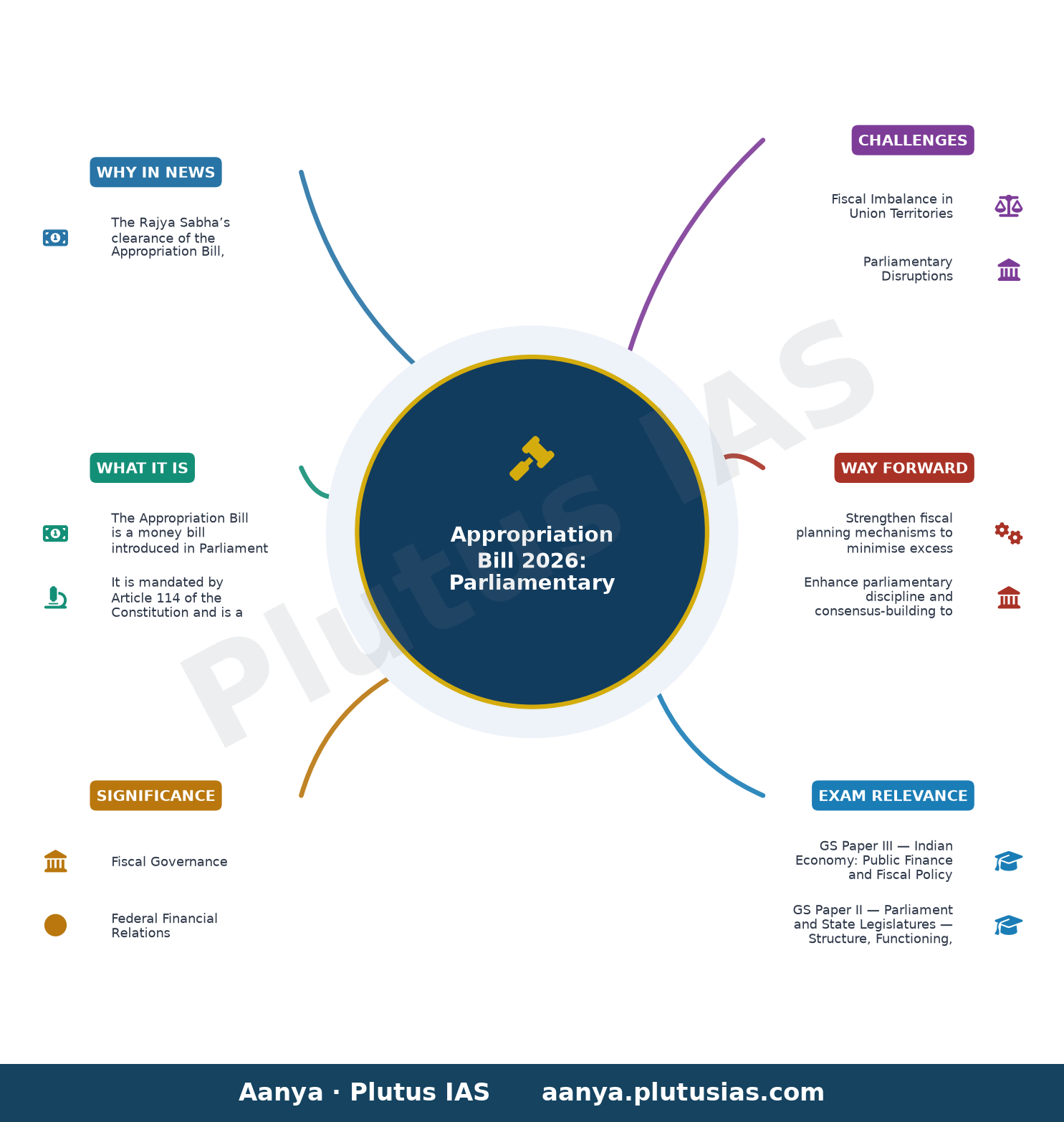
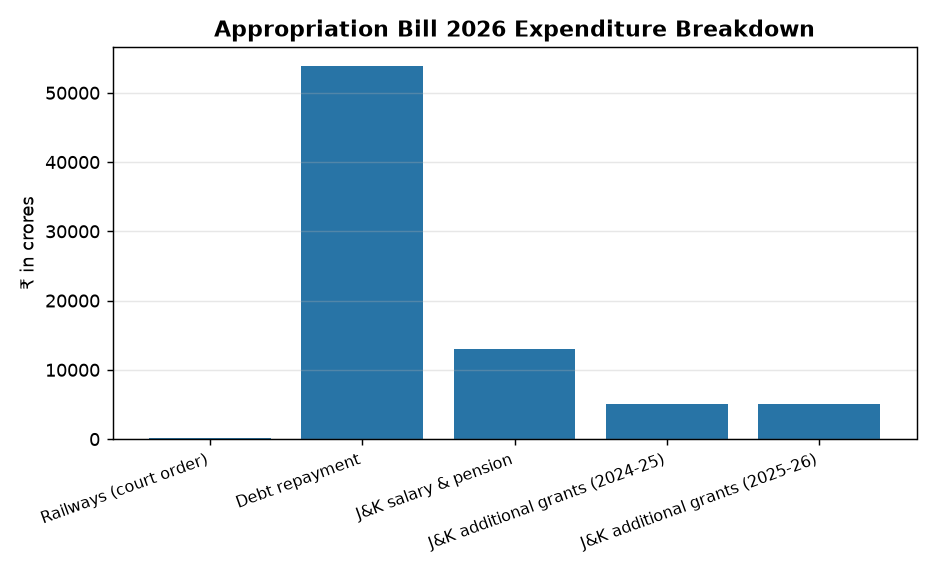
The Rajya Sabha’s clearance of the Appropriation Bill, 2026, authorising ₹54,067 crore in excess expenditure for 2022-23, underscores the procedural role of Parliament in scrutinising fiscal irregularities. The Union Finance Minister’s clarification on the sources of excess demand—including a ₹53,871 crore debt repayment and a ₹196.44 crore railway-related court order—highlights the intersection of judicial orders, fiscal management, and parliamentary oversight. Additionally, the debate on financial assistance to Jammu & Kashmir post-Aricle 370 abrogation reflects ongoing federal fiscal adjustments.
Background
- The Appropriation Bill is a constitutional mechanism under Article 114 of the Constitution, enabling Parliament to authorise expenditure from the Consolidated Fund of India for excess grants incurred during a financial year.
- The Public Accounts Committee (PAC), a parliamentary standing committee, examines excess expenditure and submits reports to Parliament, as seen in its 39th Report presented in April 2026.
- Excess expenditure arises when actual spending exceeds the budgetary allocations approved by Parliament, necessitating post-facto approval through the Appropriation Bill.
- The Union government’s financial support to Jammu & Kashmir post-reorganisation (2019) includes meeting the entire salary and pension burden of the J&K Police (₹13,000 crore annually) and restructuring debt to stabilise the Union Territory’s finances.
- The abrogation of Article 370 in August 2019 led to the reorganisation of Jammu & Kashmir into two Union Territories, altering their fiscal relationship with the Centre.
- Parliamentary debates on fiscal matters often intersect with federalism, judicial interventions, and socio-political demands, as evidenced by Opposition protests in the Rajya Sabha.
What is the Appropriation Bill?
- The Appropriation Bill is a money bill introduced in Parliament to authorise the withdrawal of funds from the Consolidated Fund of India for expenditures incurred during a financial year, which exceeded the originally approved budget.
- It is mandated by Article 114 of the Constitution and is a critical instrument of parliamentary control over executive spending, ensuring fiscal accountability.
- The Bill does not propose new taxes or expenditures; it merely ratifies spending already undertaken by the government.
- Parliamentary scrutiny includes discussions in both Houses, with the Rajya Sabha having limited powers to amend or reject the Bill, as per constitutional provisions.
- The Public Accounts Committee (PAC) plays a pivotal role in examining excess expenditure, identifying irregularities, and recommending corrective measures to Parliament.
- The Appropriation Bill is distinct from the Finance Bill, which deals with taxation proposals, and the Demand for Grants, which seeks Parliament’s approval for planned expenditures.
- Failure to pass the Appropriation Bill can lead to a government shutdown or financial gridlock, as it is essential for the release of funds for ongoing operations.
Key Features
| Feature | Significance |
|---|---|
| Appropriation Bill, 2026 | Legislative instrument authorising excess expenditure incurred during 2022-23, ensuring parliamentary oversight and fiscal accountability. |
| Excess expenditure of ₹54,067 crore | Includes ₹53,871 crore for debt repayment and ₹196.44 crore due to a court order, reflecting fiscal adjustments and legal obligations. |
| Public Accounts Committee (PAC) scrutiny | Excess demands examined by PAC in its 39th Report (April 2026), demonstrating parliamentary financial oversight mechanisms. |
| Jammu & Kashmir financial support | Union government bears entire salary and pension of J&K Police (₹13,000 crore annually) and provides additional ₹5,000 crore for 2024-25 and 2025-26, post-Article 370 abrogation. |
| Debt restructuring of Ladakh | Union government repaid entire debt of Ladakh and restructured J&K’s debt, ensuring financial stability in Union Territories. |
Why it Matters
Fiscal Governance
- Demonstrates adherence to constitutional provisions (Article 114) requiring parliamentary approval for excess expenditure, reinforcing fiscal discipline.
- Highlights the role of PAC in examining excess demands, ensuring transparency and accountability in public finance.
- Excess expenditure of ₹54,067 crore underscores the need for robust financial planning and contingency mechanisms in government spending.
Federal Financial Relations
- Illustrates the Union government’s financial commitments to Union Territories, particularly post-Article 370 abrogation, ensuring equitable resource allocation.
- Showcases the Centre’s role in debt restructuring and financial support for J&K and Ladakh, addressing fiscal imbalances and developmental needs.
- Emphasises the Centre’s assumption of salary and pension liabilities for J&K Police, reducing fiscal burden on the UT administration.
Parliamentary Procedures
- Rajya Sabha’s consideration of the Appropriation Bill amid disruptions reflects procedural challenges in legislative functioning, particularly during Opposition protests.
- The walkout by Opposition members highlights tensions in parliamentary discourse, impacting smooth legislative proceedings.
- The Finance Minister’s response to demands for J&K’s financial assistance underscores the need for bipartisan consensus on fiscal matters.
Challenges
1. Fiscal Imbalance in Union Territories
- Post-Article 370 abrogation, J&K and Ladakh face significant fiscal dependencies on the Union government, straining central resources.
- Debt restructuring and additional financial support (₹5,000 crore annually) may create long-term fiscal liabilities for the Centre.
- Ensuring equitable resource allocation while maintaining fiscal discipline remains a persistent challenge in federal financial relations.
UPSC Link: GS-II: Federalism, Centre-State Relations
2. Parliamentary Disruptions
- Frequent disruptions and walkouts in Parliament impede legislative efficiency, delaying critical financial bills like the Appropriation Bill.
- Opposition demands for the presence of the Home Minister highlight political polarisation, affecting consensus-building on fiscal matters.
- Such disruptions erode public trust in parliamentary institutions and hinder effective governance.
UPSC Link: GS-II: Parliament and State Legislatures
3. Debt Management and Legal Obligations
- Excess expenditure arising from court orders (e.g., ₹196.44 crore for Railways) underscores the need for proactive legal risk management in government contracts.
- Debt repayment obligations (₹53,871 crore) reflect past fiscal mismanagement, necessitating stringent fiscal controls.
- Balancing debt servicing with developmental expenditure remains a critical challenge for fiscal policy.
UPSC Link: GS-III: Indian Economy, Fiscal Policy
Challenges — UPSC Perspective
| Issue | Concern |
|---|---|
| Fiscal Dependence of UTs | Long-term sustainability of Centre’s financial commitments to J&K and Ladakh. |
| Parliamentary Disruptions | Erosion of legislative efficiency and delayed approval of financial bills. |
| Debt Repayment Obligations | Strain on fiscal resources due to past fiscal mismanagement. |
| Legal Risks in Expenditure | Excess expenditure arising from court orders, necessitating risk mitigation. |
| Political Polarisation | Opposition demands and walkouts disrupting consensus on fiscal matters. |
Way Forward
- Strengthen fiscal planning mechanisms to minimise excess expenditure and legal risks in government contracts.
- Enhance parliamentary discipline and consensus-building to reduce disruptions in legislative proceedings.
- Review fiscal commitments to Union Territories post-Article 370 abrogation, ensuring balanced resource allocation.
- Implement robust debt management strategies to reduce fiscal strain from debt repayment obligations.
- Promote transparency in public finance by publishing detailed PAC reports and expenditure audits.
- Encourage bipartisan dialogue on fiscal matters to foster consensus and reduce political polarisation.
- Develop contingency funds for legal and unforeseen expenditure to mitigate fiscal shocks.
UPSC Value Addition
Keywords for Mains Answer-Writing
Appropriation Bill · Parliamentary financial procedures · Public Accounts Committee (PAC) · excess expenditure · Article 114 of the Constitution · Comptroller and Auditor General (CAG) · Union Budget · Jammu and Kashmir financial assistance · Article 370 abrogation · debt restructuring · Rajya Sabha legislative process · fiscal federalism
Constitutional & Policy Linkages
- [‘Article 114: Excess expenditure approval by Parliament.’]
- [‘Seventh Schedule: Distribution of financial powers between Centre and States/UTs.’]
Concept Flow
Excess expenditure incurred during 2022-23 → Parliamentary approval via Appropriation Bill → PAC scrutiny for accountability → Legal obligations (court orders) and debt repayment → Financial support to J&K and Ladakh post-Article 370 abrogation → Fiscal imbalances and political tensions → Challenges in federal financial relations and parliamentary procedures.
Prelims Practice Questions
Q1. Consider the following statements regarding the Appropriation Bill in the Indian Parliamentary system:
1. The Appropriation Bill is introduced in the Lok Sabha only.
2. The Bill authorises withdrawal of funds from the Consolidated Fund of India.
3. The Rajya Sabha can amend the Appropriation Bill.
4. The Appropriation Bill is governed by Article 114 of the Constitution of India.
How many of the above statements are correct?
- Only one
- Only two
- Only three
- All
Answer: Only three — Statements 1, 2, and 4 are correct. The Appropriation Bill is introduced in the Lok Sabha, authorises withdrawal from the Consolidated Fund of India, and is governed by Article 114. Statement 3 is incorrect as the Rajya Sabha can only discuss and not amend the Bill.
Q2. Assertion (A): The Public Accounts Committee (PAC) examines excess expenditure incurred by the government.
Reason (R): The PAC is a parliamentary committee that scrutinises the audit reports of the Comptroller and Auditor General (CAG) of India.
- Both A and R are true, and R is the correct explanation of A
- Both A and R are true, but R is not the correct explanation of A
- A is true, but R is false
- A is false, but R is true
Answer: Both A and R are true, and R is the correct explanation of A — Both Assertion (A) and Reason (R) are true, and R correctly explains A. The PAC examines excess expenditure as part of its role in scrutinising the CAG’s audit reports.
Q3. Which of the following best describes the primary purpose of the Appropriation Bill?
- To levy new taxes
- To authorise withdrawal of funds from the Consolidated Fund of India
- To amend the Constitution
- To approve the annual financial statement
Answer: To authorise withdrawal of funds from the Consolidated Fund of India — The primary purpose of the Appropriation Bill is to authorise the withdrawal of funds from the Consolidated Fund of India for the expenditure incurred by the government during a financial year.
Mains Practice Question
✍ The Appropriation Bill, 2026, authorising expenditure of ₹54,067 crore, reflects the constitutional framework governing parliamentary financial procedures. Critically examine the significance of the Appropriation Bill in India’s parliamentary democracy, with reference to the role of the Public Accounts Committee (PAC) and the Comptroller and Auditor General (CAG). Also, analyse the implications of excess expenditure for fiscal discipline and accountability in governance. (15 Marks)
Approach: MODEL-ANSWER SKELETON:
1. **Constitutional Basis**: Define the Appropriation Bill under Article 114 of the Constitution; its introduction in the Lok Sabha and passage through Parliament.
2. **Role of PAC and CAG**: Explain the PAC’s function in examining excess expenditure (e.g., ₹53,871 crore for debt repayment and ₹196.44 crore under a court order) and the CAG’s audit role in ensuring fiscal accountability.
3. **Excess Expenditure Analysis**: Discuss the causes (e.g., court orders, debt repayment) and its implications for fiscal discipline, citing the Finance Minister’s statement on the PAC’s 39th Report.
4. **Fiscal Discipline and Accountability**: Highlight the balance between legislative oversight and executive flexibility, referencing the PAC’s reports and the CAG’s constitutional mandate (Article 149).
5. **Contemporary Context**: Link to the Jammu and Kashmir financial assistance (₹13,000 crore annually) and debt restructuring post-Article 370 abrogation, illustrating fiscal federalism and Centre-state financial relations.
6. **Conclusion**: Summarise the Appropriation Bill’s role in maintaining parliamentary democracy, fiscal discipline, and accountability, while acknowledging challenges in excess expenditure management.
Source: The Hindu
Generated by AanyaAi for educational purpose.

- सुपर एल नीनो से भारत में 15,800 अतिरिक्त गर्मी से मौतें: जानिए पूरा मामला - September 23, 2026
- Super El Niño to Cause 15,800 Heat Deaths in India: UPSC Key Analysis - September 23, 2026
- यूपीएससी/पीसीएस के लिए दूरसंचार विनिर्माण में निवेश: ग्वालियर टीएमजेड के अवसर - September 23, 2026

No Comments