


23 Sep Super El Niño to Cause 15,800 Heat Deaths in India: UPSC Key Analysis
✎ Super El Niño disrupts the Indian monsoon, elevates temperatures, and increases the risk of heat-related mortality, particularly in vulnerable populations, necessitating proactive climate adaptation and public health measures.
Subject Relevance — Where This Topic Fits
- GS Paper I — Geography (Climate and Weather Systems) | GS Paper III — Environment, Ecology, Biodiversity and Climate Change | GS Paper III — Disaster Management
- Prelims: Super El Niño, Heatwave, Excess Heat Deaths, Climate Impact Lab, European Centre for Medium-Range Weather Forecasts, Sahel Region, Monsoon Variability, Adaptive Capacity, Vulnerability Assessment
- Essay: Climate Change and Public Health: A Global Imperative, Sustainable Development and Disaster Risk Reduction: Balancing Growth and Resilience
Quick Revision: Super El Niño disrupts the Indian monsoon, elevates temperatures, and increases the risk of heat-related mortality, particularly in vulnerable populations, necessitating proactive climate adaptation and public health measures.
Why is this in the news?
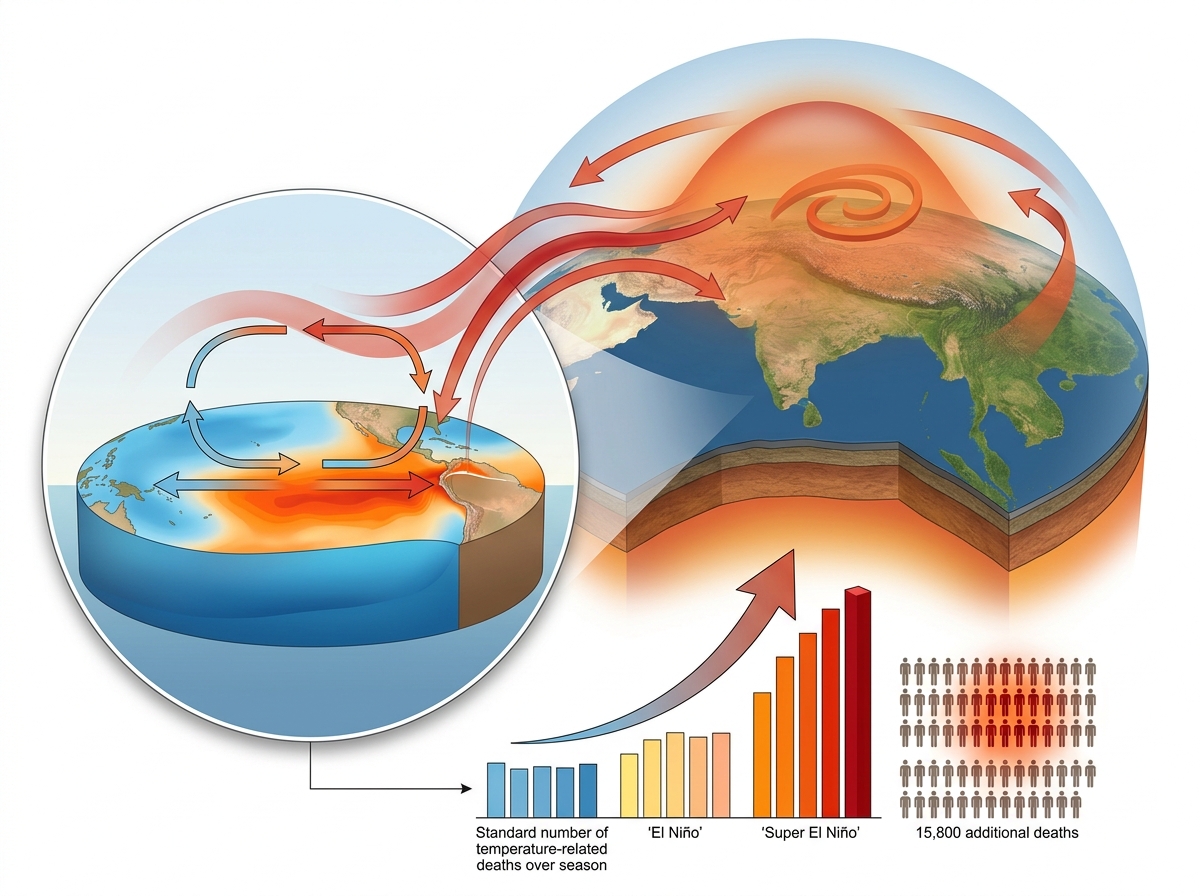
The report by the University of Chicago’s Climate Impact Lab projects approximately 15,800 additional heat-related deaths in India between September 2026 and February 2027 due to the Super El Niño phenomenon, highlighting the severe public health risks posed by extreme weather events linked to climate variability. This projection underscores the urgent need for integrated climate adaptation and public health strategies to mitigate the impacts of rising temperatures on vulnerable populations.
Background
- El Niño is a periodic warming of sea surface temperatures in the equatorial Pacific Ocean that disrupts global weather patterns, including the Indian monsoon, leading to reduced rainfall and elevated temperatures.
- Super El Niño refers to an exceptionally strong El Niño event, characterised by significantly higher sea surface temperature anomalies and more pronounced climatic impacts globally.
- The Indian subcontinent is particularly vulnerable to heat-related mortality due to high population density, socio-economic disparities, and limited adaptive capacity in many regions.
- Climate change has intensified the frequency and intensity of extreme weather events, including heatwaves, exacerbating public health risks.
- The European Centre for Medium-Range Weather Forecasts (ECMWF) provides seasonal climate forecasts that are critical for anticipating weather-related risks, including heatwaves.
- The Climate Impact Lab’s methodology integrates local climate data, vulnerability assessments, and temperature-mortality relationships to project excess deaths during extreme weather events.
What is Super El Niño and its Impact on Heat-Related Mortality?
- Super El Niño is an extreme phase of the El Niño-Southern Oscillation (ENSO) cycle, marked by unusually high sea surface temperatures in the central and eastern equatorial Pacific Ocean, which disrupts global atmospheric circulation.
- The phenomenon suppresses the Indian monsoon, reducing rainfall and increasing surface temperatures across the subcontinent, particularly during the post-monsoon and winter months.
- Higher temperatures elevate the risk of heat stress, dehydration, and cardiovascular complications, especially among vulnerable groups such as the elderly, outdoor workers, and those with pre-existing health conditions.
- The Climate Impact Lab’s model estimates excess heat deaths by correlating historical temperature-mortality data with projected temperature anomalies, accounting for regional differences in adaptive capacity and vulnerability.
- The report projects that India will experience 44% more extremely hot days than a normal year, with temperatures 1.2°C above the 1996–2025 average, intensifying heat-related health risks.
- The Sahel region, Southeast Asia, and South Asia are identified as global hotspots for heat-related mortality during Super El Niño events, with Nigeria, Indonesia, and Sudan projected to experience the highest excess death tolls.
- Public health interventions, such as early warning systems, heat action plans, and urban cooling strategies, are critical for reducing mortality during extreme heat events.
Key Features
| Feature | Significance |
|---|---|
| Super El Niño | A climate phenomenon characterized by abnormal warming in the equatorial Pacific Ocean, leading to suppressed Indian monsoon and elevated temperatures across South Asia. |
| Excess Heat Deaths | Projected mortality due to elevated temperatures, calculated using region-specific climate vulnerability and adaptive capacity models. |
| Climate Impact Lab (CIL) | Research initiative at the University of Chicago that quantifies the relationship between temperature anomalies and excess mortality globally. |
| Seasonal Forecasting | Use of European Centre for Medium-Range Weather Forecasts (ECMWF) ensemble models to project temperature anomalies and associated health risks. |
| Regional Disparities | Uneven distribution of heat-related mortality, with Sahelian Africa, South and Southeast Asia identified as high-risk zones due to climatic and demographic factors. |
Why it Matters
Public Health Impact
- Excess mortality from heat stress disproportionately affects vulnerable populations, including the elderly, outdoor workers, and those with pre-existing cardiovascular or respiratory conditions.
- The projected 15,800 additional deaths in India underscore the acute public health challenges posed by climate variability, particularly during the winter months when heat adaptation infrastructure is typically minimal.
- Heat-related mortality serves as a critical indicator of climate-sensitive health risks, highlighting the need for integrated early warning systems and adaptive public health strategies.
Climate Policy and Governance
- The study reinforces the urgency of implementing India’s National Action Plan on Climate Change (NAPCC) and its sub-missions, particularly the National Mission on Sustainable Habitat, to mitigate heat-health risks.
- The findings align with India’s commitments under the Paris Agreement, emphasizing the necessity of enhancing climate resilience in health infrastructure and urban planning.
- The report’s methodology demonstrates the importance of evidence-based policymaking, where climate science directly informs health sector adaptation and disaster risk reduction strategies.
Economic Implications
- Heat-related mortality imposes direct economic costs through lost productivity, healthcare expenditures, and premature mortality, particularly in sectors reliant on outdoor labor.
- The projected increase in extreme heat days (44% above normal) may exacerbate energy demand for cooling, straining power grids and increasing carbon emissions if reliant on fossil fuels.
- Long-term climate adaptation investments, such as heat-resilient urban design and early warning systems, are essential to reduce economic losses associated with heat stress.
International Cooperation
- The study highlights the transboundary nature of climate risks, with El Niño-driven temperature anomalies affecting multiple countries, necessitating collaborative regional and global climate adaptation strategies.
- India’s role in the Climate Vulnerable Forum (CVF) and its engagement in climate negotiations (e.g., COP processes) is critical for addressing shared vulnerabilities and accessing international climate finance.
Urban Planning and Infrastructure
- The report’s focus on December–February mortality in India underscores the inadequacy of current heat mitigation measures in urban areas, where the urban heat island effect amplifies thermal stress.
- Adaptation strategies, such as green roofs, reflective pavements, and expanded public cooling centers, are essential to reduce heat-related health risks in densely populated cities.
Challenges
1. Heat-Health Risk Management
- Limited integration of climate projections into India’s public health surveillance systems, resulting in delayed or inadequate responses to heat-related health emergencies.
- Inadequate infrastructure for heat adaptation in informal settlements and rural areas, where access to cooling spaces and healthcare is constrained.
- Challenges in real-time data collection and dissemination, particularly in remote or marginalized communities, hinder effective early warning and response mechanisms.
UPSC Link: GS3: Disaster Management
2. Climate Data and Modeling Gaps
- Uncertainty in regional climate models, particularly in capturing localized temperature anomalies and their health impacts, complicates policy planning and resource allocation.
- Insufficient granularity in mortality data, with underreporting of heat-related deaths due to diagnostic challenges and lack of standardized reporting frameworks.
UPSC Link: GS3: Science & Technology
3. Urban Heat Island Effect
- Rapid urbanization and land-use changes exacerbate local temperature anomalies, disproportionately affecting low-income populations in high-density urban areas.
- Inadequate urban planning policies that fail to incorporate heat-resilient design principles, such as green spaces, water bodies, and shaded public infrastructure.
UPSC Link: GS2: Urban Development
4. Intersectoral Coordination
- Fragmented governance structures between meteorological agencies, health departments, and local authorities impede cohesive heat-risk management strategies.
- Lack of standardized protocols for heat-health action plans across states, leading to inconsistent preparedness and response measures.
UPSC Link: GS2: Governance
5. Climate Finance and Adaptation
- Insufficient allocation of funds for heat-resilient infrastructure and public health interventions, particularly in states with high vulnerability to temperature extremes.
- Delays in accessing international climate finance due to bureaucratic hurdles and limited capacity for project formulation and implementation.
UPSC Link: GS3: Environment & Climate Change
Challenges — UPSC Perspective
| Issue | Concern |
|---|---|
| Underreporting of Heat Deaths | Lack of standardized diagnostic criteria and reporting mechanisms leads to systematic underestimation of heat-related mortality. |
| Limited Early Warning Systems | Inadequate dissemination of heat alerts and insufficient public awareness hinder timely protective actions. |
| Urban Heat Island Intensification | Unplanned urbanization and reduced green cover amplify local temperature anomalies, particularly in megacities. |
| Healthcare Infrastructure Gaps | Insufficient capacity in primary healthcare systems to manage heat-related illnesses, especially in rural and tribal areas. |
| Policy Implementation Gaps | Delayed or incomplete execution of heat action plans due to weak interdepartmental coordination and resource constraints. |
| Climate Data Uncertainty | Regional climate models struggle to capture localized temperature anomalies, complicating risk assessment and policy design. |
Way Forward
- Strengthen India’s Heat-Health Action Plans by integrating real-time climate data from agencies such as the India Meteorological Department (IMD) and the European Centre for Medium-Range Weather Forecasts (ECMWF).
- Enhance urban planning policies to incorporate heat-resilient design, including green roofs, reflective pavements, and expanded public cooling centers, particularly in high-density urban areas.
- Develop standardized protocols for reporting and diagnosing heat-related illnesses, ensuring accurate data collection for evidence-based policymaking.
- Invest in climate-resilient healthcare infrastructure, focusing on primary care facilities in vulnerable regions to improve response capacity during heat emergencies.
- Promote intersectoral coordination between meteorological agencies, health departments, local governments, and community organizations to ensure cohesive heat-risk management.
- Expand public awareness campaigns on heat safety measures, targeting outdoor workers, the elderly, and low-income communities with tailored communication strategies.
- Leverage international climate finance mechanisms, such as the Green Climate Fund (GCF) and Adaptation Fund, to support heat-resilient infrastructure and public health interventions.
- Conduct localized vulnerability assessments to identify high-risk populations and tailor adaptation strategies to specific regional and demographic contexts.
UPSC Value Addition
Keywords for Mains Answer-Writing
Climate change and health impacts · Extreme heat events · El Niño-Southern Oscillation (ENSO) · Heat-related mortality · Public health emergency · Climate vulnerability · Temperature anomaly · Adaptation and mitigation · Climate Impact Lab · Intergovernmental Panel on Climate Change (IPCC) · Sustainable Development Goals (SDG 3) · Disaster risk reduction
Concept Flow
Super El Niño → Abnormal Pacific Ocean warming → Suppressed Indian Monsoon → Elevated Land Temperatures → Increased Extreme Heat Days → Elevated Temperatures → Heat Stress on Vulnerable Populations → Rise in Heat-Related Morbidity and Mortality → Climate Impact Lab (CIL) Models → Region-Specific Mortality Projections → Integration of Local Vulnerability and Adaptive Capacity → European Centre for Medium-Range Weather Forecasts (ECMWF) Seasonal Forecasts → Temperature Anomaly Predictions → Health Risk Assessments → Excess Heat Deaths → Public Health Crisis → Need for Early Warning Systems and Adaptive Infrastructure → Climate Policy Response → National Action Plan on Climate Change (NAPCC) → Heat-Health Action Plans and Urban Resilience Strategies → Long-Term Adaptation → Climate-Resilient Urban Planning → Reduced Economic and Health Costs of Heat Stress
Prelims Practice Questions
Q1. Consider the following statements regarding the El Niño-Southern Oscillation (ENSO):
1. El Niño refers to the abnormal warming of the equatorial Pacific Ocean.
2. El Niño suppresses the Indian monsoon and leads to higher temperatures in India.
3. El Niño events are primarily driven by volcanic activity.
4. The Southern Oscillation Index is used to measure the intensity of El Niño events.
How many of the above statements are correct?
- Only one
- Only two
- Only three
- All
Answer: Only three — Statements 1, 2, and 4 are correct. Statement 3 is incorrect as ENSO is driven by ocean-atmosphere interactions, not volcanic activity.
Q2. Assertion (A): The projected 15,800 additional heat-related deaths in India due to Super El Niño are attributed to a 1.2°C rise in global land temperatures above normal.
Reason (R): El Niño events are known to cause abnormal warming in the equatorial Pacific Ocean, which disrupts global weather patterns, including the Indian monsoon.
Options:
A. Both A and R are true, and R is the correct explanation of A.
B. Both A and R are true, but R is not the correct explanation of A.
C. A is true, but R is false.
D. A is false, but R is true.
Answer: ? — Both A and R are true, and R correctly explains the mechanism through which El Niño leads to increased heat-related mortality in India.
Q3. Match the following climate phenomena with their associated impacts on India:
Column I (Phenomenon) | Column II (Impact)
1. El Niño | A. Intensified southwest monsoon
2. La Niña | B. Suppression of southwest monsoon
3. Super El Niño | C. Increased frequency of heatwaves
4. Indian Ocean Dipole (IOD) | D. Cooler temperatures in the equatorial Pacific
Options:
A. 1-B, 2-D, 3-C, 4-A
B. 1-C, 2-A, 3-B, 4-D
C. 1-B, 2-A, 3-C, 4-D
D. 1-A, 2-D, 3-B, 4-C
Answer: ? — Correct matches: 1-B (El Niño suppresses the southwest monsoon), 2-D (La Niña is associated with cooler temperatures in the equatorial Pacific), 3-C (Super El Niño increases heatwaves), 4-A (Positive IOD intensifies the southwest monsoon).
Mains Practice Question
✍ Examine the projected public health impacts of Super El Niño-induced extreme heat events in India. Critically analyse the vulnerabilities of the population and the policy measures required to mitigate heat-related mortality. Also, discuss the role of international cooperation in addressing such climate-induced health risks. (15 Marks)
Approach: MODEL-ANSWER SKELETON:
1. **Introduction (2 Marks)**:
– Briefly introduce the El Niño-Southern Oscillation (ENSO) and its impact on global and regional climate patterns.
– Mention the Climate Impact Lab’s projection of 15,800 additional heat-related deaths in India due to Super El Niño (Sep 2026–Feb 2027).
2. **Mechanism of Impact (3 Marks)**:
– Explain how El Niño suppresses the Indian monsoon, leading to prolonged heatwaves and temperature anomalies (1.2°C above normal).
– Discuss the relationship between temperature spikes and excess mortality, citing studies (e.g., Energy Policy Institute’s Climate Impact Lab).
– Highlight the disproportionate impact on vulnerable groups (elderly, outdoor workers, urban poor).
3. **Vulnerabilities in India (4 Marks)**:
– **Demographic Vulnerabilities**: Ageing population, high urban density, and occupational exposure (e.g., construction workers, farmers).
– **Infrastructure Gaps**: Lack of heat-resilient urban planning, inadequate early warning systems, and limited access to cooling spaces.
– **Health System Challenges**: Overburdened public health infrastructure, underreporting of heat-related deaths, and weak inter-sectoral coordination.
– **Climate Change Amplification**: Long-term trends in rising temperatures and extreme weather events (IPCC AR6 findings).
4. **Policy Measures (3 Marks)**:
– **Heat Action Plans (HAPs)**: Role of National Disaster Management Authority (NDMA) guidelines, state-level HAPs (e.g., Ahmedabad’s model).
– **Urban Planning**: Heat-resilient infrastructure (cool roofs, green spaces, water bodies), and revised building bye-laws.
– **Public Health Interventions**: Strengthening primary healthcare, early warning systems, and community awareness campaigns.
– **Legal and Institutional Frameworks**: Integration of heatwave management into the National Action Plan on Climate Change (NAPCC) and SDG 3 (Good Health and Well-being).
5. **International Cooperation (3 Marks)**:
– **Global Frameworks**: Paris Agreement (Article 2.2), Sendai Framework for Disaster Risk Reduction, and WHO’s climate and health action plans.
– **Bilateral/Multilateral Initiatives**: India’s participation in the International Solar Alliance (ISA), BRICS climate cooperation, and South-South cooperation on climate adaptation.
– **Data and Technology Sharing**: Collaboration with global agencies (e.g., WMO, IPCC) for improved climate modelling and early warning systems.
6. **Conclusion (2 Marks)**:
– Reiterate the urgency of multi-dimensional interventions (policy, infrastructure, health, and international cooperation).
– Emphasise the need for proactive adaptation to mitigate future risks, given the projected intensification of climate change.
Source: The Indian Express
Generated by AanyaAi for educational purpose.
Related guides on our sites
- Current affairs for upsc 2026
- How to prepare for GS paper 1 for UPSC CSE mains exam
- Best UPSC coaching for IFOS exam
- Best geography optional coaching

- बिहार सरकार का बड़ा कदम: 25 हजार परिवारों को सौर ऊर्जा सहायता, 534 प्रखंडों में सोलर मार्ट खोले जाएंगे - September 23, 2026
- Bihar Launches Mega Solar Scheme: 25,000 Families to Benefit, 534 Solar Marts - September 23, 2026
- सुपर एल नीनो से भारत में 15,800 अतिरिक्त गर्मी से मौतें: जानिए पूरा मामला - September 23, 2026

No Comments