


06 Aug Rajya Sabha Returns Appropriation Bill 2026 to Lok Sabha: Key UPSC Polity Updates
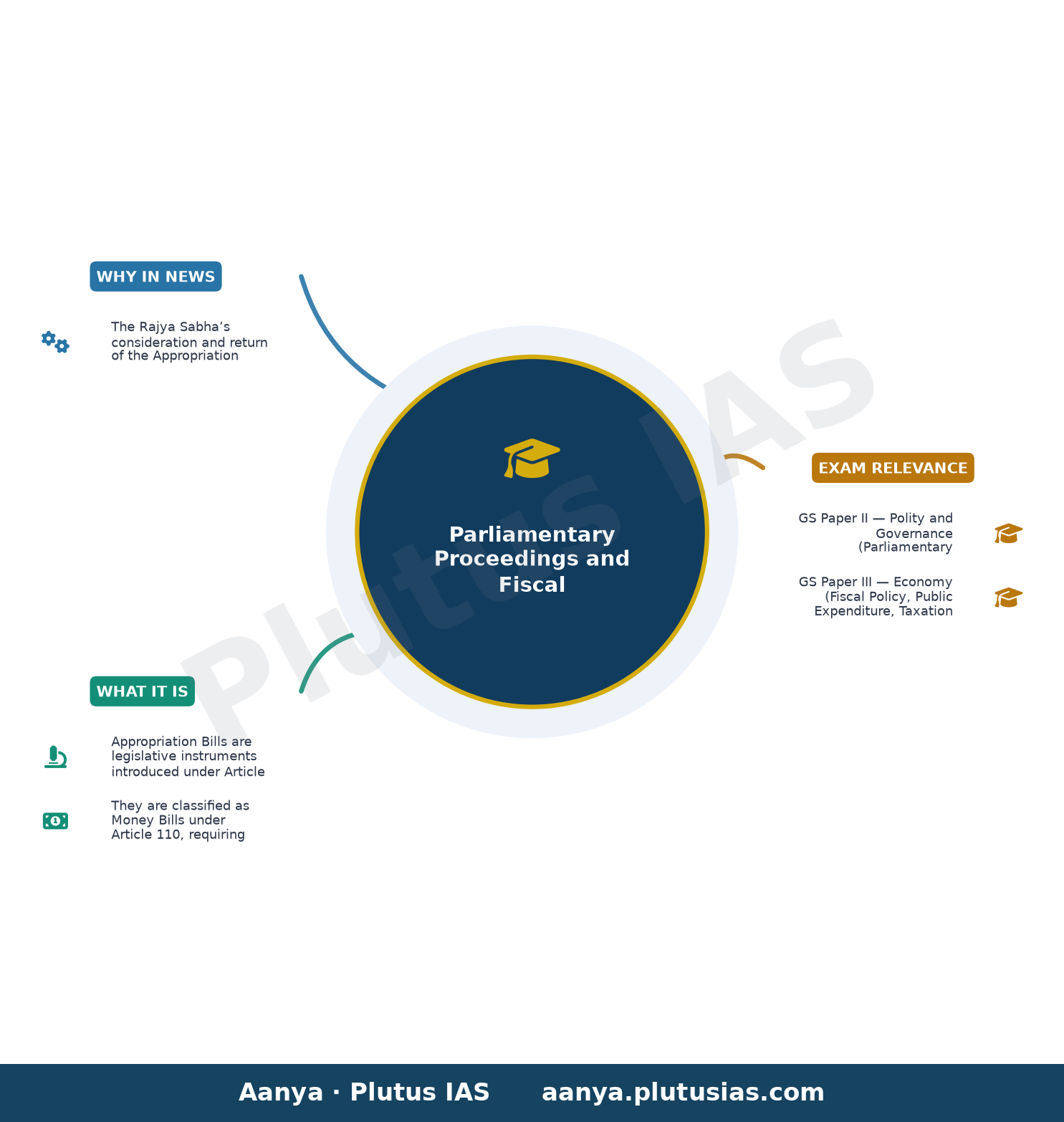
✎ Appropriation Bills are Money Bills under Article 110 of the Constitution, authorising the withdrawal of funds from the Consolidated Fund of India, with the Lok Sabha holding exclusive authority over their passage.
Subject Relevance — Where This Topic Fits
- GS Paper II — Polity and Governance (Parliamentary Procedures, Financial Bills, Appropriation Bills) | GS Paper III — Economy (Fiscal Policy, Public Expenditure, Taxation Amendments)
- Prelims: Appropriation Bill, Consolidated Fund of India, Payment and Settlement Systems Act, 2007, Taxation and Other Laws (Amendment) Bill, 2026, Foreign Contribution (Regulation) Amendment Bill, 2026, Delimitation Bill, Farakka Treaty (1996), Parliamentary Standing Committees
- Essay: The Role of Parliament in Democratic Accountability: A Case Study of Fiscal Governance and Legislative Debates
Quick Revision: Appropriation Bills are Money Bills under Article 110 of the Constitution, authorising the withdrawal of funds from the Consolidated Fund of India, with the Lok Sabha holding exclusive authority over their passage.
Why is this in the news?
The Rajya Sabha’s consideration and return of the Appropriation (No.3) Bill, 2026, to the Lok Sabha on August 6, 2026, underscores the procedural and fiscal governance mechanisms in Parliament. This development, alongside the passage of the Taxation and Other Laws (Amendment) Bill, 2026, and debates on issues such as police action against protestors and the Farakka Treaty, highlights the intersection of legislative scrutiny, fiscal policy, and democratic accountability in India’s parliamentary democracy.
Background
- The Appropriation (No.3) Bill, 2026, is a supplementary demand for grants, authorising the withdrawal of funds from the Consolidated Fund of India for expenditures incurred during the financial year 2022–23 that exceeded the originally sanctioned amounts.
- The Bill follows the constitutional mandate under Article 115 of the Constitution, which empowers Parliament to authorise additional expenditure through supplementary, additional, or excess grants.
- The Taxation and Other Laws (Amendment) Bill, 2026, seeks to amend the Payment and Settlement Systems Act, 2007, the Income-tax Act, 2025, and the Finance Act, 2026, reflecting the government’s efforts to align fiscal and regulatory frameworks with contemporary economic needs.
- Parliamentary debates on the Bill included discussions on police action against protestors on July 20, 2026, with the Leader of Opposition in the Rajya Sabha, Mallikarjun Kharge, demanding a statement from the Home Minister, Amit Shah.
- The session also witnessed adjournments and interruptions, reflecting the broader logjam over legislative priorities such as the proposed delimitation and the Foreign Contribution (Regulation) Amendment Bill, 2026.
- The Farakka Treaty (1996) between India and Bangladesh, set to expire in 2026, was highlighted by a Rajya Sabha member, raising concerns about water-sharing and groundwater depletion in Bihar.
What are Appropriation Bills and their significance in India’s fiscal governance?
- Appropriation Bills are legislative instruments introduced under Article 114 of the Constitution to authorise the withdrawal of funds from the Consolidated Fund of India for government expenditure.
- They are classified as Money Bills under Article 110, requiring the Lok Sabha’s exclusive approval, though the Rajya Sabha may recommend amendments, which the Lok Sabha is not bound to accept.
- The Appropriation (No.3) Bill, 2026, is a supplementary appropriation bill, addressing excess expenditures incurred during the financial year 2022–23 that were not covered by the original budget estimates.
- Supplementary appropriations are necessitated when actual expenditures exceed the sanctioned amounts due to unforeseen circumstances, inflation, or implementation delays.
- The Consolidated Fund of India, as per Article 266, is the primary repository of all government revenues, loans, and repayments, from which all authorised expenditures are drawn.
- The passage of Appropriation Bills is a critical step in the parliamentary approval of government spending, ensuring fiscal discipline and accountability to the legislature.
- The Rajya Sabha’s role in scrutinising these bills, though limited to recommendations, is essential for democratic oversight and debate on public expenditure.
- The Appropriation (No.3) Bill, 2026, reflects the government’s adherence to constitutional fiscal norms while addressing operational exigencies in public expenditure management.
UPSC Value Addition
Keywords for Mains Answer-Writing
Appropriation Bill · Consolidated Fund of India · financial accountability · Parliamentary procedures · Rajya Sabha · Lok Sabha · Taxation and Other Laws (Amendment) Bill, 2026 · Payment and Settlement Systems Act, 2007 · Income-tax Act, 2025 · Finance Act, 2026 · Parliamentary deadlock · Leader of Opposition · Appropriation (No.3) Bill, 2026 · financial oversight · legislative scrutiny
Prelims Practice Questions
Q1. Consider the following statements regarding the Appropriation (No.3) Bill, 2026:
1. The Bill authorises the appropriation of money out of the Consolidated Fund of India to meet expenditures incurred during the financial year ending on 31 March 2023.
2. The Bill is introduced in the Lok Sabha and then sent to the Rajya Sabha for consideration.
3. The Rajya Sabha can amend or reject the Appropriation Bill.
How many of the above statements are correct?
- Only one
- Only two
- All
- None
Answer: Only two — Statement 1 is correct as the Bill authorises appropriation for the financial year ending 31 March 2023. Statement 2 is correct as the Bill originates in the Lok Sabha and is sent to the Rajya Sabha. Statement 3 is incorrect because the Rajya Sabha can only recommend changes but cannot amend or reject the Bill; it must return it to the Lok Sabha.
Q2. Assertion (A): The Taxation and Other Laws (Amendment) Bill, 2026 seeks to amend the Payment and Settlement Systems Act, 2007.
Reason (R): The Bill also seeks to amend the Income-tax Act, 2025 and the Finance Act, 2026.
- Both A and R are true, and R is the correct explanation of A
- Both A and R are true, but R is not the correct explanation of A
- A is true but R is false
- A is false but R is true
Answer: Both A and R are true, but R is not the correct explanation of A — Both the Assertion (A) and Reason (R) are factually correct. The Bill indeed seeks to amend the Payment and Settlement Systems Act, 2007, the Income-tax Act, 2025, and the Finance Act, 2026. However, the Reason (R) does not explain why the Assertion (A) is true; it merely provides additional correct information.
Q3. Match the following Bills with their respective legislative stages as of 6 August 2026:
Column I (Bill) | Column II (Stage)
————————————-
A. Appropriation (No.3) Bill, 2026 | 1. Passed by Lok Sabha; returned by Rajya Sabha
B. Taxation and Other Laws (Amendment) Bill, 2026 | 2. Passed by Lok Sabha
C. SC Judges’ Bill | 3. Passed by Rajya Sabha
D. Foreign Contribution (Regulation) Amendment Bill, 2026 | 4. Under consideration in Lok Sabha
- A-1, B-2, C-3, D-4
- A-2, B-1, C-3, D-4
- A-3, B-2, C-1, D-4
- A-1, B-3, C-2, D-4
Answer: A-1, B-2, C-3, D-4 — A. Appropriation (No.3) Bill, 2026 was passed by the Lok Sabha and returned by the Rajya Sabha. B. Taxation and Other Laws (Amendment) Bill, 2026 was passed by the Lok Sabha. C. SC Judges’ Bill was passed by the Rajya Sabha. D. Foreign Contribution (Regulation) Amendment Bill, 2026 was under consideration in the Lok Sabha.
Mains Practice Question
✍ The Appropriation (No.3) Bill, 2026 exemplifies the constitutional mechanism of legislative financial oversight. Critically examine the significance of such Bills in ensuring executive accountability and fiscal discipline in India’s parliamentary democracy. Also, analyse the role of the Rajya Sabha in this process. (15 Marks)
Approach: MODEL-ANSWER SKELETON:
1. **Constitutional Basis**:
– Article 112-116: Enumerate the provisions governing the Annual Financial Statement (Budget), Appropriation Bills, and supplementary grants.
– Article 109: Distinguish between Money Bills and Financial Bills (I and II). Clarify that Appropriation Bills are Financial Bills (II).
– Article 114: Procedure for passing Appropriation Bills (Lok Sabha dominance; Rajya Sabha’s limited role).
2. **Significance of Appropriation Bills**:
– **Executive Accountability**: Explain how the requirement for parliamentary approval ensures that the executive (Government) cannot spend public money without legislative sanction, thereby preventing arbitrary expenditure.
– **Fiscal Discipline**: Discuss how the process compels the Government to justify its expenditures and adhere to budgetary allocations, reducing fiscal profligacy.
– **Democratic Legitimacy**: Highlight the role of elected representatives in scrutinising public expenditure, ensuring that spending aligns with public interest and constitutional priorities.
3. **Rajya Sabha’s Role**:
– **Constitutional Constraints**: Emphasise that the Rajya Sabha cannot amend or reject an Appropriation Bill but can recommend changes (Article 109(2)).
– **Deliberative Function**: Explain how the Rajya Sabha, through debates and discussions, provides a platform for diverse regional and socio-economic perspectives on fiscal matters.
– **Checks and Balances**: Discuss how the Rajya Sabha acts as a check on the Lok Sabha’s majority-driven decisions, ensuring broader consensus.
4. **Contemporary Relevance**:
– Link to the current session: Discuss how the passage of the Appropriation (No.3) Bill, 2026, despite parliamentary deadlocks, underscores the resilience of India’s financial oversight mechanisms.
– **Parliamentary Deadlocks**: Analyse how disruptions in Parliament (e.g., adjournments, opposition demands) can impact the timely passage of financial Bills and the implications for fiscal governance.
5. **Critique and Challenges**:
– **Executive Dominance**: Discuss how the Government’s majority in the Lok Sabha often leads to the swift passage of financial Bills, potentially diluting scrutiny.
– **Rajya Sabha’s Limitations**: Highlight that the Rajya Sabha’s inability to amend or reject Bills limits its effectiveness as a check on executive power.
– **Data Point**: Cite instances where financial Bills were passed without adequate scrutiny due to disruptions (e.g., 2023 Winter Session).
6. **Conclusion**:
– Summarise the critical balance between executive efficiency and legislative oversight.
– Argue that while the Appropriation Bill process is robust, its effectiveness depends on the quality of parliamentary debates and the willingness of the Government to engage in meaningful scrutiny.
Source: The Hindu
Generated by AanyaAi for educational purpose.

- मध्य प्रदेश: हाईकोर्ट ने बलात्कार मामले में आरोपी को डीएनए सबूत के आधार पर किया दोषमुक्त - September 21, 2026
- MP High Court Acquits Rape Convict Due to Negative DNA Evidence - September 21, 2026
- Odisha Launches Shree Jagannath Darshan Yojana for Senior Citizens Pilgrimage - September 21, 2026

No Comments