


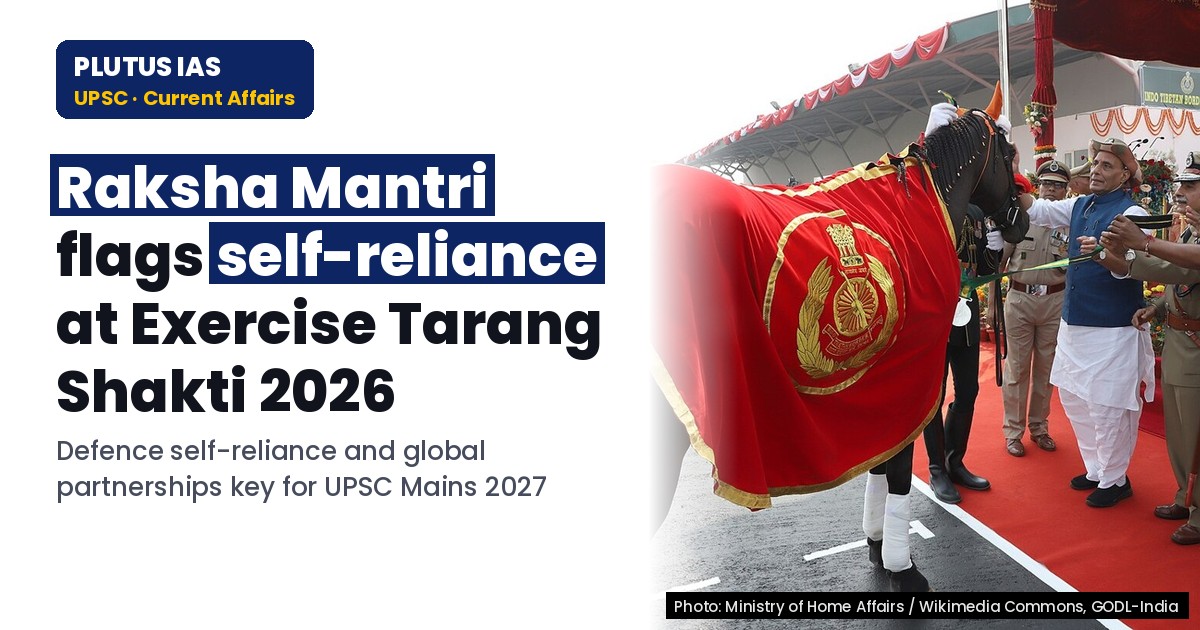
10 Oct Raksha Mantri Highlights Self-Reliance & Global Cooperation at Exercise Tarang Shakti 2026
✎ Exercise Tarang Shakti 2026 is a multilateral military exercise hosted by India to enhance joint operational capabilities, promote indigenous defence technologies, and strengthen strategic partnerships under the Atmanirbhar…
Subject Relevance — Where This Topic Fits
- GS Paper II — International Relations: India’s defence diplomacy, multilateral military exercises, strategic partnerships | GS Paper III — Security: Indigenous defence production, Atmanirbhar Bharat in defence, defence exports
- Prelims: Exercise Tarang Shakti, Raksha Mantri, Jodhpur, Defence Acquisition Council (DAC), Defence Research and Development Organisation (DRDO), Atmanirbhar Bharat in defence, Defence Industrial Corridors, Defence Export Promotion Council
- Essay: India’s journey towards self-reliance in defence: Challenges and opportunities, The role of multilateral military exercises in shaping global strategic partnerships
Quick Revision: Exercise Tarang Shakti 2026 is a multilateral military exercise hosted by India to enhance joint operational capabilities, promote indigenous defence technologies, and strengthen strategic partnerships under the Atmanirbhar Bharat initiative.
Why is this in the news?
This exercise, involving multiple countries, serves as a platform for joint military drills, interoperability, and showcasing India’s defence manufacturing prowess, aligning with the broader national objective of achieving self-reliance in defence production under the Atmanirbhar Bharat initiative.
Background
- Exercise Tarang Shakti is a biennial multilateral military exercise hosted by India, designed to enhance interoperability and cooperation among participating nations in the Indo-Pacific region and beyond.
- India’s defence diplomacy has evolved to prioritise strategic partnerships through joint exercises, capacity-building initiatives, and defence industrial collaboration, reflecting its growing role as a net security provider.
- The exercise is part of India’s broader efforts to promote indigenous defence manufacturing, reduce import dependence, and position itself as a global defence exporter, as outlined in the Defence Production and Export Promotion Policy (DPEPP) 2020.
- Jodhpur, a key airbase in Rajasthan, serves as a strategic location for military exercises due to its proximity to international borders, operational infrastructure, and logistical support.
- India’s participation in and hosting of multilateral exercises is aligned with its Act East Policy and Indo-Pacific Oceans Initiative (IPOI), aimed at fostering regional stability and maritime security.
- The exercise also provides a platform for showcasing India’s defence manufacturing capabilities, including platforms like the Tejas Light Combat Aircraft, Prachand Light Combat Helicopter, and indigenous radars.
What is Exercise Tarang Shakti 2026?
- Exercise Tarang Shakti is a multilateral military exercise hosted by India, scheduled for 2026, involving air forces and other military contingents from multiple countries, primarily in the Indo-Pacific region.
- The exercise aims to enhance joint operational capabilities, interoperability, and mutual trust among participating nations through complex air combat drills, search and rescue operations, and humanitarian assistance missions.
- It serves as a platform for India to demonstrate its indigenous defence technologies, including aircraft, radars, missiles, and electronic warfare systems, thereby promoting defence exports and strategic partnerships.
- The exercise is conducted under the framework of India’s defence diplomacy, which prioritises capacity-building, knowledge-sharing, and collaborative security initiatives with friendly nations.
- Participating countries typically include India’s strategic partners such as France, Australia, Japan, the United States, and other nations from Southeast Asia and the Gulf region, reflecting India’s diversified defence engagements.
- The exercise is structured to include both flying and ground phases, with a focus on real-time operational scenarios, including air-to-air refuelling, precision strikes, and electronic warfare simulations.
- It aligns with India’s broader objectives under the Atmanirbhar Bharat initiative, which seeks to reduce import dependence in defence and promote self-reliance through indigenous research, development, and manufacturing.
- The exercise also underscores India’s commitment to regional security frameworks, such as the ASEAN Defence Ministers’ Meeting Plus (ADMM-Plus) and the Indo-Pacific Maritime Domain Awareness (IPMDA) initiative.
Key Features
| Feature | Significance |
|---|---|
| Exercise Tarang Shakti 2026 | A multi-national air exercise demonstrating India’s strategic defence diplomacy and interoperability with foreign armed forces. |
| Self-Reliance in Defence (Atmanirbhar Bharat) | Emphasises indigenous defence manufacturing, reducing import dependence, and strengthening the domestic defence industrial base. |
| International Cooperation in Defence | Showcases India’s role as a net security provider, fostering strategic partnerships through joint exercises and defence diplomacy. |
| Raksha Mantri’s Address at Jodhpur | Highlights the convergence of India’s defence modernisation, self-reliance, and international engagement under a unified strategic vision. |
| Jodhpur Air Force Station | A key operational hub for the Indian Air Force, symbolising India’s preparedness and logistical capabilities in defence exercises. |
Why it Matters
Strategic Autonomy and Defence Diplomacy
- Exercise Tarang Shakti 2026 reinforces India’s position as a responsible global power, enhancing its strategic autonomy through multi-lateral defence engagements.
- The exercise serves as a platform for India to showcase its indigenous defence capabilities, thereby strengthening its defence diplomacy and strategic partnerships.
- Participation of foreign air forces underscores India’s role in fostering regional and global security architectures, particularly in the Indo-Pacific region.
- India’s engagement in such exercises aligns with its ‘Act East Policy’ and ‘Neighbourhood First Policy’, promoting stability and cooperation in the region.
Indigenous Defence Manufacturing
- The emphasis on self-reliance in defence aligns with the ‘Make in India’ initiative, particularly in the defence sector, to reduce import dependence.
- India’s defence industrial base, including public sector undertakings like HAL, DRDO, and private sector entities, benefits from such exercises by demonstrating indigenous platforms like Tejas, Light Combat Helicopters (LCH), and Advanced Light Helicopters (ALH).
- Self-reliance in defence manufacturing enhances India’s technological sovereignty and reduces vulnerability to geopolitical supply chain disruptions.
- The exercise provides a real-time testing ground for indigenous defence systems, accelerating their operational validation and integration into the armed forces.
Operational Preparedness and Interoperability
- Joint exercises like Tarang Shakti enhance the operational readiness of the Indian Air Force by integrating foreign air forces into complex multi-domain operations.
- Interoperability with allied forces improves India’s ability to participate in international peacekeeping, humanitarian assistance, and disaster relief missions.
- The exercise facilitates the exchange of best practices, tactics, and technologies, thereby enhancing the combat effectiveness of participating forces.
- Real-time scenarios, including air combat, air-to-air refuelling, and electronic warfare, provide critical training for pilots and ground crews.
Geopolitical and Economic Implications
- India’s participation in global defence exercises strengthens its strategic partnerships with like-minded nations, particularly in the Indo-Pacific, countering the influence of extra-regional powers.
- Enhanced defence cooperation can lead to technology transfer agreements, joint ventures, and co-development projects, boosting India’s defence exports.
- The exercise underscores India’s commitment to a rules-based international order, promoting transparency and confidence-building measures in defence engagements.
- Strengthened defence ties can also facilitate foreign direct investment (FDI) in India’s defence manufacturing sector, aligning with the ‘Atmanirbhar Bharat’ vision.
Challenges
1. Technological and Industrial Gaps in Indigenous Defence Manufacturing
- India’s defence industrial base, while advanced in certain segments, still faces gaps in critical technologies such as jet engines, avionics, and advanced materials.
- Dependence on foreign suppliers for key components, such as aircraft engines and radar systems, remains a challenge despite progress in indigenisation.
- The need for continuous R&D investment to bridge the technological divide between India and global leaders like the US, Russia, and China.
- Limited private sector participation in high-technology defence manufacturing due to regulatory and financial constraints.
UPSC Link: GS3: Science and Technology – Defence Manufacturing
2. Human Resource Development and Skill Gaps
- Shortage of skilled manpower in advanced defence technologies, including cyber warfare, artificial intelligence, and unmanned systems.
- The need for specialised training facilities and institutions to develop a cadre of defence technologists and engineers.
- Retention of talent in the defence sector, given competition from the private sector and global opportunities.
- Ensuring a steady pipeline of officers and technicians through robust recruitment and training programmes.
UPSC Link: GS3: Human Resource Development – Defence Sector
3. Logistical and Infrastructure Constraints
- Limited airbase infrastructure in certain regions, which can constrain the scale and frequency of large-scale defence exercises.
- Challenges in integrating diverse military platforms and systems due to varying technical standards and operational doctrines.
- The need for modernised logistics chains, including maintenance, repair, and overhaul (MRO) facilities, to support sustained operational readiness.
- Environmental and land-use regulations that may impede the expansion of defence infrastructure.
UPSC Link: GS3: Infrastructure – Defence Logistics
4. Geopolitical Constraints and Alliances
- Balancing strategic partnerships with multiple global powers while maintaining strategic autonomy in defence engagements.
- Navigating the complexities of defence alliances, such as the Quad, to avoid over-dependence on any single bloc.
- Addressing concerns from neighbouring countries regarding India’s growing defence capabilities and regional influence.
- Ensuring that defence exercises do not inadvertently escalate tensions or trigger arms races in sensitive regions.
UPSC Link: GS2: International Relations – Defence Alliances
5. Policy and Regulatory Bottlenecks
- Complex procurement processes and bureaucratic delays in defence acquisitions, which can hinder timely modernisation.
- Regulatory hurdles in technology transfer agreements and joint ventures with foreign defence firms.
- The need for streamlined policies to encourage private sector participation in defence manufacturing and R&D.
- Ensuring compliance with international arms control regimes while pursuing indigenous defence capabilities.
UPSC Link: GS3: Defence Procurement Policy
Challenges — UPSC Perspective
| Issue | Concern |
|---|---|
| Indigenous Technology Gaps | Dependence on foreign suppliers for critical components like jet engines and avionics. |
| Skill Shortages | Insufficient specialised training facilities and retention of talent in advanced defence technologies. |
| Infrastructure Limitations | Constraints in airbase capacity and logistics chains to support large-scale exercises. |
| Geopolitical Balancing Act | Navigating strategic partnerships without compromising strategic autonomy. |
| Policy Delays | Bureaucratic hurdles in defence procurement and technology transfer agreements. |
| Environmental Regulations | Land-use and environmental constraints impacting defence infrastructure expansion. |
Way Forward
- Establish dedicated centres of excellence for advanced defence technologies, such as jet engines, avionics, and AI-driven systems, in collaboration with premier technical institutions like IITs and IISc.
- Accelerate the implementation of the Defence Production and Export Promotion Policy (DPEPP) 2020 to streamline procurement, encourage private sector participation, and facilitate technology transfer.
- Invest in modernising defence logistics infrastructure, including MRO facilities, airbase expansion, and digital integration of supply chains to enhance operational readiness.
- Strengthen human resource development by expanding specialised training programmes in cyber warfare, unmanned systems, and electronic warfare, in partnership with defence PSUs and private sector entities.
- Enhance defence diplomacy through sustained participation in international exercises, joint R&D projects, and defence exhibitions to showcase indigenous capabilities and foster strategic partnerships.
- Develop a robust policy framework for defence exports, including financial incentives, export promotion councils, and streamlined certification processes to boost India’s defence manufacturing sector globally.
- Promote public-private partnerships (PPPs) in defence R&D and manufacturing to leverage private sector innovation and reduce the burden on public sector undertakings.
- Establish a dedicated fund for defence innovation, modelled on the Defence Innovation Organisation (DIO), to support startups and MSMEs in developing cutting-edge defence technologies.
UPSC Value Addition
Keywords for Mains Answer-Writing
Exercise Tarang Shakti 2026 · Self-reliance in defence (Atmanirbhar Bharat) · International defence cooperation · Defence exports · Defence industrial base · Joint military exercises · Defence diplomacy · Defence manufacturing ecosystem · Make in India in defence · Strategic partnerships in defence · Defence procurement · Defence exports policy · Defence logistics · Indigenous defence technologies · Defence exports to friendly foreign countries
Concept Flow
India’s participation in Exercise Tarang Shakti 2026 → Demonstrates strategic defence diplomacy and interoperability with foreign armed forces → Reinforces India’s role as a net security provider in the Indo-Pacific → Aligns with India’s ‘Act East Policy’ and ‘Neighbourhood First Policy’ → Enhances operational preparedness and combat effectiveness of the Indian Air Force → Showcases indigenous defence capabilities (e.g., Tejas, LCH) → Supports self-reliance in defence manufacturing (Atmanirbhar Bharat) → Strengthens India’s strategic autonomy and global standing → Contributes to regional stability and a rules-based international order.
Prelims Practice Questions
Q1. Consider the following statements regarding ‘Exercise Tarang Shakti 2026’:
1. It is a multilateral air exercise involving friendly foreign countries.
2. The exercise is aimed at enhancing interoperability and joint operational capabilities.
3. The exercise is being conducted under the aegis of the United Nations.
4. The exercise includes participation from India’s defence manufacturing sector.
How many of the above statements are correct?
- Only one
- Only two
- Only three
- All four
Answer: Only three — Statements 1 and 2 are correct as Exercise Tarang Shakti 2026 is a multilateral air exercise to enhance interoperability. Statements 3 and 4 are incorrect as the exercise is not under UN aegis and does not explicitly include defence manufacturing sector participation in its stated objectives.
Q2. Assertion (A): India’s defence exports have witnessed a significant rise in the past decade.
Reason (R): The ‘Atmanirbhar Bharat’ initiative has played a pivotal role in boosting indigenous defence manufacturing and exports.
In the context of the above statements, which of the following is correct?
- Both A and R are true, and R is the correct explanation of A.
- Both A and R are true, but R is not the correct explanation of A.
- A is true, but R is false.
- A is false, but R is true.
Answer: Both A and R are true, but R is not the correct explanation of A. — India’s defence exports have indeed risen significantly in the past decade, and the ‘Atmanirbhar Bharat’ initiative has been a key driver by promoting indigenous defence manufacturing and exports through policy reforms and incentives.
Q3. Match the following initiatives with their respective objectives:
Column I (Initiative) | Column II (Objective)
——————————————|——————————————
1. Make in India in Defence | A. Enhancing indigenous defence manufacturing
2. Defence Procurement Procedure (DPP) 2020 | B. Streamlining defence procurement
3. Srijan Portal | C. Promoting defence exports
4. Defence Exports Strategy | D. Facilitating MSMEs in defence production
Select the correct match:
- 1-A, 2-B, 3-D, 4-C
- 1-B, 2-A, 3-C, 4-D
- 1-C, 2-D, 3-A, 4-B
- 1-D, 2-C, 3-B, 4-A
Answer: 1-A, 2-B, 3-D, 4-C — The correct matches are: 1-A (Make in India in Defence promotes indigenous manufacturing), 2-B (DPP 2020 streamlines procurement), 3-D (Srijan Portal facilitates MSMEs in defence production), and 4-C (Defence Exports Strategy promotes exports).
Mains Practice Question
✍ The Raksha Mantri’s address at Exercise Tarang Shakti 2026 underscores the dual imperatives of ‘self-reliance in defence’ and ‘international cooperation’. Critically examine the significance of these imperatives for India’s defence posture in the contemporary geopolitical landscape. (15 Marks)
Approach: MODEL-ANSWER SKELETON:
1. **Self-reliance in Defence (Atmanirbhar Bharat in Defence)**
– Definition and objectives of Atmanirbhar Bharat in defence: reducing import dependence, enhancing indigenous R&D, and building a robust defence industrial base.
– Key initiatives: Make in India in Defence, Defence Procurement Procedure (DPP) 2020, Srijan Portal, Defence Exports Strategy, and corporatisation of OFBs.
– Progress and challenges: Data on defence exports (e.g., USD 1.5 billion in 2022-23), indigenisation lists (e.g., 411 items under 3rd positive indigenisation list), and constraints like technological gaps and bureaucratic hurdles.
– Constitutional and legal framework: Role of Article 51A (fundamental duties), Article 300A (right to property), and the Defence Production and Export Promotion Policy (DPEPP) 2020.
2. **International Cooperation in Defence**
– Strategic rationale: Enhancing interoperability, joint operational capabilities, and defence diplomacy with friendly foreign countries.
– Multilateral and bilateral engagements: Participation in exercises like Tarang Shakti, Malabar, and Milan; defence agreements (e.g., LEMOA, COMCASA); and joint ventures (e.g., BrahMos with Russia).
– Defence exports and partnerships: Examples of defence exports (e.g., BrahMos to Philippines, Tejas to Malaysia), and collaborations in defence manufacturing (e.g., HAL-Tejas with foreign partners).
– Geopolitical implications: Balancing strategic autonomy with partnerships in the Indo-Pacific and beyond.
3. **Synergy between Self-Reliance and International Cooperation**
– How self-reliance enhances India’s bargaining power in international defence cooperation.
– Case studies: Participation of Indian defence manufacturers in global supply chains (e.g., Tata Advanced Systems Limited in aerospace), and co-development projects (e.g., with Israel, France, and the US).
– Challenges: Ensuring technology transfer without compromising indigenous capabilities, and navigating export controls (e.g., ITAR regulations).
4. **Way Forward**
– Policy recommendations: Strengthening R&D through public-private partnerships, incentivising MSMEs, and simplifying export procedures.
– Institutional reforms: Enhancing the role of DRDO, DPSUs, and private sector in defence innovation.
– Balancing strategic autonomy with global partnerships: Lessons from countries like Israel and South Korea.
**Balance of Views:**
– Proponents of self-reliance argue that it reduces vulnerability to supply chain disruptions and geopolitical pressures.
– Critics highlight the time and cost overruns in indigenous projects (e.g., Tejas, INS Vikrant) and the need for selective import substitution.
**Conclusion:**
– The imperatives of self-reliance and international cooperation are complementary and essential for India’s evolving defence posture. The success of this dual approach will depend on sustained policy implementation, technological innovation, and strategic partnerships.
Source: PIB (Press Information Bureau)
Rajasthan PCS (RPSC / RAS) — State PCS Practice
Prelims: Which of the following statements is NOT correct regarding the recent address by the Raksha Mantri at Exercise Tarang Shakti 2026 in Jodhpur?
- Exercise Tarang Shakti 2026 is a multinational air exercise being conducted in Rajasthan to enhance interoperability among participating nations.
- The Raksha Mantri emphasized the need for self-reliance in defence production as a key pillar of India’s strategic autonomy.
- The event in Jodhpur is the first-ever international air exercise hosted by India, focusing solely on maritime cooperation.
- International cooperation in defence exercises is seen as a means to strengthen strategic partnerships and regional security.
Answer: The event in Jodhpur is the first-ever international air exercise hosted by India, focusing solely on maritime cooperation. — Exercise Tarang Shakti 2026 is a multinational air exercise, but it is not the first-ever international air exercise hosted by India. The event in Jodhpur is part of broader efforts to enhance defence cooperation, including maritime aspects.
Mains: Critically analyse the significance of Exercise Tarang Shakti 2026 for Rajasthan’s defence infrastructure and its potential impact on the state’s economy. How can Rajasthan leverage this exercise to promote self-reliance in defence manufacturing? (Word limit: 250)
Generated by AanyaAi for educational purpose.
Related guides on our sites
- How to prepare for GS paper 1 for UPSC CSE mains exam
- Best UPSC coaching for IFOS exam
- Best mentorship programme for upsc
- UPSC+BA degree


No Comments