


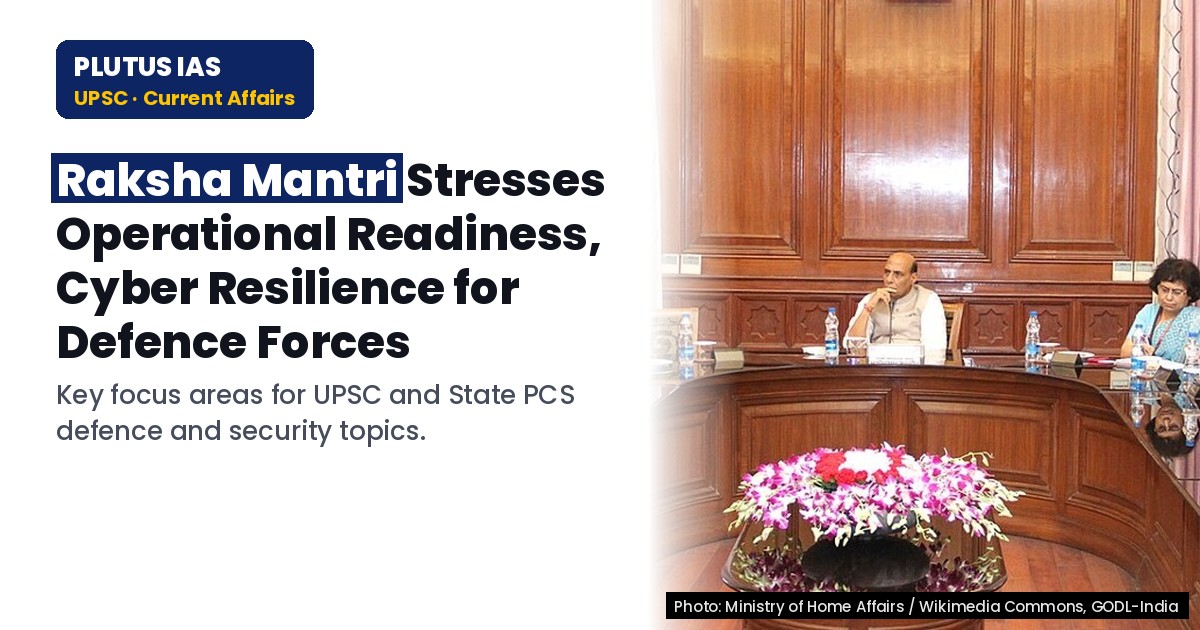
07 Nov Raksha Mantri Stresses Operational Readiness & Cyber Resilience
✎ Operational readiness, underpinned by domain awareness, cyber resilience, and information integrity, is fundamental for the Defence Forces to effectively counter the evolving spectrum of modern security threats.
Subject Relevance — Where This Topic Fits
- GS Paper III — Security Challenges and their Management in Border Areas | GS Paper III — Various Security Forces and Agencies and their Mandate | GS Paper III — Science and Technology- Developments and their Applications and Effects in Everyday Life
- Prelims: Operational Readiness, Domain Awareness, Cyber Resilience, Information Integrity, Emerging Threats, National Security, Indian Air Force, Defence Modernisation
- Essay: The Evolving Nature of Warfare and the Imperative for Comprehensive Defence Preparedness, Technological Advancement as a Double-Edged Sword: Opportunities and Challenges for National Security
Quick Revision: Operational readiness, underpinned by domain awareness, cyber resilience, and information integrity, is fundamental for the Defence Forces to effectively counter the evolving spectrum of modern security threats.
Why is this in the news?
The Raksha Mantri recently emphasised the critical necessity for the Defence Forces to sustain the highest echelons of operational readiness. This directive, articulated during a visit to Air Force Station, Bagdogra, underscored a strategic focus on enhancing domain awareness, bolstering cyber resilience, and ensuring information integrity. These measures are deemed indispensable for effectively countering the multifaceted and evolving threats to national security in the contemporary geopolitical landscape.
Background
- The contemporary security environment is characterised by rapid technological advancements, including artificial intelligence, quantum computing, and advanced cyber capabilities, which present both opportunities and challenges for defence establishments.
- Hybrid warfare, involving a blend of conventional, unconventional, and cyber tactics, has become a prominent feature of modern conflicts, necessitating a comprehensive and adaptive defence posture.
- Geopolitical shifts and regional instabilities contribute to an unpredictable security landscape, requiring constant vigilance and preparedness from defence forces.
- The increasing reliance on digital infrastructure across all sectors, including defence, makes cyber resilience a paramount concern for safeguarding critical systems and data.
- Maintaining information integrity is crucial to counter disinformation campaigns and psychological operations, which can undermine national morale and strategic objectives.
- India’s strategic location and diverse security challenges, encompassing land borders, maritime interests, and airspace, mandate a robust and integrated defence capability.
Key Pillars of Modern Defence Preparedness
- Operational Readiness: This refers to the capacity of military units to execute assigned missions effectively and immediately. It encompasses personnel training, equipment maintenance, logistical support, and strategic planning.
- Domain Awareness: This involves a comprehensive understanding of the operational environment across all domains – land, sea, air, space, and cyber. It requires advanced surveillance, reconnaissance, and intelligence gathering capabilities to detect and analyse potential threats.
- Cyber Resilience: This is the ability of an organisation to anticipate, withstand, recover from, and adapt to adverse conditions, stresses, attacks, or compromises on its cyber resources. It includes robust cybersecurity frameworks, incident response mechanisms, and continuous vulnerability assessments.
- Information Integrity: This pertains to the accuracy, consistency, and reliability of data and information throughout its lifecycle. In a defence context, it is vital for decision-making, countering disinformation, and maintaining the credibility of military communications.
- Emerging Threats: These encompass a wide array of challenges, including advanced conventional weaponry, asymmetric warfare tactics, state-sponsored cyberattacks, disinformation campaigns, and the weaponisation of emerging technologies like AI and drones.
- Defence Modernisation: This involves the continuous upgrade of military equipment, technology, and training to keep pace with evolving threats and maintain a qualitative edge over adversaries. It often includes indigenous defence production and strategic partnerships.
Key Features
| Feature | Significance |
|---|---|
| Operational Readiness | Ensures the Defence Forces are prepared to respond effectively to any security challenge, maintaining national sovereignty and territorial integrity. |
| Domain Awareness | Involves comprehensive understanding of the operational environment across all domains (land, air, sea, space, cyber) to anticipate and mitigate threats. |
| Cyber Resilience | Refers to the ability of defence systems to withstand, recover from, and adapt to cyberattacks, safeguarding critical infrastructure and sensitive data. |
| Information Integrity | Guarantees the accuracy, consistency, and reliability of information, crucial for informed decision-making and countering disinformation campaigns. |
| Emerging Threats | Encompasses a range of evolving challenges including hybrid warfare, advanced technological adversaries, and non-state actors, necessitating adaptive defence strategies. |
Why it Matters
National Security Implications
- Maintaining a high state of operational readiness is paramount for deterring potential adversaries and responding to external aggression, thereby safeguarding national interests.
- Enhanced domain awareness across all operational spheres (air, land, sea, space, cyber) provides a comprehensive understanding of threat landscapes, enabling proactive defence measures.
- Robust cyber resilience is critical for protecting sensitive military networks, command and control systems, and strategic infrastructure from sophisticated cyberattacks, which could cripple defence capabilities.
- Ensuring information integrity is vital in an era of information warfare, where disinformation and propaganda can undermine public trust, influence perceptions, and destabilize national security.
Technological and Strategic Imperatives
- The emphasis on cyber resilience underscores the increasing reliance on digital technologies in modern warfare and the necessity to secure these assets against evolving threats.
- Focus on information integrity reflects the strategic importance of managing and protecting data, which is a critical resource in contemporary military operations and intelligence gathering.
- Addressing emerging threats necessitates continuous technological upgrades, research and development in defence, and adaptation of strategic doctrines to maintain a qualitative edge.
- The directive highlights the need for integrated defence capabilities, where traditional military domains are seamlessly combined with cyber and information warfare strategies.
Governance and Policy Direction
- The statement from the Raksha Mantri provides a clear policy directive for the Defence Forces, guiding their strategic planning, resource allocation, and training priorities.
- It reinforces the government’s commitment to modernizing the armed forces and equipping them to face complex security challenges in the 21st century.
- The focus areas indicate a shift towards a more comprehensive and multi-domain approach to national defence, acknowledging the interconnectedness of various threat vectors.
Challenges
1. Technological Obsolescence
- Rapid advancements in military technology globally necessitate continuous upgrades and procurement, posing significant financial and logistical challenges.
- Maintaining a technological edge against potential adversaries requires substantial investment in research, development, and indigenous manufacturing capabilities.
UPSC Link: Science and Technology – developments and their applications and effects in everyday life; Achievements of Indians in science & technology; Indigenization of technology and developing new technology.
2. Cyber Warfare Capabilities
- Developing and maintaining advanced cyber defence and offensive capabilities requires a highly skilled workforce and state-of-the-art infrastructure.
- The elusive nature of cyber threats and attribution challenges make effective deterrence and response complex.
UPSC Link: Security challenges and their management in border areas; linkages of organized crime with terrorism; Various Security forces and agencies and their mandate.
3. Information Warfare and Disinformation
- Countering sophisticated disinformation campaigns and maintaining information integrity in a hyper-connected world requires robust analytical capabilities and strategic communication.
- The challenge lies in distinguishing factual information from propaganda and ensuring public trust in official narratives.
UPSC Link: Role of media and social networking sites in internal security challenges; basics of cyber security; money-laundering and its prevention.
4. Resource Allocation and Budgetary Constraints
- Balancing the need for modernization, operational readiness, and personnel welfare within finite budgetary allocations is a perpetual challenge for defence planning.
- Prioritizing investments across different domains (air, navy, army, cyber, space) requires strategic foresight and efficient resource management.
UPSC Link: Government policies and interventions for development in various sectors and issues arising out of their design and implementation.
5. Human Resource Development
- Attracting, training, and retaining personnel with specialized skills in emerging domains like cyber warfare, artificial intelligence, and data analytics is crucial.
- Ensuring continuous professional development to keep pace with technological advancements and evolving threat doctrines.
UPSC Link: Issues relating to development and management of Social Sector/Services relating to Health, Education, Human Resources.
Challenges — UPSC Perspective
| Issue | Concern |
|---|---|
| Rapid Technological Evolution | Maintaining parity with global adversaries necessitates continuous investment in advanced defence technologies and infrastructure, often at significant cost. |
| Hybrid Warfare Tactics | The integration of conventional, unconventional, and cyber tactics by adversaries complicates traditional defence strategies, requiring a multi-faceted response. |
| Cyber Threat Landscape | The increasing frequency and sophistication of cyberattacks pose a constant threat to critical defence systems, requiring robust and adaptive cybersecurity measures. |
| Information Manipulation | The proliferation of disinformation and propaganda through digital platforms can undermine national cohesion and strategic communication efforts. |
| Resource Optimization | Allocating finite defence resources effectively across diverse operational requirements and modernization initiatives remains a critical challenge. |
| Skill Gap in Emerging Domains | Developing a workforce proficient in advanced technologies like AI, machine learning, and quantum computing for defence applications is a significant human resource challenge. |
Way Forward
- Prioritize indigenous defence manufacturing and research and development to reduce reliance on foreign imports and foster self-reliance in critical technologies.
- Invest significantly in advanced cybersecurity infrastructure, training, and threat intelligence capabilities to bolster cyber resilience across all defence networks.
- Develop a comprehensive national strategy for information integrity, including robust mechanisms for countering disinformation and enhancing strategic communication.
- Foster inter-service cooperation and integration to ensure a unified and coordinated response to multi-domain threats, leveraging combined strengths.
- Enhance human resource development through specialized training programs, skill upgrades, and recruitment of talent in emerging technological domains relevant to defence.
- Strengthen international defence cooperation and intelligence sharing to gain insights into global threat patterns and best practices in defence preparedness.
- Regularly review and update defence doctrines and operational procedures to adapt to evolving geopolitical realities and technological advancements.
- Promote a culture of innovation within the Defence Forces to encourage the adoption of new technologies and methodologies for enhanced operational effectiveness.
UPSC Value Addition
Keywords for Mains Answer-Writing
Operational readiness · Domain awareness · Cyber resilience · Information integrity · Emerging threats · National security · Defence modernisation · Technological advancements · Strategic autonomy · Military preparedness · Hybrid warfare · Information warfare
Constitutional & Policy Linkages
- {‘article’: ‘Article 51A(d)’, ‘note’: ‘Duty to defend the country’}
Concept Flow
Emerging Threats Identified → Directive for Enhanced Operational Readiness → Focus on Domain Awareness → Emphasis on Cyber Resilience → Importance of Information Integrity → Strengthened National Security
Prelims Practice Questions
Q1. Consider the following statements regarding India’s defence preparedness:
1. The Defence Acquisition Procedure (DAP) 2020 aims to promote indigenous manufacturing of defence equipment.
2. The ‘Make in India’ initiative in defence focuses solely on public sector undertakings.
3. Cyber warfare capabilities are considered a critical component of modern military strategy.
How many of the above statements are correct?
- Only one
- Only two
- Only three
- None
Answer: Only two — Statement 1 is correct: DAP 2020 indeed emphasizes indigenous manufacturing and self-reliance in defence. Statement 2 is incorrect: The ‘Make in India’ initiative in defence encourages participation from both public and private sector entities, including MSMEs. Statement 3 is correct: Cyber warfare is an increasingly vital aspect of modern military strategy, crucial for protecting critical infrastructure and disrupting adversary operations.
Q2. Which of the following best describes ‘domain awareness’ in a military context?
- The ability to understand and interpret global economic trends impacting defence budgets.
- Comprehensive understanding of the operational environment across all relevant domains (air, land, sea, space, cyber).
- Knowledge of international treaties and conventions related to arms control.
- The capacity to predict future geopolitical shifts and their impact on national security.
- The capacity to predict future geopolitical shifts and their impact on national security.
Answer: Comprehensive understanding of the operational environment across all relevant domains (air, land, sea, space, cyber). — Domain awareness refers to a comprehensive understanding of the operational environment, encompassing all relevant domains such as air, land, sea, space, and cyber, to facilitate informed decision-making and effective response to threats.
Mains Practice Question
✍ The contemporary security landscape is characterised by an evolving spectrum of threats, necessitating a comprehensive approach to national defence. In this context, critically examine the significance of ‘domain awareness’, ‘cyber resilience’, and ‘information integrity’ for India’s operational readiness. (15 Marks)
Approach: MODEL-ANSWER SKELETON:
1. **Introduction:** Briefly define the contemporary security landscape (hybrid warfare, technological advancements, non-state actors) and the paramount importance of operational readiness.
2. **Significance of Domain Awareness:**
* **Definition:** Comprehensive understanding of the operational environment across all domains (air, land, sea, space, cyber).
* **Importance:** Enhanced decision-making, early warning, effective resource allocation, pre-emption of threats, strategic advantage.
* **Examples:** Satellite imagery, UAV surveillance, maritime domain awareness initiatives.
3. **Significance of Cyber Resilience:**
* **Definition:** Ability to anticipate, withstand, recover from, and adapt to cyberattacks.
* **Importance:** Protection of critical defence infrastructure, command and control systems, intelligence networks; prevention of data breaches and operational disruption.
* **Measures:** Robust cybersecurity protocols, training, threat intelligence sharing, secure communication channels.
4. **Significance of Information Integrity:**
* **Definition:** Ensuring the accuracy, consistency, and trustworthiness of information, especially in the context of information warfare and disinformation campaigns.
* **Importance:** Countering propaganda, maintaining troop morale, preventing misinformation from influencing public opinion and strategic decisions, preserving national cohesion.
* **Challenges:** Deepfakes, social media manipulation, foreign interference.
5. **Interlinkages and Comprehensive Approach:** Emphasize how these three elements are interconnected and collectively contribute to a robust operational readiness posture.
6. **Challenges and Way Forward:** Briefly touch upon challenges (technological gap, resource allocation, human capital) and suggest measures like indigenous R&D, international cooperation, and continuous training.
7. **Conclusion:** Reiterate that a holistic and integrated approach to these aspects is indispensable for India’s national security in the 21st century.
Source: PIB (Press Information Bureau)
Generated by AanyaAi for educational purpose.
Related guides on our sites
- How to prepare for GS paper 1 for UPSC CSE mains exam
- Best UPSC coaching for IFOS exam
- Best mentorship programme for upsc
- UPSC+BA degree

- Raksha Mantri Stresses Operational Readiness & Cyber Resilience - November 7, 2026
- तमिलनाडु की ‘வெற்றி’ लैपटॉप योजना: ₹2,000 करोड़ का आवंटन - November 7, 2026
- Rajasthan HC Summons Report on LS Speaker’s OSD Threat Case - November 7, 2026

No Comments