



09 Sep RBI Auction Results: 91, 182, 364-Day T-Bills Cut-off Yields Explained for UPSC
✎ Treasury Bills (T-Bills) are short-term government securities issued at a discount to face value, with maturities of 91, 182, and 364 days, and are used by the RBI for liquidity management and as benchmarks for short-term…
Subject Relevance — Where This Topic Fits
- GS Paper III — Indian Economy: Issues Relating to Planning, Mobilisation of Resources, Growth, Development and Employment
- Prelims: Treasury Bills (T-Bills), Yield to Maturity (YTM), Monetary Policy Transmission, Liquidity Management, RBI’s Open Market Operations, Government Securities Market
- Essay: The Role of Short-Term Debt Instruments in Fiscal and Monetary Policy Coordination
Quick Revision: Treasury Bills (T-Bills) are short-term government securities issued at a discount to face value, with maturities of 91, 182, and 364 days, and are used by the RBI for liquidity management and as benchmarks for short-term interest rates.
Why is this in the news?
The Reserve Bank of India (RBI) conducted the auction of 91-day, 182-day, and 364-day Treasury Bills (T-Bills) on 9 September 2026, with the cut-off prices and implicit yields indicating market expectations regarding short-term interest rates and liquidity conditions. The auction results are significant for assessing the transmission of monetary policy, the government’s short-term borrowing programme, and investor sentiment in the money market.
Background
- Treasury Bills (T-Bills) are short-term government securities issued by the Government of India to meet its immediate cash requirements. They are issued at a discount to face value and redeemed at par, with the difference representing the interest earned.
- The RBI conducts auctions for T-Bills on behalf of the Government of India to ensure efficient price discovery and allocation of funds. The auction results reflect market demand, liquidity conditions, and expectations of future interest rate movements.
- T-Bills are a key instrument for the RBI’s liquidity management operations, including Open Market Operations (OMOs) and the Standing Deposit Facility (SDF). They are also used as collateral in repo transactions and as benchmarks for pricing other short-term debt instruments.
- The yields on T-Bills are closely monitored by policymakers, financial institutions, and investors as indicators of short-term interest rate expectations and the overall health of the money market.
- The auction notified face values for the 91-day, 182-day, and 364-day T-Bills were ₹9,000 crore, ₹8,000 crore, and ₹7,000 crore, respectively, with all notified amounts fully subscribed, indicating robust demand.
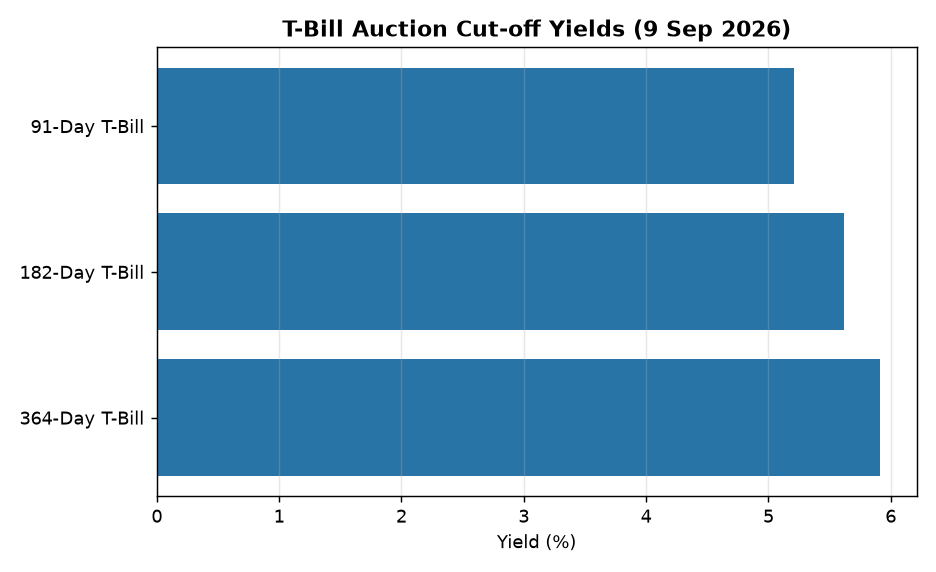
- The implicit yields (YTM) for the 91-day, 182-day, and 364-day T-Bills were 5.2089%, 5.6174%, and 5.9148%, respectively, reflecting a normal upward-sloping yield curve, which is typical in a stable macroeconomic environment.
What are Treasury Bills (T-Bills)?
- Treasury Bills (T-Bills) are short-term debt instruments issued by the Government of India to meet its immediate cash requirements. They are issued at a discount to face value and redeemed at par, with the difference representing the interest earned.
- T-Bills are issued with maturities of 91 days, 182 days, and 364 days, making them the shortest-term government securities available in the Indian financial market.
- They are issued through auctions conducted by the Reserve Bank of India (RBI) on behalf of the Government of India, ensuring transparency and efficient price discovery.
- T-Bills are zero-coupon securities, meaning they do not pay periodic interest. Instead, the return is embedded in the difference between the issue price and the face value at maturity.
- They are highly liquid instruments and are actively traded in the secondary market, making them a preferred choice for investors seeking short-term, risk-free investments.
- T-Bills are used by the RBI for liquidity management operations, including Open Market Operations (OMOs) and the Standing Deposit Facility (SDF), to regulate money supply in the economy.
- The yields on T-Bills serve as benchmarks for pricing other short-term debt instruments, such as commercial paper and certificates of deposit, and influence the pricing of loans and deposits in the banking system.
- Investors in T-Bills include commercial banks, mutual funds, insurance companies, provident funds, and other financial institutions, as well as retail investors through primary dealers and mutual funds.
Key Features
| Feature | Significance |
|---|---|
| Total Face Value Notified | Indicates the government’s short-term borrowing requirement for the respective maturity periods, reflecting fiscal liquidity management. |
| Cut-off Price and Implicit Yield at Cut-Off Price | Determines the cost of government borrowing; higher yields signal tighter liquidity or higher inflation expectations. |
| Total Face Value Accepted | Confirms full subscription, demonstrating investor confidence in sovereign paper and the efficacy of the auction mechanism. |
| Yield Spread Across Tenors | Reveals the term structure of interest rates, with longer tenors commanding higher yields due to increased duration risk. |
| Auction Mechanism | Ensures transparent, market-determined pricing of government securities, aligning with principles of fiscal prudence and monetary policy transmission. |
Why it Matters
Monetary Policy Transmission
- T-Bill yields serve as a benchmark for pricing other short-term debt instruments, influencing interbank rates and broader financial market liquidity.
- The RBI uses these auctions to calibrate liquidity conditions, aligning with its stance on inflation and growth objectives.
- Higher yields may reflect expectations of tighter monetary policy or elevated inflation, impacting corporate borrowing costs and investment decisions.
Fiscal Management
- Short-term borrowings via T-Bills are a critical component of the government’s Ways and Means Advances (WMA) framework, ensuring smooth cash flow management.
- The notified face values align with the Union Budget’s gross market borrowings, reflecting fiscal discipline and debt sustainability considerations.
- Full subscription in all tenors indicates robust investor appetite, reducing the risk of fiscal slippage or liquidity crunches.
Investor Sentiment and Market Dynamics
- The yield curve steepening (higher yields for longer tenors) suggests rising expectations of future interest rate hikes or inflationary pressures.
- Domestic institutional investors (e.g., banks, mutual funds) rely on T-Bills for high-quality liquid assets (HQLA) under Basel III norms.
- Foreign portfolio investors (FPIs) may adjust their allocations based on relative yield differentials, impacting capital flows and exchange rate stability.
Macroeconomic Indicators
- T-Bill yields are a leading indicator of market expectations regarding GDP growth, inflation, and RBI policy rates.
- The implicit yields provide insights into the term premium, which is influenced by factors such as fiscal deficit, global risk sentiment, and geopolitical developments.
- A sustained rise in yields may signal tightening financial conditions, potentially constraining private sector credit availability.
Challenges
1. Liquidity Management Challenges
- Balancing the need for adequate government borrowing with the risk of crowding out private sector credit, especially in a high-deficit scenario.
- Managing the impact of rising yields on debt servicing costs, which could exacerbate fiscal pressures in subsequent budgets.
- Ensuring sufficient participation from non-bank investors (e.g., insurance companies, pension funds) to avoid over-reliance on banks.
UPSC Link: GS3: Fiscal Policy & Monetary Policy
2. Inflation-Interest Rate Nexus
- The RBI faces the challenge of aligning T-Bill yields with inflation targets while avoiding excessive tightening that could stifle growth.
- Persistent inflationary pressures may necessitate higher yields, increasing the cost of short-term borrowing for the government.
- Global factors (e.g., US Fed policy, commodity price shocks) can distort domestic yield curves, complicating monetary policy calibration.
UPSC Link: GS3: Inflation & Monetary Policy
3. Debt Sustainability Risks
- Prolonged high yields could elevate the debt-to-GDP ratio, raising concerns about long-term fiscal sustainability.
- The government must balance short-term borrowing needs with the objective of minimizing the weighted average cost of debt (WACD).
- External shocks (e.g., geopolitical conflicts, supply chain disruptions) may force deviations from planned borrowing calendars.
UPSC Link: GS3: Public Debt Management
4. Market Volatility and Investor Confidence
- Sudden spikes in yields can trigger volatility in bond markets, affecting financial stability and investor sentiment.
- Over-reliance on short-term borrowings may expose the government to refinancing risks, particularly in a rising rate environment.
- Ensuring transparency and predictability in auction schedules is critical to maintaining investor trust and avoiding speculative attacks.
UPSC Link: GS3: Financial Markets & Capital Flows
Challenges — UPSC Perspective
| Issue | Concern |
|---|---|
| Fiscal Deficit Management | Risk of excessive borrowing leading to unsustainable debt levels and higher interest burdens. |
| Inflation-Growth Trade-off | Higher yields may curb growth but are necessary to control inflation, creating a policy dilemma. |
| Investor Diversification | Over-concentration of T-Bill holdings among banks could reduce market depth and liquidity. |
| Global Spillovers | External factors (e.g., US rate hikes) may force domestic yields higher, complicating policy independence. |
| Refinancing Risk | Rollover of short-term debt at higher yields could strain future budgets. |
| Regulatory Arbitrage | Potential for banks to shift from T-Bills to riskier assets in search of higher returns, undermining financial stability. |
Way Forward
- Enhance the predictability of T-Bill auction calendars to reduce market uncertainty and improve investor planning.
- Diversify the investor base by promoting participation from insurance companies, pension funds, and retail investors through innovative instruments (e.g., floating-rate bonds).
- Strengthen coordination between the Ministry of Finance and RBI to align borrowing strategies with monetary policy objectives, ensuring a balanced approach to liquidity management.
- Monitor global macroeconomic conditions (e.g., US Fed policy, commodity prices) to anticipate spillover effects on domestic yields and adjust borrowing strategies accordingly.
- Explore the issuance of longer-tenor T-Bills (e.g., 5-year or 10-year) to reduce refinancing risks and lock in current yield levels.
- Conduct periodic reviews of the debt management strategy to assess the impact of rising yields on fiscal sustainability and adjust borrowing mix (e.g., more long-term bonds) if necessary.
- Improve transparency in the auction process by providing detailed post-auction disclosures, including bid-cover ratios and investor-wise allocations.
- Collaborate with SEBI and other regulators to ensure that banks’ exposure to T-Bills remains within prudential limits, preventing systemic risks.
UPSC Value Addition
Keywords for Mains Answer-Writing
Treasury Bills · Money Market Instruments · Yield to Maturity · Cut-off Price · Public Debt Management · Reserve Bank of India · Government Securities · Liquidity Management · Monetary Policy Transmission · Fiscal Deficit Financing · Short-Term Borrowing · Implicit Yield · Primary Market Auctions · Debt Market Dynamics · Capital Market Instruments
Concept Flow
Government’s short-term borrowing requirement (fiscal deficit) → RBI conducts T-Bill auctions to meet liquidity needs. → Auction mechanism determines cut-off yields → Reflects market expectations of inflation, growth, and RBI policy stance. → Higher yields signal tighter liquidity or inflationary pressures → Impacts monetary policy transmission and corporate borrowing costs. → Investor participation (banks, FPIs, institutional investors) → Ensures full subscription but may expose the government to refinancing risks. → Yield curve dynamics (term structure) → Influences term premium and long-term debt sustainability. → Fiscal-monetary policy interaction → RBI’s liquidity management aligns with government’s borrowing strategy to maintain macroeconomic stability.
Prelims Practice Questions
Q1. Consider the following statements regarding Treasury Bills (T-Bills) in India:
1. T-Bills are issued by the Government of India to meet short-term borrowing requirements.
2. T-Bills are money market instruments and are issued at a discount to their face value.
3. The maturity period of T-Bills ranges from 91 days to 364 days.
4. T-Bills are eligible for inclusion in the Statutory Liquidity Ratio (SLR) for banks.
How many of the above statements are correct?
- Only one
- Only two
- Only three
- All
Answer: All — Statements 1, 2, and 4 are correct. T-Bills are indeed issued by the Government of India to meet short-term borrowing needs, are sold at a discount, and are eligible for SLR compliance. Statement 3 is incorrect as the maturity period of T-Bills ranges from 91 days to 364 days, but 364 days is the maximum, not a range starting from 91 days alone.
Q2. Assertion (A): The cut-off price in a Treasury Bill auction is the price at which the entire notified amount is accepted.
Reason (R): The cut-off price is determined based on the bids received and the notified amount, ensuring full subscription.
Options:
A. Both A and R are true, and R is the correct explanation of A.
B. Both A and R are true, but R is not the correct explanation of A.
C. A is true, but R is false.
D. A is false, but R is true.
Answer: ? — Both assertion (A) and reason (R) are true. The cut-off price in a T-Bill auction is indeed the price at which the entire notified amount is accepted, and this is determined by the bids received. However, R is not the correct explanation of A, as the cut-off price is derived from the yield curve and bid patterns, not merely to ensure full subscription.
Q3. Match the following columns related to Treasury Bills (T-Bills) in India:
Column I (Maturity Period) | Column II (Type of T-Bill)
1. 91 days | A. Treasury Bill
2. 182 days | B. Treasury Bill
3. 364 days | C. Treasury Bill
4. More than 364 days | D. Not a T-Bill
Options:
A. 1-A, 2-B, 3-C, 4-D
B. 1-B, 2-A, 3-C, 4-D
C. 1-A, 2-C, 3-B, 4-D
D. 1-D, 2-A, 3-B, 3-C
- A
- B
- C
- D
Answer: A — The correct pairing is: 91 days (1-A), 182 days (2-B), 364 days (3-C), and more than 364 days (4-D) as it does not qualify as a T-Bill. T-Bills in India have maturity periods of 91, 182, and 364 days only.
Mains Practice Question
✍ The Reserve Bank of India (RBI) conducts auctions for Treasury Bills (T-Bills) to manage the government’s short-term borrowing requirements. In this context, critically examine the role of T-Bills in India’s public debt management and monetary policy transmission mechanism. Also, analyse the implications of rising implicit yields on T-Bills for fiscal sustainability and investor confidence. (15 Marks)
Approach: MODEL-ANSWER SKELETON:
1. **Introduction (2 marks)**
– Define Treasury Bills (T-Bills) as zero-coupon, short-term government securities issued by the Government of India.
– Mention their role in financing the fiscal deficit and managing liquidity in the money market.
– State that T-Bills are auctioned by the RBI on behalf of the Government of India.
2. **Role in Public Debt Management (4 marks)**
– Explain how T-Bills help the government meet short-term borrowing needs without resorting to long-term debt, reducing interest burden.
– Discuss their role in maintaining a balanced debt portfolio (mix of short-term and long-term debt).
– Highlight their contribution to reducing the average cost of borrowing for the government.
– Cite data from recent RBI auctions (e.g., notified amounts, cut-off prices, and implicit yields) to illustrate their significance.
3. **Monetary Policy Transmission (4 marks)**
– Explain the transmission mechanism: T-Bills serve as a benchmark for short-term interest rates, influencing the broader yield curve.
– Discuss how the RBI uses T-Bill auctions to signal its monetary policy stance (e.g., through yield movements).
– Link T-Bill yields to liquidity conditions in the banking system and the repo rate adjustments.
– Reference the concept of ‘liquidity trap’ or ‘crowding out’ if T-Bill yields rise excessively.
4. **Implications of Rising Implicit Yields (3 marks)**
– Analyse the causes of rising implicit yields (e.g., inflation expectations, fiscal slippage, global interest rate trends).
– Discuss the implications for fiscal sustainability: higher borrowing costs increase the interest burden on the exchequer.
– Examine the impact on investor confidence: rising yields may deter domestic and foreign investors, affecting demand in subsequent auctions.
– Reference the recent RBI auction data (e.g., 91-day T-Bill yield at 5.2089%, 364-day at 5.9148%) to support the analysis.
5. **Conclusion and Way Forward (2 marks)**
– Summarise the dual role of T-Bills in debt management and monetary policy.
– Suggest measures to mitigate adverse implications: improving fiscal discipline, diversifying investor base, and enhancing transparency in auction processes.
– Conclude with a balanced view on the necessity of T-Bills in India’s financial architecture.
Source: RBI
Generated by AanyaAi for educational purpose.
Related guides on our sites
- Current affairs for upsc 2026
- Best PSIR optional coaching for upsc
- Best PSIR optional teacher for upsc
- Best teacher of PSIR optional for upsc

- यूपी हाईकोर्ट ने स्कूल बस सुरक्षा पर दिया सख्त आदेश, डीएम को 1 माह में रिपोर्ट देने का निर्देश - September 22, 2026
- UP High Court Directs DM & Chief Secretary on School Vehicle Safety: Key Facts for UPSC/PCS - September 22, 2026
- पेरियार टाइगर रिजर्व में 6 नई प्रजातियाँ खोजी गईं, जानिए क्या हैं विशेषताएँ - September 22, 2026

No Comments